|
|
Originally OCRed 17 JUL 2010
Slightly Revised
27 OCT 2021
STUDY S-467
THE EVOLUTION OF U.S. STRATEGIC COMMAND AND CONTROL AND WARNING, 1945-1972 (U)
PART
FOUR
1968-1972
XXVIII. INTRODUCTION
In the 1968-72 time period, the field of command, control, communications, and warning was marked by continuity in the development of concepts and practice and by the changing strategic relationship between the United States and the Soviet Union. Operationally, the period did not see any dramatic improvements in the national command and control system, but rather an emphasis on improved planning as a basis for decisions on how to move ahead in the future. It was generally more a period of developing and refining ideas rather than creating new elements in the command and control structure.
Toward the end of his second administration, President Johnson called for contributions from the Department of Defense and other agencies of the government for a speech to be called "National Defense, Eight Years of Remarkable Progress, the Democratic Administration's Record of Achievement, 1961-68." The final document emphasized the ways in which US security had been strengthened. It reported that much attention had been paid to the improvement of command and control, particularly to command centers, including continuously airborne centers. No doubts about the adequacy of such centers or the efficacy of the entire command and control system were voiced.
The period 1961-68, however, left a legacy of doubts and uncertainties, along with some new ideas in the strategic field. Some of the new ideas that had emerged during the Kennedy-Johnson administrations became the issues that gave shape to the discussion of nuclear strategy and of the narrower issues of command and control under President Nixon. The most significant of these issues concerned the concepts of sufficiency and flexible response. These concepts focused attention on the critical importance of command and control in a limited nuclear exchange. At the same time, they suggested that the National Command Authorities would not be the targets of attack by an adversary who hoped for a measured response and ultimate negotiation from the other side.
Along with these basic strategic issues, serious and important questions persisted with regard to the maintenance and development of systems for the support of command and control, many of them raised by technological change in the fields of automated data processing and communications. Other important and continuing questions were raised about the centralization of the command and control system and the character and function of the command centers. All of these questions had been important in previous years, particularly so in the last months of the Johnson administration. They dominated the command and control problem in the years 1968-72. What was done about them—or not done—determined the significance of the period for command and control as a system and as an important part of the overall strategic relationship between the United States, and the Soviet Union.
That the complexities of command and control were not easily grasped, even for those most deeply involved and in the most powerful and influential positions, became apparent. In the period under consideration, documents reveal instances of the Secretary of Defense expressing his doubts as to the Joint Chiefs' understanding of the capabilities of the system, of the Chairman of the Joint Chiefs doubting the DDR&E's grasp of the problem, and of various high officials in the defense establishment giving vent to their feelings that almost no one seemed to understand how the system was really likely to work in a nuclear environment.1
One reason for the problems involved in understanding command and control was the institutional complexity of the command and control structure that had evolved. Another reason for the difficulties was the impossibility of testing the system in a realistic environment. No one could say that he knew what would happen in an actual strategic exchange. Thus, it was always possible to hope that systems were better than the studies showed, a course that was particularly tempting to those most closely associated with the various command and control subsystems. The obverse of this was the temptation to find the system totally inadequate—a conclusion that seemed to be supported by numerous studies and exercises. The apparent vulnerability of every system to natural phenomena or to enemy action, of course, made it impossible to dismiss the arguments of the pessimists.
Another factor that made assessment of command and control difficult was the lack of comparability between the US and the Soviet command and control systems. With bombers, missile submarines, land-based missiles, missile defenses, and so on, it was possible to compare Soviet and US equipment and its relative capabilities, limitations, and vulnerabilities. In the command and control field, however, our limited knowledge of the Soviet side made it difficult to draw useful analogies.
XXIX. THE BALANCE OF STRATEGIC FORCES
A dominant feature of the 1968-72 period was the US recognition of the changed strategic relationship between the United States and the Soviet Union. The enormous US superiority of the early 1960s steadily disappeared under the Soviet drive for parity. In January 1968, Secretary McNamara, on the eve of his departure, reviewed his seven years in office and stressed the significance of the new strategic relationship:
Finally, we undertook an extensive program to improve and make more secure the command and control of our strategic offensive forces. Among the measures taken was the establishment of a number of alternate national command centers, including some which would be maintained continuously in the air so that the direction of all our forces would not have to depend upon the survival of a single center. Steps were also taken to enhance the survivability, reliability and effectiveness of the various command and communications systems, including, for example, provision for the airborne control of bomber, MINUTEMAN and POLARIS launch-ings. These were all forged into a new integrated National Military Command System. To guard against accidental or unauthorized firings, new procedures, equipment and command arrangements were introduced to ensure that all nuclear weapons could be released only on the positive command of the national authorities.
Many of the tasks we set out for ourselves seven years ago have been successfully accomplished. But, the situation which we foresaw then is now well upon us. The Soviets have, in fact, acquired a large force of ICBMs installed in hardened underground silos. To put it bluntly, neither the Soviet Union nor the United States can now attack the other, even by complete surprise, without suffering massive damage in retaliation. This is so because each side has achieved, and will most likely maintain over the foreseeable future, an actual and credible second strike capability against the other. It is precisely this mutual capability to destroy one another, and, conversely, our respective inability to prevent such destruction, that provides us both with the strongest possible motive to avoid a strategic nuclear war.
That we would eventually reach such a stage had been clearly foreseen for many years. Five years ago I pointed out to this Committee that: "We are approaching an era when it will become increasingly improbable that either side could destroy a sufficiently large portion of the other's strategic nuclear force, either by surprise or otherwise, to preclude a devastating retaliatory blow."
In January 1956, Secretary of Defense Wilson noted that "... independent of what year it might happen, within a reasonable number of years we are almost bound to get into a condition sometimes described as 'atomic plenty' or a condition where the two parties could, as a practical matter, destroy each other." In the following month, Secretary of the Air Force Quarles was even more explicit. He said, "I believe it will mean that each side will possess an offensive capability that is so great and so devastating that neither side will have a knockout capability, and, therefore, a situation in which neither side could profitably initiate a war of this kind.... This has been frequently referred to as a position of mutual deterrence, and I believe we are moving into that kind of a situation."
Indeed, as far back as February 1955, a distinguished group of scientists and engineers, frequently referred to as the Killian Committee, had concluded on the basis of a comprehensive study of our continental air defense that within probably less than a decade a nuclear attack by either the United States or the Soviet Union would result in mutual destruction. "This is the period," the Committee's report stated, "when both the U.S. and Russia will be in a position from which neither country can derive a winning advantage, because each country will possess enough multimegaton weapons and adequate means of delivering them, either by conventional or more sophisticated methods, through the defenses then existing. The ability to achieve surprise will not affect the outcome because each country will have the residual offensive power to break through the defenses of the other country and destroy it regardless of whether the other country strikes first."
Clearly, nothing short of a massive preemptive first strike on the Soviet Union in the 1950s could have precluded the development of the situation in which we now find ourselves. This point, too, was noted by Secretary McElroy in 1958. Indeed, the hearings of the Congressional Committees concerned with national defense during that period are replete with references to this crucial issue.
Be that as it may, the problem now confronting the Nation is how best to ensure our safety and survival in the years ahead, in an era when both we and the Soviet Union will continue to have large and effective second strike strategic offensive forces and when the Red Chinese may also acquire a strategic nuclear capability.1
The arrival of this long-anticipated situation was probably the chief cause of the conceptual and doctrinal turmoil of these years, and it led to the growing sense of frustration that marked efforts to improve strategic command and control.
A. THE PERCEIVED SOVIET THREAT
When the Nixon administration took office in 1969, there was initial concern that the speed and scope of the USSR's buildup indicated its intention to pursue a first-strike capability. The United States was also concerned lest the Soviets develop a true ABM system from the rudimentary GALOSH system in place around Moscow.
Often the Soviet offensive forces becoming operational in a given year exceeded previous US projections for that year. The projections for ICBM and SLBM strengths were revised upward steadily as additional information on Soviet deployments became available. In early 1970, Secretary Laird illustrated the trend with the following tabulation.2
|
|
Estimated strength (mid-year) |
||||
|
Year of Estimate |
1967 |
1968 |
1969 |
1970 |
1971 |
|
ICBM |
|||||
|
1966 |
420-476 |
514-582 |
505-695 |
509-792 |
499-844 |
|
1967 |
423-484 |
670-764 |
805-1,010 |
775-1,027 |
805-1,079 |
|
1968 |
536-566 |
848-924 |
946-1,038 |
949-1,154 |
939-1,190 |
|
1969 |
570 |
858 |
1,038-1,112 |
1,158-1,207 |
1,181-1,270 |
|
1970 |
570 |
858 |
1,028 |
1,262-1,312 |
1,360-1,439 |
|
Actual |
570 |
858 |
1,028 |
|
|
|
SLBM |
|||||
|
1966 |
24-30 |
24-42 |
24-78 |
24-114 |
30-138 |
|
1967 |
21 |
29 |
37-53 |
61 -85 |
85-117 |
|
1968 |
24-27 |
43-46 |
75-94 |
123-158 |
187-238 |
|
1969 |
27 |
43 |
94-110 |
158-238 |
222-366 |
|
1970 |
27 |
43 |
110-126 |
184-248 |
296-376 |
|
Actual |
27 |
43 |
104-120 |
|
|
Only the Soviet strategic heavy bomber force declined in strength, dropping from 155 aircraft in October 1967 to 140 by mid-1972. The Soviets also had a force of some hundreds of medium bombers, some of which could be refueled for strikes against North America.
The Joint Chiefs stated in the Joint Strategic Objectives Plan for 1972-79 that while strategic nuclear war was the least likely of all levels of warfare,
the most dangerous threat to the United States is the strategic nuclear force of the Soviet Union which has continued to grow at a rapid pace. The Soviet strategic nuclear threat to the United States is so serious in its potential consequences, regardless of estimated Soviet intentions, that it must receive primary consideration in the formulation of military strategy, including the development of force levels.3
It was this steep climb in Soviet numerical capability, made all the more striking by the relatively static nature of US strategic offensive forces, that underlay the revived attention given to strategic war in this period and to the means to control such operations. Contributing to the revived attention, too, was the wind-down of the US involvement in Southeast Asia, which had, after 1965, absorbed a large share of the interest and attention of the top policymakers.
B. US STRATEGIC FORCE POSTURE
The US strategic offensive forces remained quite stable in this period. Force levels at the beginning and end of the period were as follows:
|
|
1 October 19674 |
Mid 19725 |
|
ICBM launchers |
1,054 |
1,054 |
|
SLBM launchers |
656 |
656 |
|
Heavy bombers |
697 |
521 |
During these years, however, the United States achieved a technological breakthrough with the development of the multiple independently targetable reentry vehicle (MIRV). While force levels remained constant, the United States in 1970 began to replace its Minuteman I missiles with Minuteman III, each of which carried three MIRVs. This, in effect, would ultimately double the number of targets at which the Minuteman force could strike. Similarly, the first Poseidon-equipped SSBN became operational in early 1971, each missile of which carried some 10 MIRVs.
The continuing Soviet strategic offensive buildup convinced the Defense Department that a major new strategic initiative was needed to signal to both the Soviets and US allies the US will to maintain a sufficient strategic force and to avoid allowing the Soviets to achieve an overwhelming numerical superiority in land-based and sea-based missiles. There was always the increasing military risk that future technological advances, in conjunction with much larger numbers of Soviet strategic missiles, could offset the qualitative improvements planned for US land-based strategic forces. After review of the several alternatives, Secretary Laird in early 1972 decided that an acceleration of the Undersea Long-Range Missile System (ULMS) was the most appropriate initiative, since the at-sea element of the sea-based strategic forces seemed to have the best long-term prospect for high pre-launch survivability. A second element of the "triad"—the bomber force—was to be strengthened by development of the B-1 bomber, intended as a replacement for the B-52, which was started in this period.
XXX. COMMAND AND CONTROL SYSTEMS, 1968-72
In the course of the twenty-seven years covered by this study, an elaborate and enormous command and control structure had evolved. This chapter presents a picture of the end product of that evolutionary process. The command and control structure as it existed in 1968 did not change significantly in the next four years.
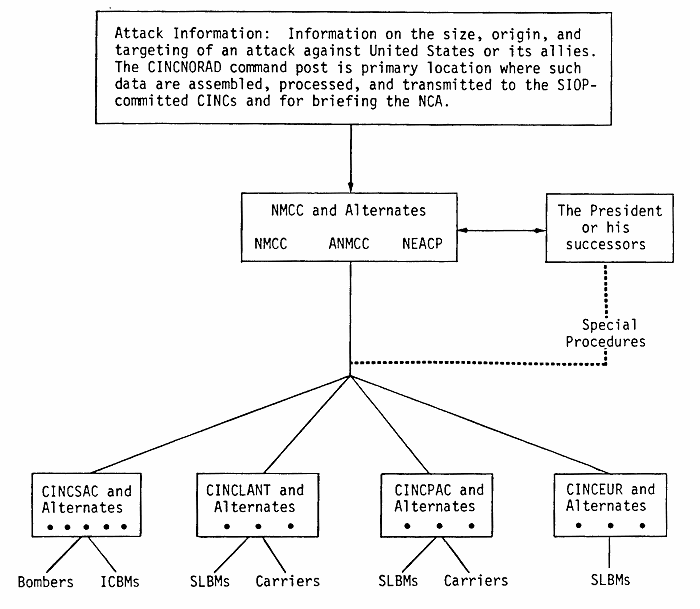
Operational control of US strategic forces was exercised in different ways by the three levels of command involved (see Figure 1), namely:
(1) The National Command Authority level consisted of the President and the Secretary of Defense, operating through the Chairman, JCS, and the NMCC at the Pentagon, the ANMCC at Fort Ritchie, or the airborne command post (NEACP) on ground alert at Andrews AFB.
(2) The CINC level consisted of the SIOP-committed CINCs—CINCSAC, CINCPAC, CINCLANT, and CINCEUR. SAC, for example, operated through the SAC underground command post at Offutt ABF, the SAC airborne command post (LOOKING GLASS), or the SAC alternate command posts at the 2nd and 15th Air Forces (or their airborne alternates on ground alert).
(3) The weapons level—the Titan launch control centers, the Minuteman ground and air launch control centers, the SAC bombers, and the SSBNs.
A. THE NATIONAL MILITARY COMMAND SYSTEM
The heart of the myriad systems for strategic operations was the National Military Command System, consisting of the facilities, equipment, doctrine, procedures, personnel, and communications supporting national authorities in the exercise of their military operational command function. It included the National Military Command Center in the Pentagon, which served as the primary center of command for the highest levels of military command, including the President, the Secretary of Defense, and the Joint Chiefs of Staff. It also included the fixed, underground Alternate National Military Command Center at Port Ritchie, a mobile National Emergency Command Post Afloat on a naval vessel off Annapolis (until 1970), and a mobile National Emergency Airborne Command Post in an aircraft based at Andrews AFB. At the beginning of this period, all were continuously manned and ready for use by the NCA or their alternates or successors. All were supposed to be linked to each other and to the unified and specified commands by reliable, secure, and survivable communications so as to provide for a non-interruptable (or at least rapidly recoverable) national command capability at all times.
|
|
Supporting the NMCS were a series of systems designed to control the tactical forces or to provide warning through ballistic missile tactical warning and attack assessment systems. The command systems were designed to ensure that the orders of the NCA and the unified commanders would reach SAC and naval SIOP forces, both the Polaris boats and the carriers. There were also Air Force and Navy LF-VLF communications systems linked to the NMCS. The Air Force LF-VLF Special Purpose Communications System and the Navy LF-VLF communications net for the Polaris fleet were combined, along with SAC's Emergency Rocket Communications System (ERCS), into a Minimum Essential Emergency Communications Network (MEECN). Also Included was the teletype net from the JCS to all unified and specified commanders called the Emergency Actions Teletype System (EMATS).
The need for such a minimum essential communications backup to primary and alternate facilities supporting the command and control structure was first acknowledged In February 1963, when the Secretary of Defense directed a study on how to use the LF-VLF spectrum to meet such a requirement. The painfully slow process of planning for and developing the MEECN was typical of much in the command and control area. It was not until 1968 that a procedural plan was promulgated, and centralized direction was established under the JCS only in May 1969. The MEECN System Engineer was not designated until May 1970, more than seven years after the Secretary's study request.1
B. CINC SYSTEMS: SAC
The SAC command control structure was divided into pre-attack and post-attack systems. At the beginning of this period, the pre-attack system consisted of the primary alerting system, the high frequency, single side band net, the telephone and teletype nets, and the SAC Automated Command and Control System (SACCS). These were all considered non-survivable systems primarily intended for day-to-day operation, but they would be costly for an enemy to attack because of the extensiveness of the facilities involved.
The SAC Automated Command and Control System had attained a full operational capability by January 1968. It was designed to furnish CINCSAC with the data necessary to assure effective control of the SAC force. It provided automated assistance in information submission, secure high-speed transmission, and automated routing, processing, and display of information. By the time SACCS was completed, however, the computers (the 465L) were already obsolescent and a program change for new ADP equipment was requested by the Air Force immediately after the system went into operation.
Concern over SACCS survivability and quick-reaction capability led to the development of a separate Post Attack Command and Control System (PACCS). This system Included airborne command post and communications relay aircraft, the Sur-vivable Low-Frequency Communications System (SLFCS), the Airborne Launch Control System (ALCS), the Emergency Rocket Communications System, and the GREEN PINE UHF radio.
The basic post-attack system was composed of 14 airborne command posts and 18 communications relay aircraft. During peacetime, one SAC command post aircraft (LOOKING GLASS) from Offutt AFB was continuously airborne. On board was an alternate CINCSAC and a battle staff. At each numbered air force in SAC, 1 command post aircraft was on 15-minute alert, and 2 communications relay aircraft were on 15-minute alert at Grissom AFB, Ind., Ellsworth AFB, S.D., and Minot AFB, N.D. In periods of tension or in the event of attack, the alert aircraft would be launched to provide a line-of-sight link with the National Command Authorities and from CINCSAC to the numbered air forces, the SAC strike force, and Headquarters NORAD. SAC could launch its Minuteman missiles by command from PACCS aircraft using the Airborne Launch Control System. Such a procedure was to be used in the event that missiles became isolated from their parent launch control centers through loss of communications. All Minuteman stations were to be equipped for airborne launch by 1970.
The second SAC post-attack system was the Survivable Low Frequency Communications System, capable of transmitting teletype messages, which would be used to transmit the "go code" and other operational messages to waiting aircraft. Tests had indicated that low frequencies could be used during and immediately following nuclear detonations with relatively little loss of signal strength. During emergencies, the SAC network could become part of the DoD Minimum Essential Emergency Communications Network, which would permit preemptive use by the JCS. Complete operational capability for the SLFCS was planned by mid-1970.
The Emergency Rocket Communications System (494L) became operational in December 1967. Designed to disseminate the "go code" to bombers subsequent to their launch, it consisted of communications-transmitting equipment substituted as warheads on six Minuteman missiles. The ERCS recorders would accept a 30 to 90 second voice message for broadcast over two UHF transmitters, a message that would be repeated during the ballistic trajectory of the missiles. The ERCS had been developed to provide a reliable and survivable means of trans-and post-attack communication from CINCSAC to SAC forces. The coverage included SAC control elements; SAC aircraft launched under positive control; SAC forces operating along airborne alert routes in the Pacific, Atlantic, North Polar, and Mediterranean areas; SAC ground command elements and alert forces in Europe, the Pacific, and North America; and SAC missile forces in the United States.
The GREEN PINE system was a dedicated voice network consisting of 14 UHF transceiver sites, 13 located along the 70th parallel from Alaska to Iceland and 1 in Sardinia. These were connected to the SAC command post by diversely routed leased landlines. The primary use of the system would be to relay the "go code" to SAC aircraft under positive control procedures. The GREEN PINE stations could receive the transmission of the ERCS and the SLFCS.2
C. SACEUR-CINCEUR STRATEGIC COMMAND AND CONTROL ARRANGEMENTS
In 1968, a special problem in command and control of strategic forces existed in the delicate interface with NATO of the US force of nine Polaris submarines that supported NATO. The force represented a unique case in both strategic command organization and communication. Three of the Polaris boats were assigned to SACEUR and six to CINCEUR. All other boats in the Atlantic fell under the command of CINCLANT and operated under him normally, except when special arrangements were made.
The boats operated out of Rota, Spain, or Holy Loch, Scotland, and normally patrolled the Mediterranean. The SACEUR-assigned boats actually did half of their patrol in the Atlantic, while en route from Holy Loch to the Mediterranean, and went on alert from the time they left Scotland. The boats were controlled by CINCLANT for administrative, safety, and navigational purposes while passing through Atlantic waters, but this arrangement did not change their release procedures.
The SACEUR boats operated day-to-day under US national command, specifically under the US submarine force in EUCOM (CTP 64), which was under USNAVEUR and thus under CINCEUR. The CTF 64 also commanded the six CINCEUR-assigned boats while on patrol. It should be noted that the command arrangements described above for both the SACEUR- and CINCEUR-assigned boats pertained only to actual patrols. While the boats were in Holy Loch or Rota for refitting, they were under the command of CINCLANT.
SACEUR had targeting and alerting responsibility for his three boats, and even though normally under national command, the SACEUR boats were at all times officially under SACEUR's release-message control. SACEUR could declare a higher state of readiness for his boats at his own discretion, but any release message still required a US authenticator.
At the declaration of Reinforced Alert, SACEUR's three boats came under NATO operational control, but in actual fact the change was more apparent than real. With ReinforcedgAlert and the general switch of EUCOM to NATO command, CTF 64 would become a NATO command, designated CTF 442, under the Commander Strike Force South (Commander Sixth Fleet). In effect, the command structure would remain the same, except for a change of hats.
The six boats assigned to CINCEUR were also earmarked for NATO. When directed specifically at Reinforced Alert (this dual requirement removed any automaticity of action) by the US command, the boats were switched to NATO operational control and came under CTF 442. There was a degree of fiction in this command relationship because the CINCEUR boats were targeted in accordance with SIOP, and, even though switched to NATO control, they remained targeted for US-designated targets and under US release authority.
The specific weapons release procedures called for the release message to go to the CINCEUR boats via SACEUR. However, the concept of SACEUR release had meaning only if the SACEUR scenario of a general nuclear war in Europe without a US-Soviet strategic exchange were to come to pass. Otherwise, the boats would fire on US orders at SIOP targets and by the time the message went through SACEUR the missiles would have been launched.
In sum, a command and control arrangement had been devised for the CINCEUR and SACEUR submarines that recognized the boats as "belonging to SACEUR," but at the same time it was difficult to conceive that operation of the boats would actually follow the specified procedures when war came. There were clearly unresolved command and control problems In the operation of the NATO boats, but the question inevitably arose, although not formally admitted, as to how much effort should be expended in an attempt to solve these problems when it was generally recognized that the arrangements were essentially nominal.
A change in system was being discussed in 1971 whereby the assignment of specific boats to NATO would be ended and replaced with assigned missiles instead. These assigned missiles could be on any number of boats, Instead of just three, and all the missiles could be constantly on alert, since there would not be the loss of alert status as under the existing system when a specified boat was being refitted.3
D. CINCPAC STRATEGIC COMMAND AND CONTROL ARRANGEMENTS
As one of the SIOP-committed unified commanders, CINCPAC controlled strategic forces that included at this time seven fleet ballistic missile submarines with 112 missiles plus nuclear-capable, general-purpose forces (carriers and Army surface-to-surface missiles).
CINCPAC had an airborne command post (EC-135) manned and equipped to perform essential SlOP-related command and control functions. The command post had been maintained on airborne alert status through the 1960s, but it was reduced to ground alert at the end of 1969 for budgetary reasons. The CINCPAC TACAMO aircraft, designed to function as a continuously airborne VLF communications relay to the PACOM fleet ballistic missile submarines, constituted a highly survivable link for transmitting SIOP execution messages, but it was not intended to be a true alternate command center. Generally, PACOM provisions for alternate emergency command arrangements and facilities for continuity of command under general war conditions were considered to be inadequate.4
E. COORDINATION OF NUCLEAR OPERATIONS
The earlier problem of coordination of nuclear operations, which had once posed such difficulties, was well in hand by 1968. Under the DoD Reorganization Act of 1958, the USAF had been relieved of managerial responsibility for the Joint Coordination Centers (JCCs), but SAC had continued to operate them for the JCS through field representatives (FRE for Europe and FRFE for the Far East).
By 1969, the JCCs, which had become redundant with the creation of the Joint Strategic Target Planning Staff in 1961, had been under review for some time. The Far East JCC had moved from Tokyo to Kunia, Oahu, in 1957, and Headquarters SAC was proposing that the JCC Europe be moved from England to the United States. It was decided to consolidate the two JCCs into one coordination center and to relocate both at Fort Ritchie and in April 1971 Fort Ritchie assumed responsibility for both. Henceforth it was to be "the" JCC and the supporting Coordination of Atomic Operations Communications Network (CAOCOMNET) was realigned accordingly.5
F. REORGANIZATION OF THE WORLD-WIDE MILITARY COMMAND AND CONTROL SYSTEM
The procedures and systems for the command of strategic nuclear forces were tied into the World-wide Military Command and Control System (WWMCCS). The WWMCCS mission was to provide
the National Command Authorities with the information on world situations needed for accurate and timely decisions, to include the communications required for reliable transmission of those decisions with a minimum of delay under all conditions of peace and war for the national direction of the US military forces.6
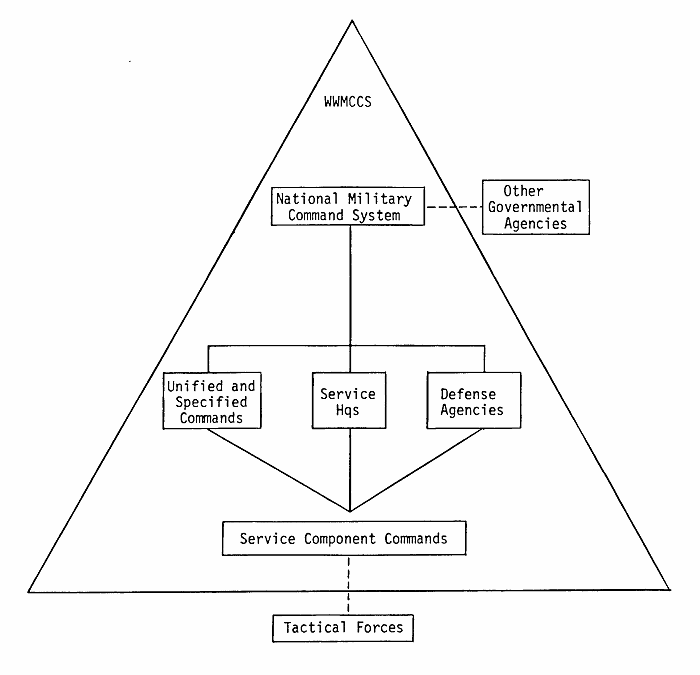
The WWMCCS supported the requirements of the chain of command from the NCA down to and including the component commanders of the unified and specified commands and such contingency commands as existed or might be established. The WWMCCS consisted of communications equipment, facilities, personnel, and procedures that provided: (1) the operational and technical support required to control US forces; (2) the means by which the President, Secretary of Defense, and the Joint Chiefs could receive information, selected responses, and apply military resources; and (3) the means for the NCA to direct the unified and specified commands.
The WWMCCS—and many of its basic problems—were the result of the 1958 Amendments to the National Security Act. Those amendments retained the existing concept of a decentralized military structure. Operational command of the forces was given to the unified and specified commands, while the services retained their role In the development, generation, and support of the military forces. Both groups remained subject to the direction, authority, and control of the Secretary of Defense, who later delegated to the JCS the duties of serving as his advisers and as his military staff in the chain of command.
The command and control systems that were developed to support the unified and specified commands were formally incorporated in the 1962 WWMCCS directive. This step was intended to give the commands a greater voice in developing and implementing a command and control system in the interest of making the system more responsive to the needs of the NCA. Basically, standardization and cooperation of service-aimed-and-oriented command and control systems were to be enforced through controls over the operational specifications of the systems, but the specifics of requirements and management were left open for later resolution.
Many of the major problems and deficiencies of the WWMCCS were clearly the result of Its structure and management. The WWMCCS in 1968 still consisted of a number of independent subsystems comprising 37 activities. It was not a totally integrated system by any definition. It constituted a network of primary and alternative command facilities and interconnecting communications that served the various commanders and headquarters comprising the system (see Figure 2). In general, the structure accommodated the chain of command from the JCS (who were then integral to the NCA) through the unified and specified commands to their service component commanders. At the same time, it recognized and interfaced with the separate service chains of command. While the composite reflected the functioning of command relationships established by the National Security Act and subsequent amendments, it did not appear to lend itself to the trend toward centralization of command of the forces, which had characterized the crises and operations of the previous decade.
The WWMCCS was six years old in 1968 and by that time had accumulated a large number of resources. The Washington nerve center alone was supported by two major fixed command centers, three EC-135 airborne command posts, and two major naval vessels. CINCSAC maintained one of five EC-135 command posts continuously airborne and had an elaborate underground (but unhardened) command post. CINCONAD had a much more elaborate command center at Cheyenne Mountain, Colo. Other commands had made similar investments in command centers, and communications and tactical warning systems circled the globe. Automatic data processing was becoming more important and more evident in many command and control functions.
|
|
The problems of the WWMCCS were made evident by three contingency episodes in 1967-69—the USS Liberty, the USS Pueblo, and the reconnaissance EC-121 incidents. In all three incidents, there were serious failures in command and control. While not involving the strategic forces and their command systems, the episodes carried great impact because of their implications. These concerned not only national prestige and the capacity to act in such minor contingencies, but also the vastly more serious matter of strategic nuclear operations. The episodes raised questions concerning the enormous amounts of money expended on command and control In view of the inefficiency demonstrated, and no doubt made the lines between tactical and strategic command and control seem less sharp in the view of those in authority. However, response to these episodes in terms of steps to improve the WWMCCS in a major way were very slow.
One major source of weakness In the WWMCCS concept was the lack of single-agent responsibility for the WWMCCS in the period from 1962 to 1970. This was intentional and the result of the clash of interests between the services and OSD.
Movement toward a systematic effort to improve the WWMCCS was given impetus when the JCS received the WSEG/IDA Staff Study 153, which suggested an overall study plan for command and control problems.7 Then in July 1970 came the Blue Ribbon Defense Panel Report (see Chapter XXXII) which criticized the loose decentralized management of the WWMCCS. The report provided some additional impetus to change the WWMCCS, although it does not cause any specific major change by itself. Then, in February 1971, WSEG/IDA Report 159 was submitted, and in the words of an OJCS historian, "it caused consternation in the OJCS because of the bleak but largely accurate picture it painted of the WWMCCS."8
A really major influence was the interest developed in command and control by Deputy Secretary of Defense Packard while he was a member of the Washington Special Actions Group. As a result of their mutual interest, Packard and the Chairman of the JCS, Admiral Moorer, worked together in the fall of 1971 to rewrite the WWMCCS directive. The Deputy Secretary sought to stress the primacy of the needs of the National Command Authorities as expressed through the NMCS, and he wanted the Chairman, JCS, to be responsible for running the NMCS. He specifically stated that instead of unified commanders having as their first priority the design of a command system to meet the requirements of their mission, they were instead to design a system that met first the requirements of the NMCS and, secondly, those of their own mission.
The new directive, issued in December 1971, differed from the 1962 version In three principal respects.9 First, the Chairman of the Joint Chiefs of Staff was given overall responsibility for the system under the direction of the Secretary of Defense. He was directed to operate the NMCS, define its scope and components, develop and validate its requirements maintain cognizance of all WWMCCS programs and capabilities, and make recommendations to the Secretary of Defense to insure the responsiveness, functional interoperability, and standardization of WWMCCS.
Second, the directive provided for an Assistant to the Secretary of Defense for Telecommunications, a step that reflected the widespread concern in the defense community and the government at large about strategic communications and the problems involved in their centralization and coordination.
Third, a WWMCCS Council, made up of the Deputy Secretary of Defense, the Chairman, JCS, and the Assistant Secretaries of Defense for Intelligence and Telecommunications, was established to provide policy guidance for the development and operation of the WWMCCS and to evaluate its overall performance.10
Although Deputy Secretary Packard and Chairman Moorer seemed to have worked out a mutually satisfactory understanding on the new WWMCCS directive, there was disagreement among the military on four major aspects of the document.11 The first had to do with the redefinition of the National Command Authorities to exclude the Joint Chiefs of Staff, who had been included under the previous directive. The decision reportedly was based on an OSD legal office opinion that the National Security Act of 1947 implied that only the President and the Secretary of Defense could control US military forces, an affirmation of civilian primacy and the subordinate role of the military.12
Another major issue considered concerned the redefinition of the WWMCCS insofar as it affected resource management responsibilities of the military departments. The third issue was the apparent exclusion of the chiefs of the services from the chain of command by making the Chairman of the Joint Chiefs an independent agent for the implementation of the orders of the National Command Authorities for SIOP execution. The service chiefs through the CJCS should have been designated the executive agent of the Joint Chiefs. The final Issue was that of responsibility for WWMCCS development. The new directive assigned this responsibility to the Chairman, so the issue again was that of the services against the Chairman. How serious these issues were at the time is difficult to determine. It would appear that such problems as might have existed had been taken care of by mutual agreement between the Chairman and the service chiefs. Nevertheless, the combined support for the directive by the Deputy Secretary and the Chairman of the Joint Chiefs assured the promulgation of the document in the form in which they had conceived it.
XXXI. SURVEILLANCE AND WARNING, 1968-72
There was a steady decrease in the late 1960s in that portion of the air defense and warning structure that dealt with an aerodynamic threat. Ballistic missile warning systems continued, however, and were improved.
A. BALLISTIC MISSILE WARNING
In 1968, there were two systems in operation to detect silo-launched missiles, the BMEWS and the Forward-Scatter, Over-the-Horizon (OTH) Radar system (440-L). Both were owned and operated by the Air Defense Command. In addition, there was the Defense Support Program (DSP), which used synchronous-altitude satellites for Eastern and Western Hemisphere ballistic-missile-launch detection and nuclear-burst location.
With stations at Clear (Alaska), Thüle (Greenland), and Fylingdales (England), BMEWS was capable of detecting and reporting in real time ballistic missiles in trajectory over the North Polar region. BMEWS had become operational as a complete system in January 1964. The second system, the 440-L, was capable of detecting solo-launched missiles within minutes after launch. It was aimed at the threat from the Soviet fractional orbital bombardment system (FOBS), a low-altitude missile that would cut the BMEWS fan at low altitude and thus reduce the time from cutting the fan to impact to as little as five-to-seven minutes.1
The 440-L system consisted of four transmitting stations in the Pacific and five receiving stations in Europe. By covering the Soviet ICBM and satellite-launch sites, as well as launch sites that might be developed in China, the system could detect a mass ICBM attack regardless of which direction or on what trajectory the missiles might be launched. It could thus provide warning of Soviet missiles launched over the South as well as the North Polar regions.
The 440-L system, operating in the HF band, was subject to the same widespread and long-lasting blackout effects as HF point-to-point radio. These blackout effects could be increased if weapons were used specifically for that purpose (e.g., exo-atmospheric or high-altitude bursts). The propagation outages could begin at the initiation of the nuclear exchange and continue for periods of up to 24-36 hours. Under massive nuclear exchange conditions, little or no useful data could be expected from the 440-L system.2
The 474N system for detecting SLBMs came into full operation in mid-1972. This system covered both the Soviet 300-n.m. and 650-n.m. range missiles, but the introduction of the Soviet 1,300-n.m. missile required modifications to the system. The SLBM radar, however, was limited to line-of-sight ranges and suffered also from other coverage limitations. Generally, BMEWS was considered to be a more effective system than the OTH radar and the OTH more effective than the 474N. The purpose of all the ballistic missile warning systems was to provide warning to get the SAC bomber force off the ground.
There were also two nuclear weapon detonation reporting systems operational in January 1968. The Bomb Alarm System, operational since 1962, was designed to detect ground level bursts. There was also a High-Altitude Radiation Detection System (HARDS) for the reporting of exo-atmospheric detonations. The Bomb Alarm System was eventually deactivated in 1970.
B. AIRCRAFT WARNING
In the aircraft warning field, the reduction of the system was continuous. Secretary McNamara in early 1968 reminded Congress that three years earlier he had stated that one of the major issues to be faced in the strategic defensive area concerned the proper level of the anti-bomber defense program. The existing system had been designed in the mid-1950s, he said, when it was estimated that the Soviets would build a large fleet of aircraft capable of attacking the United States. That threat did not develop as estimated. In the late 1960s, however, with no defense against the ICBM and only very limited defense against the SLBM, the US anti-bomber defenses could operate only against a small portion of the Soviet offensive threat. Moreover, the anti-bomber defense was also vulnerable to missile attack. What was needed, McNamara said, was a balanced strategic defense posture, which would Involve a major reorientation of efforts both within the anti-bomber defense program and between anti-bomber and anti-missile defenses.3
In all the various alternative command and control structures examined at this time, an indispensable element seemed to be the new Airborne Warning and Control System (AWACS). The AWACS promised much because of its ability to track aircraft at low altitudes and to detect them at great distances from the United States, and because its vulnerability to missile attack was low compared with the ground-based surveillance, warning, and control network. The feasibility of the AWACS would depend upon the successful development of a "downward looking" airborne radar that could detect aircraft flying over land at any altitude.
It had been planned that the AWACS and the over-the-horizon radar would permit the phasing out of much of the old surveillance system, since these elements would be effectively replaced by the two new systems. Although the AWACS was not developed in its air defense role, because of the reduction in air defense generally, extensive revisions were nevertheless made throughout the period in the surveillance, warning, and control systems, including the organization of the command structure. The objective was to retain a system that, though reduced from year to year, still provided coverage of the main threat corridors. Between 1969 and 1971, for example, the number of search radars was reduced from 118 to 102. By mid-1971, there were to be 57 search radars in the continental United States, 30 in Canada and Labrador, 13 in Alaska, and 2 in Iceland. There were also two Air National Guard search radars in Hawaii and one in Puerto Rico. The 17 remaining gap filler radars, which had limited effectiveness, were phased out in 1971, too. The DEW Line radars were reduced in 1970 from 39 to 33- The EC-121 airborne early warning force, which was very costly to operate, was also reduced in 1970 from 80 to 51 aircraft.4
In summary, it became clear that the tactical warning requirements set by the JCS could not be met by the systems then existing or programmed. Sensor capability, even in a non-degraded operating mode, was inadequate, and the information collection and warning systems were easily destroyed or degraded. The existing warning systems, NSSM 64 concluded, did not offer significant potential for improvement; the most serious weakness was that all were soft and could be destroyed by Soviet attack. However, softness in a warning system was not so serious as in a command and control system. There was probably no avoiding such softness.
Although numerous tactical warning systems existed, the inherent detection-surveillance and vulnerability limitations of these systems, coupled with the fact that output data available from independent warning systems were not effectively correlated, made it unlikely that the US tactical warning apparatus could be depended upon as a source of reliable data for providing decisionmakers with an integrated overview of what was occurring in the early stages of a nuclear attack. It appeared, too, that the US tactical warning apparatus was designed and operated primarily to provide warning alert and not attack assessment, the principal objective being to utilize warning information to preserve the integrity of the US retaliatory capability rather than to provide a basis for retaliatory-action decisions.5
C. WARNING AND AIR DEFENSE INTEGRATION EFFORT
In early 1968, Secretary McNamara pointed out that the time had come for the United States to examine systematically all the various warning systems in relation to one another with a view to eliminating redundancy and to ensuring that the remaining systems were truly integrated into a workable whole. He requested that the JCS establish a Joint Continental Defense System Integration Planning Staff (JCDSIPS) to study the problem, including the functioning of all defense systems in a wartime environment.6
The new organization worked to resolve differing interpretations of warning and warning needs and developed a set of warning plans, costed them, and suggested priorities. Among the projects undertaken was the development of a master plan for the evolution of SPASUR (Space Surveillance) and SPACETRACK, the satellite tracking and identification systems in the NORAD Space Detection and Tracking System (SPADAT). The SPASUR system was designed to give warning when a new space object passed through its field, while SPACETRACK detected, tracked, and computed the orbits of objects in space.
One of the key problems that occupied the organization was that of the impact of the Sentinel ABM on efforts to coordinate the offense and defense. The Sentinel ABM was the system designed to defend the entire nation, although it would be weighted more heavily in certain key areas. As planning for the ABM system advanced, it was recognized that the problem of fratricide, the killing of outgoing Minuteman missiles by Sentinel missiles, would become very serious. The new JCDSIPS, working under a charter carefully phrased by the JCS, began to function in 1969 and was to advise the JCS on this problem. Command and control arrangements for the Sentinel program clearly demanded a greater centralization of control than any previous air defense system.
A special committee of JCDSIPS was set up to handle the Minuteman-Sentinel coordination issue. Plans to coordinate firing procedures and a doctrine to avoid fratricide were drawn up. The Strategic Air Command, speaking for the Air Force in this planning, had to agree to the firing regulations.
It should be added that in this period there was a certain degree of interservice rivalry between the Air Force and the Army over the question of air defense. The Air Force saw its prime air defense role threatened by the Army's control of anti-ballistic missile systems. The specific issue of controversy came over the battle management of a ballistic missile defense (BMD), with the Army not wishing to put BMD system under Air Force control centers.
The Sentinel planning continued until early 1970, when the Sentinel was discarded and the United States turned to the Safeguard system. The new system made the problem of offense-defense coordination even more difficult, since the Safeguard missiles would be sited right in the midst of the Minuteman fields. If the Safeguard system were to become a heavy defense instead of a token one, the coordination problem would become intolerable. Plans were made, however, on the basis of a token defense. Agreements were made by CINCSAC and CINCNORAD and forwarded to the JCS for approval.
With the signing of the SALT agreement in 1972 and the downgrading of the ABM issue, the need for JCDSIPS faded and the organization was disbanded that year. In retrospect, the warning-systems planning conducted by JCDSIPS was probably more significant than its work on the Safeguard system.
D. MINUTEMAN-SAFEGUARD COORDINATION
The ABM issue requires some further discussion, since it seemed at the time likely to add a whole new set of command and control problems to the already strained command and control structure.
The problem of offense-defense coordination was examined definitively by the JCS in a study early in 1970, from which emerged a general policy governing coordination. That policy essentially required only a minimum degree of coordination and communications between the Minuteman and the Safeguard systems, the objective being to achieve an "acceptable" level of Safeguard-induced weapon fratricide. Specifically, the JCS policy called for:
(1) Preplanning for the operational employment of the offensive and defensive forces to enable:
• The full Safeguard system to operate without restriction at any time the offensive missile force was not being launched.
• Flyout corridors to be established for the offensive missile force.
• Unrestricted use of Sprint missiles throughout all phases of the engagement without regard to offensive missile corridors or offensive missile launch.
• Restricting Spartan missiles from engagements in the flyout corridors during launch of the offensive missiles, except for self-defense and if directed otherwise by the NCA on a preplanned basis.
• Bomber flyout corridors to be established through preplanned coordination by the offense and defense to achieve the best defense siting and corridor locations.
(2) Communications between CINCSAC and CINCONAD to pass the necessary information, i.e., launch times and holds, so that preplanned actions could be carried out.
(3) Incorporating within the Safeguard firing doctrine elements that would permit the selective hold or release of Spartan to match the conditions set forth in the coordination plan.7
The principal coordination component was to be the flyout corridors in time and space for the Minuteman. Coordination was to be achieved by planning, with a minimum reliance on trans-attack communications. The primary functional need for trans-attack communications was to permit adjustment of the time windows on the flyout corridors should the Minuteman force be required to delay launch (due, for example, to pin down) from the E-hour specified in the Emergency War Plan. Should communications be lost during trans-attack, the Safeguard system would proceed according to the planned option contained in the Emergency War Plan (or presumably on the last received information from SAC). Under this situation, the JCS study postulated that the level of "Spartan fratricide" would be no worse than that resulting from no coordination.
The JCS study projected that possibly 9 percent of the Minuteman launches would be lost to fratricide, but an IDA-WSEG study predicted a loss of 20 percent if the Spartan's lethal radius were set at 200 n.m. instead of 80 n.m. The IDA-WSEG study suggested that, in this event, some survivable communication between appropriate Minuteman-Safeguard control centers might become necessary to minimize fratricide to special Minuteman missions, such as the ERCS or defense suppression packages. Nevertheless, the projected Minuteman attrition due to a total loss of trans-attack Safeguard-Minuteman coordination, although not desirable, was judged acceptable by DoD management and became a cornerstone rationale for the adoption by the JCS of their policy.8
The intended solution to the problem was thus really not a solution at all. It merely accepted the Inevitability of the problem of fratricide and settled on what might be an acceptable loss rate.
XXXII. CONTINUING PROBLEMS IN THE COMMAND AND CONTROL STRUCTURE
A. THE BLUE RIBBON DEFENSE PANEL REPORT
A major study of overall defense matters in this period was the July 1970 Report to the President and the Secretary of Defense by the Blue Ribbon Defense Panel. The Panel, formed by the Nixon administration in the summer of 1969, was made up of a group of distinguished citizens who were charged with reviewing the organization of the Department of Defense in all its ramifications.
The Panel's report, which received considerable official and public attention, included a top secret section on "National Command and Control Capabilities and Defense Intelligence," which began by stating, in effect, that US policy and doctrine complicate the matter of command and control:
It is stated U.S. policy to retaliate only in the event of unmistakable attack, only by decision of the President or his constitutional successor, and with discrimination according to the source, magnitude and type of attack.... [But] in evaluating the capability of the NMCS to perform as desired, it is well to emphasize that its continued functioning in the uncertain ... environment of nuclear war would be extremely difficult at best. Yet, the possibility of a disruption of command which would either immobilize retaliatory forces, subject them to piecemeal destruction, or bring about a weak or uncoordinated response which an enemy might feel he could cope with, might offer an aggressor too tempting an objective and thereby dangerously weaken deterrence.1
In essence, the Panel had this to say about particular aspects of the command and control system:
On the importance of warning and the difficulty of providing it: Short of confirmation of nuclear detonations, "it is possible that no President could be sure, with the present warning system configuration, that an attack was in progress or that retaliation was justified...."
On survival of presidential authority. One of the most uncertain conditions, if not the most uncertain."
On command centers: The NMCC and its alternates are vulnerable to attack. The NEACP would be survivable If airborne, but the size of the existing NEACP limits its usefulness.
On communications: "All media are vulnerable to electromagnetic pulse (EMP) and transient radiation effects on electronics systems (TREES)...."2
On the subject of communications, the report went on to say that after an attack had begun there would be little if any capability to provide information in time for a rapid decision. Hence, "the feasibility of ... [present] plans and preparations is questionable, certainly for attacks in which command and communications facilities are targeted."3
Perhaps the most interesting thing about the Blue Ribbon Panel report was that It did not go on from the point just noted to the proposition that in a limited strategic conflict command and communications facilities might not be targeted, possibilities that were being examined in the ongoing discussions of the concepts of a limited strategic option and a flexible response. Nor did the Panel mention the growing arguments in the defense community to the effect that command posts and communications probably could not be sufficiently hardened to provide effective protection against nuclear weapons, even if it were decided that that was the best course.
The recommendations of the Blue Ribbon Panel were that the Secretary of Defense "should direct, as a matter of urgency, a comprehensive and objective analysis of the requirements for the National Military Command System in the next decade," and that the analysis should address the "continuity of political authority, as well as the facilities, equipment and concept of operations needed to provide maximum support to the National Command Authorities...." It also recommended that a Strategic Command be created, joining the existing-Strategic Air Command, the Joint Strategic Target Planning Staff, the Continental Air Defense Command, and the fleet ballistic missile submarines.
The first of these recommendations went right to the heart of a problem that remained moot throughout the period under investigation, a matter that seemed to be discussed less often than its importance warranted, that often indeed seemed to be put aside on the unspoken assumption that the highest authorities did not want to make a public decision because of the political and practical problems that any delegation of authority might raise. The second recommendation, for a single strategic command, was similarly ignored. While on the whole, a surprising number of its recommendations were ultimately implemented, the Panel's influence on major issues of command and control was probably not great.
B. COST AND PERFORMANCE PROBLEMS
If the development of doctrine with respect to command and control was a difficult and perplexing problem for those involved, maintenance of the actual operating command and control system seemed at least as difficult, as full of disappointments, and as seldom marked by breakthroughs. The defense community and the government as a whole were aware of the importance of speed and efficiency in command, control, and communications. President Nixon, for example, was quoted by a Subcommittee of the House Armed Services Committee as saying "when a war can be decided in twenty minutes, the nation that is behind will not have time to catch up."4
In its report, the Blue Ribbon Defense Panel noted the difficulty and costs of maintaining command and control systems
Command, Control and Telecommunications technology is changing more rapidly than almost any other discipline and there is no indication that the rate of change will slow in the foreseeable future.... Current annual expenditures ... are in the two to four billion dollar range. More than 1,000 people on DoD payrolls spend full time in Command, Control and Telecommunications activities in locations around the world.
The Panel then made recommendations aimed at increased economy, concluding that "even if only ten percent improvement flows from the implementation of these recommendations, that equates to $200,000,000 to $400,000,000 savings annually based on current levels of activity."5
It is probably impossible to more than estimate the amount of resources invested in command and control systems. A JCS study of the WWMCCS made the judgment that by 1974 the WWMCCS was consuming between 2 and 10 percent of the total defense budget, depending on how one charged costs. It should be noted that these estimates refer to the entire WWMCCS, not to the strategic operational elements alone. It was difficult, if not impossible, to isolate the nuclear and nonnuclear elements since many elements, especially communications, were decidedly dual purpose.
Economies were certainly possible, but the problem was not that easily resolved. As the Secretary of the Air Force observed in a memo to the Secretary of Defense, "as is commonly known, Command and Control does not readily lend Itself to quantifiable cost-effectiveness analysis. You will note that our approach ... is primarily a qualitative comparison."6
As noted earlier, three major communications failures during contingencies between 1967 and 1969 aroused the Congress and the public and raised questions about the entire worldwide military communications system. The USS Liberty, an intelligence collection ship, was caught in the cross fire of the 1967 Arab-Israeli war and brought under heavy attack by Israeli forces. The intention had been to get the ship out of the war zone, but orders to leave the area had been delayed in transmission, sent the wrong way round the world, delayed again, and then sent to the wrong addressees. In January 1968, another communications intelligence ship, the USS Pueblo, was captured by the North Korean forces. The confusion in US military communications that attended this incident was still being investigated when an electronic intelligence aircraft, a Navy EC-121, was shot down by the North Koreans in April 1969. Communications—hardware, procedures, and personnel— again seemed to have failed badly.
The systems involved in these three incidents were, of course, not those involved in strategic command and control, but the widespread concern, the congressional investigations, and the difficulty of explaining the complex WWMCCS system made it hard to provide reassurance about the reliability of US command and control. The importance of these incidents for command and control was the resultant focus of attention on all communications systems and the complete review that it brought about.
Other and more practical, though still highly complex, problems persisted through the period in question. There had always been concern about the functioning of electronic systems in a nuclear environment, but in the 1968-72 period increased attention was turned to the question of Electro-Magnetic Pulse (EMP) and Transient Radiation Effects on Electronic Systems (TREES), both the consequence of nuclear explosions. Most of the exploration of these effects, of course, had to be theoretical, but the best informed students of these phenomena were convinced that there was something there to worry about. Some felt that a few well-timed nuclear bursts could be used to pin down launch vehicles. The problem was a persistent one, and no solution appeared or seemed likely to appear.
Still another problem was that of communications with strategic missile-carrying submarines. Complicated systems involving low frequencies, the use of special aircraft that relayed communications to the boats (TACAMO), and the use by the boats of long, trailing wire antennas produced an end result that was not entirely satisfactory. The Sanguine antenna system was one recommended improvement, but problems of cost and public opposition delayed implementation. A continuing difficulty, too, lay in the lack of interoperability among the various communications systems.
Throughout the period, reports on the shortcomings of the strategic command, control, and communications system were continuous. Typical was the memorandum written for Secretary McNamara on the weaknesses of the system as indicated in WSEG Report 123 on HIGH HEELS 67, the worldwide exercise carried out in a simulated strategic crisis. The report made the following observations concerning the mechanics of strategic operations :
(1) Low precedence traffic was generally controlled (during the course of the exercise), but procedures did not seem adequate to control the increased volume of high precedence operational traffic.
(2) Alerting procedures for changes in Defcons were rapid, but the implementation process by CINCs does not insure that the objectives of the uniform readiness conditions can be met.
(3) Major delays occurred in staffing selective release requests for nuclear weapons.
(4) CINCs took considerable time to reformat and retransmit decisions to forces once a decision at the national level was made.7
National Security Study Memorandum (NSSM) 64 (see discussion in Chapter XXXIV) also produced numerous gloomy comments on the state of the command and control system. The following extracts were typical:
(1) HIGH HEELS repeatedly demonstrated that the masses of communications and reports, which are designed for crisis management or for idealized operating conditions, will quickly overwhelm the actual Command and Control structure.
(2) The National Command Authorities today have a limited capability for ascertaining the type of attack which the U.S. is experiencing and, therefore, probably would have insufficient information to determine with confidence the proper type of response.
(3) Capabilities did not exist to obtain accurate reconnaissance of targets struck by U.S. strategic weapons within any reasonable and useful time span (i.e., within a week at the most).
(4) The current capability for ad hoo planning and for retargeting of strategic weapons is limited and time consuming. Capabilities are greater where strikes are small and retargeting is not required.
(5) The programmed U.S. command and control structure will degrade significantly following any heavy nuclear attack, even if command and control itself is not targeted.
(6) Replanning capability will be reduced significantly even if command and control is not attacked.
(7) Following a heavy nuclear exchange, effective war termination capabilities are marginal.8
The same message was contained in a memorandum for the Deputy Secretary of Defense from DDR&E entitled "Improvement of C3 for Strategic Forces." The current system is critically deficient, the memorandum said, in these respects:
(1) The growing Soviet SLBM threat could catch many of our bombers on the ground. Improvements in tactical warning have not kept pace because of the division of responsibility.
(2) We are deficient In our ability to assess the nature of a nuclear attack on the United States. "Our entire system for collecting and assessing attack data is fragmented and under-exercised."
(3) Communications to submarines and bombers are fragile and vulnerable.
(4) Our ability to plan limited strategic strikes is cumbersome.
(5) Realistic plans have not been developed for deliberate devolution of presidential authority.9
In early 1972, the ASD (Telecommunications) reported to the Secretary of Defense on a study of the "Vulnerability of Strategic Command and Control Communications (Minimum Essential Emergency Communications Network—MEECN)":
The results are extremely disquieting. With less than one percent of the Soviet Strategic Forces, the USSR can take out Command and Control to eighty percent of our strategic forces. By "take out" is meant forces never get the Go word. By spending about $4 billion over about 5-10 years, these figures could be 10% to 50% respectively—better, but hardly comforting.... The results, understandably, are producing shocks throughout the WWMCCS Council, JCS, Systems Analysis, etc. Counterreaction will result in re-study and checking but the results are most unlikely to change from bad to good.10
At the bottom of the page is a note written by Secretary Laird: "I want to talk to Eb [Eberhardt Rechtin—ASD(T)] about this— I don't think Joint Chiefs are as aware as should be of this problem—We must convince them and SAC and then the Congress."11 Laird's comment, after three years as Secretary of Defense, seems to reflect the frustration of those who were working to improve strategic command and control. After all their efforts, the same problems remained.
C. IMPROVING THE SYSTEM
The "Response to NSSM 64," the Blue Ribbon Panel report, and other developments In 1970 stimulated the interest of Deputy Secretary of Defense Packard in command and control. They were also having their influence on the military. The Director of the Joint Staff, Lt. Gen. John Vogt, and the Chairman of the Joint Chiefs, Admiral Moorer, became more and more aware of the importance and timeliness of the subject and of the interest of the Deputy Secretary of Defense.12 And so a subject that had received major attention in the early 1960s and then had been pushed into the background by the war in Southeast Asia again became the preoccupation of key figures in Washington. As noted earlier, Mr. Packard and Admiral Moorer became deeply involved in the development of new policies and new procedures in command and control and rewrote the Department of Defense directive on WWMCCS, the fundamental US government document on the subject.
The Deputy Secretary accepted special responsibility for the matter of command and control in the Defense Department. He became the most frequent recipient of memorandums and special studies on the subject, and his own memorandums and correspondence show his interest and concern. It was, however, not an easy subject to grasp or to do anything about. In a July 1969 memorandum on the "Draft, For Comment" of the Draft Presidential Memorandum, Packard outlined possible command and control improvements that were being evaluated:
(1) Providing pre-planned options for the NCA for additional selective responses against military and industrial targets.
(2) Providing the procedures, data processing equipment, and computer programs for planning new, selective responses on a timely basis during a crisis.
(3) Installing higher power transmitters in TACAMO aircraft.
(4) Maintaining an option to defend Washington, D.C., with the Safeguard ABM system.
(5) Improving the sensitivity and survivability of our Satellite Early Warning System (Program 647).
(6) Providing a survivable satellite communications system to replace our more vulnerable ground transmitters and provide a more versatile means of communicating with our strategic forces.13
In April 1971, the Chairman of the Joint Chiefs sent the Deputy Secretary of Defense a memorandum entitled "National Strategic Targeting and Attack Policy and Command and Control Survivability," which summarized the results of a Joint Staff study that had reviewed the vulnerability of US command and control systems and investigated ways to guarantee delivery of retaliatory weapons. Requirements for the latter were:
(1) Survivability and availability of presidential authority.
(2) Availability of adequate survivable command centers for the NCA and SlOP-committed CINCs.
(3) Availability of reliable communications from the NCA to the commands.
(4) Communications to fleet ballistic missile submarines for SIOP execution.
The memo reported that "the study effort revealed that a fully survivable, perfect Command and Control system is not attainable." It then went on to list some actions that would help to overcome the most severe limitations:
(1) Establishing a dedicated, survivable SIOP communications satellite system.
(2) Acquisition of an advanced airborne command post (AABNCP) and improvements to the EC-135 ABNCPs of CINCEUR and CINCPAC.
(3) Improved LF-VLF systems on TACAMO and ABNCP aircraft.
In addition, the Chairman reported that he had:
(1) Requested the Chief of Staff of the Air Force to determine the feasibility of (a) providing the WWABNCP system with additional ground entry points into the AUTOVON Polygrid Network and selected FAA ground-air communications facilities and (b) using drones for relay of messages to Minuteman launch control centers.
(2) Requested the CNO to determine the feasibility of nuclear submarines as command centers.
(3) Reevaluated HF propagation in a nuclear environment.
(4) Forwarded a memo requesting release of available information on the procedural interface between civilian and military authorities during nuclear attack.14
Another development of importance that resulted from Packard's and Moorer's interest in command and control was the dissolution of the Joint Command and Control Requirements Group (JCCRG) and the assignment of the WWMCCS Plans and Requirements functions to the Director for Operations, J-3. There had been a division within the JCS over WWMCCS and NMCS functions. Now both WWMCCS and NMCS requirements were the responsibility of the Deputy Director for Operations (Command and Control).15
Deputy Secretary Packard played the leading role in the Defense Department's attempt to reorganize command and control in the years from 1969 to 1972. When he left the Department early in 1972, he did so with a keen awareness of the problems that remained in the command and control field. He made this point in an interview published in the Washington Star on 20 March 1972. The article in the Star said:
The U.S. might not be able to respond at all to a surprise attack from the Soviet Union because of weaknesses in control over the nation's strategic nuclear forces, according to former Deputy Defense Secretary David Packard. Packard ... said in an interview here that he had concluded the weakest link in the nation's strategic force was in Command and Control.
Shortly before leaving the Pentagon, Packard had signed the order making the Chairman of the JCS the link between the NCA and the strategic forces for strategic operations. The change had been brought about at Packard's initiative, impressed as he was with the institutional barriers to JCS decisionmaking.
4He wanted an individual responsibility and in this the CJCS supported him. Curiously, resistance to the step from the Joint Chiefs themselves was not as strong as had been expected. "Interservice rivalry," he said, "is one reason some times the Joint Chiefs have difficulty in making a good decision. If one of the Chiefs feels very strongly about an issue, there's no mechanism to override it or the other Chiefs simply won't override it."16
XXXIII. THE COMMAND POST PROBLEM
The idea of hardening command posts, including those from which the National Command Authorities would operate in wartime, had been greatly stimulated by the advent of nuclear warfare. In time, the capabilities of the new weapons made the hardening process only marginally effective, but it proved difficult for those responsible for the command centers to acknowledge this. Despite what was known about the power of nuclear weapons, it continued to seem prudent to provide a certain amount of protective hardening for national command posts.
For a time at least, the high CEPs of nuclear weapons did make a hardened command post seem sensible. It became increasingly controversial, however, as to whether a hardened command post at the seat of government could possibly be large enough to accommodate the men, records, machines, and so on that made the capital a desirable place from which to conduct business in the first place. The use of alternate sites was devised to give the National Command Authorities options and to introduce uncertainty into the calculations of an enemy. Alternate command posts inherently provided a certain element of redundancy, and this advantage was extended by the conscious development of different communications systems, not only so that there would be alternates in the event one or more were destroyed but also to take advantage of the prospect that one might function under circumstances in which others would not.
The ANMCC at Fort Ritchie had the advantage of a degree of hardness and a great deal more space and more extensive facilities than the command posts in the air and on the water. Still, it could not have anything like the facilities available in Washington. Much more important, its existence and location could not be concealed, and its hardness was insignificant in the face of the nuclear weapons available to the Soviet Union. For a time, it was accepted doctrine that the President would operate from the White House and the NMCC in the Pentagon in a crisis until danger of nuclear war threatened, at which time he would move to Fort Ritchie. Regular exercises were carried out to ensure that the President could be moved with maximum speed from the White House to Fort Ritchie, but, while the people responsible for maintaining the ANMCC were prefecting their routines, it became more and more widely agreed that in a real crisis it was highly unlikely that the President would relinquish control of the situation for half an hour in order to go to a place targeted by the enemy and vulnerable to attack by a very few warheads.
At one point, the Assistant to the Secretary of Defense (Telecommunications) warned against the dangers involved in making the ANMCC much more attractive than the AABNCPs. "These two alternatives must be equivalent, if not identical, in capability for command and control of the forces," he said. Fort Ritchie could not survive an SS-9 attack, and its external communications were vulnerable to an SLBM, but the AABNCP was supposed to be more survivable. "Survivability is more difficult for the ANMCC than for the AABNCP since the former absorbs and the latter avoids nuclear blast and near-field EMP effects. Hence, the ANMCC must be no less survivable (at least to SLBMs) in its communications than an AABNCP." The Assistant Secretary warned against the temptation to make the ANMCC so comfortable and desirable that the NCA would have to use it rather than the AABNCP. "This choice would guarantee suicide for the NCA that chose it."1
The Assistant Secretary did not recommend that the ANMCC be abandoned, simply that it not be made more tempting than the AABNCPs. No one could bring himself to abandon the facility, though in 1969 the Deputy Secretary of Defense ordered that it go on standby—for reasons of economy.2 The Chairman of the Joint Chiefs found this recommendation difficult to accept and argued against it.3 Fort Ritchie remained, however, only an alternate—and not a very likely one.
Another choice offered the NCA as an alternate command post in the sixties was the NECPA. The command post afloat had the advantage of space—less than that of the ANMCC but greater than the ABNCP—and of endurance—again less than the ANMCC but much greater than that of the ABNCP. Even in the Navy, however, it was generally felt that the location of the ships in Chesapeake Bay so as to be easily available from Washington, and their slow speed, made it very unlikely that they could avoid surveillance and destruction by a vigilant opponent. One of the two ships was taken out of commission in 1969 and the other shortly after.
The airborne command post offered the most appealing alternative to the NMCC in the view of the majority. Because of its maneuverability, it had a relatively high chance of survival while airborne, and it could be brought to a place quite near the NCA in time of emergency, even follow the President on journeys away from Washington. Its capabilities were, of course, limited by its relatively small size, but with technological improvements, its capabilities increased.
In the late sixties, a proposal had been made for substantially expanding the capabilities of the airborne command post by using one of the large airframes that were then coming into commercial and military use. The Boeing 747 soon became the most likely candidate and there followed long discussions of the arrangement and of the facilities to be provided for what was to be designated the AABNCP. Differences of view were not quickly resolved for they centered on questions as to cost, mission, what facilities should be included, and the familiar question raised about every command post other than i .e normal seat of government—whether limitations on its capabilities, endurance, and survivability made it a reasonable choice for the NCA over their normal place of business.
An example of basic differences that persisted, or were thought to persist, was a charge made by the Chairman of the Joint Chiefs against the DDR&E in a memorandum for the Secretary of Defense. The Chairman said:
There is some indication that the lack of progress [by DDR&E] may be attributable, in part, to confusion over the role of the ABNCP. The issue is whether the current ABNCP system should be maintained simply to provide a capability for inflexible execution of a single SIOP task, or whether an AABNCP should be created to provide a capability for assessing the attack situation and for flexible execution of SIOP tasks.
The Chairman said that the former capability was already provided by the current system of EC-135s, and that the latter capability could only be provided by the AABNCP. In fact, it turned out that there was no difference between the JCS and DDR&E on this matter, despite suspicions.4 It was, however, indeed this new and complex idea of a completely new function for the command post that made the decision on the AABNCP so difficult. Many people continued to wonder if even the AABNCP was big enough, survivable enough, and had enough endurance— after all, it could stay in the air only for a matter of hours and depended on supporting bases to get into the air again. On 17 December 1971, the new WWMCCS Council chose the faster of two options which would put seven 747 AABNCPs in the air in 1975.5
Throughout consideration of this issue, it was Deputy Secretary Packard's position that there should be a strong and well-equipped NEACP operating out of Washington. He felt that the NCA should have a capability comparable to that of SAC and should not have to depend on the SAC airborne command post, LOOKING GLASS.
The question of the survivability of AABNCPs had not been resolved, however. On 26 April 1972, WSEG Report 179 appeared. It identified the following vulnerabilities in the ABNCPs:
(1) Under current conditions, ABNCPs are vulnerable to SLBM attack. They are under 15-minute ground alert, but all bases are within 13.8 minutes flight time of potential SS-N-6 launch locations.
(2) The unique electromagnetic transmission of ABNCPs could be used for terminal homing of enemy aircraft.
(3) Lack of air defense coverage in south-central CONUS could permit an enemy aircraft to get through undetected.
(4) The relatively small emergency wartime orbit of LOOKING GLASS might appear attractive for a barrage missile attack.
(5) Present procedures for LANTCOM's TACAMO aircraft make them highly vulnerable to tracking.
(6) Current HF-LF-VLF radio communications linking ABNCPs within CONUS to overseas WWABNCPs are not reliable in a nuclear environment.6
The AABNCPs on order were expected to correct some but by no means all of the vulnerabilities listed in the WSEG report.
Even if the provision of alternate command posts and of redundant communications had provided a more hopeful outlook for survivability, there would have remained the more basic problem of getting the President to one of them and getting his decisions to the strategic forces after he was there. The communications problem is highlighted by the conclusion reached by DDR&E about the value of a Deep Underground Command Center (DUCC), one so deep underground that it could survive hits by the USSR's largest weapons. The conclusion was: "the utility of a DUCC is limited by the possibilities for equally survivable communications" and these are simply not realistically available.7 The problem had been authoritatively discussed in 1968 in WSEG Report 129, Command and Control of Offensive Nuclear Weapons in the 1970 to 1975 Time Period. "In the 1970 to 1975 period," it said, "obtaining a decision from the President or his successor will remain the most uncertain of events that must occur in the NMCS to ensure that the nuclear force could be executed after an enemy-initiated attack." The Soviet Union could, "with a high degree of confidence," kill the President and Vice President and 14 remaining presidential successors within five-to-six minutes after launch of the first missile. "High assurance that the US nuclear force could be executed can be obtained only by establishing some form of predelegated authority."8 In other words, WSEG was recommending a redundant NCA, something that no President had been willing to do, at least not publicly, for political and psychological reasons of a compelling nature.
The question of what to do in this dilemma had not been resolved in mid-1972 when the first SALT agreement was signed. The NMCC in the Pentagon was undergoing expansion and improvement but was being left relatively soft and dependent on extensive systems and manpower outside the command post itself. Progress was being made with the AABNCPs, which were due to become operational in 1975. The decision not to try for the survivable fixed command post that the JCS had repeatedly set down as a goal was the consequence of, first, the realization that it was probably not attainable, and, second, the widening consensus to the effect that a massive surprise attack in which command posts were targeted was highly unlikely. The emphasis in the new command post systems was on providing facilities for the exercise of limited strategic options with emphasis on flexibility and management.
Soviet influence on all these developments was real. The increasing size and capability of the USSR's strategic forces—particularly the enormous throw weight of its ICBMs, along with its growing SLBM force—focused attention on the problem of the vulnerability of the command and control system, particularly the capability of the system to function in the trans- and post-attack periods.
XXXIV. DOCTRINAL DEBATE: COMMAND AND CONTROL FOR FLEXIBLE RESPONSE
It will be noted that there were comparatively few major changes in the structure and the systems just described during the four years under review. What was different in this period was the effort to take this structure—-with its systems and their associated problems—and accommodate it to a "new" strategic doctrine.
The environment in which the Nixon administration reviewed and shaped its strategic doctrines was, of course, dominated by the fact that the late sixties had seen the Soviet Union build up its strategic arsenal. Yet, despite the dangers and uncertainties inherent in the overall situation and the general concern within the United States about the buildup of Soviet strategic strength, the Nixon administration chose to follow its predecessor's lead in pursuing a policy of restraint. That policy, President Nixon said in his 1970 Report to the Congress, was based on two judgments:
First, it was believed that there was relatively little we could do to keep the Soviets from developing over a period of time a strategic posture comparable in capability to our own. Second, it was thought that nuclear superiority of the kind we had previously enjoyed would have little military or political significance because our retaliatory capability was not seriously jeopardized by larger Soviet forces and because their goal was in all likelihood a retaliatory capability similar to ours.1
Later in the same Report the President declared, "We sought, in short, a strategic goal that can best be termed 'sufficiency'."2 This goal provided the foundation for strategic doctrine and policy during succeeding years.
Associated with the concept of "sufficiency" was another concept with even greater meaning for command and control, that of avoiding the inevitability of a mutually destructive all-out response by limited or measured use of nuclear weapons, the concept of flexible response. This concept, of course, was new only in the renewed attention given to it, inasmuch as flexible response had been a major doctrinal concern at the outset of the Kennedy administration.
In his 1971 Foreign Policy report, President Nixon reiterated his view of the importance of this option:
I must not be—and my successors must not be— limited to the indiscriminate mass destruction of enemy civilians as the sole possible response to challenges.... We must insure that we have the forces and procedures that provide us with alternatives appropriate to the nature and level of the provocation.3
Obviously critical elements in such a capability would be improved command and control, communications, and targeting capability. However, the concept was challenged on the grounds that a limited response might very well be indistinguishable from a full response and that measures taken to Improve missile accuracy and control could well be interpreted by the Soviets as moves toward a first-strike capability. Such measures would thus run counter to the objective of mutual stability and, in the end, prove self-defeating.
Still another subject in the President's 1970 Report to the Congress had command and control implications, the issue of strategic arms limitations. The rationale for what eventually became the Strategic Arms Limitation Talks was suggested by Secretary McNamara in January 1968 when, in reference to a possible all-embracing ABM system, he stated:
I do not see how we would have really improved our security or freedom of action. And neither can I see how the Soviets will have improved their security and freedom of action if, after all their additional expenditures for offensive and defensive systems, we can still inflict unacceptable damage on them, even after absorbing their first strike. For this reason we have come to the conclusion that both sides would be far better off if we can reach an agreement on the limitation of all strategic nuclear forces, including ABMs.4
Although President Johnson had announced in July 1968 that the United States and the Soviet Union had agreed to open talks for the purpose of limiting both offensive nuclear and ABM systems, the actual negotiations did not get under way until November 1969. The SALT negotiations continued throughout the period covered by this paper and the agreement concluded in May 1972 marks the end of this study. While the talks carried implications for command and control, it is not clear to what extent command and control, per se, was involved in the negotiations.
Woven into both the controlled response and sufficiency concepts was the ABM issue, which at the outset of this period was the subject of such bitter debate. That debate is not part of the command and control story, as such, but the ABM did have significance for command and control in that it initially seemed to offer a way to resolve the problem of survivability by providing a means to protect the NCA.
Together, these concepts and issues had a major impact on strategic doctrine and planning and recommended a general review of defense policy. To this end, the President directed the formation of the Defense Program Review Committee (DPRC)— consisting of the Assistant to the President for National Security Affairs (Chairman), the Under Secretary of State, the Deputy Secretary of Defense, the Chairman of the Joint Chiefs, the Director of the Bureau of the Budget, the Director of Central Intelligence, and the Chairman of the Council of Economic Advisors.5 To support the DPRCs deliberations, National Security Study Memorandums (NSSMs) 64 and 65, calling for thorough reviews of US strategic capabilities, generally and in the NATO alliance, were promulgated.
The 1967 general exercise to test the whole spectrum of command in a strategic crisis (HIGH HEELS 67) had revealed serious weaknesses and deficiencies in command and control. Numerous assessments of our strategic command and control system were also made in the period under review here. In early 1969, for example, a Draft Presidential Memorandum stated that the strategic retaliatory forces had some weaknesses, but these were not so significant as the weaknesses in our control for flexible responses to less than all-out attacks. The major problems were considered to be maintaining our capability to respond to full-scale attacks and ensuring the survival of the National Command Authorities. "We have enough numbers and types of weapons to respond selectively to limited nuclear attacks," the DPM stated, "but we lack the planning and command and control capability needed to use our weapons in this manner."6
Extensive discussions were held within the defense community about the command and control requirements for the emerging strategic environment. There was general agreement on a basic requirement for a planning and command and control capability that would provide a credible deterrent to limited strategic attack and enable the United States to launch such an attack. The Deputy Secretary of Defense appraised the situation in mid-1969 this way: "We need to place greater emphasis on improving our command, control, decision making, and other war-fighting capabilities so that our options in time of crisis or war are not restricted to large, preplanned responses."7
An assumption that was gaining increasing currency was the idea that in a limited nuclear exchange the command centers on both sides would be spared.8 This assumption implied a survivable NCA and command and control center that would enable the NCA to (1) launch selective and flexible attacks, (2) know which US targets had been attacked and the extent of the damage, (3) negotiate termination of war, (4) compensate for planning uncertainties, (5) continue to control residual and reconstituted forces, (6) deal with third countries, (7) employ more forces with greater discrimination and efficiency, and (8) diminish risks of escalation.
Various JCS-WSEG analyses at this time also pointed up the need for specific capabilities:
(1) More flexibility than is available in the SIOP today.
(2) Inclusion at NMCC levels of capabilities currently associated with JSTPS (Joint Strategic Targets Planning Staff) activities.
(3) Concept for JCS to send all SIOP execution orders directly to SIOP forces.
WSEG Report 129 also talked of a "nuclear exchange management capability," of "option selection," "strike monitoring," and "replanning," command and control functions outside the traditional pattern.9
The "Response to NSSM 64," delivered in late 1969, reflected the knowledge and the expertise of all the relevant parts of the defense community. The report's gloomy tone on the subject of the US capability to maintain command and control of its forces in a limited strategic war posed basic doctrinal questions for US command and control. (The focus on command and control reflected the charge given to the reporting departments and agencies and the importance they assigned to the matter.) The burden of the report was that the United States possessed a good capability to execute a preplanned attack, but "Command Centers do not possess the combination of survivability and capability which is required for the conduct of limited strategic nuclear war. Those which are survivable have limited capability; those with the required capability are not survivable."10 (The point, in short, was that the NMCC and ANMCC lacked survivability and the NEACP had limited capability.)
The conclusion was the same in other assessments of the command and control system. The "Response to NSSM 65," which was concerned with strategic capabilities within the NATO alliance, was even less reassuring than the report produced for NSSM 64. 11 The "Response to NSSM 65" quoted WSEG Reports 108 and 110 to the effect that our command and control systems could not support command decisions.12
In February 1971, WSEG-IDA Report 159 summed up the problem in these words:
It seems to be accepted universally that the existing DoD C&C system was not structured to accommodate limited strategic nuclear operations and that capabilities in this area are extremely poor. At the same time, however, and for reasons which are not clear, there seems to be traditional acceptance of the position that the C&C system has an adequate capability to provide whatever support is needed in order to enable the President to decide how and when to execute the SIOP. It is concluded in this study that there is no basis for such a position. A more accurate appraisal would seem to be that our warning assessment, attack assessment, and damage assessment capabilities are so limited that the President may well have to make SIOP execution decisions virtually in the blind, at least so far as real time information is concerned. This situation will become even more acute if the Soviets continue to modify their force structure so as to increase their overall capability to launch a "zero" warning attack on the US and also to attrit our forces if we do not respond rapidly.13
The Assistant Secretary (Systems Analysis) suggested that the lead time involved in acquiring new equipment and systems to provide a strategic flexible response capability would not result in any improvement In our capability to respond with strategic nuclear weapons at less than SIOP levels until 1975-76. In view of the lead time Involved in making planning and procedural changes, he believed immediate steps should be taken to take advantage of whatever flexibility was inherent in the strategic forces and command and control structure as they existed at the time. In short, he was asking if reorganization of the command and control system could not do something to provide a flexible response capability without waiting for new hardware.l4
In mid-1971, the Defense Program Review Committee directed a comprehensive review of the US strategic force posture and objectives. A particularly pertinent response came from the Assistant Secretary (Systems Analysis).15 Unlike many more specialized papers, this one gave careful consideration to the position of the Soviet Union and the interaction of the Soviet position with that of the United States. The report listed three factors that suggested the need for flexibility in the employment of nuclear weapons— the current state of nuclear parity between the United States and the Soviet Union in strategic weapons, increased interest among US planners in the war engagement capabilities of US strategic forces, and the unpredictability of the evolution of crises. On this latter point, the report noted that during past crises the President had favored ad hoe organizations and plans that evolved with the crisis and "clearly indicated his desire for flexibility in our nuclear weapon employment capabilities."
With respect to command and control systems and their survivability, the report reiterated the conclusions of earlier studies as to (1) the vulnerability of fixed national decision centers; (2) the fact that the NEACP provided the only means of ensuring the President's survival, but it could not carry the staff and facilities the President would need to manage a crisis; and (3) the probability that in a crisis that could involve limited strategic options, the President would want to remain in Washington.
Three broad approaches to the problem were outlined in the report :
(1) No improvements beyond those currently programmed. We could declare that an attack on Command and Control systems would result in general war. The disadvantage would be that small attacks on Command and Control could force us to execute SIOP or back down.
(2) Moderate survivability measures. These measures would provide security against accidental attacks but not deliberate attacks in strength.
(3) Concerted survivability program. This would provide Command and Control survivability against attacks short of all-out, but would cost twice as much as the current program. (In any event, post-strike damage assessment would be essential for flexible response strategy to be carried out.)
One of the most interesting features of the report was a summary of Soviet views on, and capabilities for, limited nuclear warfare as perceived by the various DPRC agencies. According to the summary, the Soviets recognized that there was substantial uncertainty about the circumstances that could lead to nuclear war between the United States and the USSR and they seemed to have Included various preemptive and retaliatory strike options in their war plans. The United States had no idea how flexible Soviet war plans might be, although the Soviets had apparently given serious consideration to the need for ad hoc decisions to meet such contingencies as accidental or unauthorized missile launches and provocative attacks by third countries. Their force application concept and their command and control structure provided for integration of conventional, tactical nuclear, and strategic nuclear force into war plans for each theater of operation under direct operational control of the general staff.
Soviet sensor systems were judged adequate to distinguish between large and limited nuclear attacks, but evidence was said to be lacking as to likely Soviet reactions to a limited attack by US forces. In short, there was fundamental uncertainty concerning Soviet responses to limited US nuclear strikes on the USSR. Furthermore, the report said, there may be no high-confidence way to make such a prediction during a crisis.
The report made clear that its authors were well aware of the problems raised by fundamental uncertainties about the feasibility of the whole concept of flexible response.
If the Soviets adopt a launch-on-warning doctrine, we would be very uncertain about the nature of their response—it could be all out, even in response to a very selective US first strike. Such considerations present a real asymmetry between flexible response as a first strike or second strike proposition.... [But] the uncertainties about a selective first strike go beyond the launch-on-warning doctrine. If the Soviets had no options or doctrine for this kind of war, an all-out exchange could be triggered.
While flexible strategic nuclear response was an attractive concept, there were numerous crucial questions that had not been solved or even, to some extent, considered in depth. Some of these questions had emerged in the DPRC's review of the US strategic posture. They included the following:
(1) Does US national policy include flexible response (LSO)?
(2) What survivability goals should be established for our SIOP command and control?
(3) What procedures should be adopted to assure that authority to execute the SIOP is not decapitated?
(4) Should our command and control system be improved to extract maximum effectiveness from our forces?
(5) What mechanism should be established for crisis situations to assure integration of political and military planning for LSO?
(6) What level of system survivability should be chosen for the LSO decision-command center complex and its associated sensors and communications?
(7) What percentage of our strategic nuclear forces will be designated for LSO purposes?
(8) What are the requirements, in terms of quality and timeliness, for attack assessment, strike assessment, and damage assessment information?16
None of these questions had been resolved by May 1972, and the flexible response strategy seemed to have raised more command and control problems than it solved. Flexible response depended upon a certain unspoken agreement with the enemy, and it was apparent that, in the absence of any real understanding of this sort, one still had to be prepared to accept a full strike on the command and control system. Thus, the period ended with just as much, if not more, concern over the fundamental issue of survivability. In hindsight, the issue of flexible response seems to have been a less significant theme than it appeared to be at the time.
XXXV. OVERVIEW
Probably the outstanding feature of the years 1968-72 was the final ending of the US nuclear superiority, which had conditioned US relations with the Soviet Union for the previous two decades. In overall numbers of vehicles, at least, the Soviets achieved parity in this period. Yet the impact of the development on US command and control was probably less than at first anticipated, simply because it had earlier been realized that even without parity the Soviets could have crippled the US strategic command and control structure. Thus, the problems of command and control did not change in kind during the decade after 1962. They only became more intractable.
From recognition and acceptance of Soviet strategic parity came a revived interest in command and control at the top level of government that eventuated In a deeper awareness of strategic command and control problems and, too, of their intractability. It was apparent that every part of the strategic command and control structure was vulnerable and that a carefully concerted Soviet effort to confuse or destroy the US warning and attack assessment systems before a first-strike might make it impossible for the United States to retaliate. The list of vulnerabilities in the overall structure was virtually a list of all the elements of that structure. These weaknesses were identified again and again in reports and studies, but there was little advance toward their correction.
There was continued controversy over the feasibility of doing much of what was thought to be necessary. This was especially so in regard to the issue of survivability of the NCA. The very revival of interest in the concept of limited strategic nuclear war almost seemed to be a reflection of the sense of frustration in trying to ensure survivability, since one attractive element of the concept was that it eased the problem of NCA survivability by assuming that each side would not wish to destroy the other's top command and control structure. The concept, of course, added to the problems of command and control by requiring a command, control, and communications capability that could permit the NCA to assess an attack and to select an appropriate response, a capability that was more complex than one geared primarily to launching a retaliatory strike.
Despite the persistence of seemingly insoluble problems, some steps were taken to rationalize the command and control system as it existed, primarily through a reordering of the WWMCCS. Other improvements, primarily in communications, were possible and feasible but were hampered by primarily organizational problems. In the absence of a specific service responsibility and motivation, OSD often found itself able to enforce only limited progress.
This was a period of much debate and few concrete, long-lasting changes in the overall structure. There was a refinement and elaboration of concepts and systems Initiated in the early 1960s, but the focus was on doctrine and reorganization, rather than on the creation of new systems or structures.
FOOTNOTES
Chapter XXVIII
1(U) Harold A. Knapp, Vulnerability of U.S. Strategic Command and Control to a Soviet Surprise Attack (U), Report to the Deputy Assistant Secretary of Defense (Telecommunications), Strategic C3 Task Force, Defense Science Board (22 March 1973), TOP SECRET/RESTRICTED DATA.
Chapter XXIX
1(U) Statement of Secretary of Defense R. S. McNamara Before the House Subcommittee on DoD Appropriations of FY 1969-1973 Defense Program and 1968 Defense Budget (U), 22 January 1968, pp. 45-47, SECRET.
2(U) Statement of the Secretary of Defense Melvin R. Laird Before the House Subcommittee on DoD Appropriations on the Fiscal Year 1971 Defense Program and Budget (U), 25 February 1970, p. A1, SECRET.
3(U) Office of the Joint Chiefs of Staff, Joint Strategic Objectives Plan, 1972-1979 (U), Vol. I, TOP SECRET.
4 Statement of Secretary of Defense McNamara on DoD Appropriations of FY 1969-1973 Defense Program, p. 54.
5(U) Office of the OSD Historian, History of Strategic Arms Competition, 1945-1972 (U), 3 vols., Vol. II, Chronology-US, 1961-73 (U) (November 1974), p. 227, TOP SECRET.
Chapter XXX
1. R. À. Finkler, et al., Command, Control, and Communications Problems (U), 9 vols., Repo'ft R-172 (Institute for Defense Analyses, Arlington, Va., February 1971), Vol. II, L. B. Tidd, Worldwide Military Command and Control System: Background and Evaluation (U), p. 20, TOP SECRET.
2(U) Headquarters, Strategic Air Command, History of the Strategic Air Command, January-June 1968 (U), Historical Study No. 112, 1:38-43, TOP SECRET.
3(U) Data drawn from Finkler, Command, Control, and Communications Problems, Vol. IV, The Organizational and Operational Matrix of the WWMCCS in Europe (U), pp. 54-57, TOP SECRET.
4(U) Ibid., Vol. V, The Organizational and Operational Framework of the WWMCCS in the Pacific Theater (U), p. 35, SECRET.
5(U) Headquarters, Strategic Air Command, History of the Strategic Air Command, FY 1971 (U), Historical Study No. 119, I:41, TOP SECRET.
6(U) DoD Directive S-5100.30, "Concept of Operation of the World-Wide Military Command and Control System" (U), 16 October 1962, UNCLASSIFIED.
7(U) Weapons Systems Evaluation Group, Study Plans for Command, Control, and Communications Problems (U), Staff Study 153 (IDA Study S-362), February 1970, SECRET.
8(U) Office of the Joint Chiefs of Staff, WWMCCS Council Support Office, WWMCCS and the JCS, FY 1963-1974: A Joint Staff Perspective of the Development of the Worldwide Military Command and Control System (U) (30 August 1974), p. 18, SECRET.
9(U) DoD Directive 5100.30, "World-wide Military Command and Control System (WWMCCS)" (U), 2 December 1971, UNCLASSIFIED.
10(U) Ibid.
11(U) OJCS, WWMCCS and the JCS, FY 1963-1974, p. 23.
12(U) Ibid., p. 24.
Chapter XXXI
1. Headquarters, Strategic Air Command, History of the Strategic Air Command, January-June 1968 (U), Historical Study No. 112, 1:53, TOP SECRET.
2(U) Statement of the Secretary of Defense Melvin R. Laird Before the House Subcommittee on DoD Appropriations on the Fiscal Year 1971 Defense Program and Budget (U), 25 February 1970, p. A40, SECRET.
3(U) Statement of Secretary of Defense R. S. McNamara Before the House Subcommittee on DoD Appropriations of FY 1969-1973 Defense Program and 1968 Defense Budget (U), 22 January 1968, p. 73, SECRET.
4. Ibid., p. A34.
5(U) R. A. Finkler, et al., Command, Control, and Communications Problems (U), 9 vols., Report R-172 (Institute for Defense Analyses, Arlington, Va., February 1971), Vol. IX, Problems in Command and Control of US Strategic Forces in General Nuclear War, 1971-1980 (U), Part II, "Supporting Appendices" (U), p. 101, TOP SECRET.
6(U) Statement of Secretary of Defense McNamara Before the House Subcommittee on DoD Appropriations of FY 1969-1973 Defense Program, p. A34.
7(U) Office of the Joint Chiefs of Staff, SAFEGUARD/MINUTEMAN Coordination Study (U), Final Report (1 February 1970), TOP SECRET/RESTRICTED DATA.
8(U) Finkler, Command, Control, and Communications Problems, IX:II:187-88.
Chapter XXXII
1(U) Blue Ribbon Defense Panel, Report to the President and Secretary of Defense, National Command and Control Capabilities and Defense Intelligence (U), July 1970, p. 10, TOP SECRET.
2(U) Ibid., pp. 11-15.
3(U) Ibid., p. 17.
4. US Congress, House of Representatives, Committee on Armed Services, Bearings Before the Special Subcommittee on the USS Pueblo (Washington, D.C.: Government Printing Office, 1969), 91st cong., 1st sess.
5(U) Blue Ribbon Defense Panel, Report to the President and the Secretary of Defense, Staff Report C-3 (U), pp. 2-3 and 8, PRIVILEGED INFORMATION.
6(U) Memorandum from the Secretary of the Air Force to the Secretary of Defense transmitting a study on the Advanced Airborne Command Post, 17 May 1969, SECRET.
7(U) A summary of WSEG Report 123 prepared for the Secretary of Defense, 8 January 1968, TOP SECRET.
8(U) "Response to NSSM 64" (U), Vol. II, Part C, pp. 71, 74, 83-85, 96-97, and Vol. Ill, Part II, TOP SECRET.
9(U) Memorandum for Deputy Secretary of Defense from DDR&E, 21 December 1971, TOP SECRET.
10(U) Memorandum for Secretary of Defense from Assistant Secretary of Defense (Telecommunications), 17 February 1972, SECRET.
11(U) Ibid.
12(U) Office of the Joint Chiefs of Staff, "WWMCCS and the JCS, FY 1963-1974" (U) (working paper), p. 20, SECRET.
13(U) Memorandum from Deputy Secretary of Defense to Assistant Secretary of Defense (Systems Analysis), 11 July 1969, TOP SECRET.
14. CM-758-71, 2 April 1971, TOP SECRET.
15(U) Office of the Joint Chiefs of Staff, WWMCCS Council Support Office, WWMCCS and the JCS, FY 1963-1974: A Joint Staff Perspective of the Development of the Worldwide Military Command and Control System (U), 30 August 1974, p. 18, SECRET.
16(U) Washington Star, 20 March 1972.
Chapter XXXIII
1.(U) Memorandum from the Assistant Secretary of Defense (Telecommunications) to the Deputy Secretary of Defense, 24 April 1972, TOP SECRET.
2(U) Memorandum from the Deputy Secretary of Defense to the Secretaries, the Military Departments, and the Chairman of the Joint Chiefs, Subject: "The NMCC, Reorganization" (U), 5 December 1969, SECRET.
3(U) CM-5244-70, "Reduction of Activity at the Alternate National Military Command Center" (U), 2 June 1970, TOP SECRET.
4. CM-545-71 and Memorandum for Chairman, JCS, from DDR&E, 20 February 1971, TOP SECRET.
5. Memorandum for the Record, Minutes of WWMCCS Council Meeting of 17 December 1971, SECRET.
6. Weapons Systems Evaluation Group, Airborne Command Post Survivability (U), Report 179 (26 April 1972), SECRET.
7(U) Development Concept Paper for an AABNCP prepared by DDR&E, 21 August 1971, TOP SECRET.
8(U) Weapons Systems Evaluation Group, Command and Control of Strategic Offensive Weapons Systems in the Period 1970-1975 (U), Report 129 (July 1968), TOP SECRET.
Chapter XXXIV
1.(U) Richard M. Nixon, U.S. Foreign Policy for the 1970's: A New Strategy for Peace, Report to the Congress (Washington, D.C.: Government Printing Office, 18 February 1970), p. 119.
2(U) Ibid., p. 121.
3 (U) Richard M. Nixon, U.S. Foreign Policy for the 1970 's: Building for Peace, Report to the Congress (Washington, D.C.: Government Printing Office, 25 February 1971), pp. 171 and 173.
4 (U) Office of the Secretary of Defense, Statement of Secretary of Defense (U), January 1968, UNCLASSIFIED.
5(U) Ibid., p. 116.
6(U) Assistant Secretary of Defense (Systems Analysis), Strategic (DPM), January 1969, pp. 26-29, TOP SECRET.
7(U) Strategic (DPM), January 1969, Memorandum dated 11 July 1969, PP. 2 and 8, TOP SECRET.
8(U) Weapons Systems Evaluation Group, Command and Control of Strategic Offensive Weapons Systems in the Period 1970-1975 (U), Report 129 (July 1968), TOP SECRET, placed heavy emphasis on this assumption. (Vol. I, Summary (U), p. 3, TOP SECRET.)
9(U) Ibid.
10(U) "Response to NSSM 64" (U), Vol. II, Part V, "U.S. Strategic Capabilities" (U), pp. 92-93, TOP SECRET.
11.(U) "Response to NS.SM 65" (U), Vol. I, "Findings" (U), pp. 27-28, TOP SECRET.
12(U) Ibid., Vol. II, Part 6, p. 7.
13(U) Weapons Systems Evaluation Group, Command, Control, and Communications Problems (U), Report 159 (February 1971), Vol. IX, Part II, pp. 102-103.
14.(U) Memorandum to the Secretary of Defense from Office of Assistant Secretary of Defense (Systems Analysis), 9 June 1971, TOP SECRET.
15(U) Office of Assistant Secretary of Defense (Systems Analysis), Draft Memorandum, 2 July 1971, p. 11, TOP SECRET.
16(U) Office of Assistant Secretary of Defense (Systems Analysis), "Objectives for Strategic Command and Control and Surveillance" (U), 12 August 1971, PP. 12 ff, TOP SECRET.
PRIMARY SOURCES
Memorandums and letters cited as such are from the files of the Secretaries of Defense and the Joint Chiefs of Staff held in the OSD Message Center in the Pentagon, the National Archives, the Washington National Records Center, the Office of the Joint Chiefs of Staff, Headquarters SAC, and the Center for Naval Analysis.
DoD Directive 5100.30, World-Wide Military Command and Control System (WWMCCS) (U), 2 December 1971, UNCLASSIFIED.
DoD Directive S-5100.30, Concept of Operations of the World-Wide Military Command and Control System (U), 16 October 1962, SECRET.
DoD Directive S-5100.40, Master Plan for the National Military Command System (U), 9 June 1964, SECRET.
US Congress, House of Representatives, Committee on Armed Services, Hearings (U), 8lst cong., 1st sess., October 1949, UNCLASSIFIED.
US Congress, House of Representatives, Committee on Armed Services, Hearings Before the Special Subcommittee on the USS Pueblo (U), 91st cong., 1st sess., April 1969, UNCLASSIFIED.
US Congress, House of Representatives, Committee on Armed Services, Hearings on Military Posture and HR 4016 (U), 89th cong., 1st sess., 18 February 1965, UNCLASSIFIED.
US Congress, House of Representatives, Committee on Armed Services, Study of Air Power (U), 84th cong., 2nd sess., 1956,
OFFICIAL REPORTS AND HISTORIES
Blue Ribbon Defense Panel, Report to the President and the Secretary of Defense (U), July 1960: "Command and Control Annex" (U), TOP SECRET; "National Command and Control Capabilities and Defense Intelligence" (U), TOP SECRET; and "Staff Report C-3" (U), PRIVILEGED INFORMATION.
Knapp, Harold A., Vulnerability of U.S. Strategic Command and Control to a Soviet Surprise Attack (U), Report to the Deputy Assistant Secretary of I jfense (Telecommunications), Strategic C3 Task Force, Defense Science Board, 22 March 1973, TOP SECRET/RESTRICTED DATA.
Nixon, Richard M., U.S. Foreign Policy for the 1970's: A New .Strategy for Peace (U), Report to the Congress, 18 February 1970 (Washington, D.C.: Government Printing Office), UNCLASSIFIED.
Nixon, Richard M., U.S. Foreign Policy for the 1970's: Building for Peace (U), Report to the Congress, 25 February 1971 (Washington, D.C.: Government Printing Office), UNCLASSIFIED.
Public Papers of the Presidents of the United States: John F. Kennedy, 1961 (Washington, D.C.: Government Printing Office, 1962).
Office of the Secretary of Defense
Office of the Assistant to the Secretary of Defense (Atomic Energy), History of the Custody and Deployment of Nuclear Weapons, 1945-1969 (U) , 2 vols, 1970, TOP SECRET.
Office of the Secretary of Defense, Semi-Annual Report of the Secretary of Defense, January 1-June 30, 1951 (U) (Washington, D.C.: Government Printing Office, 1951), UNCLASSIFIED.
Statement of the Secretary of Defense (U), January 1968, UNCLASSIFIED.
Statement of Secretary of Defense Melvin R. Laird Before the House Subcommittee on DoD Appropriations on the Fiscal Year 1971 Defense Program and Budget (U), 25 February 1970, SECRET.
Statement of Secretary of Defense R. S. McNamara Before the House Subcommittee on DoD Appropriations of FY 1969-1973 Defense Program and 1968 Defense Budget (U), 22 January 1968, SECRET.
Office of the OSD Historian, History of Strategic Arms Competition, 1945-1972 (U), 3 vols.: Vol. I, Chronology-US (1945-60) (U), October 1974; Vol. II, Chronology-US (1961-73) (U), November 1974, TOP SECRET/RESTRICTED DATA,
Joint Chiefs of Staff
Far East Command, Headquarters, Report to the JCS Upon HUDSON HARBOR, An Exercise Conducted in the Far East Command 24 September to 15 October 1951 to Demonstrate the Capability of Combined Armed Forces to Employ the Atomic Bomb Tactically in Support of Ground Forces (U), 3 January 1952, TOP SECRET/RESTRICTED DATA.
Office of the Joint Chiefs of Staff, Chronology of Significant Events and Decisions Relating to the US Missile and Earth Satellite Development Programs, May 1942-0ctober 19 57 (U), TOP SECRET.
Office of the Joint Chiefs of Staff, Final Report of the JCS Evaluation Board for Operation CROSSROADS : The Evaluation of the Atomic Bomb as a Military Weapon (U), 30 June 1947, TOP SECRET.
Office of the Joint Chiefs of Staff, Joint Strategic Objectives Plan, 1972-1979 (U), Vol. I, TOP SECRET.
Office of the Joint Chiefs of Staff, SAFEGUARD/MINUTEMAN Coordination Study (U), Final Report, 1 February 1970, TOP SECRET/RESTRICTED DATA.
Office of the Joint Chiefs of Staff, WWMCCS Council Support Office, WWMCCS and the JCS, FY 1963-1974: A Joint Staff Perspective of the Development of the Worldwide Military Command and Control System (U) , 30 August 1974, SECRET.
Department of the Air Force
Directorate of Plans, USAF Intermediate Range War Plan (COWLICK) (U), March 1949, TOP SECRET.
Headquarters, History of DCS/Operations (U), July 1952-31 December 1952, SECRET.
____, History of DCS/Plans (U), July-December 1950, SECRET.
Aerospace Studies Institute
Futrell, Robert F., Ideas, Concepts, Doctrine: A History of Basic Thinking in the United States Air Force, 1907-1964 (U), 2 vols., June 1971, UNCLASSIFIED.
Air Defense Command, Headquarters
A Chronology of Air Defense, 1914-1961 (U), Historical Study No. 19 (undated), UNCLASSIFIED.
Buss, Lydus H., Seaward Extension of Radar, 1946-1956 (U), Historical Study No. 10 (1955), UNCLASSIFIED.
McMullen, Richard F., Air Defense and National Policy, 1946-1950 (U), Historical Study No. 22 (undated), SECRET.
___, Air Defense and National Policy, 1951-1957 (U), Historical Study No. 24 (undated), SECRET.
___, Command and Control Planning, 1958-1965 (U), Historical Study No. 35 (undated), SECRET.
__, Radar Programs for Air Defense, 1946-1966 (U), Historical Study No. 34 (undated), SECRET.
___, The Birth of SAGE, 1951-1958 (U), Historical Study No. 33 (undated), SECRET.
Ray, Thomas W., A History of the DEW Line, 1946-1964 (U), Historical Study No. 31 (June 1965), SECRET.
___, The ADC Airborne Early Warning and Control Program, 1946-1964 (U), Historical Study No. 28 (January 1965), SECRET.
Historical Division Liaison Office
Berger, Carl, USAF Strategic Command and Control Systems, 1958-1963 (U), November 1964, SECRET.
Lemmer, George F., The Air Force and Strategic Deterrence, 1951-1960 (U), December 1967, TOP SECRET.
___, The Air Force and the Concept of Deterrence, 1945-1950 (U), June 1963, SECRET.
Little, Robert D., Air Force Operational Problems, 1958-1959 (U), June 1961, SECRET.
___, Organizing for Strategic Planning, 1945-1950: The National System and the Air Force (U), April 1964, CONFIDENTIAL.
___, and Bowen, Lee, A History of the Air Force Atomic Energy Program, 1943-1953 (U), 4 vols., 1959, TOP SECRET/ RESTRICTED DATA.
Marmor, Arthur K., USAF Command and Control Problems, 1958-1961 (U), January 1963, SECRET.
Sturm, Thomas A., Command and Control for North American Air Defense, 1959-1963 (U), January 1965, SECRET.
___, The Air Force and the Worldwide Military Command and Control System, 1961-1965 (U), August 1966, SECRET.
___, The Air Force Command and Control System, 1950-1966 (U), August 1967, SECRET.
___, USAF Overseas Forces and Bases, 1947-1967 (U), March 1969, UNCLASSIFIED.
Strategic Air Command
Headquarters, Eighth Air Force, History of the Eighth Air Force, 1 November-31 December 1946 (U), undated, SECRET.
Headquarters, SAC, Establishment and Test of the Command Elements X-RAY and ZEBRA (U), 4 May 1953, TOP SECRET.
___, History of the Joint Strategic Target Planning Staff: Background and Preparation of SIOP-62 (U), 10 April 1962, TOP SECRET/RESTRICTED DATA.
___, History of the Strategic Air Command (U), for all years from 1946 to 1952.
___, History of the Strategic Air Command, 1 July 1954-30 June 1956 (U), TOP SECRET/RESTRICTED DATA.
___, History of the Strategic Air Command (U), for various years between 1957 and 1960.
___, Operation CROSSROADS: The Role of the AAF From, the Project's Inception Until 7 May 1946 (U), 2 vols., 1947, TOP SECRET.
___, Outstanding Events, Strategic Air Command, 1946-1971 (U), 1971 (updated), SECRET.
___, Phonetic Commands, May 1951-1959 (U), undated, TOP SECRET/RESTRICTED DATA.
___, The Development of the Strategic Air Command, 1946-1971 (U), 25 July 1972, UNCLASSIFIED.
___, Historical and Research Division, History of the Joint Strategic Target Planning Staff: The Preparation of SIOP-64 (U), TOP SECRET.
___, History of the Strategic Air Command, January-June 1961 (U), Historical Study No. 86, TOP SECRET.
___, History of the Strategic Air Command, January-June 1968 (U), Historical Study No. 112, TOP SECRET.
___, History of the Strategic Air Command, FY 1971 (U) , Historical Study No. 119, TOP SECRET.
___, SAC Communications in an Age of Transition : A Consideration of Problems Past and Present (U), Historical Study No. 78 (30 December 1959), SECRET.
___, SAC Operations in the Cuban Crisis of 1962 (U) , Historical Study No. 90, TOP SECRET.
___, Strategic Command Control Communications, 1959-1964 (U), Historical Study No. 98 (October 1965), SECRET.
___, The Development of the Strategic Air Command, 1946-1973 (U), 19 September 1974, UNCLASSIFIED.
___, The Strategic Air Command: A Chronological History, 1946-1956 (U), Historical Study No. 78 (undated), CONFIDENTIAL.
Weapons Systems Evaluation Group
Airborne Command Post Survivability (U), Report 179, 26 April 1972, SECRET.
An Analysis of Operational Procedures During Exercise HIGH HEELS 67 (U), Report 123, December 1967, TOP SECRET.
Command and Control of Offensive Nuclear Weapons in the 1970 to 1975 Time Period (U), Report 129, 4 vols., July 1968, TOP SECRET.
Command, Control, and Communications Problems (U), Report 159, 10 vols., February 1971, TOP SECRET.
Decisions at the Tactical Nuclear Threshold (U), Report 108, February 1967, TOP SECRET.
Defense Against Sea-Launched Missile Attack (U), Report 35, Third Annual Review, 15 February 1962, TOP SECRET.
Evaluation of Effectiveness of Strategic Air Operations (U), Report 1, 10 February 1950, TOP SECRET.
Evolution of Strategic Offensive Weapons Systems (U) , Report 50, 21 September 1960, Enclosure C, "Command and Control of Strategic Offensive Weapons Systems in the Period 1964-1967" (U), TOP SECRET.
Present and Planned Command and Control Systems for Strategic Offensive Systems and Estimated Response Times for the Period 1964-1967 (U), Staff Study No. 78, 19 August 1960, TOP SECRET.
OTHER SOURCES
Allison, Graham T., Essence of Decision, Explaining the Cuban Missile Crisis (Boston: Little, Brown & Co., 1971).
David, Paul T., ed., The Presidential Election and Transition, 1960-1961 (Washington, D.C.: The Brookings Institution, 1961).
Enthoven, Alain C. and Smith, K. Wayne, How Much is Enough: Shaping the Defense Program, 1961-1969 (New York: Harper & Row Publishers, Inc., 1971).
Pinkler, R. A., et al., Technical Characteristics of Selected Components of the WWMCCS in 1982 (U), S-420, 8 vols., Institute for Defense Analyses (Arlington, Va., 1973), TOP SECRET/RESTRICTED DATA/NOFORN.
George, A. L.; Hall, D. K.; and Simons, W. E.; The Limits of Coercive Diplomacy (Boston: Little, Brown & Co., 1971)•
Horelick, Arnold L., and Rush, Myron, Strategic Power and Soviet Foreign Policy (Illinois: University of Chicago Press, 1965).
Huntington, Samuel P., The Common Defense (New York: Columbia University Press, 1961).
Kaufmann, William W., The McNamara Strategy (New York: Harper & Row Publishers, Inc., 1964).
Legere, Laurence J., and Corson, Judith C, Presidential Succession and the Authority to Release Nuclear Weapons (U), P-537, Institute for Defense Analyses (Arlington, Va., August 1969), UNCLASSIFIED.
Lilienthal, David E., Journals: The Atomic Energy Years, 1945-1950 (New York: Harper & Row Publishers, Inc., 1964).
Millis, Walter, Arms and the State (New York: Twentieth Century Fund, 1958).
Millis, Walter ed., The Forrestal Diaries (New York: Viking Press, 1951 .
Nathan, James A., "The Missile Crisis: His Finest Hour Nov;," in World Politics, January 1975.
Newhouse, John, Cold Dawn: The Story of SALT (New York: Holt, Rinehart and Winston, 1973).
Osgood, Robert Endicott, NATO: The Entangling Alliance (Illinois: University of Chicago Press, 1962).
RAND Corporation, Soviet Naval Interaction with the United States and Its Influence on Soviet Naval Developments (U), P-4913 (Santa Monica, Calif., October 1972), UNCLASSIFIED.
RAND Corporation, The Effectiveness of Command and Control in Strategic Operations for the Mid-Sixties (U), RM-3151-PR (Santa Monica, Calif., October 1962), TOP SECRET.
Rostow, Walt W., "The Third Round," in Foreign Affairs, 42:1 (October 1963) .
Schlesinger, Arthur F., Jr., A Thousand Days: John F. Kennedy in the White House (Boston: Houghton Mifflin Co., 1965).
Schilling Warner R.; Hammond, Paul Y.; and Snyder, Glenn H.; Strategy, Politics, and Defense Budgets (New York: Columbia University Press, 1962).
Sorenson, Theodore C, Kennedy (New York: Harper & Row Publishers, Inc., 1965).
Stanley, David T., Changing Administrations: The 1961 and 1964 Transitions in Six Departments (Washington, D.C.: The Brookings Institution, 1965).
Sturm, Thomas A., "Emergence of the Air Force Command and Control System," in Aerospace Commentary, 1:3 (Summer 1969) .
Truman, Harry S., Memoirs, Vol. II, Years of Trial and Hope (New York: Doubleday, 1956).
Wolfe, Thomas W., and Ermarth, Fritz, The Interaction Process and Its Influence on Major Soviet Arms decisions (U), R-1180-PR, RAND Corporation (Santa Monica, Calif., August 1973), SECRET.