DOE/ES-0005 (Draft)
– – – – – – – – – – – – – – – – – – – – – – – – – – – – – – – –
DOE/ES-0005 (Draft)
By:
Roger M. Anders
Archivist
With:
Jack M. Holl
Alice L. Buck
Prentice C. Dean
March 1983
U.S. Department of Energy
Assistant Secretary, Management and
Administration
Office of The Executive Secretariat
History
Division
Washington, D.C. 20585
– – – – – – – – – – – – – – – – – – – – – – – – – – – – – – – –
The Department of Energy Organization Act of 1977 brought together for the first time in one department most of the Federal Government's energy programs. With these programs came a score of organizational entities, each with its own history and traditions, from a dozen departments and independent agencies. The History Division has prepared a series of pamphlets on The Institutional Origins of the Department of Energy. Each pamphlet explains the history, goals, and achievements of a predecessor agency or a major program of the Department of Energy.
This pamphlet, which replaces Roger M. Anders' previous booklet on "The Office of Military Application," traces the history of the United States nuclear weapon program from its inception during World War II to the present. Nuclear weapons form the core of America's modern defenses. Anders' history describes the truly formidable efforts of the Atomic Energy Commission, the Energy Research and Development Administration, and the Department [ILLEGIBLE] to create a diverse and sophisticated arsenal of nuclear [ILLEGIBLE] accomplishments of these agencies and their plants and lab... [ILLEGIBLE] created an "atomic shield" which protects America today.
Roger M. Anders is a trained historian working in the History Division. Although whenever possible he has checked his work with appropriate offices within the Department, the author, and the Chief Historian ultimately determined the content and conclusions of the study. The pamphlet is the product of teamwork within the History Division, and the author joins me in thanking Alice Buck, Prentice Dean, Jeannie Raines, and Travis Hulsey for their unflagging skill, cheerfulness, and hard work in creating the final manuscript.
It is our hope that this pamphlet will prove useful both to Departmental personnel and the public.
/S/
Jack M. Holl
Chief Historian
– – – – – – – – – – – – – – – – – – – – – – – – – – – – – – – –
Introduction
The Commission and the Cold War
The Korean
War
Quickening the Pace of Testing
Producing Nuclear
Weapons
Testing and Fallout
Toward Nuclear Test Ban
Negotiations
Mutual Defense and NATO
The Limited Test Ban
Treaty
The Cold War Heats Up
A New Era
Toward the Department
of Energy
Weapon Program of the Department of
Energy
Summary
Footnotes
Appendix I - Chronology
Appendix II - Nuclear Detonations and
Early Stockpile Data
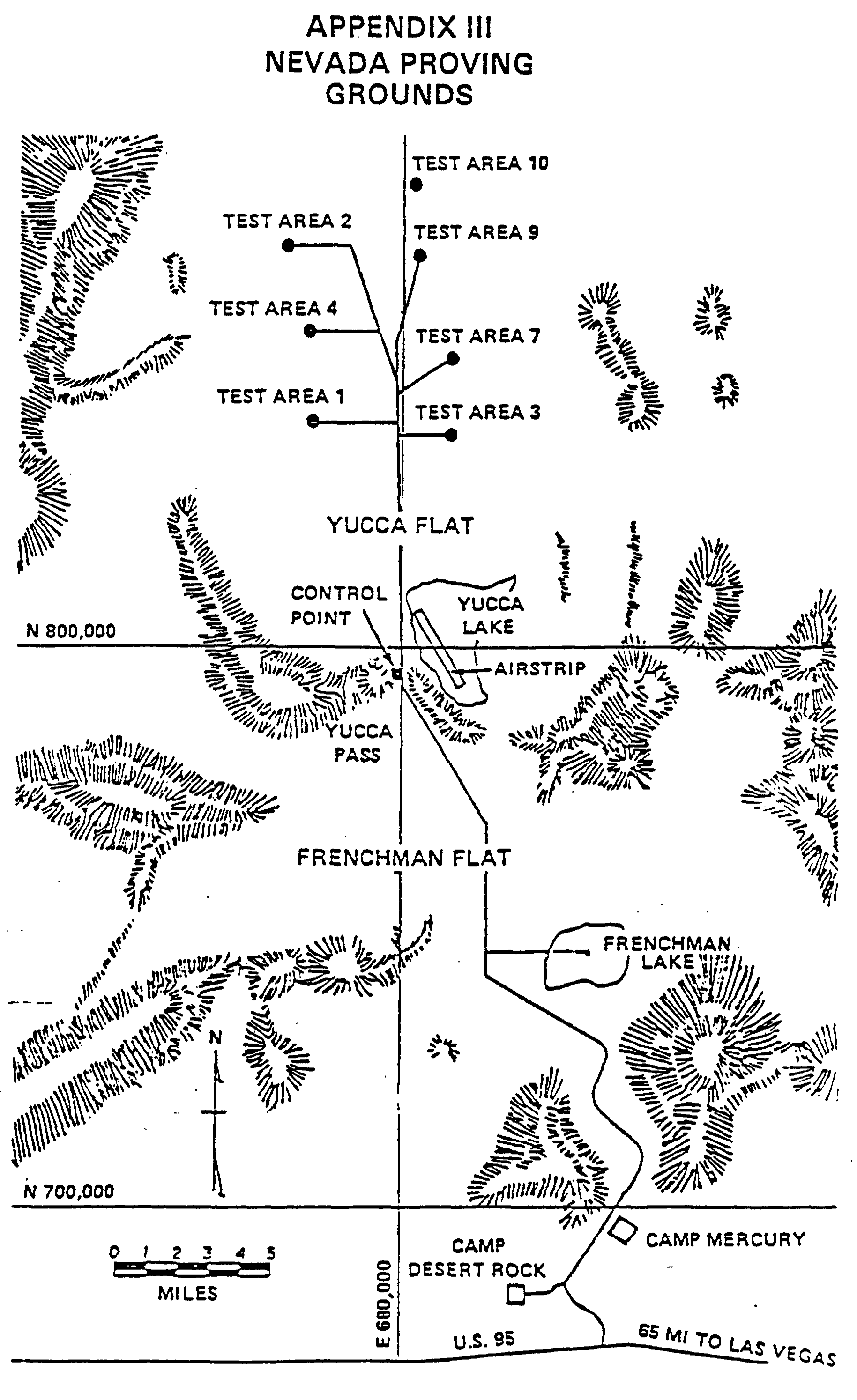
Appendix III - Nevada Proving
Grounds
Appendix IV - Bravo Fallout
Appendix V - Laboratories
and Production Facilities
Appendix VI - Department of Energy
Research and Development Production Facilities
Appendix VII -
Financial Statistics
Appendix VIII - Personnel
Appendix IX -
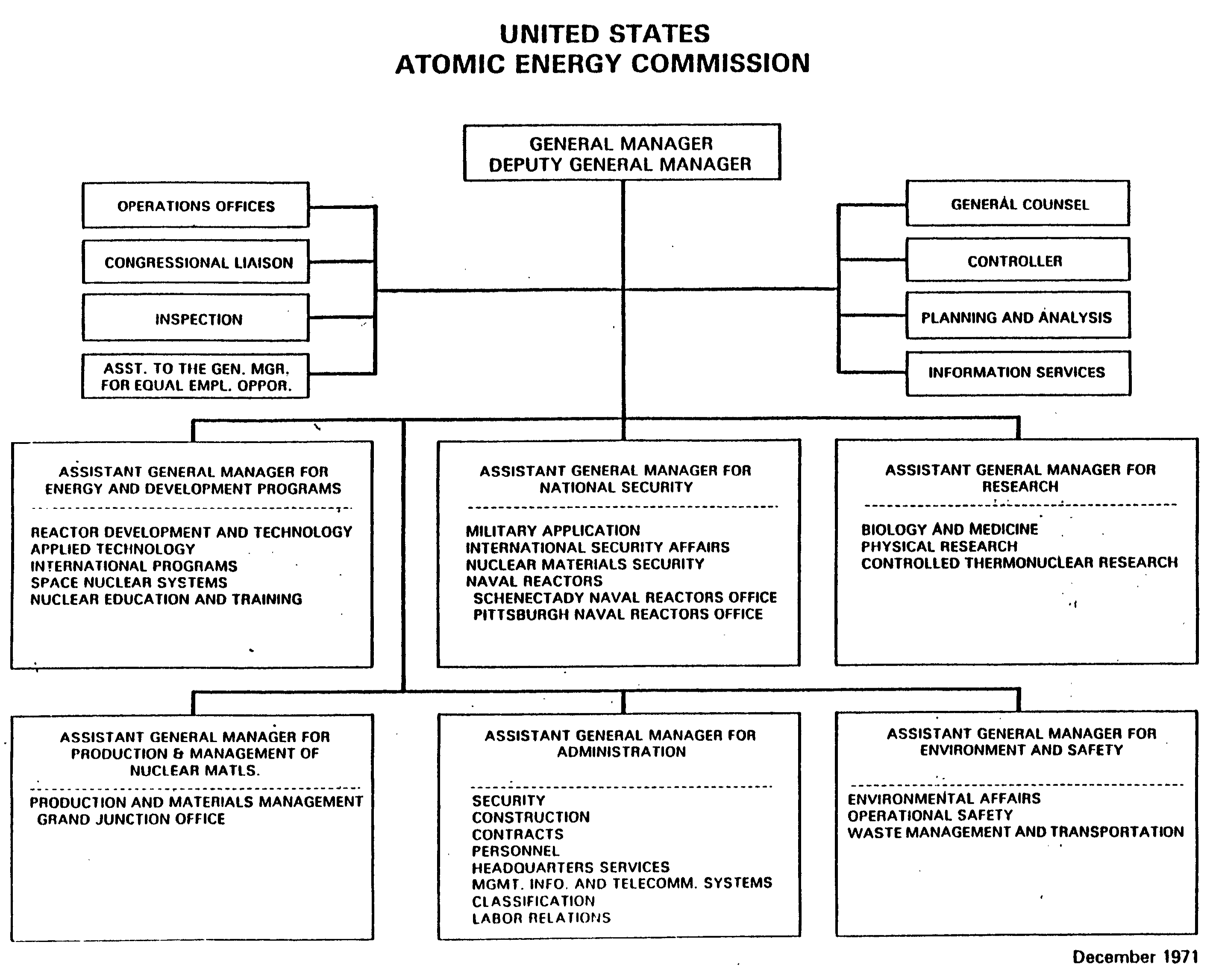
Organization Chart
– – – – – – – – – – – – – – – – – – – – – – – – – – – – – – – –
The origins of the United States' nuclear weapon program can be traced to the discovery of fission in 1939. After scientists discovered that an atom of uranium could be split, they also realized that fission could release huge amounts of energy. If a fission bomb could be developed, weapons of tremendous explosive power could be produced. The weapons potential of fission was as apparent to American nuclear physicists as to their counterparts in Nazi Germany. [1] Because German scientists had discovered fission, Hitler seemed to have a significant head start on the road to a weapon which could terrorize Europe and perhaps even the United States. American scientists organized themselves into research teams in an urgent effort to develop an atomic bomb before Germany. Hitler's attack on Poland and the fall of France fueled their efforts. When the United States entered the war in December 1941, the atomic effort already had become a large project involving teams of researchers directed by scientist-administrators Vannevar Bush and James B. Conant.
Thereafter the Manhattan Engineer District under General Leslie Groves built the plants and laboratories required to produce a bomb. At Oak Ridge, Tennessee, Groves' engineers erected a huge gaseous diffusion plant to produce enriched uranium. At Hanford, Washington they built three reactors to produce the recently discovered fissionable element plutonium. Finally at Los Alamos Groves created a weapon laboratory under the direction of J. Robert Oppenheimer to design atomic bombs. Oppenheimer and his colleagues were certain that a "gun" bomb using uranium would work but feared that an implosion bomb using plutonium might fizzle. Therefore, they conducted the world's first nuclear weapon test at Alamagordo, New Mexico in July 1945. The Trinity shot was a dramatic success and the implosion bomb, called "Fat Man" was used on Nagasaki on August 9, 1945, three days after the "gun" bomb, called "Little Boy" was used on Hiroshima. The atomic bombs leveled both cities and ended the war in the Pacific. [2]
America now debated how to manage the awesome power of atomic energy. The debate centered on congressional efforts to create an agency to direct nuclear research and development. One of the most controversial issues was whether to entrust the atom to a civilian or to a military agency. Deciding to entrust the atom to civilians, Congress passed the Atomic Energy Act which President Truman signed on August 1, 1946. The Act established a five member commission and assigned to the Commission all atomic energy facilities and programs. The Atomic Energy Act admonished the Commission to manage the atom "subject at all times to the paramount objective of assuring the common defense and security." [3] The congressional mandate meant that developing and testing nuclear weapons would be the first priority of the Atomic Energy Commission. To assure that the Commission factored military needs into weapon programs, the Act created a military liaison committee which reported both to the Commission and the Secretary of Defense. To provide Congressional checks and balances over the atomic energy program, the Act also created a Joint Congressional Committee on Atomic Energy.
Before the Commission assumed control of the atom, the Navy wanted to know what the atomic bomb would do to a modern fleet. The Manhattan Engineer District accordingly arranged the CROSSROADS test at Bikini atoll. Two bombs were detonated near a "fleet" consisting of captured German and Japanese warships, a variety of other surface vessels, and submarines. For a public conditioned to equate the atomic bombs with the devastation of entire cities, the comparatively few ships sunk or damaged were a let-down. Afterwards, some congressmen questioned the need to hold the CROSSROADS test at all. [4] A coordinated plan for developing atomic weapons and investigating their effects would have to wait until the new Commission could organize.
The Atomic Energy Commission officially assumed its duties on January 1, 1947. The Commission delegated responsibility for nuclear weapon development to the division of military application. The division established programs for the research, development, and production of nuclear weapons, and interpreted military requirements for the production of atomic bombs to the Commission. [5]
International events soon lent urgency to the weapon program. Tensions between the United States and the Soviet Union had split the Grand Alliance of World War II and had begun the Cold War. The Communist guerillas under Mao Tse-Tung then brought China into the Soviet orbit. Simultaneously Communist guerrillas threatened to engulf Greece and perhaps the whole eastern Mediterranean. A coup in February 1948 installed a Communist government in Czechoslovakia, and a few months later the Soviets shut off the land routes to Berlin. President Truman equated Stalin with Hitler and determined to stand up to the Communist threats.
Warning President Truman that the United States' supply of atomic weapons was not adequate to meet the security requirements, the Commission went to work. [6] In the next few years the Commission converted an obsolete Oak Ridge plant to the production of weapons parts; solved operating problems plaguing Hanford reactors; put plutonium production on an efficient basis; and decided to build two more reactors at Hanford. The Commission also stepped up the production of enriched uranium from the Oak Ridge gaseous diffusion plants and moved weapon ordnance work from Los Alamos to the Sandia laboratory in Albuquerque, New Mexico, allowing Los Alamos to concentrate on weapon research. Finally, the Commission established a proving grounds at Enewetak Atoll in the Pacific, scheduling its first test series, called SANDSTONE, for the spring of 1948. The SANDSTONE series was a technical success and enabled the Commission to double the small stockpile of bombs. [7] In response to the Soviet threat, the Commission had taken weapon production out of the laboratory and had put it on an assembly-line basis.
After the Berlin crisis the Commission decided to add a third gaseous diffusion plant to the Oak Ridge complex. The Joint Chiefs of Staff, however, determined in May 1949 that the Defense Department needed far more bombs than Commission plants could then produce. The Joint Chiefs's requirements meant that the Commission would have to build a fourth gaseous diffusion plant at Oak Ridge and redesign one of the new reactors at Hanford. The news that Russia had set off an atomic explosion on August 29 shocked the nation and touched off a debate within the government over whether to develop a hydrogen bomb. After both the Commission and the National Security Council had considered the issue, President Truman ordered the Commission to proceed with the development of a hydrogen bomb on January 31, 1950. [8]
The President's order put the Commission in a difficult position. To produce the large quantities of tritium that the hydrogen bomb would require, the Commission would have to reduce plutonium production at Hanford and switch reactors to tritium production. If plutonium production dropped, so would the production of weapons. The Commission decided in May 1950, therefore, to build two reactors at a new site (Savannah River was later selected) to produce tritium for the hydrogen bomb program. [9]
On June 25, 1950, North Korean forces attacked South Korea. Within days the United States had committed air, naval, and ground forces to the Korean War. Once again the nation was at war and the Joint Chiefs of Staff had to send what few reserves of trained infantry units America possessed into action. Because of fears that the Korean War easily could escalate into a general war, the Commission felt even greater urgency for the nuclear weapon program.
President Truman soon decided to reinforce overstretched American troops with atomic muscle. With the "very safety of the nation . . . in the balance," the Joint Chiefs of Staff asked the Commission to transfer nonnuclear weapon components to military bases in the United Kingdom in early July. Only nuclear cores would then have to be rushed across the Atlantic should the Communists attack in Europe. Because the process of arming the bombs and loading them onto airplanes was so ponderous, the move constituted a significant increase in American combat readiness. Concurrently the Commission agreed to transfer nonnuclear components to "an advance base in the Pacific." [10]
The Korean war also stimulated a dramatic expansion of the plants which produced uranium and plutonium for nuclear weapons. On August 8, 1950, President Truman ordered the Commission and the Department of Defense to study requirements "to increase the output of fissionable material in the immediate future." The Commission and the Department formed a joint working group which recommended that the Commission build a new gaseous diffusion plant complex (later erected at Paducah, Kentucky) and add three more reactors to the Savannah River plant. Total capital expenditure for the expansion came to $1.4 billion – the cost of all the facilities erected by the Manhattan Engineer District during World War II. President Truman approved the plan on October 9, 1950. [11]
After initial reverses, American soldiers stopped the North Korean advance, then counterattacked, and largely destroyed the North Korean army. As President Truman ordered the 1950 expansion program, American soldiers launched their victorious pursuit into North Korea. Within a month, however, Communist China sent her armies into the war, over-running some American units and inflicting a bloody defeat on others. Outnumbered by the Chinese and surprised by their sudden assault, the Americans retreated from North Korea. The Korean police action had become an undeclared war. Grimly, the President declared a national emergency on December 16, 1950.
The national emergency justified testing nuclear weapons within the continental United States. Weapon development had now become so sophisticated that it became possible to plan tests to resolve specific design problems. Simultaneously the Korean War had made the Enewetak proving grounds rather vulnerable in addition to being very expensive in terms of military resources. Two days after he declared the national emergency, President Truman approved the Commission's recommendation to establish a continental proving ground at the Las Vegas bombing and gunnery range in Nevada. One of the chief advantages of the Las Vegas site was that using it posed fewer radiological hazards to Americans than any of the other sites considered. Due to the Korean emergency the Commission began planning its first continental test series on December 20, 1950, and conducted the first test explosion a little over a month later. The test series, called operation RANGER, eventually consisted of six test shots, all of them of relatively small yields, and provided important data for fission weapons and for the thermonuclear program tests scheduled for the Pacific in April. [12]
Meanwhile, the hydrogen bomb program was floundering. Calculations by Los Alamos mathematician Stanislaw Ulam demonstrated that a proposed design for the hydrogen bomb would not ignite a fusion reaction. A few weeks later Ulam suggested a new approach and by April Edward Teller had grasped the key to starting the fusion reaction. A successful experiment in the spring test series confirmed that Teller was on the right track. [13]
The spring test series, called GREENHOUSE, was conducted in the Pacific in April and May 1951. The series was designed to test design principles for fission weapons, and because of Teller's recent idea, would be an important milestone in the development of thermonuclear weapons. GREENHOUSE, which produced the largest atomic explosion to that date, provided convincing proof of the soundness of Teller's design for the hydrogen bomb. So extensive and complex were the logistics for the Pacific test series that GREENHOUSE consumed the efforts of approximately 6,000 military and civilian personnel, and 2,580 scientists and technicians from the Commission. [14]
Commission scientists quickly analyzed the GREENHOUSE data. To coordinate the final drive for the hydrogen bomb the Commission called a conference at Princeton University in June 1951. Meeting for two days the Commissioners and key scientists discussed every aspect of the thermonuclear program. All agreed – "success was at last possible." The scientists could embark on the last leg of the journey with a feeling of confidence. Yet the hydrogen bomb had caused bitter divisions among scientists over both the ethics of building the fusion bomb and the resources which the thermonuclear program would command from other priorities. Never satisfied with the resources allocated to the hydrogen bomb program, Edward Teller finally resigned from Los Alamos in September 1951. He remained close to the program, however, as a consultant. [15]
The technical advances at RANGER and GREENHOUSE raised questions about the rate of the production of enriched uranium and plutonium. The rapid strides in developing fission weapons resulted in greater demands for both types of fissionable materials. As the Commission considered the issue, Senator Brien McMahon, Chairman of the Joint Committee on Atomic Energy, asked the Commission "to estimate the cost of (a) increasing by 50 percent, (b) doubling, and (c) increasing by 150 percent our existing and presently planned capacity for producing fissionable material and atomic bombs." So complex were the issues involved in McMahon's request that the Commission put together a team to prepare another expansion study. Cost estimates for the program ranged from $2 billion to $7 billion. After submitting a report to Senator McMahon, the Commission referred the expansion program to the National Security Council. [16]
While the Commission debated whether to build new production facilities, it conducted a second continental test series, called BUSTER-JANGLE. Already continental tests had become complex. In addition to testing weapon designs, the Commission used the blasts to test weapon effects for the Department of Defense and the Federal Civil Defense Administration. The Department of Defense sent a 5,000 man regimental combat team and 3,450 observers to the proving grounds to train the soldiers for atomic warfare. The Commission was responsible for the radiological safety of the soldiers as well as for the technicians who studied the effects of the blasts. So hastily had some of the military experiments been devised that the Commission's test manager advised the Commission that it should assume complete control of all future test series. [17] Despite his admonition, however, the military retained control of its experiments and eventually assumed responsibility for the radiological safety measures taken to protect the soldiers who trained for atomic warfare.
Fission weapon advances fueled the expansion debate within both the Joint Committee and the Commission. Meeting on January 16, 1952, the National Security Council approved a second major expansion of the Commission's production facilities. The program, scheduled for completion in 1957, cost an estimated $4.9 billion and added an additional gaseous diffusion plant to the Oak Ridge complex and two new plants to the Paducah complex. In addition, a third gaseous diffusion complex was erected at Portsmouth, Ohio. To increase plutonium production two new large reactors were added to the Hanford complex. [18]
Edward Teller, meanwhile, continued to press for a second weapon research laboratory. Failing to convince the Commission, he took his campaign to the Joint Committee on Atomic Energy and the Department of Defense. By late March 1952, he had won so many allies that the Commission concluded it would have to build another weapon research laboratory. The Commission picked Livermore, California as the site and by September the laboratory was a reality. [19]
As the Commission activated its second weapon laboratory the pace of testing accelerated. The proximity of the Nevada Test Site to Los Alamos allowed laboratory scientists to commute easily between test series and laboratory planning. By April 1, 1952, the Commission began a third continental series of weapon tests, called TUMBLER-SNAPPER. Again the yields were relatively small. Again the Commission conducted military effects tests and units of soldiers maneuvered across the desert after several shots. At TUMBLER-SNAPPER, however, the Commission shared radiological safety responsibility for the soldiers with the Army. For the first time the Commission invited a limited number of newsmen to witness and film the April 22, 1952 shot in order to give the American people first-hand knowledge of an atomic explosion. The Commission had finally completed permanent facilities at the test site and had established an extensive off-site radiation monitoring network. [20]
The monitoring network, which could track fallout across the nation, had been established by the Commission's division of biology and medicine. The division provided the Commission with advice from medical experts on the hazards and effects of radiation as well as with analyses of the data captured by the radiation monitoring network. To provide the scientific foundation for data gleaned from the monitoring network, the division supervised several research programs which investigated radiation effects. The division gave the Commission advice on the effects of fallout for atmospheric and later for underground test series.
In November 1952, the Commission successfully tested a thermo-nuclear device in the Pacific IVY series, called MIKE. The experimental device produced a blast of 10.4 megatons, more than 500 times larger than the TRINITY shot. MIKE was so powerful that the explosion which blew the island of Elugelab from the face of the earth could be seen hundreds of miles away. [21] The world had entered the thermonuclear age, but the Commission had yet to create a deliverable thermonuclear weapon.
The Commission's testing program was only one part of the nuclear weapon program. The Commission also established systematic weapon research and development, and built plants to produce enriched uranium, plutonium, and nonnuclear weapon components. On March 21, 1953, the Commission and the Department of Defense signed an agreement which delineated their roles in building nuclear weapons. The Commission would develop and produce weapons to military specifications established by the Defense Department. Since 1953 nuclear weapons have been developed and produced jointly under this agreement. [22]
The Commission completed the fissionable materials production plants ahead of schedule. The first two Savannah River reactors began production in 1953 and the other three started up a year later. By early 1954 the Paducah gaseous diffusion plants were producing enriched uranium and by September the Portsmouth plants were in operation. The two large Hanford reactors went into operation in 1955. Thereafter, the Commission consistently exceeded goals for the production of fissionable materials. [23]
As the Commission produced more enriched uranium and plutonium it built additional plants to assemble weapons. The Commission erected plants for manufacturing weapon parts in Rocky Flats, Colorado (1952), Kansas City, Missouri (1952), Burlington, Iowa (1952), Miamisburg, Ohio (1955), and Pinellas, Florida (1957), and also opened a weapon assembly plant in Amarillo, Texas in 1952. Weapon engineering for the Livermore Laboratory was concentrated in a Livermore branch of Sandia laboratories in 1958. [24]
The production and assembly plants produced a large weapon stockpile. By 1953 assembled weapons were being turned over to the military and by 1956 most of the stockpile was in the physical, if not the formal, control of the Defense Department. The Commission, however, continued to exercise its statutory responsibility to maintain safe, but reliable weapons. As the stockpile grew, the number of nuclear weapons being transported and stored around the country increased. To prepare for the remote possibility that a transit or storage accident might detonate the conventional explosive in a weapon, the Commission incorporated safety considerations into weapon design, drew up policies for safely transporting and storing weapons, and established special teams trained and equipped to handle a weapon accident. [25]
After the MIKE shot of November 1952, the major problem facing the Commission and its scientists was the development of a deliverable thermonuclear weapon. The UPSHOT-KNOTHOLE series of the spring of 1953 included an open shot for reporters and civil defense officials, military effects shots, and troop maneuvers (the Army was now completely responsible for the radiological safety of its soldiers). The drive for a deliverable thermonuclear weapon, however, dominated the series. To accommodate Los Alamos' need for crucial experiments and precise data, the test group decided to permit comparatively larger explosions than were usually fired at Nevada. The group decided to fire shots from 300-foot towers. The test group, which anticipated fallout beyond the test site, was confident that its radiological safety procedures would protect local communities. [26]
The Commission had learned that fallout from one of the RANGER shots had come down in measurable amounts in a radioactive snowstorm in Rochester, New York in 1951. Since then the Commission had worked hard to improve fallout prediction by installing an expanded radiation monitoring network around the test site. The system seemed to work well enough for the first six UPSHOT-KNOTHOLE shots, limiting fallout in inhabited areas to small or negligible amounts. But fallout from the seventh shot, called SIMON, drifted across local highways and forced the Commission to set up road blocks and to wash down cars contaminated with the fallout. The ninth shot, HARRY, sent a fallout cloud over local highways and toward St. George, Utah. The Commission had to wash cars again and had to ask St. George residents to take cover until the cloud had passed. The incidents caused local concern and resulted in two mild Congressional inquiries to the Commission. But most people feared that the atomic explosions had caused the severe tornadoes, and other unusual weather plaguing the country that spring of 1953. [27]
The Commission, however, was worried about the UPSHOT-KNOTHOLE fallout. Troy, New York had suffered a long-distance rainout and the Commissioners had received reports that fallout had caused the unusually large number of deaths in 1953 among sheep herds grazing around the test site. The fallout issue came to a head when Los Alamos scientists wanted to add an additional shot to produce vital data for the 1954 thermonuclear test series. Although the President and the Commission approved the shot, one of the Commissioners was so concerned about fallout that he requested a full-scale review of "the highly inter-related public relations and safety problems" the Commission had created in Nevada. [28]
The Commission immediately launched an investigation of the sheep deaths and a full-scale review of Nevada testing. Commission scientists, "fully aware that the future of continental testing might hang on the results," concluded that fallout did not cause the sheep deaths. They remained silent on whether it might have been a contributing factor and in public announcements the Commission "glossed over the fact that scientific opinion on the question was not unanimous." [29] The review committee decided that continental testing should continue but suggested several methods to reduce fallout from test shots. The Commission adopted most of the suggestions and integrated them into planning for the next continental series.
While the Commission was planning the 1954 series the Soviet Union announced the explosion of a hydrogen bomb. Actually the Russians had probably detonated a large fission weapon which burned some thermo-nuclear fuel. For security reasons the Commission could not explain that the Soviets hardly had a deliverable thermonuclear weapon. [30] To most Americans the Commission had to work even harder so as not to lose the grim race with the Soviet Union.
The 1954 spring Pacific tests series, called CASTLE, provided perhaps the greatest technical successes of any tests other than TRINITY or MIKE. Six thermonuclear shots were fired and most of these surpassed the Commission's most optimistic predictions. Not only did the Commission have a deliverable thermonuclear weapon but it also could produce a whole "family" of thermonuclear weapons in a spectrum of yields from small tactical to large strategic weapons. Now the Commission could use a whole new philosophy in building the stockpile. Rather than build bombs with a balanced distribution of yields, the Commission concentrated on making specific types of weapons and working optimum characteristics into them. [31]
CASTLE, however, unexpectedly demonstrated that multi-megaton thermonuclear weapons also could produce significant amounts of deadly fallout. The first shot of the series, a fifteen megaton blast called BRAVO, produced a massive fallout cloud which rose more than twenty miles into the stratosphere and triggered thunderstorms and rain squalls throughout the Pacific test area. Fallout from the cloud was scattered over more than seven thousand square miles of ocean, the naval task forces supporting the test; 236 Marshallese natives living on several near-by atolls, 31 American weather service personnel stationed on the atolls, and the Japanese fishing vessel, the Lucky Dragon. The fate of the Lucky Dragon received prominent attention in the Japanese press and brought the dangers of fallout to the attention of the world. [32] The BRAVO shot ensured that fallout would become a concern of all Americans, not just those who lived near the Nevada Test Site.
BRAVO linked the fallout issue to the test ban issue. On April 2, 1954, shocked by BRAVO fallout, Prime Minister Nehru of India called for a test moratorium. His plea led the Eisenhower Administration briefly to consider halting nuclear weapon tests, but the Administration which wanted to preserve America's technical lead over the Russians could find no way to enforce such a test ban. [33]
Increasing public concern about the BRAVO fallout put pressure upon the Commission to release "the facts" about fallout. Wishing to inform the American people about fallout, the Commission released "A Report by the United States Atomic Energy Commission on the Effects of High Yield Nuclear Explosions" on February 15, 1955. In it the Commission not only explained BRAVO fallout but also discussed fallout from Nevada tests. The Commission characterized iodine 131 and strontium 90 as the two most hazardous components of fallout but assured Americans that testing posed little hazard to health. [34] The report, nevertheless, fueled rather than calmed the fallout controversy. Perhaps because its publication coincided with the beginning of the spring 1955 test series, it helped to touch off a new wave of concern about continental testing.
The 1955 Nevada series was dubbed TEAPOT and again consisted of weapon development, military effects, and "open" shots. The Commission planned to fire fourteen shots to test new weapon designs and to find ways to reduce fallout from all weapons. Under the new criteria for testing on the continent, nine of the shots had yields of less than ten kilotons and were fired from towers 400 to 500 feet high. Over eight thousand military personnel participated in the series although troop maneuvers were held at only two shots. The Army retained sole responsibility for the radiological safety of the troops for TEAPOT and all other continental series. The Commission had put far more resources into off-site monitoring but assigned sole responsibility for the monitoring to the Public Health Service which had established fixed stations in small communities around the test site. The Public Health Service, henceforth, conducted most off-site monitoring and transformed the perception of fallout radiation from a problem in industrial safety to that of a general hazard to the public as a whole. [35]
As testing accelerated, more people became concerned about the health hazards of fallout. Consequently fallout became a national issue with scientists and laymen concerned about both the somatic and genetic effects of fallout radiation. In response to the Commission's weapon effects statement the Federation of American Scientists proposed that a United Nations' commission assess the hazards of testing. At the Commission's request the National Academy of Sciences also launched a radiation study. Simultaneously in 1955 the Joint Committee on Atomic Energy and the Senate Armed Services Committee held hearings on problems related to the hazards of fallout. [36]
The Commission responded by authorizing Commissioner Libby to release scientific data about fallout. On June 3, 1955, Libby addressed the alumni of the University of Chicago and assured them that fallout did not "constitute any real hazard to the immediate health" of Americans. In January 1956 he revealed that the Commission had been studying the hazards of fallout worldwide under the name of Project Sunshine. Project Sunshine scientists labeled strontium 90 as the most hazardous radioisotope in fallout and created a worldwide network to monitor its presence in humans, foods, and soils. Libby, who became the Commission's spokesman on fallout, subsequently released more scientific data on fallout through a series of highly technical speeches. [37]
As fears of fallout rose so did fears of the ultimate consequences of the nuclear arms race. President Eisenhower, fully aware that a nuclear war could result in "civilization destroyed" and "the annihilation of the irreplaceable heritage of mankind handed down to us generation from generation" was firmly committed to halting the nuclear arms race. To inject life into deadlocked disarmament negotiations he took the unprecedented step of appointing Harold Stassen to a cabinet level post for developing disarmament policy. At the Geneva conference in 1955, the President offered to exchange blueprints of military facilities with the Russians; meanwhile, he prodded Harold Stassen to devise a comprehensive disarmament plan. To the Commission's dismay Stassen seemed all too willing to separate the test ban issue from comprehensive disarmament negotiations. The Commission argued that a properly supervised ban on weapon tests should be an integral part of a comprehensive disarmament agreement with the Russians. [38] The weapon program was so firmly linked to arms control issues that the Commission would have to manage the program with one eye on arms control negotiations.
The 1956 Presidential election campaign gave increased impetus to the push for a test ban when candidate Adlai Stevenson suggested that the United States unilaterally stop testing as a first step in obtaining a test ban agreement with the Soviet Union. Although Stevenson ultimately lost the election, he made test ban a partisan issue. As Stevenson and Eisenhower sparred on the test ban issue, the Commission conducted a seventeen shot Pacific test series called REDWING, which further advanced the Commission's designs of nuclear weapons which produced minimal fallout. Within a few months of the election, and during the internal Eisenhower Administration sparring over positions to take at the 1957 London disarmament conference, Stassen virtually separated test ban negotiations from the American disarmament package and set the stage for separate agreement on the test ban issue. In 1957 Albert Schweitzer added his voice to the opponents of testing, the Pope endorsed Schweitzer's stand, and Linus Pauling obtained the signatures of 2,000 scientists on a petition opposing testing. That spring the Joint Committee on Atomic Energy cautiously explored the health effects of radiation in hearings held over the summer of 1957. [39]
As the Eisenhower Administration moved toward test ban negotiations the Commission stepped up the pace of testing, conducting the twenty-four shot PLUMBBOB series at Nevada in 1957. The tests, which explored air defense and anti-submarine warheads consisted of relatively small explosions. The Commission also explored a novel method to prevent fallout by testing a device deep underground. Consequently, the RAINIER shot proved that nuclear weapon tests could be performed entirely underground. Again, the Federal Civil Defense Administration and the Department of Defense conducted civil and military effects tests as part of the series. [40]
Stassen's failure in London proved to be only a temporary halt in the march to test ban negotiations. On March 31, 1958, only days after they had completed their most extensive series to that date, the Soviet Union announced a unilateral test ban and appealed to other nuclear powers to halt their tests. President Eisenhower and Chairman Nikita Khrushchev agreed shortly thereafter to sponsor a technical conference to determine whether a system to detect nuclear weapon tests could be created. The technical conference was held in Geneva from July 2 until August 21, 1958, and concluded that such a system was technically feasible. President Eisenhower accepted the conclusions of the conference and announced on August 22 that the United States would suspend testing for a year once test ban negotiations began. [41]
With a test ban at hand the Commission tested at an even more urgent pace. Phase I of the HARDTACK series, held at the Pacific proving grounds from April through August 1958, consisted of thirty-five shots, most of them relatively small. Rockets carried two megaton range experiments high into the atmosphere from launching sites on Johnson Island. Phase II of HARDTACK, held at Nevada, consisted of nineteen shots, four of them underground and ten with the devices suspended 1900 feet above the ground by balloons. Most of these shots were small and fallout was minimal. [42] The HARDTACK series concluded on October 30, 1958. On November 1 test ban negotiations opened in Geneva. For a time, the era of confrontation between the United States and the Soviet Union was giving way to an era of negotiations.
When the Eisenhower Administration embraced test ban negotiations, it also sought closer ties with America's allies. The Administration obtained an amendment to the Atomic Energy Act on July 2, 1958, which allowed the United States to transfer to its allies nonnuclear components of atomic weapons and certain information about the weapons. The next day the United States and the United Kingdom signed a broad agreement which permitted the exchange of detailed atomic weapon information, nonnuclear weapon components, and certain weapon materials. Within a year more restricted mutual defense agreements were concluded with Canada, France, West Germany, Greece, the Netherlands, and Turkey. The Commission henceforth had to decide what information or parts could be given each nation and to monitor jointly with the Department of Defense the information and components going overseas. [43]
The Geneva test ban talks, which eventually made more progress than most East-West negotiations during the 1950's, stumbled over verification primarily because of the difficulty of detecting underground nuclear explosions. The negotiations stimulated attention within the Commission to the problems of detecting nuclear weapon tests. In cooperation with the Department of Defense, the Commission established the Vela programs to explore the detection of tests performed underground and in outer space, and the monitoring of tests by satellite. During the Geneva negotiations both the United States and the Soviet Union refrained from testing, resulting in an unpoliced test moratorium from late 1958 until September 1961. On September 1, 1961, the Soviet Union suddenly broke the moratorium with an extensive series of tests and the conference collapsed soon after. [44]
When the Soviets broke the moratorium President John F. Kennedy had been studying the issue of test resumption. After a personal appeal to Chairman Khrushchev failed, President Kennedy ordered the resumption of American tests and the Commission responded with the NOUGAT series in Nevada. The next year the Commission continued NOUGAT at Nevada and launched the DOMINIC series in the Pacific. Most Nevada tests were underground, except for three atmospheric shots and a cratering experiment. Again the Defense Department conducted training exercises, which involved troop maneuvers, in conjunction with the one atmospheric shot. The Pacific series, which began on April 25, 1962 consisted almost entirely of atmospheric shots. Included in the series was an underwater shot and five high altitude shots. By the end of the year the Commission had announced 61 shots at Nevada and 36 shots in the Pacific. [45]
The Nevada tests had included two shots from a new Commission program called PLOWSHARE. Originating at the Livermore laboratory in 1957 the objective of PLOWSHARE was to use nuclear explosives for peaceful purposes such as large-scale excavation projects, power production, isotope production, and the recovery of oil from shale, tar sands, or depleted wells. The program consisted of both laboratory studies and field experiments. By late 1961 the Commission had detonated the GNOME explosion to explore the possibility of recovering useful heat energy and valuable isotopes from a nuclear explosion. The Project SEDAN experiment at Nevada in July 1962 studied the usefulness of nuclear explosions for large excavation projects such as harbors or canals. The 100 kiloton SEDAN shot dug out a crater 320 feet deep and with an average diameter of 1280 feet and displaced almost 7.5 million cubic yards, or 12 million tons of earth. [46]
The Commission conducted the 1961 and 1962 tests as the international situation became more tense. Heating up the Cold War, the Soviet Union began a series of confrontations over Berlin in 1961. But the worst crisis came in October 1962, when President Kennedy demanded that the Soviet Union withdraw missiles it had deployed in Cuba. Although Chairman Krushchev removed the missiles, the world seemed close to the brink of nuclear war before the crisis ended.
The Cuban missile crisis profoundly affected test ban negotiations which had resumed in Geneva. Doubtlessly the crisis made both the United States and the Soviet Union more willing to compromise. [47] On October 11, 1963, the two powers formally entered into a treaty banning nuclear testing in the atmosphere, under water, and in outer space. Thereafter all American nuclear testing was conducted underground.
Three months later in his first State of the Union address, President Lyndon B. Johnson announced that the United States would reduce its production of enriched uranium by 25 percent and shut down four production reactors. The United States, the President declared, would not stockpile arms beyond its needs. Indeed, so efficiently had the production complexes operated that the Commission had put only one new reactor into production since the mid-1950's. Called the New Production Reactor and added to the Hanford complex, the unit was symbolic of the abundance of fissionable materials in that it was designed to produce either plutonium or electric power. [48]
The Limited Test Ban Treaty and the production cut-back signaled a new era for the nuclear weapon program. The overriding Cold War mission of the Atomic Energy Commission, producing a nuclear arsenal to protect the free world, had been successfully achieved and the fact politically recognized. The Commission had created warheads for strategic and tactical missiles, a variety of nuclear bombs, nuclear shells for artillery pieces, atomic demolition devices resembling gigantic land mines, antisubmarine weapons, and torpedos. So efficient were its factories that by the early 1960's the nuclear arsenal numbered in the tens of thousands of weapons. "Of this huge total, Secretary of Defense Robert McNamara . . . reported that 7000 were located in Western Europe." [49] The Commission's achievement ranked as one of the most dramatic and awesome feats in the history of the nation. Although the nuclear weapon program consumed the largest portion of the Commission's budget, it could no longer claim the urgency or overriding importance of the 1950's.
The Commission continued to carry out an extensive weapon testing program, now planning and conducting tests by fiscal year rather than by periodic series. In the 1960's test series consisted of weapon design and verification shots, PLOWSHARE experiments, and VELA program shots. Because the shots were all fired underground no further military or civil effects tests were conducted. The Commission, however, maintained the Pacific proving grounds and was ready to resume atmospheric testing should the Russians violate the test ban treaty. [50]
Although atmospheric testing stopped in 1963, reassessments of doses received from atmospheric testing did not. That year a series of hearings before the Joint Committee on Atomic Energy explored the hazards of iodine 131. As a result of the hearings the Commission and the Public Health Service expanded morbidity and mortality studies of off-site Nevada communities. The data collected indicated that there were somewhat more leukemia deaths than would normally be expected, but results were not conclusive. Data from the Marshall Islanders exposed to the BRAVO fallout indicated radiation-related thyroid problems were a distinct possibility, especially among children exposed to fallout. In 1965 the Public Health Service began a major thyroid study among school children in selected counties in Utah, Arizona, and Nevada. Although thyroid abnormalities were found in ninety-five students, final results again seemed inconclusive. [51]
The Commission initiated a search for test sites to supplement the Nevada Test Site in 1966. Commission engineers soon located sites in central Nevada and on Amchitka Island suitable for tests which could not be held near Las Vegas. The Commission fired a nonnuclear VELA detection shot on Amchitka in 1967 and conducted an intermediate yield test in central Nevada a year later. The Commission ultimately fired two nuclear shots, MILROW and CANNIKIN on Amchitka, but by 1969 the use of Amchitka had aroused environmental groups concerned that the shots would irreparably damage local ecology or set off seismic disturbances. To preserve the Amchitka environment the Commission established a number of environmental programs. Along with several state groups, the Commission relocated Amchitka sea otters to new homes in an attempt to rebuild the sea otter population. In a dramatic gesture to demonstrate his faith that the CANNIKIN shot would not touch off serious seismic disturbances, Commission Chairman James R. Schlesinger took his wife and two daughters to the island for the November 6, 1971 test shot. [52]
As the Commission tested, the United States and the Soviet Union found more common ground for arms control agreements. A series of treaties banned nuclear weapons testing, storage, or deployment in Antarctica (Antarctic Treaty, 1959), outer space (Outer Space Treaty, 1967), Latin America (Treaty of Tlateloco, 1967), and on the ocean floor (Sea-Bed Treaty, 1971). In 1969 the two superpowers began a series of strategic arms limitation (SALT) talks aimed at halting the development of anti-ballistic missile systems. By 1972 the talks had produced agreements which would help to keep nuclear war from starting and reduce Soviet missile production. The SALT agreements led President Nixon to proclaim that the era of confrontation between America and the Soviet Union had been successfully transformed into an era of negotiations. [53]
The Commission not only continued to perfect nuclear weapons but also investigated new ways to produce weapons and fissionable materials. In the concept of laser fusion, Commission scientists explored the ability of high-energy lasers to induce thermonuclear reactions in small deuterium-tritium pellets. Because laser fusion had military as well as power implications the Commission counted it as a weapon program. Commission scientists also examined the potential use of lasers to separate isotopes of uranium. By 1974 laser isotope separation had become a large program. [54]
The energy crisis, meanwhile, overtook the Atomic Energy Commission. President Gerald R. Ford signed the Energy Reorganization Act of 1974 on October 11, abolishing the Atomic Energy Commission and transferring its nuclear weapon program to the newly formed Energy Research and Development Administration (ERDA). Because the Energy Research and Development Administration's primary purpose was to develop new sources of energy Congress questioned whether nuclear weapon programs should be assigned to the agency. After a year of study, ERDA and the Department of Defense recommended that ERDA should retain the weapon program. One compelling reason for leaving the weapon program in the civilian energy agency was that the weapon laboratories also had important energy research capabilities. [55]
The continuing arms control negotiations had far more impact on the weapon program than energy reorganization. The United States signed the Threshold Test Ban Treaty which prohibited underground tests with yields exceeding 150 kilotons and specified that nuclear weapon tests must be confined to specific test sites. The United States agreed to use national technical means to verify compliance with the treaty and henceforth conducted weapon testing programs in compliance with it. The United States also signed a companion to the Threshold Test Ban Treaty, the Treaty on Underground Nuclear Explosions for Peaceful Purposes on May 28, 1976. The treaty on peaceful explosions defined certain activities which did not constitute peaceful nuclear explosions and applied to all nuclear explosions conducted outside specified weapon testing grounds. The Peaceful Nuclear Explosions Treaty also limited all underground test shots to 150 kilotons. [56]
In 1977 President Jimmy Carter, following his campaign promise to give energy reorganization a high priority, proposed the establishment of a single cabinet level Department of Energy to be created from several existing energy agencies. He obtained legislation creating the department and activated it on October 1, 1977. The entire nuclear weapon program was transferred to the new department and placed under an assistant secretary for defense programs. [57] In contrast to 1975 only one Congressman raised the question of whether it was appropriate to assign the weapon program to a civilian energy agency.
The department launched a comprehensive weapon program, including the production of TRIDENT/POSEIDON warheads, the development of warheads for MINUTEMAN and CRUISE missiles, and plans for improved artillery fired projectiles. The department continued to study new generations of nuclear weapons. In November 1977 the department announced the completion at Lawrence Livermore Laboratory of a major facility designed to conduct laser-driven fusion research. The department foresaw great progress using carbon dioxide lasers of even greater power and intensity, and erected a laser fusion laboratory at Los Alamos as well as a Particle Beam Fusion Facility at Sandia Laboratories. To support the Carter Administration's search for a comprehensive test ban treaty the department also pursued a vigorous program of seismic research and placed an advanced seismic detection station at McMinnville, Tennessee. The department conducted a nuclear weapon accident exercise at the Nevada Test Site and initiated a program to improve and arrest deterioration in the aging nuclear weapon production plants. [58]
One of the major problems the Department faced was determining whether fallout radiation from atmospheric weapon tests had caused cancer or leukemia among former soldiers or local off-site residents. The Marshallese and Japanese victims who received large doses of radiation from the BRAVO fallout had been compensated for their injuries. But had the very low doses from fallout radiation also caused injury to others? Former military personnel who had participated in troop maneuvers at the test site argued that soldiers were exposed to more radiation than previously believed and that the exposure had caused illness and death from cancer. Reports of the soldier's health problems and new studies among the Marshallese, which demonstrated the smaller the radiation dose the longer the period before thyroid tumors became evident, caused intense public anxiety and by the fall of 1977 had swamped the Departments of Energy and Defense with calls from cancer patients and their relatives. [59]
In November 1978, in response to the outpouring of public concern President Carter ordered the Department of Health, Education, and Welfare to establish a program of research on the effects of radiation exposure. In addition, Congress directed the Department of Health, Education, and Welfare to establish a comprehensive program of research on the effects of low-level radiation and to review all federal programs in this field. Cooperating with the Department of Health, Education, and Welfare the Department of Energy opened its files on the effects of radiation and atmospheric testing programs to federal researchers and Congressional investigators. In February 1979 in response to a request from Governor Scott Matheson of Utah, the Department of Energy undertook to declassify and release all information on the effects of fallout. Establishing the Offsite Radiation Exposure Review Project, the department collected all relevant records and data relating to atmospheric testing and fallout, deposited them in a Coordination and Information Center in Las Vegas, Nevada, and used the data to reassess radiation doses to the local residents. A year later the department established a Dose Assessment Advisory Group to provide advice and general direction to the Offsite Radiation Exposure Review Project. [60]
Dr. Joseph Lyon, an epidemiologist who published a controversial study of the radiation effects of fallout in 1979, found that the childhood leukemia rate for children in southern and eastern Utah tripled for the years 1959 to 1967. Lyon believed that his data established a possible link between testing and childhood leukemia. Although scientists questioned his methodology, the government intensified its investigations of the health effects of fallout. News of Lyons' study, and of the alleged injuries to former soldiers, however, had sparked a wave of claims against the government requesting damages for illness caused by fallout radiation. By mid 1982 the department faced over 53 radiation litigation cases with alleged damages totaling over $2 billion. [61]
Ronald Reagan was elected President of the United States in November 1980. Although the new President promised to reduce the federal government's role in energy regulation and management, he resolved to strengthen nuclear research and development, including the weapon program. Within a year the department was working to increase the production and testing of nuclear weapons and to upgrade deteriorating production facilities. [62]
The President's actions were indicative of the vital role nuclear weapons have played in protecting the Nation and the free world for nearly forty years. Originating in the crash effort to produce an atomic bomb, the nuclear weapon program provided the keystone for American's defenses during the Cold War. As tension between the United States and the Soviet Union gradually relaxed, the production of nuclear weapons became a less urgent, but nevertheless vital task for America. The energy crisis of the 1970's seemed to obscure the importance of the weapon program. As the energy crisis faded, President Reagan put the weapon program at the top of the Department of Energy's priorities.
– – – – – – – – – – – – – – – – – – – – – – – – – – – – – –
1. Richard G. Hewlett and Oscar E. Anderson, Jr. The New World, 1939-1946 Volume I of A History of the United States Atomic Energy Commission (University Park, 1962), pp. 10-11, (hereafter cited as Hewlett and Anderson, New World.)
2. For a detailed study of the wartime project, see Hewlett and Anderson, New World.
3. Hewlett and Anderson, New World, pp. 428-455 and 482-530. Joint Committee on Atomic Energy, Atomic Energy Legislation Through 94th Congress, 1st Session (Washington, 1976), p. 353.
4. Hewlett and Anderson, New World, pp. 580-581.
5. Alice Buck, "A History of the Atomic Energy Commission," Institutional Origins of the Department of Energy, Energy History Series, DOE/ES-0003, August, 1982, p. 1, (hereafter cited as Buck, "Atomic Energy Commission," Institutional Origins); Roger M. Anders, "The Office of Military Applications," Institutional Origins of the Department of Energy, Energy History Series, Volume I, No. 1, November, 1978, pp. 2-3, (hereafter cited as Anders, "Office of Military Applications," Institutional Origins); Prentice C. Dean, "Energy History Chronology from World War II to the Present," Institutional Origins of the Department of Energy, Energy History Series, DOE/ES-0002, August 1982, p. 4, (hereafter cited as Dean, "Energy History Chronology," Institutional Origins).
6. Report to the President of the United States from the Atomic Energy Commission January 1 - April 1, 1947, April 3, 1947. The stockpile probably contained sufficient parts for seven bombs, not one of which was completely assembled. David A. Rosenberg, "U. S. Nuclear Stockpile, 1945 to 1950," Bulletin of Atomic Scientists, Vol. 38, No. 5, May 1982, p. 26.
7. Anders, "Office of Military Applications," Institutional Origins, p. 3. A. R. Leudecke to the Commission, August 16, 1963, AEC 1140, History of Expansion of AEC Production Facilities, pp. 2-7, (hereafter cited as AEC 1140). Dr. Richard G. Hewlett, the Commission's historian, was the primary author of the paper.
8. AEC 1140, pp. 8-12. The hydrogen bomb decision is described in Richard G. Hewlett and Francis Duncan, Atomic Shield, 1947-1952 Volume II of A History of the United States Atomic Energy Commission (University Park, 1969), pp. 362-409, (hereafter cited as Hewlett and Duncan, Atomic Shield.)
9. AEC 1140, pp. 14-16. Hewlett and Duncan, Atomic Shield, pp. 411-17 and 430-32.
10. The quote regarding the safety of the nation comes from James F. Schnabel, United States Army in the Korean War, Policy and Direction: The First Year (Washington, 1972), p. 105. Hewlett and Duncan discuss the transfers in Atomic Shield on pp. 521-22 and 524-25. The quote about the Pacific base is from Atomic Shield, p. 524.
11. AEC 1140, pp. 19-23. The quote is from Hewlett and Duncan, Atomic Shield, p. 525.
12. Gordon Dean, Background Statement for RANGER, January 9, 1951; Gordon Dean, Memorandum for the Chairman, Military Liaison Committee, December 20, 1950, AEC 388; and James McCormack to the Commission, December 22, 1950, AEC 388/1; Richard G. Hewlett, "Nuclear Weapon Testing and Studies Related to Health Effects: An Historical Summary," Consideration of Three Proposals to Conduct Research on Possible Health Effects of Radiation From Nuclear Weapon Testing in Arizona, Nevada, and Utah and Nuclear Weapon Testing and Studies Related to Health Effects: An Historical Summary: Responding to Recommendations by the Panel of Experts on the Archive of PHS Documents (Washington, 1980), pp. 42-43, (hereafter cited as Hewlett, "Nuclear Weapon Testing," Panel of Experts); Hewlett and Duncan, Atomic Shield, p. 535.
13. Hewlett and Duncan, Atomic Shield, pp. 535-37 and 541.
14. Hewlett and Duncan, Atomic Shield, pp. 541-42; Hans A. Bethe, "Comments on the History of the H-Bomb," Los Alamos Science, Fall, 1982, p. 48; Joint AEC-DOD Press Release No. 377, June 13, 1951.
15. Hewlett and Duncan, Atomic Shield, pp. 542-545; Edward Teller with Allan Brown, The Legacy of Hiroshima (New York, 1962), pp. 53-55, (hereafter cited as Teller, Legacy of Hiroshima); Herbert F. York, The Advisors: Oppenheimer, Teller, and the Superbomb (San Francisco, 1976), p. 81, (hereafter cited as York, The Advisors).
16. AEC 1140, pp. 28-39. McMahon is quoted on p. 31.
17. Hewlett and Duncan, Atomic Shield, pp. 563-64; Gordon Dean, Memorandum for the Chairman, Military Liaison Committee, AEC 446/5, August 14, 1951.
18. AEC 1140, pp. 44-46; Hewlett and Duncan, Atomic Shield, pp. 576-78.
19. Hewlett and Duncan, Atomic Shield, pp. 569-571, and 581-584; Teller, Legacy of Hiroshima, pp. 58-62; York, The Advisors, pp. 129-131.
20. Hewlett, "Nuclear Weapon Testing," Panel of Experts, pp. 48, and 59; U. S. Atomic Energy Commission, Major Activities in the Atomic Energy Programs: January-June, 1952 (Washington, 1952) pp. 13 and 44-45.
21. Hewlett and Duncan, Atomic Shield, pp. 592-593; Hewlett, "Nuclear Weapon Testing," Panel of Experts, pp. 50-51; Gordon Dean to General Eisenhower, November 7, 1952.
22. Anders, "Office of Military Applications," Institutional Origins, p. 6.
23. AEC 1140, pp. 46-48.
24. Anders, "Office of Military Applications," Institutional Origins, pp. 4-5.
25. Anders, "Office of Military Application," Institutional Origins, pp. 5-6.
26. Hewlett, "Nuclear Weapon Testing," Panel of Experts, pp. 51-52.
27. Hewlett, "Nuclear Weapon Testing," Panel of Experts, pp. 52-54.
28. The quote is from Eugene Zuckert to the Commissioners and General Manager, June 9, 1953; Hewlett, "Nuclear Weapon Testing," Panel of Experts, pp. 47-48 and 54-57, Minutes, Commission Meeting 862, May 13, 1953.
29. The quotes about the sheep studies are from Hewlett, "Nuclear Weapon Testing," Panel of Experts, pp. 56-57. The approval of the report of the Committee reviewing the use of the Nevada Test Site is found in Minutes, Commission Meeting 1012, June 30, 1954.
30. Hewlett, "Nuclear Weapon Testing," Panel of Experts, p. 69; York, The Advisors, pp. 89-92 and 97-100.
31. York, The Advisors, pp. 85-87; Minutes, General Advisory Committee meeting 41, July 12-15, 1954.
32. Hewlett, "Nuclear Weapon Testing," Panel of Experts, pp. 60-62; U. S. Atomic Energy Commission, A Report by the United States Atomic Energy Commission on the Effects of High Yield Nuclear Explosions (Washington, 1955), p. 15, (hereafter cited as AEC, Report on Effects). For a description of the Lucky Dragon's fate, see: Ralph E. Lapp, The Voyage of the Lucky Dragon (New York, 1958), (hereafter cited as Lapp, Voyage of the Lucky Dragon).
33. Lapp, Voyage of the Lucky Dragon, p. 132; Earl Voss, Nuclear Ambush: The Test-Ban Trap (Chicago, 1963), pp. 44-47, (hereafter cited as Voss, Test-Ban Trap).
34. AEC, Report on Effects, pp. 13-18.
35. Hewlett, "Nuclear Weapon Testing," Panel of Experts, pp. 59 and 62-66.
36. Buck, "Atomic Energy Commission," Institutional Origins, p. 4. Lewis L. Strauss Men and Decisions (New York, 1962), p. 415.
37. AEC Press Release, Remarks Prepared by Dr. Williard F. Libby for Delivery at the Alumni Reunion, The University of Chicago, Chicago, Illinois, June 3, 1955; Buck, "Atomic Energy Commission," Institutional Origins, p. 4; Hewlett, "Nuclear Weapon Testing," Panel of Experts, p. 49.
38. President Eisenhower made the statement about the destruction of civilization in his famous Atoms-For-Peace speech. See: Public Papers of the Presidents of the United States: Dwight D. Eisenhower, 1953 (Washington, 1960), p. 817; Voss, Test-Ban Trap, pp. 59-66, 69, 93-94, and 101.
39. Harold K. Jacobson and Eric Stein, Diplomats, Scientists, and Politicians: The United States and the Nuclear Test Ban Negotiations (Ann Arbor, 1966), pp. 16-18, 21 and 24, (hereafter cited as Jacobson and Stein, Diplomats, Scientists, and Politicians); Hewlett, "Nuclear Weapon Testing," Panel of Experts, pp. 66-67; Voss, Test-Ban Trap, pp. 84-91, 93-105, and 114-120.
40. Lewis Strauss to President Eisenhower, December 21, 1956; U. S. Atomic Energy Commission, Major Activities in Atomic Energy Programs, July-December, 1957 (Washington, 1958), pp. 274-75.
41. Jacobson and Stein, Diplomats, Scientists, and Politicians, pp. 45-52, 67-80, and 89-90.
42. Hewlett, "Nuclear Weapon Testing," Panel of Experts, pp. 68-69; U. S. Department of Energy "Announced United States Nuclear Tests, July 1945 Through December 1979," NVO-209, pp. 10-13, (hereafter cited as DOE, "Announced Nuclear Tests"); Dean, "Energy History Chronology," Institutional Origins, pp. 24-25.
43. Anders, "Office of Military Application," Institutional Origins, p. 7; Jacobson and Stein, Diplomats, Scientists, and Politicians, pp. 36-37.
44. The VELA programs are briefly described in Jacobson and Stein, Diplomats, Scientists, and Politicians, p. 178.
45. Hewlett, "Nuclear Weapon Testing," Panel of Experts, pp. 73-74; United States Atomic Energy Commission, Annual Report, 1962 (Washington, 1963), pp. 233-234, (hereafter the annual reports are cited as AEC, Annual Report).
46. AEC, Annual Report, 1961, pp. 210-211; AEC, Annual Report, 1962, pp. 241 and 147-49; Anders, "Office of Military Application," Institutional Origins, pp. 9-10.
47. Jacobson and Stein discuss the impact of the crisis on negotiations in Diplomats, Scientists, and Politicians, pp. 423-424.
48. Public Papers of the Presidents of the United States: Lyndon B. Johnson, 1963-1964, Book I (Washington, 1965), p. 117; AEC, Annual Report, 1963, pp. 46-47.
49. Herbert York describes the many different uses for nuclear weapons in The Advisors, pp. 136-37. The quote is from p. 137.
50. AEC, Annual Report, 1963, pp. 64-72, 207-233; AEC, Annual Report, 1964, pp. 66-72 and 157-64; AEC, Annual Report, 1965, pp. 99-108 and 191-209; DOE, "Announced Nuclear Tests," pp. 17-35.
51. Hewlett, "Nuclear Weapon Testing," Panel of Experts, pp. 77-81.
52. AEC, Annual Report, 1966, p. 126; AEC, Annual Report, 1967, p. 63; AEC, Annual Report, 1968, p. 64; AEC, Annual Report, 1969, p. 75; AEC, Annual Report, 1970, pp. 136-38; AEC, Annual Report, 1971, pp. 3 and 95-98.
53. Ola Dahlman and Hans Israelson, Monitoring Underground Nuclear Exposions (New York, 1977), pp. 13-17, (hereafter cited as Dahlman and Israelson, Monitoring Underground Nuclear Explosions); Keesing's Research Report, Disarmament: Negotiations and Treaties 1946-1971 (New York, 1972), pp. 358-368; James R. Schlesinger, "National Security in 'An Era of Negotiations,'" Speech before the Commonwealth Club of California, San Francisco, California, September 22, 1972.
54. Anders, "Office of Military Application," Institutional Origins, p. 10.
55. Alice L. Buck, "A History of the Energy Research and Development Administration," Institutional Origins of the Department of Energy, Energy History Series, DOE/ES-0001, March, 1982, pp. 1-2 and 10; U. S. Energy Research and Development Administration, Funding and Management Alternatives for ERDA Military Application and Restricted Data Functions: Executive Summary (Washington, 1976), p. 16.
56. Dahlman and Israelson, Monitoring Underground Nuclear Explosions, pp. 17-19.
57. Jack M. Holl, "The United States Department of Energy: A History," Institutional Origins of the Department of Energy, Energy History Series, DOE/ES-0004, November, 1982, pp. 4-5, (hereafter cited as Holl, "Department of Energy," Institutional Origins); Dean, "Energy History Chronology," Institutional Origins, p. 63.
58. U. S. Department of Energy, Annual Report to Congress, 1978 (Washington, 1978) pp. 145-48, (hereafter cited as DOE, Annual Report); DOE, Annual Report, 1980, pp. 8-2, 8-4, and 8-10.
59. Hewlett, "Nuclear Weapon Testing," Panel of Experts, pp. 89-92; Buford L. Allen to Leon Silverstrom, January 24, 1977.
60. Jimmy Carter to Joseph Califano, November 27, 1978; Hewlett, "Nuclear Weapon Testing," Panel of Experts, pp. 92-96; DOE, Annual Report, 1982, p. 110; "Off-Site Radiation Exposure Review Project Document Collection," Briefing Chart compiled by Prentice Dean, History Division, January 1983; Joseph L. Lyon, et al., "Childhood Leukemias Associated with Fallout from Nuclear Testing," The New England Journal of Medicine, February 22, 1979, p. 401.
61. Hewlett, "Nuclear Weapon Testing," Panel of Experts, pp. 88-89 and 94-95; A categorical Analysis of Cases on File as of August 12, 1982, Prepared by the Office of General Counsel.
62. Holl, "Department of Energy," Institutional Origins, pp. 7-8; DOE Annual Report, 1982, pp. 107 and 110.
– – – – – – – – – – – – – – – – – – – – – – – – – – – – – – – – – – – – – –
January 1939
German scientists Hahn and Strassmann published results of their 1938 experiments with which they discovered the fission process.
September 1, 1939
Nazi Germany invaded Poland; World War II began.
December 7 & 15, 1941
United States entered war with Japan and Germany, respectively.
August 13, 1942
Manhattan Engineer District established to produce nuclear weapons.
December 2, 1942
Physicists under direction of Enrico Fermi at the University of Chicago's Metallurgical Laboratory created the first controlled, self-sustaining nuclear chain reaction.
March 15, 1943
Weapon laboratory established at Los Alamos, New Mexico. Now called Los Alamos National Laboratory.
July 16, 1945
First atomic bomb, TRINITY, detonated at Alamogordo, New Mexico by the Manhattan Engineer District.
August 6, 1945
First atomic bomb "Little Boy" dropped on Hiroshima, Japan.
August 9, 1945
Second atomic bomb "Fat Man" detonated over Nagasaki, Japan.
August 14, 1945
The government of Imperial Japan accepted the Potsdam Declaration and surrendered.
January 26, 1946
The United Nations General Assembly in London established the United Nations Atomic Energy Commission.
June 14, 1946
Bernard Baruch, U. S. delegate to the U.N. Atomic Energy Commission proposed a plan to outlaw the manufacture of atomic bombs, dismantle those already existing, and share atomic energy secrets with other nations. The Soviet Union rejected the plan and it failed.
June-July 1946
The Manhattan Engineer District conducted Operation CROSSROADS, detonating two shots in the Bikini Atoll in the Marshall Islands.
August 1, 1946
Atomic Energy Act signed by President Truman established the Atomic Energy Commission and transferred the Army's Manhattan Engineer District atomic programs and facilities to the five member commission.
January 1, 1947
Atomic Energy Commission, officially began operation under Chairman David E. Lilienthal.
March 12, 1947
President Truman proposed U. S. aid to Greece and Turkey, (the Truman Doctrine).
June 5, 1947
Plan for economic aid to Europe proposed by Secretary of State George Marshall, later called the "Marshall Plan."
April-May 1948
The Commission conducted Operation SANDSTONE, firing three shots on Enewetak in the Marshall Islands. February 1948
A communist coup in Czechoslovakia took control of the government.
June 23, 1948
Berlin Blockade declared by the Soviet Union; lifted in May 1949.
August 29, 1949
Soviet Union detonated its first atomic device. President Truman announced it on September 23.
September 30, 1949
Communist Mao Tse-Tung established the Peoples Republic of China.
January 31, 1950
President Truman announced program to develop the thermonuclear bomb.
February 2, 1950
Klaus Fuchs, British atomic scientist, confessed to British investigators that he betrayed secrets of the atomic bomb project to the Soviet Union.
June 25, 1950
North Korean troops invaded South Korea, starting the Korean War.
July 11, 1950
Gordon E. Dean became chairman of the Atomic Energy Commission.
July 17, 1950
Julius Rosenberg was arrested by the FBI and charged with conspiracy to commit espionage. His wife Ethel was arrested in August. On June 19, 1953 they were executed.
October 9, 1950
President Truman approved an expansion of Commission facilities which produced uranium and plutonium for nuclear weapons.
November 26, 1950
Chinese troops entered the fighting in Korea.
December 16, 1950
President Truman declared a National Emergency due to the fighting in Korea.
December 18, 1950
President Truman approved the Commission's recommendation to establish a continental proving ground.
January-February 1951
Operation RANGER, the first continental nuclear test series conducted at the Nevada Proving Ground, now called Nevada Test Site, 60 miles north of Las Vegas, Nevada. Five shots were fired.
April-May 1951
The Commission conducted Operation GREENHOUSE at Enewetak, detonating four tests.
October-November 1951
The Commission conducted Operation BUSTER-JANGLE at the Nevada Test Site, which consisted of seven tests.
January 11, 1952
United Nations Disarmament Commission established.
January 16, 1952
The National Security Council approved second major expansion of the Commission's nuclear production facilities.
April-June 1952
The Commission conducted Operation TUMBLER-SNAPPER at the Nevada Test Site, detonating eight nuclear tests.
June 1952
University of California's Livermore Laboratory, now Lawrence Livermore National Laboratory, established by the Commission.
November 1, 1952
The first thermonuclear device, code named "MIKE," detonated by the Commission at Enewetak, during Operation IVY. The device exploded with a yield at 10.4 megatons.
March-June 1953
The Commission conducted Operation UPSHOT-KNOTHOLE at the Nevada Test Site, detonating eleven explosions including shots "SIMON" and "HARRY."
July 2, 1953
Lewis L. Strauss became new chairman of the Atomic Energy Commission.
August 20, 1953
The Soviet Union detonated a large fission weapon which burned some thermonuclear fuel. The United States called the shot JOE 4.
November 28, 1953
U.N. Disarmament Commission created subcommittee of Five; members were United States, Soviet Union, Canada, France, and Great Britain.
December 8, 1953
President Eisenhower delivered "Atoms for Peace" speech before the United Nations.
January 21, 1954
U.S.S. Nautilus, the first nuclear powered submarine, launched by the Navy.
February 1954
In a Memorandum of Understanding signed by the Commission, the Public Health Service accepted responsibility for monitoring off-site radiation.
March-May 1954
The Commission conducted Operation Castle at the Marshall Islands, which consisted of six tests.
March 1, 1954
"BRAVO," the first shot of CASTLE, exploded with a force of fifteen megatons, the largest announced U. S. nuclear test.
June 29, 1954
The Commission announced that it denied Dr. J. Robert Oppenheimer access to restricted data.
August 30, 1954
President Eisenhower signed the Atomic Energy Act of 1954, a major revision of the 1946 Act, which gave added emphasis to development of peacetime uses of atomic energy, and encouraged private and public groups to build, own, and operate power reactors.
February-May 1955
The Commission conducted Operation TEAPOT at the Nevada Test Site, detonating fourteen tests.
February 15, 1955
"A Report by the United States Atomic Energy Commission on the Effects of High Yield Nuclear Explosions" was released.
April 15, 1955
Joint Committee on Atomic Energy held hearings on health and safety problems associated with atmospheric nuclear testing.
May 14, 1955
The Commission and the Department of Defense conducted Operation WIGWAM, an underwater nuclear test 500 miles southwest of San Diego, California.
July 21, 1955
President Eisenhower proposed an "Open Skies" policy of mutual aerial inspection during a summit conference held in Geneva, Switzerland between the United States, Great Britain, France, and the Soviet Union.
August 8-20, 1955
The United States participated in the first International Conference on the Peaceful Uses of Atomic Energy, in Geneva, Switzerland.
May-July 1956
The Commission conducted Operation REDWING at the Marshall Islands, firing seventeen nuclear test shots, including the first airdrop of a U. S. thermonuclear weapon.
July 26, 1956
Egypt nationalized the Suez Canal which provoked the "Suez Crisis" and an attack on Egypt by Israel, Great Britain, and France, October 29-November 6.
November 4, 1956
Soviet Union crushed demonstrations in Hungary.
February 1957
First PLOWSHARE symposium held at Livermore Laboratory.
March 18, 1957-September 6, 1957
U.N. Disarmament Subcommittee ("of Five") held last series of negotiations in London.
May 27, 1957-June 7, 1957
Joint Committee on Atomic Energy held hearings on radioactive fallout and its effects on man.
May 1957-March 1958
The Commission conducted Operation PLUMBBOB at the Nevada Test Site, firing thirty-three tests including shot "RAINIER," the first detonation contained underground. Shot "SMOKY" was also detonated.
April-August 1958
The Commission conducted the thirty-five shot Operation HARDTACK I in the Marshall Islands.
July 1, 1958-August 21, 1958
The "Conference of Experts to Study the Possibility of Detecting Violations of a Possible Agreement on the Suspension of Nuclear Tests" held.
July 14, 1958
John A. McCone became chairman of the Atomic Energy Commission.
August 22, 1958
President Eisenhower announced moratorium on weapon testing to begin October 31.
August-September 1958
The Commission conducted Operation ARGUS in the South Atlantic, detonating three high-altitude nuclear tests.
September 1-13, 1958
The United States participated in the second United Nations International Conference on the Peaceful Uses of Atomic Energy in Geneva, Switzerland.
September 1958
Libby-Cockcroft agreement signed, allowed closer cooperation for mutual defense between United States and Great Britain.
September-October 1958
The Commission conducted Operation HARDTACK II at the Nevada Test Site, which consisted of thirty-six tests.
November 1, 1958-September 1961
United States, Great Britain, and Soviet Union abide by moratorium on atmospheric nuclear weapon testing as negotiations continued for a definitive agreement.
May 5-8, 1959
Joint Committee on Atomic Energy held hearings on radiation and fallout from nuclear tests.
November 24, 1959
A Memorandum of Cooperation between the United States and Soviet Union signed by Chairman McCone and Professor Vasily Emelyanov, Head of the USSR Main Administration for Utilization of Atomic Energy.
March 1, 1961
Glenn T. Seaborg named by President Kennedy to be chairman of the Atomic Energy Commission.
August 13, 1961
East German government began construction of Berlin Wall, which closed all land routes between East and West Berlin.
September 1, 1961
Soviet Union broke nuclear test moratorium, and on October 23 and 30 fired shots estimated at thirty and fifty megatons.
September 5, 1961
President Kennedy ordered resumption of underground nuclear testing.
September 1961-June 1962
The Commission conducted Operation NOUGAT at the Nevada Test Site, firing thirty-two shots.
December 10, 1961
As part of Nougat shot "GNOME" the first Peaceful Nuclear Explosion (as part of Project PLOWSHARE) was detonated in a salt cavity in Carlsbad, New Mexico.
April 24, 1962
President Kennedy authorized resumption of atmospheric nuclear weapon testing.
April-November 1962
The Commission conducted Operation DOMINIC I in the Christmas Island and Johnston Island areas of the Pacific. This was the last U. S. atmospheric test series.
July 1962-June 1963
The Commission conducted Operation STORAX at the Nevada Test Site; all tests were underground. Operation DOMINIC II, conducted at the Nevada Test Site during July 1962 was the last above ground test series held in the United States.
July 6, 1962
Project PLOWSHARE's shot "SEDAN" was detonated at the Nevada Test Site.
October 1962
Cuban missile crisis.
June 3-6, 1963
Joint Committee on Atomic Energy held hearings on fallout and radiation.
August 5, 1963
The Limited Nuclear Test Ban Treaty signed by the United States, Great Britain, and Soviet Union, banned nuclear tests in the oceans, atmosphere, and outer space. The Treaty took effect in November 1963.
January 8, 1964
President Johnson announced a 25 percent reduction in the production of enriched uranium and shutdown of four production reactors.
December 10, 1967
Project "GASBUGGY," a Peaceful Nuclear Explosive, was detonated in New Mexico as part of Project PLOWSHARE. It was the first joint government industry natural gas stimulation experiment. Project RULISON, September 10, 1969 and Project RIO BLANCO May 17, 1973 were also gas stimulation experiments.
October 2, 1969
The Commission detonated shot "MILROW" at Amchitka, Alaska.
March 5, 1970
Ratification of the Treaty for the Nonproliferation of Nuclear Weapons by the United States, the United Kingdom, and the Soviet Union and 45 other nations.
August 17, 1971
James R. Schlesinger became chairman of the Atomic Energy Commission.
November 6, 1971
The Commission detonated shot "CANNIKIN" at Amchitka, Alaska.
May 22, 1972
President Nixon, in the first visit of a U.S. President to Moscow, participated in a summit meeting and signed the SALT I agreement.
February 6, 1973
Atomic Energy Commissioner Dixy Lee Ray designated chairman by President Nixon.
July 1974
Threshold Test Ban Treaty signed by the United States and the Soviet Union.
October 11, 1974
President Ford signed the Energy Reorganization Act, abolishing the Atomic Energy Commission and transferring its nuclear weapon program to the Energy Research and Development Administration.
January 19, 1975
Energy Research and Development Administration activated and Robert C. Seamans, Jr., named Administrator.
May 28, 1976
Treaty on Underground Nuclear Explosions for Peaceful Purposes signed by the United States and Soviet Union.
August 4, 1977
President Carter signed the Department of Energy Act abolishing the Energy Research and Development Administration and Federal Energy Administration, and transferred their functions to the new Department of Energy. The Department began operation on October 1.
August 5, 1977
James R. Schlesinger nominated as first Secretary of Energy.
November 27, 1978
President Jimmy Carter ordered the Department of Health, Education, and Welfare to establish a program for research on the health effects of low-level radiation exposure to communities in Nevada, Utah and Arizona.
February 22, 1979
Joseph Lyons published "Childhood Lukemias Associated with Fallout from Nuclear Testing," in The New England Journal of Medicine.
April 19, 1979
House Committee on Interstate and Foreign Commerce held hearing on the health effects of low-level radiation at Salt Lake City, Utah.
August 24, 1979
Charles W. Duncan, Jr., named second Secretary of Energy by President Carter.
May 16, 1980
Dose Assessment Advisory Group established.
January 23, 1981
James B. Edwards named third Secretary of Energy by President Reagan.
July 23, 1981
Coordination and Information Center opened in Las Vegas, Nevada.
September 13, 1982
Irene Allen v. United States trial began in Salt Lake City, Utah.
November 5, 1982
Donald Paul Hodel named fourth Secretary of Energy by President Reagan.
– – – – – – – – – – – – – – – – – – – – – – – – – – – – – – – – – – – – – –
United States Nuclear Detonations 1945 - 1974 |
||
|
Event or Series Name |
Description |
Dates |
|
Trinity |
First test of an atomic bomb |
July 16, 1945 |
|
Hiroshima |
First use in combat |
August 6, 1945 |
|
Nagasaki |
Second use in combat |
August 9, 1945 |
|
Crossroads |
|
June - July 1946 |
|
Sandstone |
|
April - May 1948 |
|
Ranger |
|
January - February 1951 |
|
Greenhouse |
|
April - May 1951 |
|
Buster-Jangle |
|
October - November 1951 |
|
Tumbler-Snapper |
|
April - June 1952 |
|
Ivy |
|
October - November 1952 |
|
|
Mike, experimental, thermonuclear device |
October 31, 1952 |
|
Upshot-Knothole |
|
March - June 1953 |
|
Castle |
|
February - May 1954 |
|
|
Bravo, experimental, thermonuclear device |
February 28, 1954 |
|
Teapot |
|
February - May 1955 |
|
Wigwam |
|
May 14, 1955 |
|
Redwing |
|
May - July 1956 |
|
Plumbbob |
|
May - October 1957 |
|
Hardtack |
|
April - August 1958 |
|
Argus |
|
August - September 1958 |
|
Hardtack |
|
September - October 1958 |
|
NO TESTS CONDUCTED FROM OCTOBER 30, 1958 to SEPTEMBER 1961 |
||
|
Nougat |
|
September 1961 - June 1962 |
|
Dominic I |
|
April 1962 - June 1962 |
|
Storax |
|
|
|
|
Sedan, excavation experiment |
July 6, 1962 |
|
Dominic II |
Four above ground tests |
July 1962 |
|
LIMITED TEST BAN TREATY, AUG. 5, 1963, PROHIBITED NUCLEAR DETONATIONS IN ATMOSPHERE, OUTER SPACE AND UNDER WATER |
||
|
Niblick |
|
August 1963 - June 1964 |
|
Whetstone |
|
July 1964 - June 1965 |
|
Flintlock |
|
July 1965 - June 1966 |
|
Latchkey |
|
July 1966 - June 1967 |
|
Crosstie |
|
July 1967 - June 1968 |
|
Bowline |
|
July 1968 - June 1969 |
|
Mandrel |
|
July 1969 - June 1970 |
|
Emery |
|
October 1970 - June 1971 |
|
Grommet |
|
July 1971 - May 1972 |
|
Toggle |
|
July 1972 - June 1973 |
|
Arbor |
|
October 1973 - June 1974 |
|
Bedrock |
|
July 1974 - |
|
Anvil |
|
July 1975-September 1976 |
|
Fulcrum |
|
October 1976-September 1977 |
|
Cresset |
|
October 1977-September 1978 |
|
Quicksilver |
|
October 1978-September 1979 |
|
Tinder Box |
|
October 1979-September 1980 |
|
Guardian |
|
October 1980-September 1981 |
|
Preatorian |
|
October 1981-September 1982 |
Total Detonations by Year |
|
|
1945 |
3 |
|
1946 |
2 |
|
1947 |
0 |
|
1948 |
3 |
|
1949 |
0 |
|
1950 |
0 |
|
1951 |
16 |
|
1952 |
10 |
|
1953 |
11 |
|
1954 |
6 |
|
1955 |
18 |
|
1956 |
18 |
|
1957 |
32 |
|
1958 |
77 |
|
1959 |
0 |
|
1960 |
0 |
|
1961 |
10 |
|
1962 |
96 |
|
1963 |
43 |
|
1964 |
29 |
|
1965 |
28 |
|
1966 |
40 |
|
1967 |
28 |
|
1968 |
33 |
|
1969 |
29 |
|
1970 |
30 |
|
1971 |
12 |
|
1972 |
8 |
|
1973 |
9 |
|
1974 |
7 |
|
1975 |
16 |
|
1976 |
15 |
|
1977 |
12 |
|
1978 |
12 |
|
1979 |
14 |
|
1980 |
14 |
|
1981 |
16 |
|
TOTAL |
697 |
Early Nuclear Weapon Stockpile Data |
||||
|
Number of nonnuclear components |
FY 1945 |
FY 1946 |
FY 1947 |
FY 1948 |
|
1. Gun-type |
0 |
0 |
0 [*] |
2 [*] |
|
2. Implosion-type |
2 |
9 |
29 [*] |
53 [*] |
|
Number of nuclear components |
FY 1945 |
FY 1946 |
FY 1947 |
FY 1948 |
|
3. Gun-type |
0 |
0 |
0 |
0 |
|
4. Implosion-type |
2 |
9 |
13 |
50 |
|
* – Numbers declassified in 1976 |
||||
– – – – – – – – – – – – – – – – – – – – – – – – – – – – – – – – – – – – – –
– – – – – – – – – – – – – – – – – – – – – – – – – – – – – – – – – – – – – –
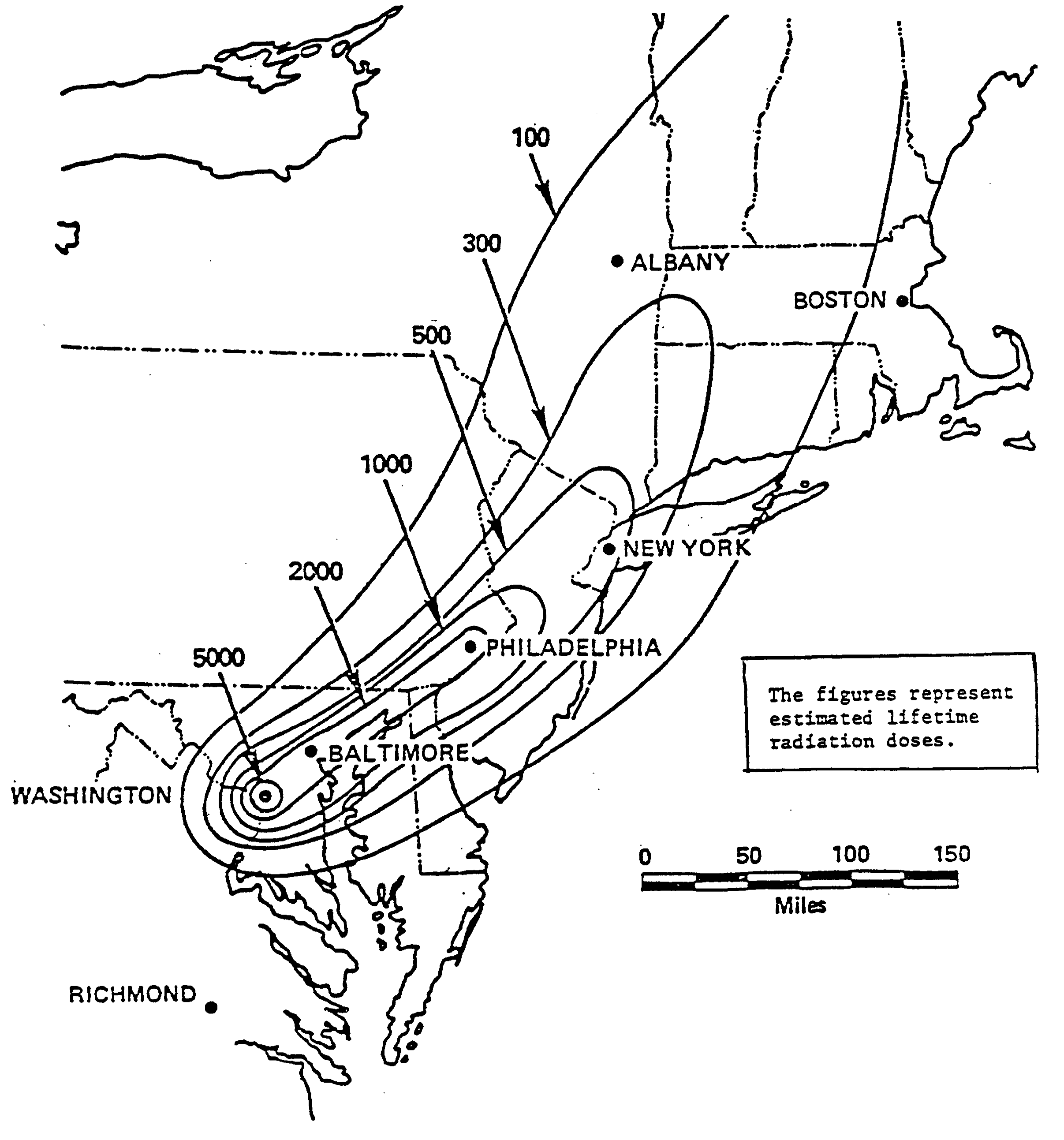
– – – – – – – – – – – – – – – – – – – – – – – – – – – – – – – – – – – – – –
1974 Annual Report to Congress
|
MULTIPROGRAM LABORATORIES |
||
|
AEC facility |
Location |
Contractor-operator |
|
Argonne National Laboratory |
Chicago, Ill. |
Univ. of Chicago and Argonne Universities Assn. |
|
Brookhaven National Laboratory |
Upton, N.Y. |
Associated Universities, Inc. |
|
Lawrence Berkeley Laboratory |
Berkeley, Ca. |
University of California |
|
Lawrence Livermore Laboratory |
Livermore, Ca. |
University of California |
|
Los Alamos Scientific Laboratory |
Los Alamos, N. Mex. |
University of California |
|
Oak Ridge National Laboratory |
Oak Ridge, Tenn. |
Nuclear Div., Union Carbide Corp. |
|
Pacific Northwest Laboratory |
Richland, Wash. |
Pacific Northwest Div. Battelle Memorial Inst. |
|
ENGINEERING DEVELOPMENT |
||
|
AEC facility |
Location |
Contractor-operator |
|
[illegible] Atomic Power Laboratory |
Pittsburgh, Pa. |
Westinghouse Electric Corp. |
|
Harvard Engineering Development Lab |
Richland, Wash. |
Westinghouse Hanford Co. |
|
[illegible] Atomic Power Laboratory |
Schenectady, N.Y. |
General Electric Co. |
|
Liquid Metal Engineering Center |
Santa Susana, Ca. |
Atomics International Div., Rockwell Int'l Corp. |
|
Idaho National Engineering Lab |
Idaho Falls, Id. |
Aerojet Nuclear Co. |
|
Naval Reactors Facility, INEL |
Idaho Falls, Id. |
Westinghouse Electric Corp. |
|
Sandia Laboratories |
Albuquerque, N. Mex. & Livermore, Ca. |
Sandia Corp. (Western Electric-Bell System) |
|
Savannah River Laboratory |
Aiken, S.C. |
E.I. du Pont de Nemours & Co |
|
Shippingport Atomic Power Station |
Shippingport, Pa. |
Duquesne Light Co. |
|
SPECIALIZED PHYSICAL RESEARCH LABORATORIES |
||
|
AEC facility |
Location |
Contractor-operator |
|
Ames Laboratory |
Ames, Iowa |
Iowa State U. of Sci. & Tech. |
|
Fermi National Accelerator Laboratory |
Batavia, Ill. |
Universities Research Assn. |
|
Notre Dame Radiation Lab |
South Bend, Ind. |
Univ. of Notre Dame |
|
Princeton Plasma Physics Lab |
Princeton, N.J. |
Princeton University |
|
Stanford Linear Accelerator Center |
Palo Alto, Ca. |
Stanford University |
|
SPECIALIZED BIOMEDICAL RESEARCH LABORATORIES |
||
|
AEC facility |
Location |
Contractor-operator |
|
Comparative Animal Research Laboratory |
Oak Ridge, Tenn. |
University of Tennessee |
|
Franklin McLean Memorial Research Inst. (formerly Argonne Cancer Res. Hosp.) |
Chicago, Ill. |
University of Chicago |
|
Inhalation Toxicology Res. Inst. |
Albuquerque, N. Mex. |
Lovelace Foundation of Medical Education and Research |
|
Laboratory of Nuclear Medicine & Radiobiology |
Los Angeles, Ca. |
Univ. of Calif. at L.A. (UCLA) |
|
Laboratory of Radiobiology |
San Francisco, Ca. |
Univ. of Calif. Medical Center |
|
MSU/AEC Plant Research Lab |
E. Lansing, Mich. |
Michigan State University |
|
ORAU Research Facilities |
Oak Ridge, Tenn. |
Oak Ridge Associated Universities |
|
Puerto Rico Nuclear Center |
Mayaguez and Rio Piedras, P.R. |
University of Puerto Rico |
|
Radiobiology Laboratory |
Davis, Calif. |
University of Calif. (Davis) |
|
Radiobiology Laboratory |
Salt Lake City, Utah |
University of Utah |
|
Savannah River Ecology Lab |
Aiken, S.C. |
University of Georgia |
|
U. of Rochester Med. Lab |
Rochester, N.Y. |
University of Rochester |
|
PRODUCTION, DEVELOPMENT, AND FABRICATION CENTERS |
||
|
AEC facility |
Location |
Contractor-operator |
|
Burlington-AEC Plant |
Burlington, Iowa |
Mason & Hanger-Silas Mason Co., Inc. |
|
Feed Materials Plant |
Ashtabula, Ohio |
Reactive Metals, Inc. |
|
Feed Materials Plant |
Fernald, Ohio |
National Lead Co. |
|
Feed Materials Plant |
Paducah, Ky |
Nuclear Div., Union Carbide Corp. |
|
Hanford Works |
Richland, Wash |
Atlantic-Richfield Hanford Co. and United Nuclear, Inc. |
|
Idaho Chemical Processing Plant |
INEL, Idaho |
Allied Chemical Corp. |
|
Kansas City Plant |
Kansas City, Mo |
Bendix Corp. |
|
Mound Laboratory |
Miamisburg, Ohio |
Monsanto Research Corp. |
|
Nevada Test Site |
Mercury, Nev |
Reynolds Electrical & Engineering Co.; EG&G, Inc.; and Holmes & Narver Inc. |
|
Oak Ridge Gaseous Diffusion Plant |
Oak Ridge, Tenn |
Nuclear Div., Union Carbide Corp. |
|
Paducah Gaseous Diffusion Plant |
Paducah, Ky |
Nuclear Div., Union Carbide Corp. |
|
Portsmouth Gaseous Diffusion Plant |
Portsmouth, Ohio |
Goodyear Atomic Corp. |
|
Pantex Plant |
Amarillo, Texas |
Mason & Hanger-Silas Mason Co. Inc. |
|
Pinellas Plant |
Clearwater, Fla |
General Electric Co. |
|
Rocky Flats Plant |
Golden, Colo |
Atomics International Div. Rockwell International Corp. |
|
Savannah River Plant |
Aiken, S.C |
E.I. du Pont de Nemours & Co. |
|
Y-12 Plant |
Oak Ridge, Tenn |
Nuclear Div., Union Carbide Corp. |
– – – – – – – – – – – – – – – – – – – – – – – – – – – – – – – –
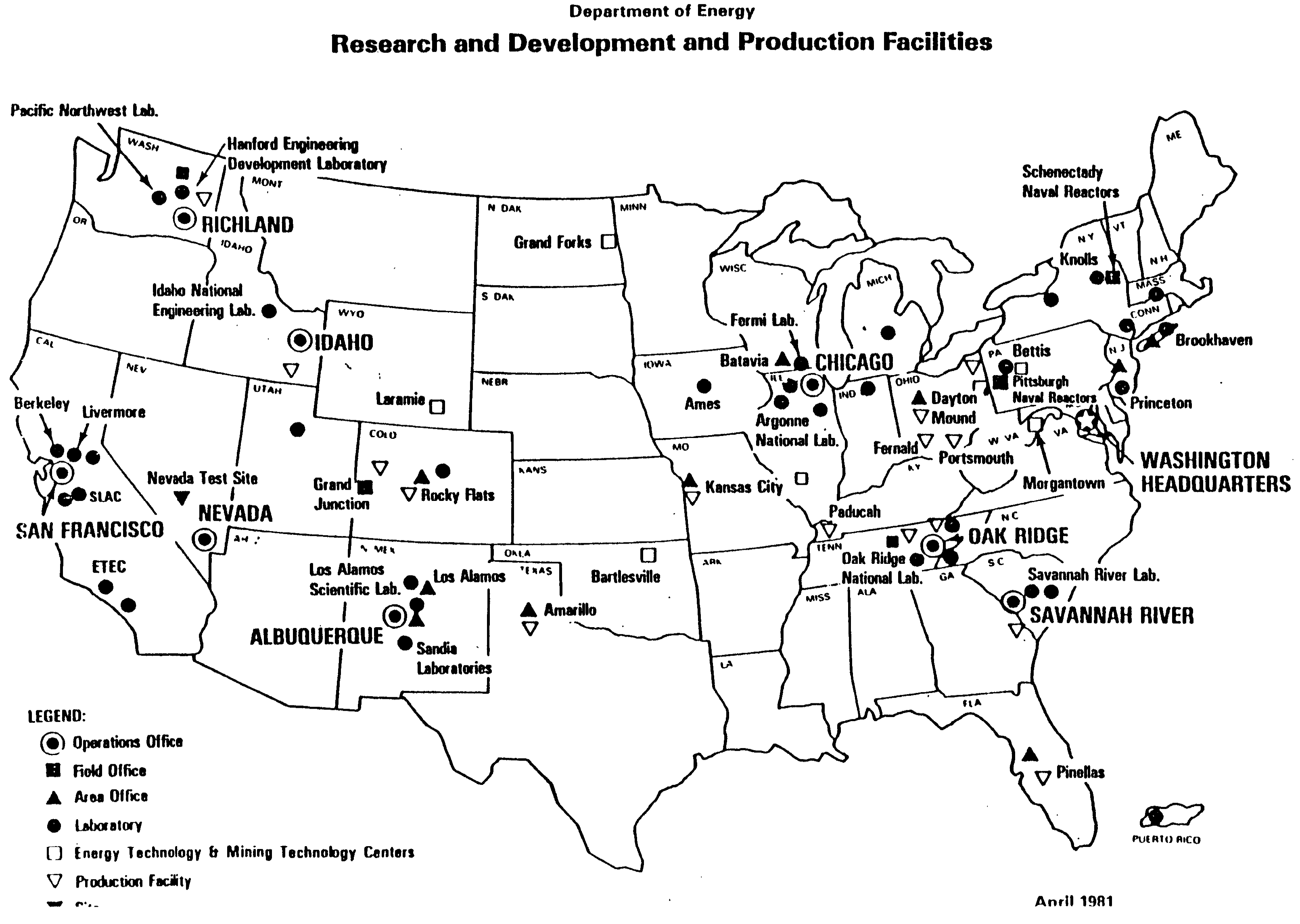
– – – – – – – – – – – – – – – – – – – – – – – – – – – – – – – –
|
U.S. Government Investment in the Atomic
Energy Program |
|
|
Appropriation Expenditures: |
(in millions) |
|
National Defense Research Council |
$ 0.5 |
|
Office of Scientific Research and Development |
14.6 |
|
War Department (including Manhattan Engineer District) |
2,218.3 |
|
|
2,233.4 |
|
Atomic Energy Commission: |
(in millions) |
|
Fiscal years prior to 1966 |
34,643.8 |
|
Fiscal year 1966 |
2,402.9 |
|
Fiscal year 1967 |
2,263.7 |
|
Fiscal year 1968 |
2,466.6 |
|
Fiscal year 1969 |
2,450.4 |
|
Fiscal year 1970 |
2,455.0 |
|
Fiscal year 1971 |
2,274.7 |
|
Fiscal year 1972 |
2,392.1 |
|
Fiscal year 1973 |
2,393.1 |
|
Fiscal year 1974 |
2,307.5 |
|
Fiscal Year 1975 (through January 18) |
1,512.6 |
|
Total AEC |
57,562.4 |
|
Total Appropriation Expenditures |
59,795.8 |
|
Unexpended Balance of Funds in U.S. Treasury January 18, 1975 |
3,439.9 |
|
Total Funds Appropriated |
63,235.7 |
|
Less: |
|
|
Collections paid to U.S. Treasury |
58.0 |
|
Property and services transferred to other Federal agencies without reimbursement, net of such transfers received from other Federal agencies |
462.0 |
|
Cost of operations from June 1940 through January 18, 1975 |
46,562.2 |
|
AEC Equity at January 18, 1975 as shown on Balance Sheet |
$16,153.5 |
– – – – – – – – – – – – – – – – – – – – – – – – – – – – – – – –
Joint Committee on Atomic Energy |
|
|
CHAIRMEN |
DATES OF SERVICE |
|
Brien McMahon |
1946 - |
|
Burke B. Hickenlooper |
1947 - 1948 |
|
Brien McMahon |
1949 - 1952 (d. 7/28/52) |
|
Carl T. Durham (Acting) |
1952 - |
|
W. Sterling Cole |
1953 - 1954 |
|
Clinton P. Anderson |
1954 - 1956 |
|
Carl T. Durham |
1956 - 1958 |
|
Clinton P. Anderson |
1959 - |
|
Chet Holifield |
1960 - 1961 |
|
John O. Pastore |
1962 - 1964 |
|
Chet Holifield |
1965 - 1966 |
|
John O. Pastore |
1967 - 1968 |
|
Chet Holifield |
1969 - 1970 |
|
John O. Pastore |
1970 - 1972 |
|
Melvin Price |
1973 - |
Military Liaison Committee |
|
|
CHAIRMEN |
DATES OF SERVICE |
|
Lt. Gen. Lewis H. Brereton, USAF |
1946 - 1948 |
|
Donald F. Carpenter |
1948 - |
|
William Webster |
1948 - 1949 |
|
Robert F. LeBaron |
1949 - 1954 |
|
Herbert B. Loper |
1954 - 1960 |
|
Gerald W. Johnson |
1961 - 1962 |
|
W.J. Howard |
1963 - 1965 |
|
Carl Walske |
1966 - 1972 |
|
Donald R. Cotter |
1973 - |
General Advisory Committee |
|
|
CHAIRMEN |
DATES OF SERVICE |
|
J. Robert Oppenheimer |
1946 - 1952 |
|
Isidor I. Rabi |
1952 - 1956 |
|
Warren C. Johnson |
1956 - 1959 |
|
Kenneth S. Pitzer |
1960 - 1961 |
|
Manson Benedict |
1962 - 1963 |
|
L.R. Hafstad |
1964 - 1967 |
|
Norman F. Ramsey |
1968 - |
|
Howard G. Vesper |
1969 - 1972 |
|
Lombard Squires |
1973 - |
AEC Commissioners |
||
|
|
From |
To |
|
Sumner T. Pike |
Oct. 31, 1946 |
Dec. 15, 1951 |
|
David E. Lilienthal, Chairman |
Nov. 1, 1946 |
Feb. 15, 1950 |
|
Robert F. Bacher |
Nov. 1, 1946 |
May 10, 1949 |
|
William W. Waymack |
Nov. 5, 1946 |
Dec. 21, 1948 |
|
Lewis L. Strauss |
Nov. 12, 1946 |
Apr. 15, 1950 |
|
-------Chairman |
July 2, 1953 |
June 30, 1958 |
|
Gordon Dean |
May 24, 1949 |
June 30, 1953 |
|
-------Chairman |
July 11, 1950 |
June 30, 1953 |
|
Henry DeWolf Smyth |
May 30, 1949 |
Sept. 30, 1954 |
|
Thomas E. Murray |
May 9, 1950 |
June 30, 1957 |
|
Thomas Keith Glennan |
Oct. 2, 1950 |
Nov. 1, 1952 |
|
Eugene M. Zuckert |
Feb. 25, 1952 |
June 30, 1954 |
|
Joseph Campbell |
July 27, 1953 |
Nov. 30, 1954 |
|
Willard F. Libby |
Oct. 5, 1954 |
June 30, 1959 |
|
John Von Neumann |
Mar. 15, 1955 |
Feb. 8, 1957 |
|
Harold S. Vance |
Oct. 31, 1955 |
Aug. 31, 1959 |
|
John S. Graham |
Sept. 12, 1957 |
June 30, 1962 |
|
John Forrest Floberg |
Oct. 1, 1957 |
June 23, 1960 |
|
John A. McCone, Chairman |
July 14, 1958 |
Jan. 20, 1961 |
|
John H. Williams |
Aug. 13, 1959 |
June 30, 1960 |
|
Robert E. Wilson |
Mar. 22, 1960 |
Jan. 31, 1964 |
|
Loren K. Olson |
June 23, 1960 |
June 30, 1962 |
|
Glenn T. Seaborg, Chairman |
Mar. 1, 1961 |
Aug. 16, 1971 |
|
Leland J. Haworth |
Apr. 17, 1961 |
June 30, 1963 |
|
John G. Palfrey |
Aug. 31, 1962 |
June 30, 1966 |
|
James T. Ramey |
Aug. 31, 1962 |
June 30, 1973 |
|
Gerald F. Tape |
July 15, 1963 |
Apr. 30, 1969 |
|
Mary I. Bunting |
June 29, 1964 |
June 30, 1965 |
|
Wilfred E. Johnson |
Aug. 1, 1966 |
June 30, 1972 |
|
Samuel M. Nabrit |
Aug. 1, 1966 |
Aug. 1, 1967 |
|
Francesco Costagliola |
Oct. 1, 1968 |
June 30, 1969 |
|
Theos J. Thompson |
June 12, 1969 |
Nov. 25, 1970 |
|
Clarence E. Larson |
Sept. 2, 1969 |
June 30, 1974 |
|
James R. Schlesinger, Chairman |
Aug. 17, 1971 |
Jan. 26, 1973 |
|
William O. Doub |
Aug. 17, 1971 |
Aug. 17, 1974 |
|
Dixy Lee Ray |
Aug. 8, 1972 |
|
|
-------Chairman |
Feb. 6, 1973 |
Jan. 18, 1975 |
|
William E. Kriegsman |
June 12, 1973 |
Jan. 18, 1975 |
|
William A. Anders |
Aug. 6, 1973 |
Jan. 18, 1975 |
General Managers |
||
|
|
From |
To |
|
Carroll L. Wilson |
Dec. 31, 1946 |
Aug. 15, 1950 |
|
Marion Boyer |
Nov. 1, 1950 |
Oct. 31, 1953 |
|
Kenneth D. Nichols |
Nov. 1, 1953 |
Apr. 30, 1955 |
|
Kenneth F. Fields |
May 1, 1955 |
June 30, 1958 |
|
Paul F. Foster |
July 1, 1958 |
Nov. 30, 1958 |
|
A. R. Luedecke |
Dec. 1, 1958 |
July 31, 1964 |
|
R. E. Hollingsworth |
Aug. 11, 1964 |
Dec. 31, 1973 |
|
John A. Erlewine |
Feb. 15, 1974 |
Dec. 31, 1974 |
DIRECTORS OF THE DIVISION OF MILITARY APPLICATION |
|
|
Brig. General James McCormack, Jr., USAF |
February 1, 1947- August 19, 1951 |
|
Brig. General Kenneth E. Fields, USA |
August 20, 1951- April 30, 1955 |
|
Maj. General Alfred D. Starbird, USA |
July 1, 1955- January 25, 1961 |
|
Maj. General Austin W. Betts, USA |
January 26, 1961- February 14, 1964 |
|
Brig. General Delmar L. Crowson, USAF |
February 17, 1964- June 30, 1967 |
|
Maj. General Edward B. Giller, USAF [*] [+] |
July 1, 1967 - June 30, 1972 |
|
Maj. General Frank A. Camm, USA [*] |
July 1, 1972- November 23, 1973 |
|
Maj. General Ernest Graves, USA [*] |
December 15, 1973- September 21, 1975 |
|
Maj. General Joseph K. Bratton, USA |
September 22, 1975- August 17, 1979 |
|
Maj. General William W. Hoover, USAF |
September 13, 1979 – |
|
* – Also held the title of Assistant General Manager for Military Application while serving as division director. * – Also held the title of Assistant General Manager for National Security while serving as division director. |
|