|
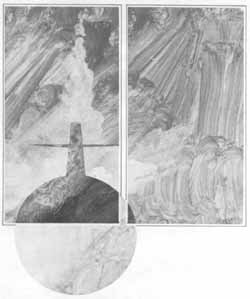
Originally from Frank C. Odell’s [now defunct] webpage at http://www.reocities.com/fodellsea/fbmhistory1.html MY (Frank C. Odell’s) INVOLVEMENT WITH FBM The FBM fleet has been the pivotal point of the Odell family for 34 years. I was not in the Navy, but worked as a civilian contractor concerned with the Instrumentation and Telemetry systems installed aboard the submarines. This employment began in 1962 and continued through 1996. Think SITP/SOTP, DASO, OT/FOT, CET/FCET, Sea Trials and shipyard availability's. Five years teaching in the Naval Ordnance Test Unit's Advanced Electronics School. The school is located on Cape Canaveral Air Station, Florida. My last five years on the program were on USNS RANGE SENTINEL, a surface ship sailing out of Port Canaveral, Florida, in support of submarine operations. Primary interest while aboard RANGE SENTINEL was using Sonar techniques for underwater navigation and submarine tracking. I am proud to have been in the Sonar Tribe. Interstate Electronics, Corp. (IEC) was my employer for over 34 years and I filled many different positions during that time. Technical Instructor, Technical Writer, Liaison Engineer and Field Service Engineer describes some of the positions I have filled. My career assignments with IEC were a wonderful spread of work positions and locations. My family has traveled over most of the United States America as a direct result of my employment. IEC was sold to L3 during the month of May 1999. Don Switzler, retired IEC, maintains a data base of retired IEC and others of the FBM project family. His knowledge extends from The Program to persons working on other projects the company was involved with. - - - - - - I worked on all "41 For Freedom" submarines and found that each had a different personality. Some standout in my mind more than the others because of some activity or event. One such is the George Fish, AKA, SSBN 598 USS GEORGE WASHINGTON. During an overhaul period in the Charleston Naval Shipyard the Fish became the object of a much extended overhaul. We were finally ready to go to sea at 02-dark-30 hours one morning when a Depth Control Tank (DCT) noisily changed shape while it was the subject of a last minute, pre-sea run, pressure test (or perhaps a bubble burst). Two shipyard engineers came aboard and inspected the tank and pronounced it safe to go to sea. After listening to the two engineers the Commanding Officer (CO) told the two engineers that they could not return to shore and would ride the ship with us. Also, they were told that they would be setting beside the DCT when we used it to hover. The two engineers had a long detailed re-discussion about the problem before agreeing to go with us. Happily they were correct in their estimation that the tank was really safe to use. [Launch picture] A Trident airframe departing for a trip downrange. This is a test firing from a submerged submarine off the coast of Florida. The Test Instrumentation (TI) mast can be seen to the right of the departing missile. The TI mast allows radio and telemetry communications with the submarine while it is submerged. The submarine runs just below the surface of the ocean, so the top of the mast is above the surface of the water. Radio waves do not travel well below the surface of the ocean, so the mast is necessary. Telemetry signals from the missile, while it is still in the missile tube on the submarine, are transmitted through the mast to the Launch Area Support Ship (LASS). LASS equipment records the signals and retransmits them via satellite to the USAF Range Operation Control Center (ROCC) located on Cape Canaveral Air Station (CCAS), Cape Canaveral, Florida. This provides calibration signals to the ROCC equipment before the missile is launched. It also provides data to the ROCC to validate range safety capability prior to the launch. Because of the curve of the earth signals from a just launched missile can not be transmitted directly the ROCC. During this short time period, immediately after the missile is launched, the LASS receives the in-flight signals from the missile records them and sends them, via satellite, to the ROCC to provide for continued Range Safety considerations. When the missile launching operations are completed the TI mast is removed from the submarine. It would not do to have a TI mast mounted on the submarine when it departs Kingsbay, Georgia for patrol duty. What looks like smoke is a combination of fire, smoke and steam. The acceleration of the airframe is shocking to a first time viewer. While I have seen many launches the immediate acceleration of the missile, as it leaves the water, still surprises me. [REB picture] After completing most of the trip down range aboard the Poseidon missile body, the Re-Entry Bodies (REB) are released and are sent on their way. REB is an outdated term, but it shall be used here anyway. This picture is of a normal test shot so the REBs are just simulated bombs. The REBs are traveling very fast as they reenter the earth's atmosphere. The very high reentry speed causes the REBs to become heated as they race to their targets. The air that the REBs pass through also becomes heated and both the REBs and the heated air are visible to the Inferred (IR) film used to capture this image. The white streaks on the IR photograph is caused by the heated air and the heated REBs are visible at the lower end of the lines. The REBs will contact the surface of the ocean well off the coast of West Central Africa, thereby ending the test firing. The bubbles on the left of the picture are celestial bodies that have nothing to do with the test; they are just there. Few people have been close enough to the impact site to see this view. |
Most of the information on these pages was selected from a SSP publication circa 1978. The booklet was distributed to inform the public about SP and SSP's role in the Fleet Ballistic Missile Program. The book is in the public domain.
Special Projects (SP) Became Strategic Systems Projects (SSP)
DETERRENCE
The Nation's mix of strategic deterrent weapons has a purpose unique in the history of warfare: To prevent nuclear war.
The Fleet Ballistic Missile FBM Weapon System is the Navy's major contribution to this mix. Hidden, mobile, ready, a fleet of nuclear powered submarines, each carrying 16 nuclear tipped POLARIS or POSEIDON missiles, ranges the oceans of the world, assuring a potential enemy that, should he launch a nuclear attack on the United States, he would receive a devastating nuclear blow in response. He is thus deterred from initiating a nuclear exchange.
THE SYSTEM
The United States Navy's Fleet Ballistic Missile Weapon System, better known by the name of its missile, POLARIS, has been operational since 15 November 1960. On that date, the first FBM submarine, USS GEORGE WASHINGTON (SSBN 598) deployed on patrol with a full load of 16 tactical missiles.
In addition to missiles and submarines, the FBM system covers the entire aspect of activities from research, development, building of hardware, training of crews, and construction of facilities, through the continued operational support of the deployed weapons systems. Operational FBM submarines in the Atlantic are under control of the Commander in Chief, U.S. Atlantic Command, who exercises his authority through the Commander in Chief, U.S. Atlantic Fleet, and Commander Submarine Force, U. S. Atlantic Fleet. FBM submarines in the Pacific are under the control of the Commander in Chief, U.S. Pacific Command, who exercises his authority through the Commander in Chief, U.S. Pacific Fleet, and Commander Submarine Force, U.S. Pacific Fleet.
Selection of targets and their assignment to operational FBM submarines are under the control of the Joint Chiefs of Staff.
System development and production are managed for the Navy by the Director of Strategic Systems Projects, Rear Admiral Robert II. Wertheim. Assisting him is an imposing team of Navy missile experts, scientific leaders, universities and more than 20,000 industrial contractors and government agency personnel.
STATUS OF SYSTEM
All 41 ships of the authorized FBM submarine force have been on operational patrol. The 41st, USS WILL ROGERS (SSBN 659) was commissioned on 1 April 1967 and deployed on patrol on 3 October 1967. The first 10 submarines (598 and 608 Class) carry the POLARIS missile on operational patrol. Subsequently, the other 31 POLARIS SSBNs have been returned to the United States, and refitted to carry the longer range POSEIDON C-3 missile, which has been deployed in FBM submarines since March 1971. All 31 of the Navy's 41 FBM submarines scheduled to be converted to carry the POSEIDON C-3 have been completed.
Thirty-one FBM submarines are assigned to the Atlantic Fleet and 10 to the Pacific Fleet.
THE BRITISH POLARIS PROJECT
The joint United States/United Kingdom program established by the Polaris Sales Agreement was a direct result of the now historic meeting at Nassau in December 1962 between President Kennedy and Prime Minister MacMillan. Strategic Systems Project Office (SSPO) has additional responsibilities related to the British Polaris Force.
Under the terms of the Sales Agreement, the U.S. has sold Polaris missiles (less warhead) to the U.K. In addition to the missiles, the subsystems which make up the weapon system were also sold. The British have built their own nuclear powered submarines to house the weapon system, and provided their own warheads. The U.K. deterrent force consists of 4 Polaris submarines, each carrying 16 nuclear Polaris A-3 missiles.
The Director, Strategic Systems Projects, is the U.S. project officer for this program. Rear Admiral Sir David Scott, KBE, CB, the Chief Polaris Executive (Royal Navy), is the British project officer. A small British staff is assigned to SSPO and a US liaison from SSPO has been assigned to duty in the British Ministry of Defence to assure prompt and effective support to the U.K. Polaris program. A joint Steering Task Group, chaired by the Admirals in turn, meets alternately in London and Washington three times a year.
December 13, 1969 marked the end of the initial outfitting period. At that time the U.K. had their operating base at Faslane built and all four Polaris submarines accepted for service. These British designed submarines were built in the North of England, two at the Barrow Shipyard of Vickers shipbuilding Group and two at Cammell Lairds of Birkenhead. The first U.K. submarine, HMS RESOLUTION, was launched in September 1966 and visited Cape Canaveral in February and early March 1968, where both Port and Starboard Crews successfully launched a Polaris A-3 missile into a downrange target area. RESOLUTION made her first deterrent patrol in June 1968. HMS RENOWN was launched in February 1967. HMS REPULSE was launched in November 1967, and HMS REVENGE in March 1968. After routine overhauls, each returns to fire missiles on the U.S. Eastern Test Range.
Similar in size to the USS LAFAYETTE, the British submarines have the distinctive whale-like hull form the British have already adopted for their first generation nuclear hunter/killer submarines, with the diving planes positioned on either side of the bow and not on either side of the sail as the U.S. FBM submarines. The submarines are powered by British pressurized-water nuclear reactors built by Rolls-Royce and Associates of Derby. Each submarine is equipped with 16 nuclear tipped missiles.
The force operates from a modern, specially designed submarine base at Faslane on the Clyde in Scotland, with an associated Armament Depot at nearby Coulport. Located on the base, which includes accommodations, recreational facilities, and amenities to the most modern standards, is the Royal Navy's Polaris Weapon System School, commissioned 30 June 1966.
CONCEPT
With almost unlimited cruising range and with endurance limited only by the crew, the FBM nuclear submarine is capable of extended submerged operations in the international waters of the world which comprise about 70 percent of the earth's surface. Free of the need to surface or extend a snorkel above the surface for continuous operation, FBM nuclear submarines remain hidden by an oceanic curtain, their locations unknown to any potential enemy. The POLARIS/POSEIDON missiles, powered by a solid propellant rocket motor, are ready for launch within minutes of receiving the command, without the need for a long countdown. Authority for launch command rests with the President. Mobile, hidden, ready for Instant action (or carefully delayed action), the FBM system provides the U.S. a powerful deterrent against a global war.
POLARIS, named for the North Star, is a two-stage ballistic missile, powered by solid fuel rocket motors and guided by a self-contained inertial guidance system independent of external commands or control. There is currently one generation of POLARIS, the A-3.
POLARIS A-1 was officially retired from active duty when USS ABRAHAM LINCOLN (SSBN 602), the last of the first five SSBNs to carry it, returned to the United States on 14 October 1965 for her initial overhaul and conversion to A-3.
A-2 was officially retired from the Fleet when USS THOMAS JEFFERSON (SSBN 618) returned to the United States on 3 June 1974 for her initial overhaul and conversion to A-3.
The first successful underwater launching of a POLARIS test vehicle from a submarine was conducted by the first POLARIS submarine, USS GEORGE WASHINGTON (SSBN 598) on 20 July 1960, while cruising submerged off Cape Canaveral, Florida. Less than 3 hours later, she successfully launched a second POLARIS missile, to bring to fruition a remarkable Navy-Industry research and development effort begun only 4 years earlier.
On 6 May 1962, USS ETHAN ALLEN (SSBN 608), operating in the Pacific as a unit of Joint Task Force 8, successfully fired a POLARIS missile with a nuclear warhead. Successful nuclear detonation was achieved.
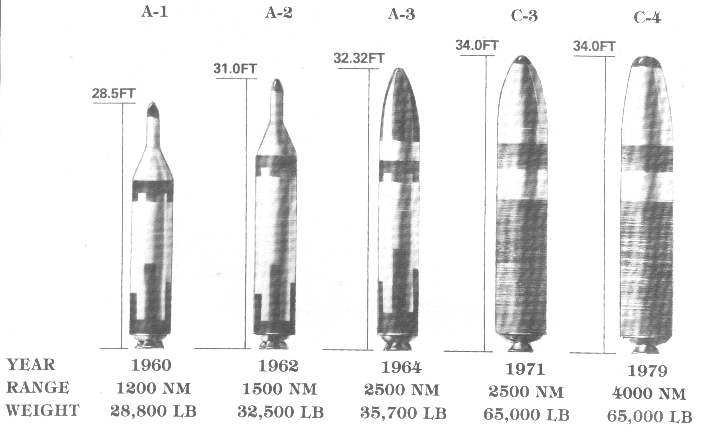
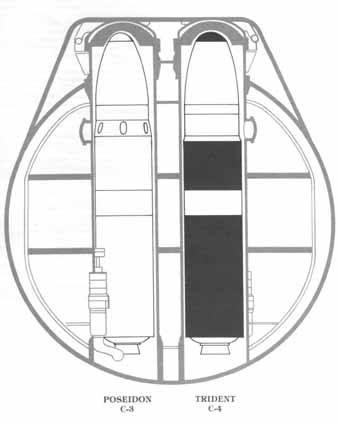
POSEIDON, which has its roots in POLARIS technology, is a two-stage, solid propellant missile, capable of being launched from a submerged FBM submarine. It is 2 feet longer than the 32-foot POLARIS A-3 and is 30,000 pounds heavier. Yet, despite this increase in size the growth potential of the FBM submarines allows POSEIDON missiles to fit into the same 16 missile mount tubes that carry POLARIS.
POSEIDON is outfitted with multiple warheads, each of which can be separately targeted. This capability, known as MIRV, or Multiple, Independently Targetable Re-entry Vehicles, helps assure POSEIDON's ability to penetrate enemy defenses.
TRIDENT, the popular name given to the new sea-based, strategic weapon system, stems from Roman mythology.
Using advanced technology in propellants, electronics, and other materials, the TRIDENT-I (C-4) missile will have a much greater range than POSEDON, carrying a full payload to a range of 4,000 nautical miles and a reduced payload to even greater ranges.
Like POSEIDON, each TRIDENT missile will be equipped with MIRV, which will give it a multiple target strike capability.
|
POLARIS/POSEIDON/TRIDENT MISSILES (A-3, C-3,
C-4)
|
|||
|
|
Polaris (A-3) |
Poseidon (C-3) |
Trident-I (C4) |
|
Length |
32' |
34' |
34' |
|
Diameter |
54' |
74' |
74' |
|
Weight |
35,700 lbs. |
65,000 lbs. |
65,000 lbs. |
|
Powered Stages |
2 |
2 |
3 |
|
Motor Case Materials |
*1st Stage-Glass Fiber *2nd Stage-Glass Fiber |
1st Stage-Glass Fiber 2nd Stage-Glass Fiber |
Keviar Fiber |
|
Nozzles |
4, each stage |
1, each stage |
1, each stage |
|
Controls |
* * 1st Stage-Rotating **2nd Stage-Fluid Injection |
Single Moveable Nozzle Actuated Nozzles By a Gas Generator |
Single Moveable Nozzle Actuated By a Gas Generator |
|
Propellant |
Solid |
Solid |
Solid |
|
Guidance |
All Inertial |
All Inertial |
Stellar and Inertial |
|
Range (nominal) |
2500 NM (2880 SM) |
2500 NM (2880 SM) |
4000 NM (4600 SM) |
|
Warhead |
Nuclear |
Nuclear |
Nuclear |
|
NOTES: |
* First large ballistic missile to use glass motor case for all stages. (Small glass-fiber motor had previously flown in Vanguard Program. POLARIS was first large glass-fiber rocket motor case.) ** Devised and first flown by Nary in POLARIS development program. |
||
THE POLARIS 2,500 NAUTICAL (2,880 STATUTE) MILE RANGE OPERATIONAL A-3 MISSILE
The first launching of a POLARIS A-3 missile from a submerged submarine took place on 26 October 1963. The missile was launched from the USS ANDREW JACKSON (SSBN 619) while cruising submerged about 20 miles off Cape Canaveral. The completely successful test was followed by a successful launch of an A-2 missile from the same submarine on 16 November 1963, witnessed by President Kennedy from the USS OBSERVATION ISLAND.
POLARIS A-3 represented a significantly greater technological advance over A-2 than was A-2 over A-1. In terms of hardware design, POLARIS A-3 was approximately an 85% new missile.
The POLARIS A-3 missile became operational on 18 September 1964 when USS DANIEL WEBSTER (SSBN 626) began her initial operational patrol with 16 A-3's aboard.
The increase in range provided by A-3 leaves no land target inaccessible and at the same time gives the submarines an enormous Increase in sea room.
While POLARIS A-3 brings all targets within reach of POLARIS submarines, the effectiveness of the POLARIS system is best measured by the deterrent strength it gives our country.
THE POSEIDON 2,500 NAUTICAL (2,880 STATUTE) MILE RANGE OPERATIONAL C-3 MISSILE
Towards maximizing the effectiveness of the Navy's Fleet ballistic Missile weapon system as a deterrent to the outbreak of nuclear war, the Navy's Strategic Systems Project Office has produced the POSEIDON C-3 missile, an improved version of the POLARIS.
The POSEDON missile will be carried by 31 of the Navy's 41 FBM submarines. (The first 10 IBM submarines to be built including the 5 GEORGE WASHINGTON Class and the 9 ETHAN ALLEN Class. will not be retrofitted to POSEIDON.)
The first launching of a POSEIDON missile from a submerged submarine was successfully conducted on 3 August 1970. The missile was launched from USS JAMES MADISON (SSBN 627) while cruising submerged off the coast of Florida near Cape Canaveral.
The principal contribution of POSEIDON to weapon system effectiveness is its flexibility, which provides a capacity for delivery of multiple warheads, widely spaced, on separate targets over a variety of target footprints. The C-3 missile has a substantially larger diameter and much greater payload capacity.
The POSEIDON C-3 became operational on 31 March 1971, when USS JAMES MADISON (SSBN 627) began her initial operational patrol carrying 16 tactical POSEIDON C-3 missiles.
With MADISON's deployment, the POSEIDON missile was introduced into the nation's arsenal of operational deterrent weapons and brought to successful fruition the development program which was announced in January 1965 as a successor weapon system to POLARIS.
All of the submarines scheduled for retrofit have completed modification of launch tubes and have been outfitted with improved navigation and fire control systems.
Like POLARIS, POSEIDON acts as a deterrent to nuclear aggression, by guaranteeing inexorable nuclear retaliation.
THE TRIDENT-I 4,000 NAUTICAL (4,600 STATUTE) MILE RANGE C4 MISSILE
To offset the increasing strides in Soviet Naval ASW capability, which may in the future present a threat to the sea-based strategic forces, the TRIDENT program has been established to develop and deploy a vastly improved missile carrying nuclear submarine with a new long-range missile to ensure that the U.S. continues to possess a credible deterrent to nuclear war in the 1980's and beyond. The Director, Strategic Systems Projects, has been delegated authority for managing the strategic weapon system (missile and guidance, launcher, navigation. fire control, test instrumentation) and its interfaces with the submarine system. The strategic weapon system will be primarily characterized by a new TRIDENT-I (C-4) missile.
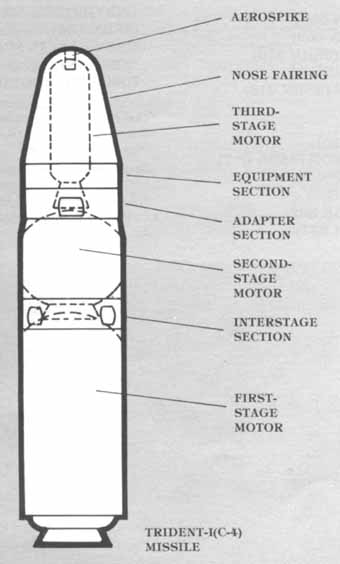
The TRIDENT-I (C-4) missile is a three-stage, solid propellant, inertially guided, submarine-launched fleet ballistic missile. It will have a range greater than the POSEIDON missile, thus providing a several-fold increase in the operational area of the U.S. submarine fleet. The C-4 will be deployed in the new TRIDENT submarine. In addition, one of the design characteristics will be a capability to be back fitted into the existing POSEIDON submarines. The new missile will be equipped with MIRV warheads. The increase in range, without a commensurate increase in the physical dimensions over the C-3 missile has been achieved through several technological advances in the following key areas: propulsion, micro-electronics, and new weight-saving materials. Missile range is controlled by trajectory-shaping with Generalized Energy Management Steering (GEMS).
In addition, TRIDENT-I also uses an extendable "aerospike" to increase its aerodynamic performance. The spike attaches to the front end of the missile and telescopes into position after launch.
The C-4 missile development flight test program commenced on 18 January 1977 when C4X-1 was launched from a flat pad at Cape Canaveral, Florida.
There are four classes of Fleet Ballistic Missile submarines. They are:
GEORGE WASHINGTON Class - about 382 feet long and about 6,700 tons.
ETHAN ALLEN Class - about 410 feet long and about 7,900 tons.
LAFAYETTE Class - about 425 feet long and about 8,250 tons.
OHIO Class - about 560 feet long and about 18,700 tons.
GEORGE WASHINGTON CLASS
[These first five carried the
POLARIS A-1. All have been converted to carry the POLARIS A-3. A-1 is
officially retired from active fleet duty.]
USS GEORGE WASHINGTON (SSBN 598)
USS PATRICK HENRY (SSBN 599)
USS THEODORE ROOSEVELT (SSBN 600)
USS ROBERT E. LEE (SSBN 601)
USS ABRAHAM LINCOLN (SSBN 602)
ETHAN ALLEN CLASS
[These submarines deployed carrying
the POLARIS A-2 missile. All five have been converted to carry the
A-3 missile. A-2 is officially retired from active fleet duty.]
USS ETHAN ALLEN (SSBN 608)
USS SAM HOUSTON (SSBN 609)
USS THOMAS A. EDISON (SSBN 610)
USS JOHN MARSHALL (SSBN 611)
USS THOMAS JEFFERSON (SSBN 618)
LAFAYETTE CLASS
[All 31 have completed conversion to
POSEIDON C-3 capability.]
USS LAFAYETTE (SSBN 616)
USS ALEXANDER HAMILTON (SSBN 617)
USS ANDREW JACKSON (SSBN 619)
USS JOHN ADAMS (SSBN 620)
USS JAMES MONROE (SSBN 622)
USS NATHAN HALE (SSBN 623)
USS WOODROW WILSON (SSBN 624)
USS HENRY CLAY (SSBN 625)
USS DANIEL WEBSTER (SSBN 626)
USS JAMES MADISON (SSBN 627)
USS TECUMSEH (SSBN 628)
USS DANIEL BOONE (SSBN 629)
USS JOHN C. CALHOUN (SSBN 630)
USS ULYSSES S. GRANT (SSBN 631)
USS VON STEUBEN (SSBN 632)
USS CASIMIR PULASKI (SSBN 633)
USS STONEWALL JACKSON (SSBN 634)
USS SAM RAYBURN (SSBN 635)
USS NATHANIAL GREENE (SSBN 636)
USS BENJAMIN FRANKLIN (SSBN 640)
USS SIMON BOLIVAR (SSBN 641)
USS KAMEHAMEHA (SSBN 642)
USS GEORGE BANCROFT (SSBN 643)
USS LEWIS AND CLARK (SSBN 644)
USS JAMES K. POLK (SSBN 645)
USS GEORGE C. MARSHALL (SSBN 654)
USS HENRY L. STIMSON (SSBN 655)
USS GEORGE WASHINGTON CARVER (SSBN 656)
USS FRANCIS SCOTT KEY (SSBN 657)
USS MARIANO G. VALLEJO (SSBN 658)
USS WILL ROGERS (SSBN 659)
|
FLEET BALLISTIC MISSILE WEAPON SYSTEM SUBMARINE CHARACTERISTICS |
||||
|
Characteristics |
598 Class |
608 Class |
616 Class |
726 Class |
|
Length |
382 feet |
410 feet |
425 feet |
560 feet |
|
Beam |
33 feet |
33 feet |
33 feet |
42 feet |
|
Surfaced Displacement |
5,900 tons |
6,900 tons |
7,320 tons |
16,600 tons |
|
Submerged Displacement |
6,700 tons |
7,900 tons |
8,250 tons |
18,700 tons |
|
Propulsion |
Steam Turbine Powered by Water Cooled Nuclear Reactors |
Same |
Same |
Same |
|
Torpedoes |
6 Bow Torpedoes Tubes |
4 Bow Torpedoes Tubes |
4 Bow Torpedoes Tubes |
4 Bow Torpedoes Tubes |
|
Officer Accommodations |
13 Berths |
12 Berths |
14 Berths |
16 Berths |
|
Enlisted |
127 Berths |
127 Berths |
133 Berths |
148 Berths |
|
Missiles |
16 POLARIS A-3 Missiles |
16 POLARIS A-3 Missiles |
16 POSEIDON C-3 Missiles |
24 TRIDENT C-4 Missiles |
|
Launch |
Tubes 16 Tubes located Midship |
Same |
Same |
24 Tubes located Midship |
|
Launch Control |
Gas Steam Generator |
Air Ejection |
Gas Steam Generator |
Gas Steam Generator |
|
Fire Control System |
MK 80 |
MK 80 |
MK 88 |
MK 98 |
|
Navigation System |
3 MK 2 MOD SINS Ships Inertial Navigation System and Navy Navigational Satellite Receiver |
2 MK 2 MOD 3 SINS and Satellite Receiver |
2 MK 2 MOD 6 SINS Satellite Receiver |
2 MK 2 MOD 7 SINS Electrostatically Supported Gyro Monitor Satellite Receiver |
|
Air Conditioning |
Over 300-ton capacity |
Same |
Same |
Same |
MISSILE GUIDANCE
The guidance system, composed of precise gyroscopes and accelerometers and its own computer, directs the missile toward a correct trajectory after launch, compensating for high winds and other effects, maintaining missile stability and triggering re-entry body separation. Separation occurs and the payload continues on the ballistic trajectory to the target. TRIDENT-I (C-4) MK 5 guidance performs all functions of the all-inertial MK 3 POSEIDON guidance plus a stellar inertial function to permit meeting comparable C-3 accuracy objectives at the longer C-4 missile range.
NAVIGATION
Two positions must be known for success in missile launching target and launcher. In the FBM system, this puts great importance on navigation since the position of the launcher is the position of the ship and is continuously changing. Several methods complement each other in the FBM submarine to provide a very high order of accuracy in determining ship's position. Heart of the system is the Ship's Inertial Navigation System (SINS), a complex system of gyroscopes, accelerometers, and computers, which relate movement and speed of the ship in all directions to true north to give a continuous report of ship position.
Systems similar to the SINS used in FBM submarines guided the NAUTILUS and SKATE on their historic voyages beneath the polar ice in 1958 and TRITON on her 84-day underwater cruise around the world in 1960.
The converted MARINER Class cargo ship USS COMPASS ISLAND (AG-153), serving as navigation test ship for the FBM program, has steamed well over 100,000 miles on development tests of the submarine navigation system to provide an all weather capability of verifying the accuracy of SINS. These include both optical and electronic (devices, all highly automated.
The TRIDENT-l (C-4) navigation subsystem is essentially the same design as that of the 616 Class POSEIDON SSBNs with the following improvements. Addition of an electrostatically supported gyro monitor (ESGM) to provide a significant increase in the allowable interval between fixes while maintaining current accuracies, thereby reducing submarine exposure; additional closed-loop air cooling; modifications for noise reduction; and re-engineering of sonar system and satellite receiver.
FIRE CONTROL
The fire control system is a large digital geoballistic computer which processes coordinated data like ship's location, local vertical, true north, and target location, and determines from these the proper trajectory for each of the missiles at any given moment. Because much of these data change in value as the ship moves about, the fire control computers can recompute all trajectories every few seconds for transfer to the missile guidance "memories."
The fire control mechanism can prepare missiles for launch at the rate of about one per minute.
COMMUNICATIONS
Very low frequency radio communications with submerged submarines have been possible for a number of years. The systems used have been (devised with special care to protect the locations of the submarines and leave the advantage of concealment unimpaired. Continuing tests repeatedly demonstrate that the Navy's world-wide communications system has the power and coverage necessary to exercise command over the always-submerged FBM submarines.
SUPPORT FACILITIES
missile testing sites, two missile assembly facilities, material expediting and requisition control offices, sub-marine tenders, missile transport ships (T-AKs), a test instrumentation ship, and a navigational test ship (AG-153).
The chief testing site is the Air Force Eastern Test Range under direct liaison with the Naval Ordnance Test Unit, Cape Canaveral, Florida. The Navy complex includes launch pads and blockhouses, missile assembly buildings, missile checkout buildings and associated supply, administration, and maintenance buildings. In addition, a Navy pier and associated port facilities at Cape Canaveral are maintained for SSBN and surface ship use.
On 16 October 1971, Operational Test Support Unit Two (OTSU2) was established. The mission of OTSU2 is to provide communications flight safety and telemetry data acquisition capabilities in support of Fleet Ballistic Missile operational flight tests in broad ocean areas. In accomplishing this mission, OTSU2 is embarked in the specially configured Operational Test Instrumentation Ship, USNS RANGE SENTINEL (TAGM-22).
The USNS RANGE SENTINEL and OTSU2 have a secondary mission as Support Ship for the POLARIS/POSEIDON Demonstration and Shakedown Operations (DASO) Program.
Cape Canaveral, Florida, has been selected as the site of the initial flight test program for the TRIDENT-I (C-4) missile and Bangor, Washington, has been selected as the location of the TRIDENT Support Site, now named Submarine Base (SUBASE), Bangor.
TRIDENT-I facilities in support of the C-4 program at the Cape, i.e., missile checkout, launch complex and guidance and technology facilities, as well as wharf and turning basin, have been completed. A complete C-4 capability exists at the Cape.
A wharf at SUBASE, Bangor, is presently under construction to provide for a TRIDENT-I missile outloads capability. Funding has been provided for missile production, operational, and support facilities.
Kings Bay, Georgia, has been selected for construction of an East Coast refit site for FBM submarines due to the need to accommodate the withdrawal of a Navy FBM submarine squadron from Rota, Spain, effective in the summer of 1979.
MISSILE LAUNCHING
POLARIS, POSEIDON, and TRIDENT missiles are launched from the submarine by an air ejection or a gas/steam generator system. On POSEIDON and TRIDENT, a small fixed rocket is ignited and its exhaust directed through cooling water into the base of the launch tube. The missile is propelled from the tube, through the water, and to the surface. At that point, the missile's first stage rocket motor ignites and sends the missile on its way. The launching system takes advantage of the reliability and instantaneous ignition characteristics of solid propellant fuel used in POLARIS. The result is increased safety for submarine and crew. Each launch tube has its own launching system independent of the other tubes. Vital parts of each missile are accessible for inspection and maintenance even when loaded in the launching tubes and while the submarine is underway at sea.
PERSONNEL AND TRAINING
Each FBM submarine has two crews, designated BLUE and GOLD, of about 140 officers and men each. While one crew mans the ship on patrol, the other crew is at home port, undergoing refresher and advanced training, taking leave, training new crew members, and in general, getting ready to go back to sea.
Each crew is made up of the highest caliber of men. Originally the main source for FBM personnel was from within the Navy. For the most part, the training required was only that needed in the specialized POLARIS field. But with the steady demand for more and more men as the POSEIDON submarine fleet has grown, and with the introduction of TRIDENT, most strategic weapon system trainees now are recruits and are the very best men our nation can make available.
A special recruiting program for high school graduates guarantees technical training and operational experience in the FBM weapon system field. For men directly concerned with POLARIS/POSEIDON/TRIDENT strategic weapon systems, initial schooling can run for about 1 year, with advanced training continuing during the off-crew periods.
Initial training is conducted at Naval Guided Missile School, Dam Neck, at Virginia Beach, Virginia. Schools for advanced and refresher training during off-crew periods are located at Groton, Connecticut; Charleston, South Carolina; Pearl Harbor, Hawaii; and Bangor, Washington.
To be able to maintain and operate the equipment, FBM personnel must be thoroughly familiar with the basic theory and fundamental physical principles involved. Trainees must grasp the basics of digital computers, inertial theory, computer logic, transistor theory, use of testing devices, and so on. Much of this kind of training is available outside the Navy only at the college level.
Like the FBM operational concept, each TRIDENT submarine will have two crews, alternating on patrols, permitting maximum on-station coverage, thus maximizing the effectiveness of the capital investment. Training for new crews and advanced training for off-line crews will be accomplished at the TRIDENT Training Facility (TRITRAFAC) at Bangor, Washington. TRIDENT training will integrate the use of tactical equipment and computer-based training technology to ensure the trainee's sound assimilation of basic theory and fundamentals of operation and maintenance of specific subsystems. Early, systematic definition of training objectives supports preparation of procedures and techniques for instruction and curricula for Courses of instruction to achieve those objectives, complemented by a personnel and training evaluation plan to provide feedback and improvement.
Fundamental to the TRIDENT strategic weapon system training concept is the capability for immediate response to the following: training deficiencies; problems in the operation, maintenance, or support of the TRIDENT weapon system; and proposed and accomplished changes in the tactical program.
The goal of this highly specialized training is to have the technician fully ready for his assigned responsibilities the day he becomes a POLARIS, POSEIDON, or TRIDENT submarine crewman. On patrol, an FBM submarine is literally a world unto itself. There is no calling for outside help. The submarine must be - and is - self-sufficient.
FLEET SUPPORT
Because of the high system performance standards required for the complete FBM weapon system, special material expediting and requisition control offices have been established to ensure complete and timely fleet support. Requisitions for material to resupply the individual submarines not available at the advance site, requisitions to support the tender repair efforts, as well as requisitions for resupply of the tender stock, are all submitted via the POLARIS Material offices (PMO), to establish positive requisition control and to ensure all materials are shipped to the site in a timely manner. Material follow-up, special expediting, shipment mode (determination, and shipment tracing are services for all FBM submarines during overhaul or conversion. PMOs are established at Charleston, S.C. and Bremerton, Washington.
SHIPYARD
CH -- Charleston Naval Shipyard, Charleston, SC
IS -- Ingalls Shipbuilding Corp., A Division of Litton Industries, Pascagoula, MS
NN -- Newport News Ship Building and Drydock Co., Newport News, VA
PS -- Puget Sound Naval Shipyard, Bremerton, WA
There are five FBM submarine tenders; four of these have been converted to POSEIDON (C-3) capability. The two AS 31 Class tenders will have a C-3 support capability only, but may be retrofitted to an A-3 only capability during a 2-month shipyard availability. The two AS 33 Class tenders will be backfitted to TRIDENT-I (C-4) capability during regularly scheduled intervals; C-3 capability will be retained. AS 19 will retain POLARIS (A-3) capability.
|
POLARIS/POSEIDON FLEET BALLISTIC MISSILE SUBMARINE STATUS
(TABLE MAY BE INCORRECT DUE TO ORIGINAL OCR ERRORS NOT BY ME) |
||||||||||
|---|---|---|---|---|---|---|---|---|---|---|
|
|
SSBN |
Bldg |
Launch |
Commission Date |
First |
Overhaul |
Second |
Overhaul |
Third |
Overhaul |
|
USS George Washington |
598 |
EB |
6-9-59 |
12-30-59 |
11-15-60 |
EB |
6-30-66 |
CH |
6-25-72 |
MI |
|
USS Patrick Henry |
599 |
EB |
9-22-59 |
4-9-60 |
12-30-60 |
EB |
12-27-66 |
PS |
7-15-72 |
MI |
|
USS Theodore Roosevelt |
600 |
MI |
2-13-61 |
10-3-59 |
-19-61 |
EB |
6-11-67 |
PS |
10-28-74 |
CH |
|
USS Robert F. Lee |
601 |
NN |
12-18-59 |
9-16-60 |
5-2-61 |
MI |
12-5-66 |
PS |
1-6-73 |
MI |
|
USS Abraham Lincoln |
602 |
PN |
5-14-60 |
3-11-61 |
8-28-61 |
EB |
8-26-67 |
MI |
8-16-74 |
MI |
|
USS Ethan Allen |
608 |
EB |
11-22-60 |
8-8-61 |
6-26-62 |
NN |
3-29-68 |
PS |
8-29-74 |
PS |
|
USS Sam Huston |
609 |
NN |
2-2-61 |
3-6-62 |
10-10-62 |
PN |
4-10-68 |
CH |
9-26-75 |
CH |
|
USS Thomas Edison |
610 |
EB |
6-15-61 |
3-10-62 |
11-7-62 |
CH |
9-22-68 |
MI |
9-15-75 |
MI |
|
USS John Marshall |
611 |
NN |
7-15-61 |
5-21-62 |
12-31-62 |
NN |
9-6-68 |
MI |
12-10-76 |
MI |
|
USS Lafayette |
616 |
EB |
5-8-62 |
4-23-63 |
1-4-64 |
NN |
5-18-69 |
EB |
6-30-75 |
EB |
|
USS Alexander Hamilton |
617 |
EB |
8-18-62 |
6-27-63 |
3-16-64 |
EB |
11-12-68 |
NN |
1-11-76 |
NN |
|
USS Thomas Jefferson |
618 |
NN |
4-24-62 |
1-4-63 |
10-28-63 |
NN |
10-29-68 |
MI |
7-14-76 |
MI |
|
USS Andrew Jackson |
619 |
MI |
9-15-62 |
7-3-63 |
4-28-64 |
PN |
1-15-70 |
EB |
5-30-76 |
EB |
|
USS John Adams |
620 |
PN |
1-12-63 |
5-12-64 |
11-3-64 |
PS |
2-25-70 |
PN |
11-20-76 |
PN |
|
USS James Monroe |
622 |
NN |
8-4-62 |
12-7-63 |
6-1-64 |
CH |
3-3-70 |
NN |
12-14-77 |
NN |
|
USS Nathan Hale |
623 |
EB |
1-12-63 |
11-23-63 |
5-25-64 |
EB |
12-24-69 |
PS |
3-7-76 |
PS |
|
USS Woodrow Wilson |
624 |
MI |
2-22-63 |
12-27-63 |
7-2-64 |
NN |
1-5-70 |
NN |
8-3-76 |
NN |
|
USS Henry Clay |
625 |
NN |
11-30-62 |
2-20-64 |
8-17-64 |
CH |
8-30-70 |
PN |
|
|
|
USS Daniel Webster |
626 |
EB |
4-27-63 |
4-9-64 |
9-28-64 |
NN |
4-30-70 |
EB |
|
|
|
USS James Madison |
627 |
NN |
3-15-63 |
7-28-64 |
1-17-65 |
EB |
3-31-71 |
EB |
|
|
|
USS Tecumseh |
628 |
EB |
6-22-63 |
5-29-64 |
1-24-65 |
NN |
9-22-71 |
NN |
|
|
|
USS Daniel Boone |
629 |
MI |
6-22-63 |
4-23-64 |
12-25-64 |
NN |
4-26-71 |
NN |
|
|
|
USS John C. Calhoun |
630 |
NN |
6-22-63 |
9-15-64 |
3-22-65 |
MI |
9-16-71 |
MI |
|
|
|
USS Ulysses S. Grant |
631 |
EB |
11-2-63 |
7-17-64 |
2-6-65 |
PS |
7-11-71 |
PS |
|
|
|
USS Von Steuben |
632 |
NN |
10-18-63 |
9-30-64 |
3-28-65 |
EB |
5-21-71 |
EB |
|
|
|
USS Casimir Pulaski |
633 |
EB |
2-1-64 |
8-14-64 |
3-6-65 |
EB |
10-27-71 |
EB |
|
|
|
USS Stonewall Jackson |
634 |
MI |
11-30-63 |
8-26-64 |
4-9-65 |
EB |
4-26-72 |
EB |
|
|
|
USS Sam Rayburn |
635 |
NN |
12-30-63 |
12-2-64 |
6-4-65 |
PN |
3-7-72 |
PN |
|
|
|
USS Nathanael Greene |
636 |
PN |
5-12-64 |
12-19-64 |
6-21-65 |
NN |
3-26-72 |
NN |
|
|
|
USS Benjamin Franklin |
640 |
EB |
12-5-64 |
10-22-65 |
5-7-66 |
EB |
12-1-72 |
EB |
|
|
|
USS Simon Bolivar |
641 |
NN |
8-22-64 |
10-29-65 |
4-27-66 |
NN |
11-16-72 |
NN |
|
|
|
USS Kamehameha |
642 |
Ml |
1-16-65 |
12-10-65 |
8-6-66 |
EB |
6-9-73 |
EB |
|
|
|
USS George Bancroft |
643 |
EB |
3-20-65 |
1-22-66 |
7-26-66 |
PN |
2-18-73 |
PN |
|
|
|
USS Lewis and Clark |
644 |
NN |
11-21-64 |
12-22-65 |
6-23-66 |
PS |
4-8-73 |
PS |
|
|
|
USS James K. Polk |
645 |
EB |
5-22-65 |
4-16-66 |
10-14-66 |
NN |
5-29-73 |
NN |
|
|
|
USS George C. Marshall |
654 |
NN |
5-21-65 |
4-29-66 |
10-25-66 |
PS |
9-2-73 |
PS |
|
|
|
USS Henry L. Stimson |
655 |
EB |
11-13-65 |
8-20-66 |
2-23-67 |
NN |
9-26-73 |
NN |
|
|
|
USS George Washington Carver |
656 |
NN |
8-14-65 |
6-15-66 |
12-12-66 |
EB |
10-13-73 |
EB |
|
|
|
USS Francis Scott Key |
657 |
EB |
4-23-66 |
12-3-66 |
6-6-67 |
PS |
12-10-73 |
PS |
|
|
|
USS Mariano G. Vallejo |
658 |
Ml |
10-23-65 |
12-16-66 |
7-31-67 |
NN |
7-12-74 |
NN |
|
|
|
USS Will Rogers |
659 |
EB |
7-21-66 |
4-1-67 |
10-8-67 |
PN |
9-22-74 |
PN |
|
|
FBM TENDERS |
||||
|
|
Bldg Yard |
Launch Date |
Commission Date |
Initial Deployment Date |
|
USS PROTEUS (AS 19) |
CH |
Conversion |
8/8/60 |
2/21/61 |
|
USS HUNLEY (AS 31) |
NN |
9/29/61 |
6/16/62 |
12/29/62 |
|
USS HOLLAND (AS 32) |
IS |
1/19/63 |
9/07/63 |
3/21/64 |
|
USS SIMON LAKE (AS 33) |
PS |
2/08/64 |
11/07/64 |
7/28/65 |
|
USS CANOPUS (AS 34) |
IS |
2/12/65 |
11/04/65 |
6/23/66 |
USS GEORGE WASHINGTON (SSBN 598)
Mrs. Robert B. Anderson
USS PATRICK HENRY (SSBN 599)
Mrs. Leslie C. Arends
USS THEODORE ROOSEVELT (SSBN 600)
Mrs. Alice Roosevelt
Longworth
USS ROBERT E. LEE (SSBN 601)
Mrs. Hanson E. Ely
USS ABRAHAM LINCOLN (SSBN 602)
Mrs. Mary Lincoln Beekwith
USS ETHAN ALLEN (SSBN 608)
Mrs. Robert H. Hopkins
USS SAM HOUSTON (SSBN 609)
Mrs. John P. Connally
USS THOMAS A. EDISON (SSBN 610)
Mrs. Madeleine Edison Stone
USS JOHN MARSHALL (SSBN 611)
Mrs. Robert F. Kennedy
USS LAFAYETTE (SSBN 616)
Mrs. John F. Kennedy
USS ALEXANDER HAMILTON (SSBN 617)
Mrs. Valentine Hollingsworth,
Jr.
USS THOMAS JEFFERSON (SSBN 618)
Mrs. Robert S. McNamara
USS ANDREW JACKSON (SSBN 619)
Mrs. Estes Kefauver
USS JOHN ADAMS (SSBN 620)
Mrs. James C. Manny
USS JAMES MONROE (SSBN 622)
Mrs. Roswell Gilpatrick
USS NATHAN HALE (SSBN 623)
Mrs. George W. Anderson
USS WOODROW WILSON (SSBN 624)
Miss Eleanor Axson Sayre
USS HENRY CLAY (SSBN 625)
Mrs. Green B. Gibson
USS DANIEL WEBSTER (SSBN 626)
Mrs. W. O. Goodrich, Jr.
USS JAMES MADISON (SSBN 627)
Mrs. A. S. Mike Monroney
USS TECUMSEH (SSBN 628)
Mrs. Robert L. Sikes
USS DANIEL BOONE (SSBN 629)
Mrs. James H. Wakelin, Jr.
USS JOHN C. CALHOIIN (SSBN 630)
Miss Rosalie J. Calhoun
USS ULYSSES S. GRANT (SSBN 631)
Mrs. David W. Griffiths
USS VON STEUBEN (SSBN 632)
Mrs. Fred Korth
USS CASIMIR PULASKI (SSBN 633)
Mrs. John A. Gronouski
USS STONEWALL JACKSON (SSBN 634)
Miss Julie Christian MeAfee
USS SAM RAYBURN (SSBN 635)
Mrs. S. E. Bartley and Mrs. W. A.
Thomas
USS NATHANAEL GREENE (SSBN 636)
Mrs. Neander W. Wade
USS BENJAMIN FRANKLIN (SSBN 640)
Mrs. Leon V. Chaplin and Mrs.
Francis L. Mosley
USS SIMON BOLIVAR (SSBN 641)
Mrs. Thomas C. Mann
USS KAMEHAMEHA (SSBN 642)
Mrs. Samuel Wilder King
USS GEORGE BANCROFT (SSBN 643)
Mrs. Jean B. Langdon and Mrs.
Anita Irvine
USS LEWIS AND CLARK (SSBN 644)
Mrs. Martin F. Erigman, Jr. and
Mrs. W. Goodridge Sale
USS JAMES POLK (SSBN 645)
Mrs. Horacio Rivero, Jr.
USS GEORGE C. MARSHALL (SSBN 654)
Mrs. George C. Marshall
USS HENRY L. STIMSON (SSBN 655)
Mrs. Thomas J. Dodd
USS GEORGE WASHINGTON CARVER (SSBN 656)
Miss Marian Anderson
USS FRANCIS SCOTT KEY (SSBN 657)
Mrs. William T. Jarvis and
Mrs. Margery K. Thorne
USS MARIANO G. VALLEJO (SSBN 658)
Miss Patricia O. V
.MeGettigan
USS WILL ROGERS (SSBN 659)
Mrs. Hubert H. Humphrey
More than 20,000 contractors and government agency personnel are engaged in work on the FBM system. Some major contractors and government agencies are listed below.
FBM
Electric Boat Division
Submarine General Dynamics Corp.
Groton,
Connecticut
Charleston Naval Shipyard
Charleston South Carolina
Newport News Shipbuilding and Drydock Co.
Newport News,
Virginia
Mare Island Naval Shipyard
Vallejo, California
Portsmouth Naval Shipyard
Kittery, Maine
Puget Sound Naval Shipyard
Bremerton, Washington
Submarine
Westinghouse Electric Corp.
Propulsion Pittsburgh, Pennsylvania
General Electric Corp.
Lynn, Massachusetts
Navigation Autonetics Division
Rockwell International
Corp.
Anaheim, California
Sperry Systems Management Div.
Sperry Rand Corp.
Great Neck,
Long Island, New York
Communications
Sylvania Electric Products Co.
Buffalo, New York
Princeton Labs, RCA
Princeton, New Jersey
Bell Telephone Labs
Whippany, New Jersey
International Telephone and Telegraph Labs
Nutley, New Jersey
Fire Control
General Electric Co.
Ordnance Systems
Pittsfield,
Massachusetts
Hughes Aircraft Co.
Culver City, California
Naval Weapons Laboratory
Dahlgren, Virginia
Control Data Corporation
Minneapolis, Minnesota
Missile Checkout
Northrop Corp.
Anaheim, California
Launching
Westinghouse Electric Corp.
Sunnyvale, California
Missile System Manager
Lockheed Missile and Space Co.
Sunnyvale, California
Missile Propulsion
Aerojet-General Corp.
Sacramento, California
Hercules Incorporated
Wilmington, Delaware
Missile Guidance
Massachusetts Institute of Technology
Cambridge, Massachusetts
General Electric Corp.
Ordnance Systems
Pittsfield,
Massachusetts
Hughes Aircraft Corp.
Culver City, California
Minneapolis-Honeywell Regulator Co.
Minneapolis, Minnesota
Raytheon Co.
Lexington, Massachusetts
Warhead
Lawrence Livermore Lab
Atomic Energy Commission
Livermore,
California
Instrumentation
Interstate Electronics Corp.
Anaheim, California
Weapon System
Vitro Laboratories
Silver Spring, Maryland
Applied Physics Laboratory
John Hopkin's University
Silver
Spring, Maryland
18 SEPTEMBER 1955
Technological advances, particularly in warhead and inertial guidance systems, made an IRBM feasible and economically practicable. On review of the technical capabilities for United States Defense (Killian Report), the National Security Council recommended and the President approved--"that a 1800 mile ballistic missile system be developed. Both land-basing and sea-basing to be considered."
8 NOVEMBER 1955
The Secretary of Defense (SecDef) directed Army and Navy to proceed jointly with development of IRISM #2 (JUPITER). This directive established the Joint Army Navy Ballistic Missile Committee (JANBMC). The Department of Defense proposed initiation of the IRBM program with priority equal to the ICBM program, the highest priority within DOD. Army and Navy immediately assigned top priority to the program. Subject to approval by the Office of Secretary of Defense Ballistic Missile Committee (OSDBMC), JANBMC was authorized and directed to carry out all aspects of the JUPITER program operating with maximum urgency.
17 NOVEMBER 1955
The Secretary of the Navy (SecNav) created the Special Projects Office to handle the problems associated with the ship-launched weapon system as contrasted to the assignment of the (land-based) basic missile system development responsibility which remained with the Army Ballistic Missile Agency (ABMA). The Navy was to develop the ship launching system while the Army developed the missile.
28 NOVEMBER 1955
Navy stated long range objective to develop a solid propellant ballistic missile for use in submarines. This was within an overall plan for development of JUPITOR. "On long term basis, the Navy proposes a solid propellant development program pointed toward surface ships and eventual submarine use. This development should be initiated immediately to alleviate the serious hazards and difficult logistic, handling, storage, and design problems associated with liquid fuels. Development of a solid propellant missile and submarine system appears feasible, but not on the time scale of the original approach. The solid propellant is an integral part of the submarine program." The target date or an operational ship-based JUPITER system had been set at 1965.
5 DECEMBER 1955
Rear Admiral William F. Raborn, USN, reported as Director, Special Projects.
19 DECEMBER 1955
The Navy Fleet Ballistic Missile Weapon System operational requirement was issued. The need for extension of research and technical know-how beyond the state-of-the-art was recognized for the following areas: inertial guidance, hypersonic aerodynamics, liquid and solid rocket motors and propellants, and ship navigation.
20 DECEMBER 1955
The OSDBMC authorized the Army and Navy to proceed with the JUPITER program.
MARCH 1956
JANBMC authorized a navigation system development program, a weapon system test and development program, an FBM surface combatant development program, and an FBM submarine development program.
20 MARCH 1956
OSDBMC approved Navy's solid propellant program for component development to determine weapon system feasibility.
11 APRIL 1956
Feasibility study contract awarded to Lockheed Aircraft Corporation to determine suitability of missile development for submarine environment.
1 JULY 1956
FBM program at this date had as its objective a ship-based liquid propellant missile adaptation of JUPITER.
16-18JULY 1956
OSD Scientific Advisory Committee (OSDSAC) reaffirmed its recommendations concerning the Navy's solid propellant project. Specifically, it recommended (1) a full-fledged solid propellant missile program instead of the existent test vehicle program, and (2) elimination of instructions to contractors that as much as possible of the JUPITER nose cone, guidance, and control components be applied to the solid propellant vehicle since the suitability of the components was very questionable.
SEPTEMBER 1956
The Atomic Energy Commission (AEC) estimated that a suitable warhead would be available for a smaller ICBM by 1965, with an even chance of attainment by 1963.
23 OCTOBER 1956
OSDSAC recommended that the Navy solid IRBM program "receive top priority, equal to that of the other IRBM program..." and that its final objective be development of a missile of the POLARIS type in the 30,000 pound class, capable of a range of 1500 nautical miles In the 1962-63 period.
NOVEMBER 1956
Eleventh test of solid propellant missile thrust vector control devices known as jetavators was successfully completed.
9 NOVEMBER 1956
The Secretary of the Navy proposed the POLARIS program to the Secretary of Defense and requested authorization to delete the interim liquid in missile launching capability from merchant hulls.
8 DECEMBER 1956
SecDef authorized the Navy to proceed with the development of the small, solid propellant POLARIS; hence, to terminate participation in the liquid JUPITOR program.
18 DECEMBER 1956
Joint Army Navy Ballistic Missile Committee was dissolved.
19 DECEMBER 1956
SecNav reaffirmed the highest Navy priority for the FBM program and established the Navy Ballistic Missile Committee (NAVBMC) to direct the program. The Special Projects Office, previously charged with the development of the ship-based aspects only of the weapon system, was given responsibility for development of the entire system.
JANUARY 1957
The FBM Navigation Development and Test Ship, USS COMPASS ISLAND (EA 153), formerly known in the program as Mariner I, began operations at sea.
JANUARY-FEBRUARY 1957
Special Projects (SP) organized POLARIS/Submarine Special Steering Group, later known as the Steering Task Group (STG), to formulate FBM program goals and plans. Members were drawn from top levels of participating agencies and contractors. First meeting was 7 January 1957. The STG tasks were to advise an optimum missile and submarine envelope and thereafter to assist in monitoring and sponsoring later contingent developments. The Chief of Naval Operations (CNO) established interim (1963) and optimum (1965) goals for the FBM program. SP began scheduling the program in phase with reasonable expected advances in the state-of-the-art to assure attainment of program goals and maximum economical use of resources.
8 FEBRUARY 1957
CNO issued a requirement for a 1500 nautical mile solid propellant ballistic missile capable of being launched from a submerged submarine to be operational by 1965.
28 MARCH 1957
The highest total impulse ever achieved in this country by a solid propellant rocket motor was attained in a static firing of a POLARIS test vehicle by Aerojet General Corporation.
MARCH 1957
Dimensions of the POLARIS missile envelope and the optimum envelope for FBM submarines were established. Determination of these parameters early in the program was vital to the sea-based system since submarine construction lead-times dictated early design of the launching vehicle.
18 JUNE 1957
CNO approved the ship characteristics of the FBM submarine. (This approval was reached 31/2 months sooner than the complex procedure customarily requires.)
1 JULY 1957
FBM program at this date had as its objective to provide an FBM submarine weapon system with a 1500 nautical mile range missile ready for operational evaluation not later than 1 January 1963.
OCTOBER 1957
AEC estimated that the POLARIS warhead development program could attain POLARIS requirements in 1960.
22 OCTOBER 1957
SecNav proposed an acceleration of the FBM program to SecDef. It included (1) attainment by December 1959 of an operable 1200 mile range missile, launchable from land and sea; (2) attainment by early 1962 of an operational capability of two FBM submarines and a third 3 months later; (3) attainment by mid 1963 of a missile with the performance specifications previously set up as a goal for 1965 (1500 mile range).
NOVEMBER 1957
Compressed air launching subsystem was proved by successful operation of PEASHOOTER, an experimental tube launcher at San Francisco Naval Shipyard.
26 NOVEMBER 1957
NAVBMC informed OSD that, for the same dollar requirements reported on 22 October, the FBM Program could be accelerated to provide a POLARIS/Submarine system by October 1960 and a 1200 in mile range missile.
9 DECEMBER 1957
SecDef authorized acceleration of the POLARIS program to achieve the first POLARIS/submarine weapon system in 1960.
DECEMBER 1957
Preliminary design of the first submarine was completed and contract design started - both ahead of schedule.
20 DECEMBER 1957
SP and the Bureau of Ships (BuShips) forwarded to CNO a plan for maximum acceleration which gave their best judgment of results possible under "national emergency" conditions. It was emphasized that the earliest submarine completion dates December 1959, March 1960, etc.) could be met only under the most optimistic conditions, "assuming every possible breakthrough and key personnel working with maximum fervor and motivation." Streamlined decision making processes and optimum fiscal support were identified as necessary to meeting such dates.
11 JANUARY 1958
First FBM test flight, Point Mugu, California.
JANUARY 1958
Construction was begun on the first three FBM submarines. The first one, USS GEORGE WASHINGTON, had been laid down as USS SCORPION but was cut in two and had a 130-foot weapon system section inserted.
12 FEBRUARY 1958
The President signed the fiscal year 1958 Supplemental Appropriation Act, including funds for construction of the first three SSBNs. Construction had begun in January using funds "borrowed" from other Navy programs.
23 MARCH 1958
First launching from the submerged tactical launcher facility (POPUP) off San Clemente Island, California was successful.
APRIL 1958
Training of the crew to be assigned to the Weapon System Test Ship (USS OBSERVATION ISLAND) was started; the trainees included missile guidance, launching and handling, propulsion, and ordnance personnel.
9 APRIL 1958
As a result of SecDef action on the Fiscal Year 1959 augmentation budget, the Navy submitted to OSDBMC a plan to provide a five submarine capability with a 1200 nautical mile range missile by mid-1961 with the first submarine ready for sea by April 1960.
23 APRIL 1958
CNO promulgated the concept of operations for the FBM weapon system and directed cognizant Navy offices to start detailed planning and action to place the system in operational status in 1960.
1 JULY 1958
Submarine Squadron Fourteen was established in the office of the Chief of Naval Operations to formulate plans for operational logistics support, crew training, crew rotation, patrol doctrine refit procedures, and to provide input from experienced submariners to the Special Project Office. Bureaus, contractors, and shipbuilders.
1 JULY 1958
FBM program at this date had as its objective a complete POLARIS/Submarine weapon system with a 1200-mile range missile in 1960 with a three submarine capability by mid-1961. Three submarines were authorized at this time.
26 JULY 1958
SecDef authorized procurement of long leadtime items for SSBNs 6 through 9.
29 JULY 1958
Construction of submarines 4 and 5 authorized by the President.
22 AUGUST 1958
The president signed the DOD fiscal year 1959 Appropriation Act. Funds for SSBNs 6-9 were withheld. Funds for submarines 4 and 5, which were provided for in the Act, had been appropriated in July.
25 AUGUST 1958
Deputy SecDef granted authority to obligate funds for procurement of long lead-time items for submarines as then proposed for the fiscal year 1960 FBM program budget (SSBNs 10 through 14).
24 SEPTEMBER 1958
Test of first POLARIS-configured flight test vehicle (AX series).
30 SEPTEMBER 1958
OSD approved construction of the POLARIS Missile Assembly facility at Charleston, S.C. This is the facility where the tactical missiles are assembled, checked out, and loaded on FBM submarines before going on operational patrol.
5 DECEMBER 1958
The Weapon System Test Ship, USS OBSERVATION ISLAND (EA 154), formerly known in the program as MARINER 2, was completed on schedule and commissioned.
23 DECEMBER 1958
The president authorized construction of the SSBN 6.
1 MARCH 1959
Construction of the Team Training Facility at Naval Base, New London, Connecticut, to support Submarine crew training began.
20 APRIL, 1959
First fully successful POLARIS AX vehicle flight test.
9 JUNE 1959
First FBM submarine, USS GEORGE WASHINGTON, launched at Groton, Connecticut.
27 JUNE 1959
The President authorized construction of SSBNs 7, 8, and 9.
1 JULY 1959
FBM Program at this date had as its objective a complete POLARIS/Submarine system with a 1200-mile range missile in 1960. Nine submarines and one submarine tender were authorized.
14 AUGUST 1959
First air-eject launched test flight, fully successful at Cape Canaveral. Missile, POLARIS -AX 14, was launched from ship motion simulator launch tube. SMS not in motion.
27 AUGUST 1959
First seaborne launch of a large solid propellant ballistic missile. POLARIS test vehicle launched from the USS OBSERVATION ISLAND at sea off Cape Canaveral, Fla. Ship had complete submarine type launching and fire control system. Missile was launched by compressed air.
21 SEPTEMBER 1959
First POLARIS A1X (tactical prototype) test vehicle flight fully successful at Cape Canaveral.
30 DECEMBER 1959
First FBM submarine, USS GEORGE WASHINGTON, commissioned at Groton Connecticut.
7 JANUARY 1960
First inertially guided POLARIS test vehicle flight fully successful at Cape Canaveral.
29 MARCH 1960
First fully integrated FBM system test. AX test vehicle launched from USS OBSERVATION ISLAND. Submarine type navigation, fire control and launching equipment used. Missile was inertially guided.
29 MARCH 1960
Naval Weapons Annex, Charleston, S.C., commissioned (POLARIS Missile Facility, Atlantic).
14 APRIL 1960
First successful underwater launch of a large solid propellant ballistic missile, San Clenmente island, California. POLARIS flight test vehicle using reduced (Quantity of propellant to produce ignition and planned 6-second powered flight Iaunched from static underwater launcher.
1 JULY 1960
FBM program at this date had as its objective a complete POLARIS/Submarine system with a 1200-mile range missile by October 1960. Nine submarines and two submarine tenders were authorized.
8 JULY 1960
First FBM weapon system submarine tender, USS PROTEUS (AS 19) commissioned. Ship was World War II tender converted for POLARIS submarine program use.
15 JULY 1960
President authorized construction of SSBNs 10, 11, 12, 13, and 14.
20 JULY 1960
First launch of POLARIS test vehicle from submerged nuclear FBM submarine (USS GEORGE WASHINGTON) at sea off Cape Canaveral. (Second POLARIS launch, same date, 2 hours 53 minutes later.) Both fully successful.
SEPTEMBER 1960
Development of the 2500 nautical mile range POLARIS A-3 missile approved by SecDef and initial funding allocated the following month.
15-18 OCTOBER 1960
USS PATRICK HENRY (SSBN 599) successfully fired four POLARIS test vehicles 500 miles at sea under operational rather than test conditions.
10 NOVEMBER 1960
First test vehicle in the second generation, 1500 nautical mile range POLARIS A-2 was successfully launched at Cape Canaveral. Missile went over 1400 nautical miles.
15 NOVEMBER 1960
USS GEORGE WASHINGTON departed Charleston, S.C., to go on operational patrol. She carried 16 tactical POLARIS A-1, 1200 nautical mile range missiles.
22 NOVEMBER 1960
USS ETHAN ALLEN (SSBN 608) launched. First submarine designed from keel up as an FBM submarine.
30 DECEMBER 1960
USS PATRICK HENRY departed Charleston, S.C., to go on operational patrol with 16 POLARIS A-1 missiles.
1 JANUARY 1961
The VLF Naval Radio Station at Cutler, Main went on the air 1 year ahead of original schedule.
21 JANUARY1961
USS GEORGE WASHINGTON arrived New London, Connecticut, having completed her first patrol. She had been gone 67 days and had set new record for length of time submerged 66 days, 10 hours. She came alongside the tender PROTEUS which was to complete her first FBM submarine upkeep in the stateside port before sailing to Holy Loch, Scotland.
29 JANUARY 1961
President Kennedy authorized the acceleration of the POLARIS program. As a result construction of SSBNs 15, 16, 17, l8, and 19 (initially planned for FY 62 budget) were authorized in fiscal year 1961. A third submarine tender was also authorized for fiscal year 1961.
8 MARCH 1961
USS PATRICK HENRY returned from patrol and came alongside the PROTEUS in Holy Loch, Scotland, to become first SSBN to use Holy Loch as a refit arid upkeep anchorage. She bettered the GEORGE WASHINGTON's record by staying submerged 66 days, 22 hours.
27 MARCH 1961
The President announced plans for 10 SSBNs be included in the fiscal year 1962 program Funds were accordingly added to the FY 1962 budget request.
2 MAY 1961
USS ROBERT E. LEE (SSBN 601) departed Charleston, S.C., to go on patrol with 16 POLARIS A-1 missiles.
1 JULY 1961
FBM program at this date had as its objective the deployment of two more submarines carrying the 1200 mile range POLARIS missile by the end of calendar 1961 and the deployment of the 1500 mile range POLARIS A-2 missiles in ETHAN ALLEN Class submarines during 1962. Nineteen SSI3Ns and three tenders were authorized.
9 JULY 1961
USS ROBERT E. LEE returned from patrol and came alongside USS PROTEUS at Holy Loch. She had established a record by staying submerged and completely sealed for 68 days, 4 hours, 15 minutes.
19 JULY 1961
USS THEODORE ROOSEVELT (SSBN 600) departed Charleston, S.C., to go on operational patrol with 16 POLARIS A-1 missiles.
19 JULY 1961
The President authorized construction of SSBNs 20 through 29.
28 AUGUST 1961
USS ABRAHAM LINCOLN (SSBN 602) departed Charleston, S.C., to go on operational patrol with 16 POLARIS A-1 missiles.
22 SEPTEMBER 1961
SecDef tentatively approved construction of six SSBNs in fiscal year 1963 and six in fiscal year 1964.
23 OCTOBER 1961
First launch of a 1500 nautical mile range POLARIS A-2 test vehicle from submerged submarine USS ETHAN ALLEN (SSBN 608) at sea off Cape Canaveral. Fully successful.
7 DECEMBER 1961
Last production model of POLARIS A-1 delivered.
26 FEBRUARY 1962
Rear Admiral Ignatius J. "Pete" Galantin relieved Vice Admiral William F. "Red" Raborn, Jr., as Director, Special Projects.
23 APRIL 1962
DOD announced selection of various facilities planned for POLARIS support in Pacific area. Puget Sound Naval Shipyard at Bremerton, Washington, was selected as FBM submarine overhaul facility; the Naval Ammunition Depot at Bangor, Washington, was selected for the POLARIS missile assembly facility (PMFPAC); Pearl Harbor, Hawaii, was chosen as the location of the crew training facility.
6 MAY 1962
USS ETHAN ALLEN, operating in the Pacific as a unit of Joint Task Force 8, successfully fired a POLARIS missile with a nuclear warhead. Successful nuclear detonation achieved.
8 MAY 1962
USS LAFAYETTE (SSBN 616), first of the largest class submarine ever built, was launched at Groton, Conn. Mrs. John F. Kennedy, wife of the President, christened the ship.
26 JUNE 1962
USS ETHAN ALLEN departed Charleston, S.C., to go on operational patrol with 16 POLARIS A-2 missiles.
1 JULY 1962
FBM program had at this date as its objective the deployment of three additional submarines carrying the POLARIS A-2 missiles and delivery to the fleet of the operational 2500-mile range POLARIS A-3 by mid-1964. Twenty-nine submarines and three tenders were authorized.
7 AUGUST 1962
First flight test of POLARIS A-3 at Cape Canaveral, Fla.
10 AUGUST 1962
The President signed the DOD fiscal year 1963 Appropriations Act providing funds for construction of SSBNs 30 through 35 and long lead-time items for SSBNs 36 through 41. Funds were also allotted for construction of a fourth submarine tender.
10 OCTOBER 1962
USS SAM HOUSTON (SSBN 609) departed Charleston, S.C., to go on operational patrol with 16 POLARIS A-2 missiles.
7 NOVEMBER 1962
USS THOMAS A. EDISON (SSBN 610) departed Charleston, S.C., to go on operational patrol with 16 POLARIS A-2 missiles.
31 DECEMBER 1962
USS JOHN MARSHALL (SSBN 611) departed Charleston, S.C., to go on operational patrol with 16 POLARlS A2 missiles.
5 MARCH 1963
Construction began on the POLARIS Missile Facility - Pacific (PMFPAC) at Bangor, Washington.
15 MARCH 1963
USS HUNLEY (AS 31) relieved USS PROTEUS at Holy Loch, Scotland.
28 MARCH 1963
Defense Department announced deployment of first of three FBM submarines in the Mediterranean and that these three would come from those operating from Holy Loch, Scotland.
10 APRIL 1963
First seaborne launch of a POLARIS A-3 test vehicle from the USS OBSERVATION ISLAND at sea off Cape Canaveral.
14 APRIL1963
USS SAM HOUSTON (SSBN 609), first POLARIS submarine assigned to Mediterranean patrol, visited Izmir, Turkey. This was first foreign port, other than Holy Loch, visited by an SSBN.
1 JULY 1963
FBM program had at this date as its objective the deployment of additional submarines carrying POLARIS A-2 missiles and the deployment in 1964 of FBM submarines carrying POLARIS A-3 missiles. Thirty-five SSBNs and four tenders were authorized with long lead-time items authorized for an additional six SSBNs.
1 SEPTEMBER 1963
POLARIS Missile Facility --- Pacific, Bremerton, Washington, was established in a development status. The facility will serve as an assembly, Checkout, and outloading base for FBM submarines and tenders operating in the Pacific.
26 SEPTEMBER 1963
First steam-eject launch of a POLARIS missile from the USS OBSERVATION ISLAND (EAG I 54) at sea off Cape Canaveral, Florida.
26 OCTOBER 1963
First POLARIS A3X missile launched from a submerged submarine. Missile launch from the USS ANDREW JACKSON (SSBN 619) off Cape Canaveral was fully successful.
28 OCTOBER 1963
USS THOMAS JEFFERSON (SSBN 618) departed Charleston, S.C., to go on operational patrol with 16 POLARIS A-2 missiles.
16 NOVEMBER 1963
President John F. Kennedy watched a successful launch of a POLARIS A-2 missile from the USS ANDREW JACKSON (SSBN 619). He saw the shot from the deck of the USS OPSERVATION ISLAND.
4 JANUARY 1964
USS LAFAYETTE (SSBN 616) departed Charleston, S.C., to go on operational patrol with 16 POLARIS A-2 missiles.
24 FEBRUARY 1964
USS PROTEUS (AS 19), the first FBM submarine tender assigned to Holy Loch, became the first FBM submarine tender at Rota, Spain. Rota to be the second advanced FBM anchorage site and home for Squadron Sixteen.
16 MARCH 1964
USS ALEXANDER HAMILTON (SSBN 617) Departed Charleston, S.C., to go on operational patrol with 16 POLARIS A-2 missiles.
1 APRIL 1964
USS HOLLAND (AS 32), the second submarine tender built from the keel up for the support of FBM submarines, arrived al Rota, Spain, to relieve PROTEUS.
20 APRIL 1964
USS HENRY CLAY (SSBN 625) Successfully launched a POLARIS A-2 missile from the Surface. This was the first demonstration that POLARIS submarines could launch missiles from the surface as well as from beneath the ocean. Thirty minutes earlier the CLAY successfully launched an A-2 missile while submerged.
28 APRIL 1964
USS ANDREW JACKSON (SSBN 619) departed Charleston, S.C., to go on operational patrol with 16 POLARIS A-2 missiles.
25 MAY 1964
USS LAFAYETTE (SSBN 616) arrived at Rota, Spain, to become the first FBM submarine to use the second advanced IBM anchorage. LAFAYETTE was the first submarine assigned to Squadron Sixteen.
25 MAY 1964
USS DANIEL BOONE (SSBN 629), first FBM submarine assigned to the Pacific Fleet, visited Hawaii, participating in shakedown operations during the visit.
25 MAY 1964
First POLARIS A3P missiles launched from a submerged submarine. Two missiles launched from USS DANIEL WEBSTER (SSBN 656) off Cape Kennedy, both fully successful.
25 MAY 1964
USS NATHAN HALE (SSBN 616) departed Charleston, S.C., to go on operational patrol with 16 POLARIS A-2 missiles.
1 JUNE 1964
USS JAMES MONROE (SSBN 611) departed Charleston, S.C., to go on operational patrol with 16 POLARIS A-2 missiles.
2 JUNE 1964
USS GEORGE WASHINGTON (SSBN 598) returned to Charleston, S.C., to off-load missiles in preparation for overhaul at General Dynamics/Electric Boat Division shipyard in Groton, Conn. This ended the initial deployment or the first FBM submarine, which began in November 1960.
2 JULY 1964
USS WOODROW WILSON (SSBN 614) departed Charleston, S.C., to go on operational patrol with 16 POLARIS A-2 missiles. The WILSON was the 16th POLARIS submarine to go on operational patrol. The FBM program had at this date as its objective the deployment of the last of the POLARIS A-2 missile-carrying submarines and the initial delivery to the fleet of the operational 2500 nautical mile range POLARIS A-3 missile. Forty-one SSBNs were authorized, with the entire force to be operational in 1967.
17 AUGUST 1964
USS HENRY CLAY (SSBN 625) departed Charleston, S.C., to go on operational patrol with 16 POLARIS A-2 missiles.
21 AUGUST 1964
USS DANIEL BOONE (SSBN 629) reported 10 the Pacific fleet, becoming the first FBM to be permanently assigned to the Pacific.
11 SEPTEMBER 1964
POLARIS Missile Facility, Pacific, was commissioned at the US Naval Ammunition Depot, Bangor, Washington. Secretary of the Navy, Paul H. Nitze, was principal speaker.
24 SEPTEMBER 1964
Raborn Hall was dedicated at the FBM Training Center, Dam Neck, Va. Named after VADM William F. "Red" Raborn, first Director of Special Projects.
28 SEPTEMBER 1964
USS DANIEL WEBSTER (SSBN 626) left Charleston, S.C. to begin her initial deployment. She carried the first boatload of the new and longer range POLARIS A-3 missile.
3 NOVEMBER 1964
USS JOHN ADAMS (SSBN 620) left Charleston, S.C. to go on operational patrol with 16 POLARIS A-2 missiles. She was the last to deploy of the SSBNs carrying A-2 missiles.
1 DECEMBER 1964
The third FBM advance anchorage site, at Apra Harbor, Guam, became operational with USS PROTEUS (AS 19) as the FBM tender. PROTEUS has opened all three FBM anchorage sites.
11 DECEMBER 1964
USS PATRICK HENRY (SSBN 599) returned to Charleston, S.C., to off-load missiles in preparation for overhaul at General Dynamics/Electric Boat Division Shipyard, Groton, Conn. This ended the initial deployment of the second FBM submarine, which began in December 1960.
25 DECEMBER 1964
USS DANIEL BOONE (SSBN 629) departed Apra Harbor, Guam, with 16 POLARIS A-3 missiles to begin the first operational patrol in the Pacific.
1 JANUARY 1965
FBM program had at this date as its objective the deployment of additional submarines carrying the POLARIS A-3 with the Pacific and Atlantic Fleets.
26 JULY 1965
USS THEODORE ROOSEVELT (SSBN 600) entered General Dynamics/Electric Boat Division Shipyard, Groton, Conn., to begin her initial overhaul
28 JULY 1965
An interim FBM anchorage site was established at the U.S. Naval Station, Charleston, S.C., with the USS SIMON LAKE (AS 33) as the FBM tender. SIMON LAKE officially became the support tender for Submarine Squadron Eighteen.
14 OCTOBER 1965
USS ABRAHAM LINCOLN (SSBN 602) returned to the United States, completing her initial deployment. She was the last of the first five SSBNs carrying the POLARIS A-1 to return to the U.S. for overhaul. This marked the official retirement of the POLARIS A-1 missile from active fleet duty.
22 OCTOBER 1965
The Cooper River FBM anchorage site near Charleston, S.C., became operational when the USS SIMON LAKE (AS 33) moved from the interim site to this location.
25 OCTOBER 1965
USS ABRAHAM LINCOLN (SSBN 602) entered General Dynamics/Electric Boat Division Shipyard, Groton, Conn., to begin her initial overhaul.
2 FEBRUARY 1966
USS GEORGE WASHINGTON (SSBN 598), the first submarine ever to carry POLARIS missiles on operational patrol, completed her initial overhaul. She has been refitted to carry the 2500 nautical mile range POLARIS A-3 missile.
1 APRIL 1966
FBM program had at this date as its objectives: completion of construction and launching of the last two SSBNs; completion of the overhauls to reflt the first five SSBNs to carry POLARIS A-3 missiles; continued deployment of SSBNs on operational patrol in the Atlantic and Pacific Fleets; and proceeding with engineering development on the newest missile, POSEIDON (C-3).
27 APRIL 1966
USS SIMON BOLIVAR (SSBN 641) departed Charleston, S.C., to go on operational patrol with 16 POLARIS A-3 missiles.
7 MAY 1966
USS BENJAMIN FRANKLIN (SSBN 640) departed Pearl Harbor, Hawaii, for operational patrol with 16 POLARIS A-3 missiles.
9 MAY 1966
USS ETHAN ALLEN (SSBN 608), first SSBN designed from keel up as a FBM submarine, returned to the United States, completing her initial deployment. She was the first submarine to carry the longer range POLARIS A-2 missile.
20 MAY 1966
USS ETHAN ALLEN (SSBN 608) entered Newport News Shipbuilding and Drydock Company Shipyard, Newport News, Va., to begin her initial overhaul.
23 JUNE 1966
USS LEWIS AND CLARK (5513N 644) departed Charleston, S.C., for operational patrol with 16 POLARIS A-3 missiles.
23 JUNE 1966
USS CANOPUS (AS 34), last of five planned FBM tenders, deployed to the Cooper River anchorage to relieve USS HUNLEY (AS 33).
3O JUNE 1966
USS GEORGE WASHINGTON (SSBN 598) departed Charleston, S.C., for operational patrol with 16 POLARIS A-3 missiles.
26 JULY 1966
USS GEORGE BANCROFT (SSBN 643) departed Charleston, S.C., for operational patrol with 16 POLARIS A-3 missiles.
6 AUGUST 1966
USS KAMEHAMEHA (SSBN 642) departed Apra Harbor, Guam, for operational patrol with 16 POLARIS A-3 missiles.
14 OCTOBER 1966
USS JAMES K. POLK (SSBN 645) departed Charleston, S.C., for operational patrol with 16 POLARIS A-3 missiles.
25 OCTOBER 1966
USS GEORGE C. MARSHALL (SSBN 654) departed Charleston, S.C., for operational patrol with 16 POLARIS A-3 missiles.
1 NOVEMBER 1966
The Secretary of Defense initiated a comprehensive study effort termed STRAT-X to examine future ballistic missile basing concepts and missile performance characteristics required to counter potential Soviet strategic offensive forces and ABM proliferation.
17 NOVEMBER 1966
The first in a series of improved POLARIS A-3 missiles was successfully fired from a land pad at Cape Kennedy, Fla.
5 DECEMBER 1966
USS ROBERT E. LEE (SSBN 601) departed Charleston, S.C., for operational patrol with 16 POLARIS A-3 missiles.
12 DECEMBER 1966
USS GEORGE WASHINGTON CARVER (SSBN 656) departed Charleston, S.C., for operational patrol with 16 POLARIS A-3 missiles.
12 DECEMBER 1966
First inert POSEIDON (C-3) test vehicle launched from a land-based launcher (PEASHOOTER) at San Francisco Bay Naval Shipyard (Hunters Point Division).
17 DECEMBER 1966
Secretary of Defense approved production of POSEIDON (C-3).
27 DECEMBER 1966
USS PATRICK HENRY (SSBN 599) departed Charleston, S.C., for operational patrol with 16 POLARIS A-3 missiles.
6 JANUARY 1967
An improved POLARIS A-3 missile was successfully launched from a land pad at Cape Kennedy, Fla.
23 FEBRUARY 1967
USS HENRY L. STIMSON (SSBN 655) departed Charleston, S.C., for operational patrol with 16 POLARIS A-3 missiles.
2 MARCH 1967
An improved POLARIS A-3 missile was successfully launched from a land pad at Cape Kennedy, Fla.
7 APRIL 1967
First STV-4K POSEIDON special test vehicle was launched from PEASHOOTER and caught by a special crane (Skycatch).
3 JUNE 1967
USS ABRAHAM LINCOLN (SSBN 602), last of the five SSBNs that carried POLARIS A-1, completed her conversion to carry A-3.
6 JUNE 1967
USS FRANCIS SCOTT KEY (SSBN 657) departed Charleston, S.C., for operational patrol with 16 POLARIS A-3 missiles.
11 JUNE 1967
USS THEODORE ROOSEVELT (SSBN 600) departed Charleston, S.C., for operational patrol with 16 POLARIS A-3 missiles.
5 JULY 1967
First full-scale firing of POSEIDON (C-3) first stage motor was statically fired at the Hercules, Inc., facilities at Magna, Utah. Test was successful.
31 JULY1967
USS MARIANO G. VALLEJO (5513N 658) departed Pearl Harbor, Hawaii, for operational patrol with 16 POLARIS A-3 missiles.
AUGUST 1967
STRAT-X study report promulgated.
12 SEPTEMBER 1967
An improved POLARIS A-3 missile was successfully launched from a land pad at Cape Kennedy, Fla. Powered flight only partially successful.
3 OCTOBER 1967
USS WILL ROGERS (SSBN 659), last of the 41 authorized SSBNs, departed Charleston, S.C. for operational patrol with 16 POLARlS A-3 missiles.
26 OCTOBER 1967
USS ABRAHAM LINCOLN (SSBN 602) deployed following completion of overhaul and retrofit from POLARIS A-1 to A-3 Capability.
1 FEBRUARY 1968
Advanced development objective for an Undersea Long Range Missile System (ULMS) was established by the Chief of Naval Operations.
3 FEBRUARY 1968
First full-scale static firing of POSEIDON (C-3) Second stage motor at the Hercules, Inc., facilities at Magna, Utah. Test was successful.
15 FEBRUARY 1968
HMS RESOLUTION (SSBN 01), the Royal Navy's first nuclear-powered submarine to be outfitted with the Polaris weapon system under the terms of the Polaris Sales Agreement, successfully launched a Polaris A-3 missile down the Atlantic Missile Test Range while cruising submerged off Cape Kennedy. (On 4 March, the Starboard Crew successfully launched a Polaris A-3.) Purpose of the U.S. visit was for final "shakedown" tests of her two crews and the weapon system before deploying for her first operational patrol.
12 MARCH 1968
The Navy awarded the Lockheed Missiles and Space Company a $456.1 million cost-plus incentive fee contract for development and production of the POSEIDON missile system. The contract represents one of the first awards made by the Navy Department providing for total system development and production.
29 MARCH 1968
USS ETHAN ALLEN (SSBN 608) deployed for her second on-line cycle after overhaul.
11 APRIL 1968
USS SAM HOUSTON (SSBN 609) deployed for her second on-line cycle after overhaul.
1 JULY 1968
The last production-line A-3 missile was turned over to the Navy by Lockheed Missiles & Space Co., prime contractor.
29 JULY 1968
Special Projects Office was officially redesigned the Strategic Systems Project Office to reflect additional responsibilities assigned by the Chief of Naval operations for strategic offensive and defensive systems.
16 AUGUST 1968
The first test flight model of the POSEIDON missile (C3X-1) was successfully launched from a land pad at Cape Kennedy. Principal objective of the test was basic missile development. The POSEIDON is scheduled for deployment on 31of the 41 FBM submarines.
29 AUGUST 1968
First submerged firing of an improved POLARIS A-3 missile from the USS DANIEL WEBSTER (SSBN 626). (The Gold Crew successfully launched two missiles.)
6 SEPTEMBER 1968
USS JOHN MARSHALL (SSBN 611) deployed for her second on-line cycle after overhaul
22 SEPTEMBER 1968
USS THOMAS A. EDISON (SSBN 610) deployed for her second on-line cycle after overhaul.
29 OCTOBER 1968
USS THOMAS JEFFERSON (SSBN 618) deployed for her second on-line cycle after overhaul.
12 NOVEMBER 1968
USS ALEXANDER HAMILTON (SSBN 617) deployed for her second on-line cycle after overhaul.
20 NOVEMBER 1968
USS FRANCIS SCOTT KEY (SSBN 657) returned to Charleston, South Carolina, and thus marked the successful completion of the 600th deterrent patrol by Units of the POLARIS submarine force, and the equivalent completion of 100 patrol years on the POLARIS submarine patrolling completely submerged for 100 years. Since the initial patrol in November 1960, 36,500 days of patrol vigilance have been successfully completed.
26 NOVEMBER 1968
POSEIDON developmental missile launched from Cape Kennedy. This was the second in a series of concept test firings.
21 JANUARY 1969
Third POSEIDON developmental missile launched from Cape Kennedy. A malfunction during first stage powered flight of the test missile caused it to veer off course and it was destroyed by the Range Safety Officer.
3 FEBRUARY 1969
USS JAMES MADISON (SSBN 627), first of the Navy's POLARIS missile submarines scheduled for conversion to POSEIDON missile capability, entered its assigned shipyard, the Electric Boat Division of General Dynamics, Groton, Conn.
19 FEBRUARY 1969
Fourth POSEIDON test missile launched from Cape Kennedy.
20 MARCH 1969
Fifth POSEIDON test missile launched from Cape Kennedy.
27 MARCH 1969
HMS REPULSE (SSBN 03), Royal Navy nuclear Powered submarine, successfully fired a Polaris A-3 missile down the Atlantic Missile Test Range while submerged off Cape Kennedy. (The Port Crew successfully fired a Polaris A-3 missile on 14 April.)
5 APRIL 1969
The 100th POLARIS patrol In the Pacific was completed when USS STONEWALL JACKSON (SSBN 634) returned to Apra Harbor, Guam.
9 APRIL 1969
Sixth POSEIDON test missile launched from Cape Kennedy.
1 MAY 1969
USS OBSERVATION ISLAND (AG-154) completed overhaul and retrofit to POSEIDON capability at the Norfolk Naval Shipyard; Port Canaveral, Florida, assigned as homeport.
12 MAY 1969
USS DANIEL BOONE (SSBN 629) entered the Newport News Shipbuilding & Drydock Co. for conversion to a POSEIDON missile capability.
18 MAY 1969
USS LAFAYETTE (SSBN 616) deployed for her second on-line cycle after overhaul.
24 MAY 1969
Seventh POSEIDON test missile launched from Cape Kennedy.
14 JUNE 1969
Eighth POSEIDON missile launched from Cape Kennedy.
9 JULY 1969
Ninth POSEIDON missile launched from Cape Kennedy.
11 JULY 1969
USS VON STEUBEN (SSBN 632) commenced overhaul and conversion to a POSEIDON capability at Electric Boat.
4 AUGUST 1969
USS JOHN C. CALHOUN (SSBN 630) commenced overhaul and conversion to POSEIDON at Mare Island Naval Shipyard, Vallejo, California.
21 AUGUST 1969
Tenth POSEIDON missile launched from Cape Kennedy.
17 SEPTEMBER 1969
Eleventh POSEIDON missile launched from Cape Kennedy.
3 OCTOBER 1969
USS ULYSSES S. GRANT (SSBN 631) commenced overhaul and conversion to POSEIDON at Puget Sound Naval Shipyard, Bremerton Washington
4 OCTOBER 1969
The Undersea Long Range Missile System (ULMS) program was established by the Chief of Naval Operations.
17 OCTOBER 1969
Strategic Systems Project Office was relocated to new quarters in Building No.3, Crystal Mall, 1931 Jefferson Davis Highway, Arlington, Va.
3 NOVEMBER 1969
Twelfth POSEIDON missile was launched from Cape Kennedy.
10 NOVEMBER 1969
USS TECUMSEH (SSBN 628) commenced overhaul and conversion to POSEIDON at Newport News.
26 NOVEMBER 1969
Thirteenth flight test in the POSEIDON development program conducted at Cape Kennedy, Fla.
16 DECEMBER 1969
Fourteenth flight teat of POSEIDON was conducted from the surface missile teat-firing ship USS OBSERVATION ISLAND (AG-153). This was the first operational missile tube launch and the first complete teat of the POSEIDON weapons system, including the launcher, fire control, and missile subsystems.
24 DECEMBER 1969
USS NATHAN HALE (SSBN 628) deployed for her second on-patrol cycle after 21 months in CONUS for overhaul and various redeployment exercises. During overhaul, SSBN 628 was provided with a POLARIS A-3 vice A-2 missile capability. SSBN 628 was the first of six SSBN 616 Class ships transferred to the Pacific Fleet following overhaul.
5 JANUARY 1970
USS WOODROW WILSON (SSBN 624) deployed for her second on-line patrol cycle. During overhaul she was provided with the A-3 capability.
15 JANUARY 1970
USS ANDREW JACKSON (SSBN 619) deployed, the last POLARIS A-2 SSBN to redeploy following regular overhaul.
19 JANUARY 1970
USS SAM RAYBURN (SSBN 685) completed overhaul and POSEIDON conversion at Portsmouth Naval Shipyard, the last of the four authorized FY 1970 conversions.
23 JANUARY 1970
Fifteenth POSEIDON missile launched from Cape Kennedy.
3 FEBRUARY 1970
USS CANOPUS (AS-34) completed conversion to POSEIDON capability at the Puget Sound Naval Shipyard. CANOPUS was the first FBM Tender to undergo modification to support POSEIDON submarines.
4 FEBRUARY 1970
Sixteenth flight test in the POSEIDON development program and the second test from the USS OBSERVATION ISLAND).
25 FEBRUARY 1970
USS JOHN ADAMS (SSBN 620) deployed for her second on-line patrol cycle. During overhaul she was provided with the A-3 missile capability.
3 MARCH 1970
USS JAMES MONROE (SSBN 622) deployed for her Second on-line patrol cycle. During overhaul she was provided with the A-3 missile capability. Eight SSBNs remain with the A-2 capability.
24 MARCH 1970
Seventeenth night test in the POSEIDON development program, and the third from the USS OBSERVATION ISLAND.
26 MARCH 1970
ULMS Program Steering and Working Groups established. The Steering Group was established to provide program guidance, a forum for program problems, and periodic evaluation of program progress. The Working Group was established to derive a list of key events, solve problems monitor progress, and ensure continuous and effective communication.
30 APRIL 1970
USS DANIEL WEBSTER (SSBN 626) deployed for her second on-line cycle after overhaul.
14 MAY 1970
Eighteenth POSEIDON test missile launched from Cape Kennedy.
28 MAY 1970
Resupply ship USNS MARSHFIELD (TAK-282) completed conversion to FBM capability. MARSHFIELD, primarily a POSEIDON resupply ship also had a capability for POLARIS A2/A3.
17 JUNE 1970
Nineteenth POSEIDON test missile launched from Cape Kennedy.
28 JUNE 1970
USS JAMES MADISON (SSBN 627), the lead ship in the POSEIDON conversion program completed conversion to C-3 capability at Electric Boat Division, Groton, Cohn.
29 JUNE 1970
Twentieth POSEIDON test missile launched from Cape Kennedy.
17 JULY 1970
Exchange Program to replace all POLARIS A3P missiles in the Atlantic Fleet with POLARIS A3T missiles was completed.
3 AUGUST 1970
First submerged launch of a POSEIDON Production Evaluation Missile (PEM) successfully conducted from USS JAMES MADISON (SSBN 627). The firing was observed by a Russian ship, LAPTEV, whose crew was unsuccessful in attempts to recover closure plate segments from the water after launch of the missile.
17 AUGUST 1970
Second submerged launch of a POSEIDON PEM was successfully conducted from USS JAMES MADISON (SSBN 627).
27 AUGUST 1970
Navigational Satellite C 30190 was launched into Polar Orbit in support of the Navy Navigation Satellite System, thereby increasing the size of the four-satellite constellation to provide improved navigation satellite coverage.
30 AUGUST 1970
USS HENRY CLAY (SSBN 625) deployed for her second on-line patrol cycle following completion of overhaul, during which time she was provided with PLOARIS A-3 capability.
8 SEPTEMBER 1970
Third submerged launch of POSEIDON PEM was successfully conducted from USS DANIEL BOONE (SSBN 629).
21 SEPTEMBER 1970
Fourth submerged launch of a POSEIDON PEM was successfully conducted from USS DANIEL WEBSTER (SSBN 629).
21 SEPTEMBER 1970
POSEIDON development flight test program was concluded.
6 OCTOBER 1970
Fifth submerged launch of a POSEIDON PEM was successfully conducted from USS JAMES MADISON (SSBN 627).
23 OCTOBER 1970
POSEIDON DASO program commenced with the successful launch of a POSEIDON missile from the USS JAMES MADISON (SSBN 627).
19 NOVEMBER 1970
USS VON STEUBEN (SSBN 632) completed conversion to POSEIDON capability at Electric Boat, Groton, Conn.
27 NOVEMBER 1970
The Blue Crew of USS DANIEL BOONE (SSBN 629) successfully fired a POSEIDON C-3 missile in support of the ship's Demonstration and Shakedown Operations.
16 DECEMBER 1970
USS ULYSSES S. GRANT (SSBN 631) completed conversion to POSEIDON capability at Puget Sound Naval Shipyard.
4 FEBRUARY 1971
The Blue Crew of USS VON STEUBEN (SSBN 632) successfully launched a POSEIDON C-3 missile in support of the ship's Demonstration and Shakedown Operations.
18 FEBRUARY 1971
USS TECUMSEH (SSBN 628) completed conversion to POSEIDON capability at Newport News, Shipbuilding and Drydock Company.
22 FEBRUARY 1971
USS JOHN C. CALHOUN (SSBN 630) completed yard availability for conversion to POSEIDON capability at Mare Island Naval Shipyard.
9 MARCH 1971
FBM tender USS SIMON LAKE (AS-33) Completed yard availability at Puget Sound Navy Shipyard. SIMON LAKE was the second FBM tender to be provided POSEIDON capability.
15 MARCH 1971
The Gold Crew of USS VON STEUBEN (SSBN 632) successfully launched a POSEIDON C-3 missile in support of the ship's Demonstration and Shakedown Operations.
29 MARCH 1971
The Gold Crew of USS ULYSSES S. GRANT (SSBN 631) successfully launched a POSEIDON C-3 missile in support of the ship's Demonstration and Shakedown Operations.
31 MARCH 1971
USS JAMES MADISON (SSBN 627) deployed from Charleston, S.C., for operational patrol with 16 tactical POSEIDON C-3 missiles. MADISON'S deployment introduced the POSEIDO into the nation's arsenal of operational deterrent weapons and brought to successful fruition the development program announced in January 1965 for successor weapon system to POLARIS. POSEIDON incorporated substantial improvements in accuracy and resistance to countermeasures over previous generations of missiles, but its principal advantage was in its flexibility, which provided a capacity for delivery of multiple warheads, widely spaced, on separate targets over a variety of target footprints.
31 MARCH 1971
The ULMS Project Manager (PM-2) was established under the Chief of Naval Material.
19 APRIL 1971
The Blue Crew of USS JOHN C. CALHOUN (SSBN 630) successfully launched a POSEIDON C-3 missile in support of the ship's Demonstration and Shakedown Operations.
30 APRIL 1971
The Blue Crew of USS TECUMSEH (SSBN 628) successfully launched a POSEIDON C-3 missile in support of the ship's Demonstration and Shakedown Operations.
30 APRIL 1971
USS CASIMIR PULASKI (SSBN 633), the seventh ship in the POSEIDON conversion program, completed availability at Electric Boat, Groton, Conn. Conversion duration was 15.75 months.
10 MAY 1971
The initial POSEIDON patrol was successfully completed with the arrival of USS JAMES MADISON (SSBN 627) alongside the tender CANOPUS (AS-34) at Holy Loch, Scotland, for a refit period.
11 MAY 1971
The Blue Crew of USS ULYSSES S. GRANT (SSBN 631) successfully launched two POSEIDON C-3 missiles in Demonstration and Shakedown Operations.
15 MAY 1971
FBM Resupply ship, USNS VICTORIA (TAK 281) completed yard availability at Norfolk Naval Shipyard. TAK 281 was the second resupply ship modified to support POSEIDON C-3 SSBNs in addition to its A2/A3 capability.
21 MAY1971
USS VON STEUBEN (SSBN 682), the third POSEIDON-carrying SSBN, deployed from Charleston, S.C., for operational period.
7 JUNE 1971
The Gold Crew of USS JOHN C. CALHOUN (SSBN 630) successfully launched a POSEIDON C-3 missile in support of the ship's Demonstration and Shakedown Operations.
8 JUNE 1971
The first Integrated Data Acquisition System (IDAS) M-35 production set was installed on board USS CASIMIR PULASKI (SSBN 633). IDAS installation was planned for all SSBNs.
2 JULY 1971
The Blue Crew of USS CASIMIR PULASKI (SSBN 633) successfully launched a POSEIDON C-3 missile in support of the ship's Demonstration and Shakedown Operations.
11 JULY 1971
USS ULYSSES S. GRANT (SSBN 631), the fourth POSEIDON-carrying SSBN, deployed from Charleston, S.C., for operational patrol.
17 JULY 1971
The Gold Crew of USS TECUMSEH (SSBN 628) successfully launched a POSEIDON C-3 missile completing the ship's Demonstration avid Shakedown Operations.
1 AUGUST 1971
The second FBM tender to be provided with POSEIDON C-3 capability, USS SIMON LAKE (AS-33) departed to the Cooper River, S.C., tender refit site.
16 AUGUST 1971
The Gold Crew of USS CASIMIR PULASKI (SSBN 633) successfully launched a POSEIDON C-3 missile, completing the ship's Demonstration and Shakedown Operations.
27 AUGUST 1971
The Navy Navigation Satellite System completed the first full year of continuous service to the fleet from a five-satellite constellation.
2 SEPTEMBER 1971
Conversion of USS SAM RAYBURN (SSBN 635) to POSEIDON capability was completed at Portsmouth Naval Shipyard, the eighth SSBN to be provided with C-3 capability.
16 SEPTEMBER 1971
USS JOHN C. CALHOUN (SSBN 630), the fifth POSEIDON-carrying SSBN, deployed from Charleston, S.C., for operational patrol.
21 SEPTEMBER 1971
Conversion of USS NATHANAEL GREENE (SSBN 636) to POSEIDON capability was completed at Newport News Shipbuilding and Drydock Company, the ninth SSBN to be provided with C-3 capability.
22 SEPTEMBER 1971
USS TECUMSEH (SSBN 628), the sixth POSEIDON-carrying SSBN, deployed from Charleston, S.C., for operational patrol.
14 OCTOBER 1971
The Blue Crew of USS SAM RAYBURN (SSBN 635) successfully launched a POSEIDON C-3 missile in support of the ship’s Demonstration and Shakedown Operations.
21 OCTOBER 1971
Range Instrumentation Ship, TAGM-22, completed POSEIDON modification at Northwest Marine Iron Works. Her primary mission was to support C-3 operational tests/follow-on operational tests.
28 OCTOBER 1971
USS CASIMIR PULASKI (SSBN 633), the seventh POSEIDON-carrying SSBN, deployed from Charleston, S.C., for operational patrol.
29 OCTOBER 1971
Conversion of USS STONEWALL JACKSON (SSBN 634) to POSEIDON capability was completed at Electric Boat, Groton, Conn. JACKSON was the 10th SSBN to be provided with C-3 capability.
4 NOVEMBER 1971
The Blue Crew of USS NATHANAEL GREENE (SSBN 636) successfully launched a POSEIDON C-3 missile in support of the ship’s Demonstration and Shakedown Operations. This was the first surface launch of a POSEIDON missile from an SSBN.
19 NOVEMBER 1971
Since the Navy Navigational Satellite System was declared operational in 1968, 10,000 successful injections had been achieved.
24 NOVEMBER 1971
The Gold Crew of USS SAM RAYBURN (SSBN 635) successfully launched a POSEIDON C-3 missile, completing the ship’s Demonstration and Shakedown Operations.
DECEMBER 1971
Undersea Long-Range Missile development contract awarded.
6 DECEMBER 1971
The Blue Crew of USS STONEWALL JACKSON (SSBN 634) successfully launched a POSEIDON C-3 missile in support of the ship’s Demonstration and Shakedown Operations.
17 DECEMBER 1971
The Gold Crew of USS NATHANAEL GREENE (SSBN 636) successfully launched a POSEIDON C-3 missile completing the ship’s Demonstration and Shakedown Operations.
21 JANUARY 1972
The Gold Crew of USS STONEWALL JACKSON (SSBN 636) successfully launched a POSEIDON C-3 missile, completing the ship’s Demonstration and Shakedown Operations.
4 FEBRUARY 1972
The Gold Crew of USS GEORGE WASHINGTON (SSBN 598) successfully launched a POLARIS A3T missile, completion the ship’s Demonstration and Shakedown Operations, while cruising submerged off Cape Kennedy. This was the first flight test of a first stage motor incorporation a SPALT designed to eliminate anomalies attributed to forward head separation. This was the first DASO firing following second overhaul.
7 MARCH 1972
USS SAM RAYBURN (SSBN 635) deployed from Charleston, S.C., for operational patrol, carrying 16 POSEIDON missiles.
26 MARCH 1972
USS NATHANAEL GREENE (SSBN 636) deployed from Charleston, S.C., for operational patrol following C-3 conversion.
1 APRIL 1972
Exchange program to replace all POLARIS A3P missiles in the Pacific Fleet with A3T missile was completed.
24 APRIL 1972
The Blue crew of USS PATRICK HENRY (SSBN 599) successfully launched a POLARIS A3T missile in support of the ship's Demonstration and Shake Down Operations.
26 APRIL 1972
USS STONEWALL JACKSON (SSBN 634) deployed from Charleston, S.C., for operational patrol following POSEIDON conversion.
MAY 1972
Accuracy ULM technical program planning phase completed.
12 MAY 1972
Conversion of USS SIMON BOLIVAR (SSBN 641) to POSEIDON capability as completed at Newport News Shipbuilding and Drydock Company. BOLIVAR was the 11th SSBN to be provided with C-3 capability.
15 MAY 1972
The 12th SSBN to undergo POSEIDON conversion, USS BENJAMIN FRANKLIN (SSBN 640) completed a scheduled yard availability at Electric Boat, Groton, Conn.
15 MAY 1972
FBM resupply ship, USNS NORWALK (TAK 279), completed a scheduled yard availability at Norfolk Naval Shipyard. NORWALK was the third resupply ship to be modified to provide support capability for POSEIDON C-3 missiles in addition to her existent POLARIS A2/A3 support capability.
16 MAY 1972
With the return of USS JOHN C. CALHOUN (SSBN 630) from POSEIDON patrol at Holy Loch, Scotland, a total of 1,000 POLARIS/POSEIDON deterrent patrols had been successfully completed (975 POLARIS/25 POSEIDON).
16 MAY 1972
The Secretary of Defense approved the proposal by the Secretary of the Navy to rename the ULMS program as the TRIDENT program.
16 JUNE 1972
The Blue Crew of USS BENJAMIN FRANKLlN (SSBN 640) successfully launched a POSEIDON C-3 missile in support of the ship's Demonstration and Shakedown Operations.
16 JUNE 1972
Modifications to the New London FBM training facility to accommodate POSEIDON MK 88 MOD 1 fire control training were completed. The facility was able to provide FBM POSEIDON off-crew refresher training.
25 JUNE 1972
USS GEORGE WASHINGTON (SSBN 598) deployed from Charleston, S.C., carrying 16 POLARIS A3T missiles following her second overhaul.
28 JUNE 1972
Modifications of the FBM weapon system laboratories at the Naval Guided Missiles School. Dam Neck, Virginia were completed. The facility was ready to accommodate POSEIDON MK 88 MOD 1 fire control training.
5 JULY 1972
The Blue Crew of USS SIMON BOLIVAR (SSBN 641) successfully launched a POSEIDON C-3 missile in support of the ship's Demonstration and Shakedown Operations.
15 JULY 1972
USS PATRICK HENRY (SSBN 599) deployed for operational patrol from Charleston, S. C. carrying 16 POLARIS A3T missiles. Following overhaul at Puget Sound Naval Shipyard HENRY successfully launched a POLARlS A3T missile in Demonstration and Shakedown operations.
21 JULY 1972
The 13th ship to undergo POSEIDON conversion, USS LEWIS AND CLARK (SSBN 644) completed a scheduled yard availability at Puget Sound Naval Shipyard.
25 JULY 1972
The first satellite in the TRANSIT Improvement Program was completed.
28 JULY 1972
The first SSBN 627 Class POSEIDON MK 88 Mod 1 fire control tenderside conversion was completed and checked out on USS SAM RAYBURN (SSBN 635) at Holy Loch, Scotland.
31 JULY 1972
Conversion of USS GEORGE BANCROFT (SSBN 643) to POSEIDON capability was completed at Portsmouth Naval Shipyard.
18 AUGUST 1972
The POSEIDON OT program commenced with the successful launch of four POSEIDON C-3 missiles by the Blue Crew, of USS ULYSSES S. GRANT (SSBN 631). The tests were supported by the range instrumentation ship, USNS RANGE SENTINEL (TAGM-22).
2 SEPTEMBER 1972
The first spacecraft of an improved Navy Navigation Satellite (TIP) series was successfully launched from Vandenberg Air Force Base.
25 SEPTEMBER 1972
The Blue Crew of USS GEORGE BANCROFT (SSBN 643) successfully launched a POSEIDON C-3 missile in support of the ship's Demonstration and Shakedown Operations.
27 SEPTEMBER 1972
Arrival of USS JOHN MARSHALL (SSBN 611) at Rota, Spain, for refit, marked the successful completion of the 1,000th POLARIS deterrent patrol since the POLARIS weapon system was initially deployed on USS GEORGE WASHINGTON (SSBN 598) on 15 November 1960.
28 SEPTEMBER 1972
The GoId Crew of USS VON STEUBEN (SSBN 632) successfully launched four C-3 missiles in the second POSEIDON operational test.
29 SEPTEMBER 1972
The FBM weapon system test ship, USS OBSERVATION ISLAND (AG 154), was decommissioned. The ship had supported various FBM missions since 1958.
5 OCTOBER 1972
The Blue Crew of USS ROBERT F. LEE (SSBN 601) successfully launched a POLARIS A3T missile in support of the ship's Demonstration And Shake Down operations.
27 OCTOBER 1973
POSEIDON Conversion Of USS KAMEHAMEHA (SSBN 642) was completed at Electric Boat, Groton, conn. KAMEHAMEHA was the 15th ship to be provided with C-3 capability.
2 NOVEMBER 1973
The Blue Crew of USS JOHN C. CALHOUN (SSBN 630) launched four C-3 missiles in the third POSEIDON operational test.
10 NOVEMBER 1972
USS SIMON BOLIVAR (SSBN 641) deployed for operational Patrol carrying 16 POSEIDON C-3 tactical missiles.
17 NOVEMBER 1973
POSEIDON conversion of USS JAMES K. POLK (SSBN 645) was completed at Newport News Shipbuilding and Drydock Company. POLK was the 16th SSBN to be provided with C-3 capability.
1 DECEMBER 1973
USS BENJAMIN FRANKLIN (SSBN 640) deployed for operational patrol carrying 16 tactical POSEIDON C-3 missiles.
14 DECEMBER 1973
The president approved TRIDENT for inclusion in BRICKBAT priority of the Master Urgency List. This is the highest industrial priority for defense projects.
15 DECEMBER 1973
The Blue Crew of USS KAMEHAMEHA (SSBN 642) successfully launched one C-3 missile in support of the ship's Demonstration And Shakedown operations.
17 DECEMBER 1973
The Blue Crew of USS DANIEL BOONE (SSBN 629) successfully launched four C-3 missiles in the fourth POSEIDON operational test.
18 DECEMBER 1973
The Gold Crew of USS LEWIS AND CLARK (SSBN 044) successfully launched one POSEIDON C-3 missile in support of the ship's Demonstration and Shakedown Operations.
18 JANUARY 1973
The Blue Crew of USS JAMES K. POLK (SSBN 645) successfully launched one POSEIDON (C-3) missile in support of the ship's Demonstration and Shakedown Operation.
13 JANUARY 1973
USS ROBERT E. LEE (SSBN 601) deployed for operational patrol carrying 16 POLARIS missiles
15 JANUARY 1973
POSEIDON conversion of USS ALEXANDER HAMILTON (SSBN 617), the 24th SSBN to be provided with C-3 capability, commenced at Newport News Shipbuilding and Drydock Company.
24 JANUARY 1973
The Gold Crew of USS TECUMSEH (SSBN 628) launched four POSEIDON (C-3) missiles in the fifth C-3 Operational Test.
30 JANUARY 1973
FBM tender USS PROTEUS (AS-19) relieved USS HUNLEY (AS 31), retaining POLARIS A-3 SSBN support capability at the Guam tender site.
8 FEBRUARY 1973
POSEIDON conversion of USS GEORGE C. MARSHALL (SSBN 654) was completed at Puget Sound Naval Shipyard. This was the 17th SSBN to be provided with C-3 capability.
16 FEBRUARY 1973
The Secretary of the Navy announced selection of Bangor, Washington, as the initial base for TRIDENT operations.
18 FEBRUARY 1973
USS GEORGE BANCROFT (SSBN 643) deployed for operational patrol carrying 16 POSEIDON C-3 tactical missiles.
2 MARCH 1973
The Gold Crew of USS CASIMIR PULASKI (SSBN 633) launched four POSEIDON (C-3) missiles in the sixth C-3 Operational Test.
15 MARCH 1973
USS ANDREW JACKSON (SSBN 619) commenced yard availability for POSEIDON conversion at Electric Boat, Groton, Conn.
22 MARCH 1973
USS HENRY L. STIMSON (SSBN 655), the 18th SSBN to be provided with C-3 capability, completed POSEIDON conversion at Newport News Shipbuilding and Drydock Company.
2 APRIL 1973
FBM tender USS HUNLEY (AS 31), the third tender to be provided with POSEIDON capability, commenced yard availability at Puget Sound Naval Shipyard.
7 APRIL 1973
USS GEORGE WASHINGTON CARVER (SSBN 656), the 19th ship in the POSEIDON conversion program, completed availability at Electric Boat, Groton, Conn. Conversion duration was 17 months.
8 APRIL 1973
USS LEWIS AND CLARK (SSBN 644), the 14th POSEIDON-carrying SSBN, deployed for operational patrol.
9 MAY 1973
The Blue Crew of USS HENRY L. STIMSON (SSBN 655) successfully launched a POSEIDON (C-3) missile In support of the ship's Demonstration and Shakedown Operation.
17 MAY 1973
USS FRANCIS SCOTT KEY (SSBN 657) completed conversion at Puget Sound Naval Shipyard. This 20th SSBN to be provided C-3 capability completed the Fiscal Year 1972 conversion program.
19 MAY 1973
The Blue Crew of USS GEORGE WASHINGTON CARVER (SSBN 656) successfully launched a POSEIDON (C-3) missile in support of the ship’s Demonstration and Shakedown Operation.
22 MAY 1973
The return of USS NATHANAEL GREENE (SSBN 636) from POSEIDON patrol marked the completion of 1100 POLARIS/POSElDON) deterrent patrols (1027 POLARIS/73 POSEIDON). This equated to approximately 181 years of submerged alert deterrence since deployment of the first POLARIS submarine, USS GEORGE WASHINGTON (SSBN 598) on 15 November 1960.
29 MAY 1973
USS JAMES K. POLK (SSBN 645), the 15th POSEIDON-carrying SSBN, deployed following a 6-month conversion at Newport News Shipbuilding and Drydock Company. During her predeployment period, POLK launched a missile in Demonstration and Shake Down operation.
9 JUNE 1973
USS KAMEHAMEHA (SSBN 642) deployed for operational patrol. Following C-3 conversion at Electric Boat, Groton, Conn. KAMEHAMEHA launched a C-3 missile during Demonstration And Shakedown operation.
10 AUGUST' 1973
The POLARIS (A-3) missile was phased out in the Atlantic when USS ROBERT E. LEE (SSBN 601) transferred to the Pacific Fleet.
20 AUGUST 1973
USS THOMAS A. EDISON (SSBN 610) completed POLARIS overhaul at Mare Island, Naval Shipyard. Overhaul was scheduled for 13-months duration.
2 SEPTEMBER 1973
USS GEORGE C. MARSHALL (SSBN 654), the 17th POSEIDON-carrying SSBN, deployed for operational patrol carrying 16 POSEIDON tactical missiles. During predeployment exercises, MARSHALL launched a C-3 missile during Demonstration And Shakedown operation.
15 SEPTEMBER 1973
The Gold Crew of FRANCIS SCOTT KEY (SSB 657) successfully Iaunched a POSEIDON (C-3) missile during Demonstration And Shakedown Operation.
26 SEPTEMBER 1973
USS HENRY L. STIMSON (SSBN 655), the 18th POSEIDON-carrying SSBN, deployed for operational patrol. During predeployment exercises, STIMSON launched a POSEIDON missile in Demonstration And Shakedown Operation.
1 OCTOBER 1973
USS WOODROW WILSON (SSBN 624), the 27th ship in the C-3 conversion program, commenced yard availability at Newport News, Shipbuilding and Drydock Company. Conversion was scheduled for 17.75 months.
12 OCTOBER 1973
USS GEORGE WASHINGTON CARVER (SSBN 656), the 19th POSEIDON-carrying SSBN deployed for operational patrol. Following C-3 conversion at Electric Boat, Groton, Connecticut, CARVER launched a C-3 at Demonstration And Shakedown Operation.
15 NOVEMBER 1973
The President signed the FY 74 Appropriation Authorization Act providing funds for the first TRIDENT submarine.
10 DECEMBER 1973
USS FRANCIS SCOTT KEY (SSBN 657), the 20th POSEIDON carrying SSBN, deployed for operational patrol. Following C-3 conversion at Puget Sound Naval Shipyard, KEY launched a C-3 missile in Demonstration and Shakedown Operation.
21 DECEMBER 1973
USS MARIANO G. VALLEJO (SSBN 658), the 21st ship in the POSEIDON conversion program, completed C-3 conversion at Newport News Shipbuilding and Drydock Company.
22 JANUARY 1974
FBM tender USS HUNLEY (AS 31) completed conversion to POSEIDON capability at Puget Sound Naval Shipyard. Conversion duration for this third tender to be provided with C-3 capability was 9.75 months.
1 FEBRUARY 1974
USS JOHN ADAMS (SSBN 620), the 28th ship in the POSEIDON conversion program, commenced yard availability at Portsmouth Naval Shipyard. Conversion was scheduled for 17.75 months.
6 FEBRUARY 1974
USS GEORGE WASHINGTON (SSBN 598) successfully launched five POLARIS A3T missiles in a Follow-on Operational Test.
8 FEBRUARY 1974
USS WILL ROGERS (SSBN 659) completed POSEIDON conversion at Portsmouth Naval Shipyard. Conversion duration for this 21st SSBN was 16 months.
6 MARCH 1974
The first flight in support of the C-4 Mk 4 Supplemental Flight Test Program was conducted from Vandenberg Air Force Base.
7 MARCH 1974
Overhaul of USS ABRAHAM LINCOLN (SSBN 602) was completed at Mare Island Naval Shipyard. Overhaul duration was 20 months.
I4 MARCH 1974
TRIDENT-I (C-4) technical program approval was granted.
14 MARCH 1974
USS ETHAN ALLEN (SSBN 608) completed POLARIS overhaul at Puget Sound Naval Shipyard. Overhaul duration was 17.5 months.
30 MARCH 1974
USS THEODORE ROOSEVELT (SSBN 600) completed POLARIS overhaul at Charleston Naval Shipyard. Overhaul duration was 28.5 months.
12 APRIL 1974
The Gold Crew of USS MARIANO G. VALLEJO (SSBN 658) successfully launched a POSEIDON (C-3) missile in Support of the ship's Demonstration and Shakedown Operation.
1 MAY 1974
The second flight in the C-4 MK 4 Supplemental Flight Test Program was conducted from Vandenberg Air Force Base.
15 MAY 1974
The Gold Crew of USS WILL ROGERS (SSBN 659) successfully launched two POSEIDON (C-3) missiles in support of the ship's Demonstration and Shakedown Operation.
31 MAY 1974
The Blue Crew of USS THEODORE ROOSEVELT (SSBN 600) successfully launched a POLARIS (A3T) missile in support of the ship's Demonstration and Shakedown Operation.
9 JUNE 1974
USS PATRICK HENRY (SSBN 599) successfully launched five POLARIS (A3T) missiles in a Follow-on Operational Test.
9 JUNE 1974
USS JOHN MARSHALL (SSBN 610) Completed her final POLARIS (A-2) deterrent patrol prior to overhaul. With completion of MARSHALL's final patrol, all of the eight POLARIS (A-2) missile carrying submarines were off-line for overhaul and conversion, the A-2 missile was phased out.
28 JUNE 1974
The third flight in support of the C-4 MK 4 Supplemental Flight Test Program was conducted from Vandenberg Air Force Base.
1 JULY 1974
USS THOMAS JEFFERSON (SSBN 618) commenced her second POLARIS overhaul at Mare Island Naval Shipyard during which she was provided with A-3 capability.
12 JULY 1974
USS MARIANO G. VALLEJO (SSBN 658), the 21st POSEIDON-carrying SSBN, deployed for operational patrol.
25 JULY1974
The Navy awarded a fixed-price incentive contract to General Dynamics Electric Boat Division for the construction of the first TRIDENT submarine. The contract included an option for construction of three additional TRIDENT submarines.
26 JULY 1974
The Gold Crew of USS ABRAHAM LINCOLN (SSBN 602) successfully launched a POLARIS (A3T) missile in Support of the ship's Demonstration and Shakedown Operation.
16 AUGUST 1974
USS ABRAIJAM LINCOLN (SSBN 602) deployed for operational patrol. Following overhaul at Mare Island Naval Shipyard, LINCOLN launched a POLARIS (A3T) missile in support of the ship's Demonstration and Shakedown Operation.
19 AUGUST 1974
OSDP contract awarded to LMSC for missile system development plus the production of the first missiles, including re-entry body shells. The contract provided for support equipment and technical services to outfit and support operation of TRIDENT-I and back fit submarines, SWFPAC, POMFLANT, and training facilities.
27 AUGUST 1974
The Gold Crew of USS THEODORE ROOSEVELT (SSBN 600) successfully launched a POLARIS (A3T) missile in support of the ship's Demonstration and Shakedown Operation.
29 AUGUST 1974
USS ETHAN ALLEN (SSBN 608) deployed for operational patrol. Following overhaul at Puget Sound Naval Shipyard, ALLEN launched a POLARIS (A3T) missile in support of the ship's Demonstration and Shakedown Operation.
3 SEPTEMBER 1974
FBM tender USS HOLLAND (AS 32) commenced conversion to POSEIDON capability at Puget Sound Naval Shipyard. Conversion duration of this fourth tender to be provided with C-3 capability was scheduled for 9.75 months.
22 SEPTEMBER 1974
USS WILL ROGERS (SSBN 659), the 22nd POSEIDON carrying SSBN, deployed for operational patrol. Following C-3 conversion at Portsmouth Naval Shipyard, ROGERS launched a POSEIDON (C-3) missile in support of the ship's Demonstration and Shakedown Operation.
15 OCTOBER 1974
USS ROBERT E. LEE (SSBN 601) successfully launched five POLARIS (A3T) missiles in a Follow-on Operational Test.
22 OCTOBER 1974
The Blue Crew of USS WILL ROGERS (SSBN 659) successfully launched four POSEIDON (C-3) missiles in an Operational Test.
28 OCTOBER 1974
USS THEODORE ROOSEVELT (SSBN 600) deployed for operational patrol. Following overhaul at Charleston Naval Shipyard, ROOSEVELT launched a POLARIS (A3T) missile in support of the ship's Demonstration and Shakedown Operation.
1 NOVEMBER 1974
USS JOHN MARSHALL (SSBN 611) commenced second overhaul at Mare Island Naval Shipyard. During the 15-months scheduled overhaul, MARSHALL was provided with POLARIS (A-3) capability.
7 NOVEMBER 1974
USS LAFAYETTE (SSBN 616) completed conversion at Electric Boat Division. Conversion duration for this 22nd SSBN was 24.75 months.
22 NOVEMBER 1974
The Gold Crew of USS MARIANO G. VALLEJO (SSBN 658) successfully launched four POSEIDON (C-3) missiles in the eighth Operational Test.
8 NOVEMBER 1974
The first SSBN Extended Refit Period (ERP) was completed at the Holy Loch tender refit site on USS JAMES MADISON (SSBN 627). The extended SSBN upkeep concept, a 60-day period, spaced at 4 and 7½ years, allowed accomplishment of preventive/corrective maintenance not possible during a normal 32-day upkeep.
30 NOVEMBER 1974
Overhaul of USS THOMAS A. EDISON (SSBN 610) was completed at Mare Island Naval Shipyard. Overhaul duration was 15.5 months.
11 DECEMBER 1974
Overhaul of USS COMPASS ISLAND (AG-153) was completed at Bethlehem Steel Corporation, Hoboken, New Jersey. Overhaul duration was 13 weeks.
16 DECEMBER 1974
The Blue Crew of USS LAFAYETTE (SSBN 616) successfully launched a POSEIDON (C-3) missile in support of the ship's Demonstration and Shakedown Operation.
10 JANUARY 1975
TRIDENT submarine production decision regarding Navy's recommendation of full production go-ahead.
15JANUARY 1975
USS JAMES MONROE (SSBN 622), the 29th ship in the POSEIDON conversion program, commenced conversion at Newport News Shipbuilding and Drydock Company.
19 JANUARY 1975
The fourth flight in support of the C-4 MK 4 Supplemental Flight Test Program was conducted from Vandenberg Air Force Base.
28 FEBRUARY 1975
The Navy exercised the contract option for construction of the second and third TRIDENT submarines.
7 MARCH 1975
Overhaul of USS SAM HUSTON (SSBN 609) completed at Charleston Naval Shipyard, a 27.25-month overhaul.
5 APRIL1975
The Dining Car Underground Test was conducted at the Nevada Test Site.
11 APRIL 1975
USS ALEXANDER HAMILTON (SSBN 617) completed POSEIDON conversion at Newport Nm Shipbuilding and Drydock Company.
12 APRIL 1975
The Blue Crew of USS THOMAS A. EDISON (SSBN 610) successfully launched a POLARIS (A3T) missile In support of the ship's Demonstration and Shakedown Operation.
18 APRIL 1975
USS JAMES K. POLK (SSBN 645) successfully launched two POSEIDON (C-3) missiles in support of the C-3 Operational Test Program.
26 APRIL 1975
The Blue Crew of USS SAM HOUSTON (SSBN 609) successfully launched a POLARIS (A3T) missile in support of the ship's Demonstration and Shakedown Operation.
29 APRIL 1975
USS HENRY CLAY (SSBN 625), the 30th ship in the POSEIDON conversion program, commenced yard availability at Portsmouth Naval Shipyard. Conversion was scheduled for 17 months.
9 MAY l975
The second Supplement Flight Test of the advanced development MK 500 Evader re-entry body was conducted from Vandenberg Air Force Base.
28 MAY 1975
The Blue Crew of USS ALEXANDER HAMILTON (SSBN 617) successfully launched two POSEIDON (C-3) missiles in support of the ship's Demonstration and Shakedown Operation.
5 JUNE 1975
Several studies were underway in the Strategic Systems Project Office. A restudy of an FBM contingency site for the Rota Squadron was directed by CNO. SSPO was designated as lead activity for site evaluation, NAVFAC as lead for site preparation, and CINCLANTFLT as lead for relocation and activity planning.
18 JUNE 1975
USS ABRAHAM LINCOLN (SSBN 602) successfully launched five POLARIS (A3T) missiles in a Follow-on Operational Test.
20 JUNE 1975
FBM tender USS HOLLAND (AS 32) completed POSEIDON conversion at Puget Sound Naval Shipyard. Conversion duration was 9.5 months.
23 JUNE 1975
The Blue Crew of USS JAMES MADISON (SSBN 627) successfully launched two POSEIDON (C-3) missiles in an Operational Test.
24 JUNE 1975
USS GEORGE WASHINGTON CARVER (SSBN 656) successfully launched two POSEIDON (C-3) missiles in a POSEIDON (C-3) Operational Test.
27JUNE 1975
USS NATHAN HALE (SSBN 623) completed conversion to POSEIDON (C-3) capability at Puget Sound Naval Shipyard. HALE was the 25th SSBN to be provided with POSEIDON (C-3) capability. Conversion was completed in 24.5 months.
3O JUNE 1975
USS LAFAYETTE (SSBN 616), the 23rd POSEIDON-carrying SSBN, deployed for operational patrol.
7 AUGUST 1975
USS ANDREW JACKSON (SSBN 619) completed conversion to POSEIDON (C-3) capability at Electric Boat Division, Groton, Conn. JACKSON was the 26th SSBN to be provided with C-3 capability. Conversion was completed in 28.75 months.
22 AUGUST 1975
USS STONEWALL JACKSON (SSBN 634) successfully launched three POSEIDON (C-3) missiles in an Operational Test.
22 AUGUST 1975
The third Supplemental Flight Test with the MK 500 Evader was successfully launched from Vandenberg Air Force Base.
29 AUGUST 1975
The Blue Crew of USS JAMES K. POLK (SSBN 645) successfully launched two POSElDON (C--3) missiles In an Operational Test.
15 SEPTEMBER 1975
USS THOMAS A. EDISON (SSBN 610) deployed for operational patrol following POLARIS overhaul.
24 SEPTEMBER 1975
The Blue Crew of USS NATHAN HALE (SSBN 623) successfully launched a POSEIDON (C-3) missile in support of the ship's Demonstration and Shakedown operation.
26 SEPTEMBER 1975
USS SAM HUSTON (SSBN 609) deployed for operational patrol following POLARIS overhaul.
30 SEPTEMBER 1975
The fifth C-4 MK 4 Supplemental Flight Test (SFT-05) was conducted from Vandenberg Air Force Base.
10 OCTOBER 1975
The Blue Crew of USS ANDREW JACKSON (SSBN 619) successfully launched one Poseidon (C-3) missile in support of the ship's Demonstration and Shakedown Operation.
12 OCTOBER 1975
Navy Navigation Satellite TIP II was launched by the Air Force Space and Missile Test Center at Vandenberg Air Force Base, California.
23 OCTOBER 1975
USS WOODROW WILSON (SSBN 624), the 26th in the POSEIDON conversion program, completed availability at Newport News Shipbuilding and Drydock Company. Conversion duration was 25 months.
5 NOVEMBER 1975
POLARIS (A-3) overhaul of USS THOMAS JEFFERSON (SSBN 618) was completed at Mare Island Naval Shipyard with a 16.5 month duration.
8 NOVEMBER 1975
The Blue Crew of USS SAM RAYBURN (SSBN 635) successfully launched two POSEIDON (C-3) missiles in Operational Test.
13 NOVEMBER 1975
USS KAMEHAMEHA (SSBN 642) launched a POSEIDON (C-3) missile in an Operational Test.
13 NOVEMBER 1975
The sixth and final C-4 MK 4 Supplemental Flight Test (SPT-06) was conducted from Vandenberg Air Force Base.
5 JANUARY 1976
Overhaul of FBM tender USS CANOPUS (AS 34) commenced at Charleston Naval Shipyard. Overhaul was scheduled for 8-month duration.
11 JANUARY 1976
USS ALEXANDER HAMILTON (SSBN 617), the 24th POSE1DON-carrying SSBN, deployed for operational patrol.
20 JANUARY 1976
USS ETHAN ALLEN (SSBN 608) successfully conducted a POLARIS (A3T) Follow-on Operational Test.
23 JANUARY 1976
The fifth Supplemental Flight Test (SFT 105) of the MK 500 Evader re-entry body was conducted from Vandenberg Air Force Base.
24JANUARY 1976
USS THEODORE ROOSEVELT (SSBN 600) successfully conducted a POLARIS (A3T) Follow-on Operational Test.
3 FEBRUARY 1976
USS GEORGE BANCROFT (SSBN 643) successfully conducted a POSEIDON (C-3) Operational Test.
6 FEBRUARY 1976
Third overhaul of USS GEORGE WASHINGTON (SSBN 598) commenced at Mare Island Naval Shipyard. Overhaul was scheduled for a 17-month duration.
14 FEBRUARY 1976
The Gold Crew of USS WOODROW WILSON (SSBN 624) successfully launched a POSEIDON (C-3) missile in support of the ship's Demonstration and Shakedown Operation.
20 FEBRUARY 1976
The contract option for construction of the fourth TRIDENT submarine was exercised.
7 MARCH 1976
USS NATHAN HALE (SSBN 623), the 26th POSEIDON-carrying SSBN, deployed for operational patrol.
23 MARCH 1976
The first POSEIDON conversion overhaul of USS DANIEL BOONE (SSBN 629) commenced at Portsmouth Naval Shipyard. Overhaul was scheduled for a 16-month duration.
29 MARCH 1976
The Blue Crew USS THOMAS JEFFERSON (SSBN 6I8) successfully launched a POLARIS (A3T) missile in support of the ship's Demonstration and Shakedown Operation.
10 APRIL 1976
Keel laying ceremony for lead TRIDENT Submarine, TRIDENT (SSBN 726) was held at General Dynamics, Electric Boat Division, Groton, Connecticut. Mrs. Robert Taft, Jr., wife of Senator Taft (R. Ohio) was the sponsor.
15 APRIL 1976
POSEIDON (C-3) conversion of USS JOHN ADAMS (SSBN 620), the last ship in the FY 1974 Conversion program, was completed at Portsmouth Naval Shipyard.
20 APRIL 1976
USS GEORGE WASHINGTON CARVER (SSBN 656) successfully launched two POSEIDON (C-3) missiles in an Operational Test.
23 APRIL 1976
USS LEWIS AND CLARK (SSBN 644) successfully launched two POSEIDON (C-3) missiles in an operational Test.
10 MAY 1976
Secretary of the Navy J. William Middendorf II announced that the name of the second TRIDENT submarine would be MICHIGAN.
23 MAY 1976
Overhaul of USS JOHN MARSHALL (SSBN 611) was completed at Mare Island Naval Shipyard. Overhaul duration was 18.75 months.
25 MAY 1976
The Blue Crew of USS JOHN ADAMS (SSBN 620) successfully launched a POSEIDON (C-3) missile In support of the ship's Demonstration and Shakedown Operation.
30 MAY 1976
USS ANDREW JACKSON (SSBN 619) deployed for operational patrol. During pre-deployment exercises, JACKSON successfully launched a POSEIDON missile during DASO.
1 JUNE 1976
Third overhaul of USS PATRICK HENRY (SSBN 599) commenced at Mare Island Naval Shipyard. Overhaul was scheduled for a 17-month duration.
22 JUNE 1976
USS VON STEUBEN (SSBN 682) successfully launched two POSEIDON (C-3) missiles in an Operational Test.
26 JUNE 1976
USS BENJAMIN FRANKLIN (SSBN 640) successfully launched two POSEID0N (C3) missiles in an Operational Test.
14 JULY 1976
USS THOMAS JEFFERSON (SSBN 618) deployed for operational patrol. During the pre-deployment period, JEFFERSON launched a POLARIS (A3T) missile during DASO.
2 AUGUST 1976
The first SSBN Extended Refit Period (ERP) at the Rota, Spain, tender refit site was completed on USS GEORGE BANCROFT (SSBN 643).
4 AUGUST 1976
USS WOODROW WILSON (SSBN 624), the 27th POSEIDON-carrying SSBN, deployed for operational patrol. During the pre-deployment period, WILSON successfully launched a POSEIDON missile during DASO.
20 AUGUST 1976
USS NATHANAEL GREENE (SSBN 636) successfully launched two POSEIDON (C-3) missiles in an Operational Test.
28 AUGUST 1976
USS SIMON BOLIVAR (SSBN 641) successfully launched two POSEIDON (C-3) missiles in an Operational Test.
28 AUGUST 1976
Overhaul of FBM tender USS CANOPUS (AS 34) was completed at Charleston Naval Shipyard.
1 SEPTEMBER 1976
The third satellite in the TRANSIT Improvement Program, TIP III, was launched from Vandenberg Air Force Base.
2 SEPTEMBER 1976
USS THOMAS A. EDISON (SSBN 610) successfully launched two POLARIS (A3T) missiles in a Follow-on Operational Test.
7 SEPTEMBER 1976
USS SAM HOUSTON (SSBN 609) successfully launched two POLARIS (A3T) missiles in a Follow-on Operational Test.
18 SEPTEMBER 1976
The Blue Crew of USS JOHN MARSHALL (SSBN 611) successfully launched a POLARIS (A3T) missile In support of the ship's Demonstration and Shakedown Operation.
20 NOVEMBER 1976
USS JOHN ADAMS (SSBN 610) deployed for operational patrol.
23 NOVEMBER 1976
USS HENRY L. STIMSON (SSBN 655) successfully launched two POSEIDON (C-3) missiles in an Operational Test.
26 NOVEMBER 1976
FBM tender USS CANOPUS (AS 34) deployed to relieve USS SIMON LAKE (AS 33) at the Rota, Spain, tender site.
30 NOVEMBER 1976
The Secretary of the Navy announced that Kings Bay, Georgia, had been identified for further study as the preferred alternative location for the possible construction of an East Coast refit site for Navy Fleet Ballistic Missile (FBM) submarines.
10 DECEMBER 1976
USS JOHN MARSHALL (SSBN 611) deployed for operational patrol. During predeployment exercises, MARSHALL successfully launched a POLARIS missile in support of the ship's Demonstration and Shakedown Operation.
3 JANUARY 1977
Third overhaul of USS ROBERT E. LEE (SSBN 601) commenced at Mare Island Naval shipyard. Overhaul was scheduled for a 17-month duration.
17 JANUARY 1977
TRIDENT-I (C-4) production decision regarding the Navy's recommendation of full production go-ahead.
18 JANUARY 1977
The first flight test in the TRIDENT-I (C4) development program, C4X-1, was successfully conducted from flat Pad 25C at Cape Canaveral.
28 JANUARY 1977
USS NATHAN HALE (SSBN 623) successfully launched four POSEIDON (C-4) missiles in a Follow-on Operational Test
3 FEBRUARY 1977
PEM tender USS SIMON LAKE commenced overhaul at Charleston Naval Shipyard. Overhaul duration for this first tender to be provided with C-4 capability was scheduled for 12 months.
4 FEBRUARY 1977
USS TECUMSEH (SSBN 628) successfully launched two POSEIDON (C-4) missiles in a Follow-on Operational Test.
15 FEBRUARY 1977
The second flight test in the TRIDENT-I (C-4) development program, C4X-2, was successfully conducted from flat Pad 25C at Cape Canaveral.
23 FEBRUARY 1977
With the completion of patrol of USS GEORGE WASHINGTON CARVER (SSBN 656) and the return to the Rota, Spain, tender refit site, a total of 1500 POLARIS/POSEIDON patrols were successfully completed. This equated to nearly 250 continuous years of submerged deterrence. No patrols had been aborted for deficiency in weapon system operational support.
24 MARCH 1977
USS WOODROW WILSON (SSBN 624) successfully launched two POSEIDON (C-4) missiles in a Follow-on Operational Test.
28 MARCH 1977
The third flight in the TRIDENT-I (C-4) development program, C4X-3, was successfully conducted from flat Pad 25C at Cape Canaveral.
30 MARCH 1977
USS GEORGE C. MARSHALL (SSBN 654) successfully launched two POSEIDON (C-4) missiles in Follow-on Operational Test.
29 APRIL 1977
The fourth flight test in the TRIDENT-I (C-4) development program, C4X-6 was successfully conducted from Flat Pad 25C at Cape Canaveral.
14 MAY 1977
Conversion of USS JAMES MONROE (SSBN 622) was completed at Newport News Shipbuilding and Drydock Company. This 29th C-3 conversion was completed in 28 months.
24 MAY 1977
The 400th POSEIDON (C-3) patrol was completed by USS BENJAMIN FRANKLIN (SSBN 640) upon its return to the Rota, Spain, tender refit site.
1 JUNE 1977
USS ULYSSES S. GRANT (SSBN 631) commenced overhaul at Newport News Shipbuilding and Drydock Company. Overhaul was scheduled for 17 months.
6 JUNE 1977
The Navy awarded a fixed-price incentive contract to General Dynamics Electric Boat Division for the construction of the fifth TRIDENT submarine. The contract included an option for two additional TRIDENT submarines.
16 JUNE 1977
USS THOMAS A. EDISON (SSBN 610) successfully launched five POLARIS (A-3) missiles in a Follow-on Operational Test.
27 JUNE 1977
The fifth flight test in the TRIDENT-I (C-4) development program, C4X-8, was successfully conducted from flat pad 25C at Cape Canaveral.
29 JULY 1977
USS HENRY CLAY (SSBN 625), the 30th ship in the POSEIDON conversion program, completed availability at Portsmouth Naval Shipyard. Conversion duration was 27 months.
3 AUGUST 1977
The Blue Crew USS JAMES MONROE (SSBN 622) successfully launched a POSEIDON (C-3) missile in support of the ship's Demonstration Shakedown Operation (DASO).
18 AUGUST 1977
The sixth flight test in the TRIDENT-I (C-4) development program was successfully conducted from Flat Pad 25C at Cape Canaveral.
3 SEPTEMBER 1977
The seventh flight test in the TRIDENT-I (C-4) development program was successfully conducted from Flat Pad 25C at Cape Canaveral.
6 SEPTEMBER 1977
The Blue Crew of USS HENRY CLAY (SSBN 625) successfully launched a POSEIDON (C-3) missile in support of the ship's Demonstration and Shakedown Operation (DASO).
27 SEPTEMBER 1977
USS TECUMSEH (SSBN 628) commenced overhaul at Portsmouth Naval shipyard.
19 OCTOBER 1977
The eighth flight test In the TRIDENT-I (C-4) development program was successfully conducted from Flat Pad 25C at Cape Canaveral.
27 OCTOBER 1977
A TRANSIT satellite was successfully launched, bringing to six the number of satellites in the Navy's Navigation Satellite Constellation.
7 NOVEMBER 1977
USS JAMES MADISON (SSBN 627) completed Extended Refit Period (ERP). This was the first ERP conducted by a naval shipyard at an overseas site.
14 NOVEMBER 1977
Rear Admiral Levering Smith, USN, was relieved by Rear Admiral Robert H. Wertheim, USN, as the Director, Strategic Systems Projects. Upon being relieved of active duty on that date, he was pointed to the rank of Vice Admiral on the retired list, effective 15 November 1977.
5 DECEMBER 1977
The ninth flight test in the TRIDENT-l (C-4) development program was successfully conducted from Flat Pad 25C at Cape Canaveral.
14 DECEMBER 1977
USS JAMES MONROE (SSBN 622) deployed following POSEIDON (C-3) overhaul at Newport News Shipbuilding and Drydock Company.
17 JANUARY 1978
The 10th flight test in the TRIDENT-I (C4) development program was successfully conducted from Flat Pad 25C at Cape Canaveral.
26 JANUARY 1978
The Secretary of the Navy announced that Kings Bay, Ga., would be the site of the new Submarine Support Base.
1 FEBRUARY 1978
USS SAM RAYBURN (SSBN 635) commenced POSEIDON overhaul at Portsmouth Naval Shipyard.
4 FEBRUARY 1978
FBM tender USS SIMON LAKE (AS 33) completed C-3/C-4 overhaul at Charleston Naval shipyard. Overhaul duration was 12 months.
14 FEBRUARY 1978
The 11th flight test in the TRIDENT-I (C-4) development program was conducted from Flat Pad 25C at Cape Canaveral.
21 FEBRUARY 1978
USS DANIEL WEBSTER (SSBN 626), the 31st and final SSBN to be provided with POSEIDON (C-3) capability, completed conversion at Electric Boat, Groton, Conn. Conversion duration was 27 months.
22 FEBRUARY 1978
Overhaul of USS GEORGE WASHINGTON (SSBN 598) was completed at Mare Island Naval Shipyard. Overhaul duration was 24.75 months.
27 FEBRUARY 1978
The Navy exercised the contract option for construction of the sixth and seventh TRIDENT submarines.
3 MARCH 1978
USS PATRICK HENRY (SSBN 599) completed overhaul at Mare Island Naval Shipyard. Overhaul duration was 20 months.
11 MARCH 1978
USS ABRAHAM LINCOLN (SSBN 602) became the first SSBN to complete 50 strategic deterrent patrols.
24 MARCH 1978
USS DANIEL BOONE (SSBN 629) completed overhaul at Portsmouth Naval Shipyard. This was the first overhaul completion of a POSEIDON submarine. Overhaul duration was 24 months.