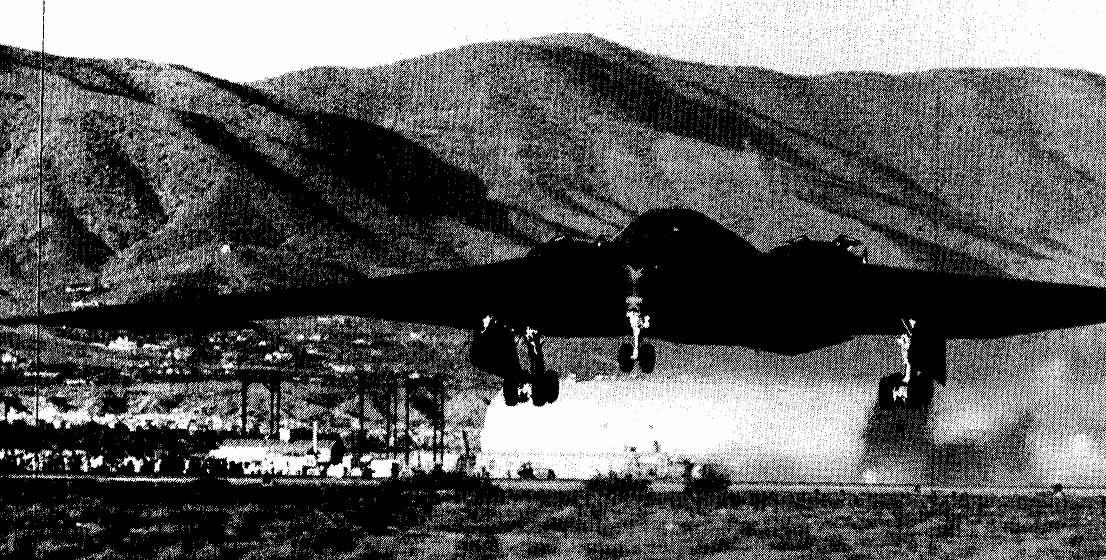
Figure 1.1: B-2 Advanced Technology Bomber
Source:
Northrop B-2 Division
United States General Accounting Office
|
|
United States B-224698 February 22, 1990 The Honorable Les Aspin Dear Mr. Chairman: This report was prepared as part of your request that we review the B-2 program. This is our first unclassified report on the B-2. As you know, before this year all aspects of the B-2 program were highly classified. Recent changes in the security classification of the program permit this unclassified report on the B-2's history and current cost, schedule, and test status. Information on performance remains classified and will be included in a separate report. We are sending copies of this report to appropriate congressional committees; the Secretaries of Defense and the Air Force; the Director, Office of Management and Budget; and other interested parties. This report was prepared under the direction of Nancy R. Kingsbury, Director, Air Force Issues, who may be reached on (202) 275-4268 if you or your staff have any questions concerning this report. Other major contributors to this report are listed in appendix I. Sincerely yours, /S/ |
The B-2 bomber is one of the most costly Department of Defense programs. Its high cost and highly classified nature have made it the subject of considerable controversy. Since 1986, GAO has issued five classified reports on the B-2 program. Recent changes in the security classification of the program permit this unclassified report on the program's history and current cost, schedule, and test status. This report contains information from our prior classified reports that is now unclassified and updated as necessary.
The B-2 has been in full-scale development since 1981. It is a flying wing aircraft with two crew members and provisions for a third. It has twin weapon bays and four engines and is designed to perform the traditional long-range bomber role for both nuclear and non-nuclear missions. The Air Force believes the B-2 has the greatest potential for a future capability against targets of uncertain locations, although concerns exist about the difficulties of locating movable targets.
The Air Force has been developing the B-2 while producing and deploying the B-1B bomber to modernize the aging B-52 bomber fleet. The B-2 is being developed to take advantage of low observable technologies, which, when combined with on-board avionics, are intended to allow penetration of current and postulated Soviet defenses.
In 1981 the Air Force estimated the cost to procure 133 B-2s – 6 development aircraft and 127 production aircraft – would be $32.7 billion in 1981 dollars. In 1986 the Department of Defense announced the estimated cost would be $36.6 billion in 1981 dollars, which was equivalent to $58.2 billion in escalated dollars over the life of the B-2's procurement. This cost estimate and the related program schedule became the baseline from which subsequent budget and schedule changes are measured.
The B-2 program's cost and schedule have changed significantly since 1986 and remain uncertain. The B-2 acquisition strategy includes cost and schedule projections that rely on very high annual funding levels and on ordering a large number of planes before the necessary testing to demonstrate that the B-2 can perform its mission is completed.
Since 1986 the B-2 cost estimate increased $12 billion, and the final B-2 delivery was extended 3 years to 1999. Future schedule changes and cost increases will occur if projected annual funding requirements are not appropriated or if planned program savings are not achieved.
The flight test program has just begun. If current schedules are met, it will be at least 3 years before critical performance requirements have been fully tested. That is the point in testing where problems are typically discovered. At that time, under the current schedule, over $48 billion would have been appropriated and 31 aircraft would have been ordered. In view of these uncertainties, as well as changing world conditions, GAO believes that alternative acquisition strategies should be considered.
Major design changes early in the B-2's development caused manufacturing difficulties that have contributed to a slower production schedule and labor cost increases. Contractors have reported improvements in productivity and reductions in manufacturing defects, but these improvements are less than anticipated. Also, further manufacturing improvements may be hindered by continuing design changes.
In June 1989 the B-2 program was estimated to cost $70.2 billion, a $12 billion increase from the baseline estimate. The June 1989 estimate depends on achieving $6.2 billion in savings through a cost reduction initiatives program and multiyear procurement strategy. The amount of savings and the feasibility of achieving them are uncertain. If the projected savings are not realized, additional funding will be required, and the B-2 program's schedule may be extended.
Since 1986 B-2 estimated cost increases have been caused primarily by an incomplete aircraft design at the start of manufacturing, underestimated material costs, and production schedule extensions. The most recent increase, $2.6 billion, occurred between January and June 1989 and was primarily due to extending the schedule 1 year.
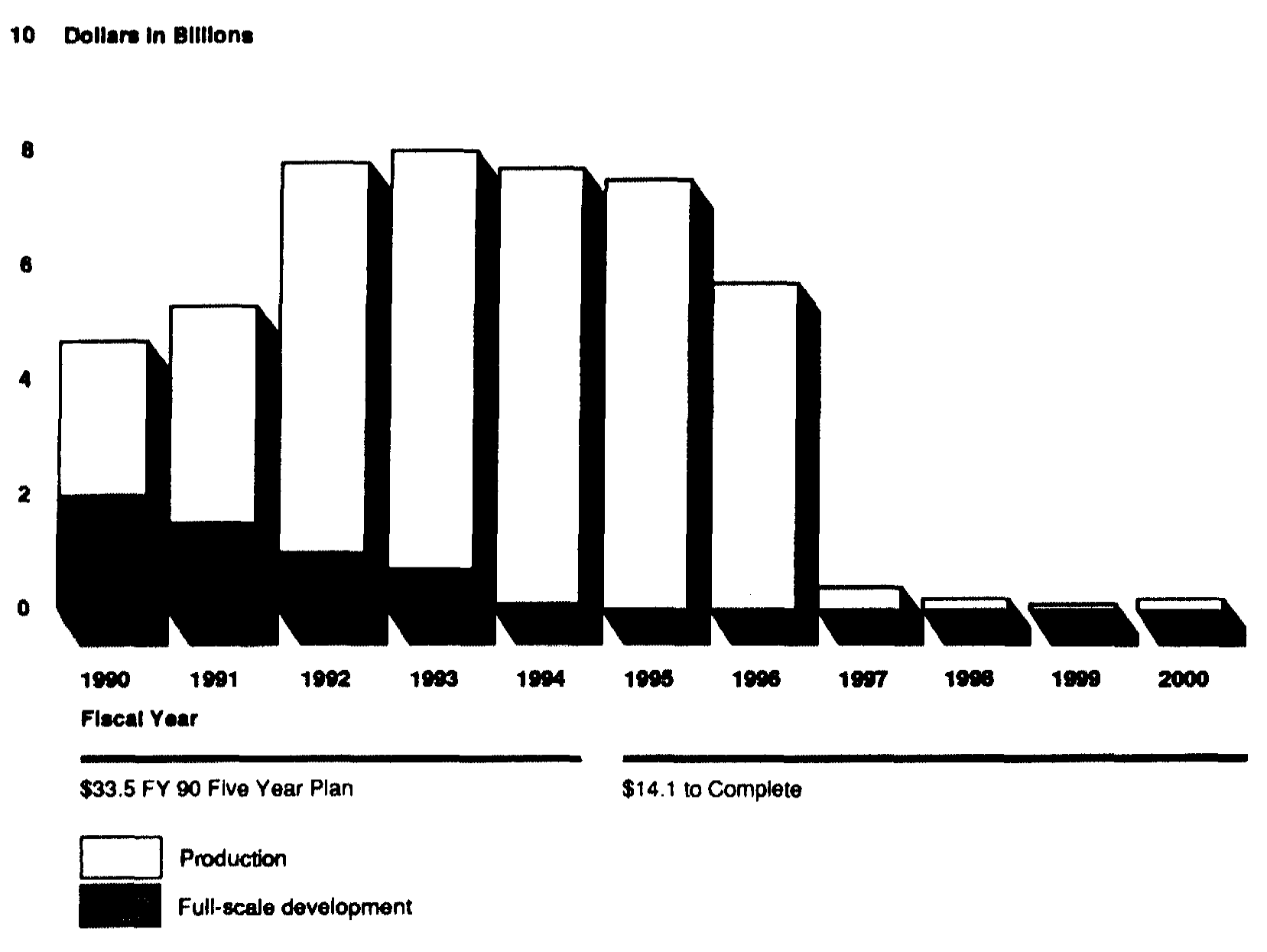
The current acquisition plan requires funding of $5.3 billion in fiscal year 1991 and $7.5 to $8 billion annually for fiscal years 1992 through 1995 to achieve the estimated program cost of $70.2 billion. If these funding levels are not achieved, the Air Force will have to delay or reduce the B-2's production program.
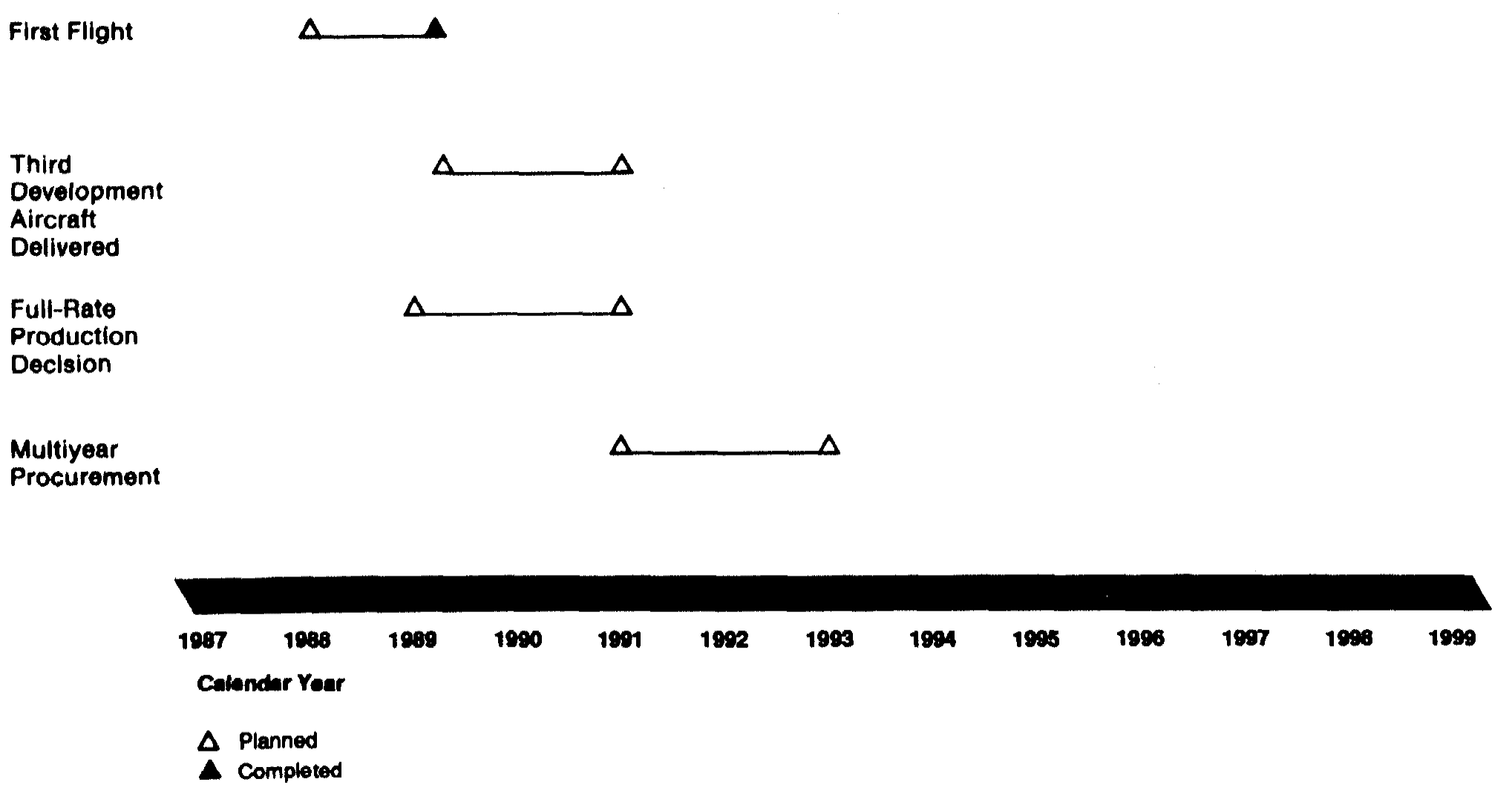
The B-2 program schedule has changed each year since 1986. The latest change in June 1989 delayed both the first full production and multi-year procurement decisions by 1 year. It also extended the B-2 final deliveries from 1998 to 1999. The last B-2 delivery is now scheduled 3 years later than planned in the 1986 baseline estimate. The Secretary of Defense approved this schedule extension because delays in completing the first aircraft delayed the start of flight testing. If the production schedule had not been extended, the concurrency in the program would have increased. The schedule extension maintained the previously planned relationship between flight testing and production.
GAO reported in August 1988 that the contractors were encountering manufacturing problems, as evidenced by a large number of manufacturing defects, inefficient labor, and the transfer of work originally planned to be accomplished at the subcontractor plants to the final assembly site. These problems were caused in part because, to maintain schedule, manufacturing was started before the aircraft design was complete. Manufacturing data collected in 1989 showed that the contractors are resolving some of these problems. The contractors are reporting they have reduced the number of manufacturing defects, improved worker efficiency, and transferred less work to the final assembly site. However, these improvements were less than anticipated. As in the case of other programs, the contractors are initiating many changes to engineering drawings, which continue to disrupt the manufacturing process. Some of these changes require new parts, new tooling, and changes to the manufacturing plan, which hinder efforts to stabilize the manufacturing process.
The B-2 flight test program began on July 17, 1989, with the first flight of the aircraft. To date, 1 percent of the flight test program has been completed. The program will likely continue into 1994. The pace of testing will increase as the remaining five development aircraft become available for testing. The first 1-1/2 years of flight testing is to demonstrate basic B-2 air worthiness and provide preliminary data on the low observable features of the aircraft. More critical operational testing, including integrated offensive and defensive avionics, where problems have frequently been discovered on other programs, is scheduled to begin in 1992.
There has been much debate on whether the Department of Defense can realistically expect to receive the funding levels projected by the Department for the B-2 program. Because of this and the fact that critical testing is several years away, the Congress may wish to require the Secretary of Defense to provide an analysis of alternative acquisition plans for the B-2 program, including various annual funding levels. This analysis would provide the Congress with information on options for future funding decisions and their related impact on the B-2's cost and schedule.
GAO did not request official written comments on this report. However, GAO discussed a draft of this report with Department of Defense officials and incorporated their comments where appropriate.
– – – – – – – – – – – – – – – – – – – – – – – – – – – – – – – – – – – – – – – – – – – – – –
Executive Summary
Chapter 1 Introduction
Background
Objectives, Scope, and Methodology
Chapter 2 B-2 Cost Estimates From 1981 to 1989
Program Cost Increases
Causes of Cost Increases
Cost Reduction Initiatives Program
Annual Funding Requirements
Conclusions
Chapter 3 Program Schedule Changes
Changes to B-2 Schedule
Changes to Program Milestones
Other Schedule Change Impacts
Conclusions
Matter for Congressional Consideration
Chapter 4 Manufacturing Trends
Work Required at Final Assembly
Manufacturing Defects
Labor Inefficiencies
Changes to Engineering Drawings
Conclusions
Appendix
Appendix I: Major Contributors to This Report
Tables
Table 2.1: Air Force Estimates of B-2 Acquisition Costs and Savings
Table 3.1: Order and Delivery Schedule Comparison for Production Aircraft
Table 4.1: Number of Hours of Work Transferred to Final Assembly
Table 4.2: Comparison of Planned and Actual Labor Hours
Figures
Figure 1.1: B-2 Advanced Technology Bomber
Figure 2.1: June 1989 Cost Estimate
Figure 3.1: B-2 Production Aircraft Order Schedule Comparison
Figure 3.2: B-2 Program Milestone Changes
Figure 4.1: Development Aircraft Defects
– – – – – – – – – – – – – – – – – – – – – – – – – – – – – – – – – – – – – – – – – – – – – –
The B-2 program has been in full-scale development since 1981. It is part of the Strategic Modernization Program, which was designed to modernize the strategic bomber forces by replacing the aging B-52 bomber fleet with B-1B and B-2 bombers. The B-2 is intended to be a long-range, multirole bomber capable of penetration at both low and high altitudes. It supports the Single Integrated Operational Plan [*] and various conventional missions.
[* – The Single Integrated Operational Plan allocates all strategic assets -- bomber, tankers, land- and sea-based ballistic missiles and cruise missiles -- to specific targets.]
The B-2 is a flying wing aircraft with two crew members and provisions for a third. It has twin weapons bays that provide up to 50,000 pounds total payload capacity. The actual payload carried by the B-2 will vary depending on the mission. It is powered by four turbofan engines that provide 19,000 pounds of thrust each. The B-2 design includes low observable technologies such as special shaping and radar absorbing materials, which are intended to reduce the radar cross section of the aircraft. These materials require new manufacturing technologies that are more challenging than the technologies of aluminum aircraft. Figure 1.1 shows the B-2 in flight.
Although concerns exist about the difficulties of locating movable targets, the Air Force believes the B-2 has the greatest potential for an enhanced capability against targets with uncertain locations because of its expected increased survivability compared to other aircraft.
|
Figure 1.1: B-2 Advanced Technology Bomber
|
The B-2 program is managed by the Air Force System Program Office, Wright-Patterson Air Force Base, Ohio. Northrop B-2 Division, Pico Rivera, California, is the prime contractor. Major subcontractors include Boeing and Vought, which manufacture separate sections of the B-2 at production facilities in Seattle, Washington, and Dallas, Texas, respectively. These aircraft sections are shipped to the B-2 final assembly site in Palmdale, California, where Northrop is responsible for the B-2 final assembly and systems integration. General Electric, Evendale, Ohio, manufactures the engines for the aircraft.
The Air Force plans to procure 133 B-2s: 6 development aircraft and 127 production aircraft. All but one of the development aircraft will be modified after the completion of the flight test program and used as operational aircraft. The Air Force plans to keep the other development aircraft available for future test purposes. In 1986 the Congress directed the Secretary of Defense to release its estimate of the program's cost. The estimate of $36.6 billion in 1981 dollars and the related schedule serve as a baseline for the B-2 program. Except where noted, all cost estimates in this report are expressed in then-year dollars, which include the estimated impact of inflation.
The first flight of the B-2 occurred on July 17, 1989, taking off from Air Force Plant 42 in Palmdale, California, and landing at Edwards Air Force Base, California. The aircraft has since flown seven more times. According to the Air Force, most of the objectives of the eight flights were accomplished, but the analysis of the data gathered is still underway.
In 1986 the Chairman, House Committee on Armed Services, requested that we review the B-2 program. Since that time we have issued five classified reports. Recent changes in the security classification of the B-2 program permit this unclassified report on the B-2 program's history and current cost, schedule, and test status. This report contains information from our prior classified reports that is now unclassified and updated as necessary.
We obtained information from records and officials at the B-2 System Program Office and the Northrop B-2 Division. In addition, we reviewed program data provided by the Office of the Secretary of Defense and Air Force Headquarters, Washington, D.C.; the Strategic Air Command, Omaha, Nebraska; the Air Force Plant Representatives Office, Pico Rivera, California; the Air Force Flight Test Center, Edwards Air Force Base, California; Hughes Radar Division, El Segundo, California; Boeing Advanced Systems Division, Seattle, Washington; and other classified organizations.
We performed our review in accordance with generally accepted government auditing standards. We did not request written agency comments. However, we discussed a draft of this report with Department of Defense officials and incorporated their comments where appropriate.
In 1981 the Air Force estimated the cost to procure 133 B-2s would be $32.7 billion in 1981 dollars. The Air Force based this and subsequent estimates through 1985 on development and production data for other aircraft. As the B-2 manufacturing process evolved, actual costs were used in the estimates, which caused them to increase.
In January 1986 the Department of Defense announced an estimate of $36.6 billion in 1981 dollars. This estimate became the baseline to measure subsequent cost and schedule changes. In June 1989 the Secretary of Defense approved a new estimate of $43.8 billion in 1981 dollars.
These increases can be attributed primarily to design-related manufacturing difficulties, underestimated material costs, and changes to the production schedule. Manufacturing difficulties increased labor costs and delayed the delivery of the first aircraft. The Air Force extended the production schedule to reduce annual funding requirements and avoid increased program concurrency. The June 1989 estimate still contains optimistic funding assumptions that may cause further increases.
As program costs increased, the Congress directed the Air Force to identify ways to reduce costs through a cost reduction initiatives program. In June 1989 the Air Force estimated that $6.2 billion could be saved through the implementation of these initiatives and a multiyear procurement strategy. Some of the initiatives, however, are based on optimistic assumptions and are subject to change.
B-2 program cost estimates have increased since the 1986 baseline estimate, even though some increases were offset by projected savings from multiyear procurement and cost reduction initiatives. The estimate is now $43.8 billion in 1981 dollars, or $70.2 billion in then-year dollars, as shown in table 2.1.
Table 2.1: Air Force Estimates
of B-2 Acquisition Costs and Savings
|
|||||
|
Costs |
Jan. 1986 |
Jan. 1987 |
Jan. 1988 [*] |
Jan. 1989 |
June 1989 |
|
Development |
$14.5 |
$16.7 |
$18.4 |
$20.2 |
$20.8 |
|
Production |
43.7 |
42.0 |
51.0 |
55.6 |
55.6 |
|
Total |
58.2 |
58.7 |
69.4 |
75.8 |
76.4 |
|
Savings |
Jan. 1986 |
Jan. 1987 |
Jan. 1988 [*] |
Jan. 1989 |
June 1989 |
|
Multiyear procurement |
$0 |
$1.5 |
$1.6 |
$2.7 |
$2.6 |
|
Cost reduction initiatives |
0 |
0 |
0 |
5.5 |
3.6 |
|
Total |
0 |
1.5 |
1.6 |
8.2 |
6.2 |
|
Total reported program cost |
$58.2 |
$57.2 |
$67.8 |
$67.6 |
$70.2 |
|
1981 Dollar equivalent |
$36.6 |
$36.6 |
$42.1 |
$42.5 |
$43.8 |
|
* – The Office of Secretary of Defense did not approve these estimates. |
|||||
The January 1986 estimate was based on a first flight date in December 1987 and delivery of the last aircraft in 1996. Increases in development costs in the January 1987 estimate were offset by lower estimates for production costs because of $1.5 billion in savings expected from multi-year procurement. This was the first estimate in which the Air Force assumed projected savings from multiyear procurement.
In January 1988 the Air Force revised its estimate to $67.8 billion. This increase reflected a 3-year extension of the program, with final aircraft delivery scheduled for 1999. This estimate was not approved by the Secretary of Defense, and the Air Force was directed to examine the program to identify ways to reduce the program's cost.
In January 1989 the program was estimated to cost $67.6 billion. This estimate was based on an accelerated schedule, with final aircraft delivery scheduled for 1998, and included $8.2 billion in potential savings from a cost reduction initiatives program. These potential savings lowered the estimate from $75.8 billion to $67.6 billion. In March 1989 we reported that the feasibility of some of these savings was uncertain.
In June 1989 the cost estimate increased to $70.2 billion. This increase was primarily due to extending the schedule 1 year, with final aircraft delivery scheduled for 1999. Expected savings from the cost reduction initiatives program were reduced to $6.2 billion.
We have been informed the Air Force revised the June 1989 estimate to reflect higher inflation rates, the impact of the labor strike at Boeing, and congressionally directed changes to the 1990 aircraft order schedule. As of February 9, 1990, the Department of Defense had not released a new estimate of B-2 program costs that reflected these factors.
The B-2 program cost increases have been primarily caused by an incomplete aircraft design at the start of manufacturing, underestimated material costs for a composite aircraft, and production schedule extensions.
In early 1981, before the full-scale development contract was awarded, the Air Force modified its requirements to include a low-altitude capability for the B-2. This change was made because the Air Force wanted the flexibility of a bomber that could fly at both high and low altitudes. This change forced Northrop to redesign its original B-2 airframe, adding additional control surfaces and improved structures to accommodate the stresses of low-altitude, high-speed flight. Northrop's efforts to redesign the airframe also delayed its efforts to complete the other aspects of the B-2's design. However, no change was made to the B-2's production schedule. To meet its first flight deadline, the contractors started manufacturing the B-2 in January 1986, even though the aircraft design was not completed. In August 1988 we reported that problems caused by initiating manufacturing activities before the B-2 design was stabilized delayed the completion of the first development aircraft. Manufacturing personnel were receiving engineering drawings late or were not able to use existing drawings and thus forced to wait for new drawings and parts. As a result, manufacturing labor hours increased significantly. The incomplete B-2 design also led to parts shortages, tooling problems, and the transfer of manufacturing activities to the final B-2 assembly site.
Material cost estimates have increased significantly since the 1986 baseline estimate. The Air Force used a cost estimating model in the 1986 estimate to predict B-2 material costs. The model was based on building an aluminum aircraft. Even though the Air Force attempted to compensate for the differences between building an aluminum aircraft and a composite B-2 structure, the model produced an estimate that was lower than the costs actually incurred.
Development costs increased as a result of changes in the production schedule. As the production schedule is delayed, and fewer aircraft are in process, more fixed costs are allocated to each aircraft. Production costs increase as the schedule is extended because the aircraft are produced over a longer period of time, increasing the fixed costs required to build the aircraft.
The fiscal year 1988 Defense Authorization Act required the Department of Defense to establish a B-2 cost, performance, and management initiatives program. In response, the Air Force developed a cost reduction initiatives program with a 10-percent cost reduction goal. The Air Force also developed the program due to the $10 billion increase in estimated program costs from the January 1987 to January 1988 estimates. B-2 contractors and the Air Force identified over 150 technical and management initiatives to reduce program costs such as increased multiyear procurement, reduced overhead rates, and production improvements.
In March 1989 we reported that the Air Force estimates of cost reduction savings were based on optimistic assumptions. Many of the initiatives were still being evaluated and subject to change. In addition, we stated that it was uncertain if and when the Congress would approve multiyear procurement. Estimated savings from multiyear procurement were $2.7 billion in January 1989. Because of the schedule changes in June 1989, two cost reduction initiatives included in the January 1989 estimate were removed. The enhanced schedule initiative was estimated in 1988 to save $1.4 billion by completing the production program in 1998. This initiative had to be eliminated when the production program was extended to 1999. Also, the Air Force eliminated an initiative to save $500 million to reduce direct costs because the changes to the program schedule made it difficult to predict when and how direct costs could be reduced.
Figure 2.1 shows the distribution of the June 1989 $70.2 billion estimate from fiscal year 1990 through the completion of the program. In fiscal year 1991, $5.3 billion is required. The peak funding requirements occur in fiscal years 1992 through 1995 and are $7.8, $8, $7.7, and $7.5 billion, respectively. Annual funding levels for fiscal years 1989 and before totaled $22.6 billion.
|
Figure 2.1: June 1989 Cost Estimate
|
The B-2 annual appropriations to date have not exceeded approximately $5.2 billion. More importantly, there are indications that future funding will not grow to the peak levels required in fiscal years 1992 through 1995. For example, the Chairman of the House Committee on Armed Services stated during the fiscal year 1990 defense authorization hearings that "... it is a ... certainty that the B-2 program will not be funded at the $7 billion to $8 billion level..."
B-2 program costs have increased substantially since the 1986 baseline estimate. Manufacturing problems and schedule instability continue to contribute to cost increases. The current estimate assumes several successive years of funding levels of approximately $8 billion. This assumption is not consistent with recent appropriation experience. If these funding levels are not achieved, cost will increase and schedule changes may occur.
The January 1986 baseline schedule estimated that the final B-2 would be delivered in early 1996. The scheduled approved by the Secretary of Defense in June 1989 estimated that the final B-2 would be delivered in mid-1999, over 3 years later than the date in the baseline schedule. The schedule change affects the overall procurement plan, such as when full-rate production and multiyear procurement are initiated. The schedule change also affects fixed-price options currently held by the prime contractor, subcontractor schedules, the quantity and timing of tooling purchases, and flight testing.
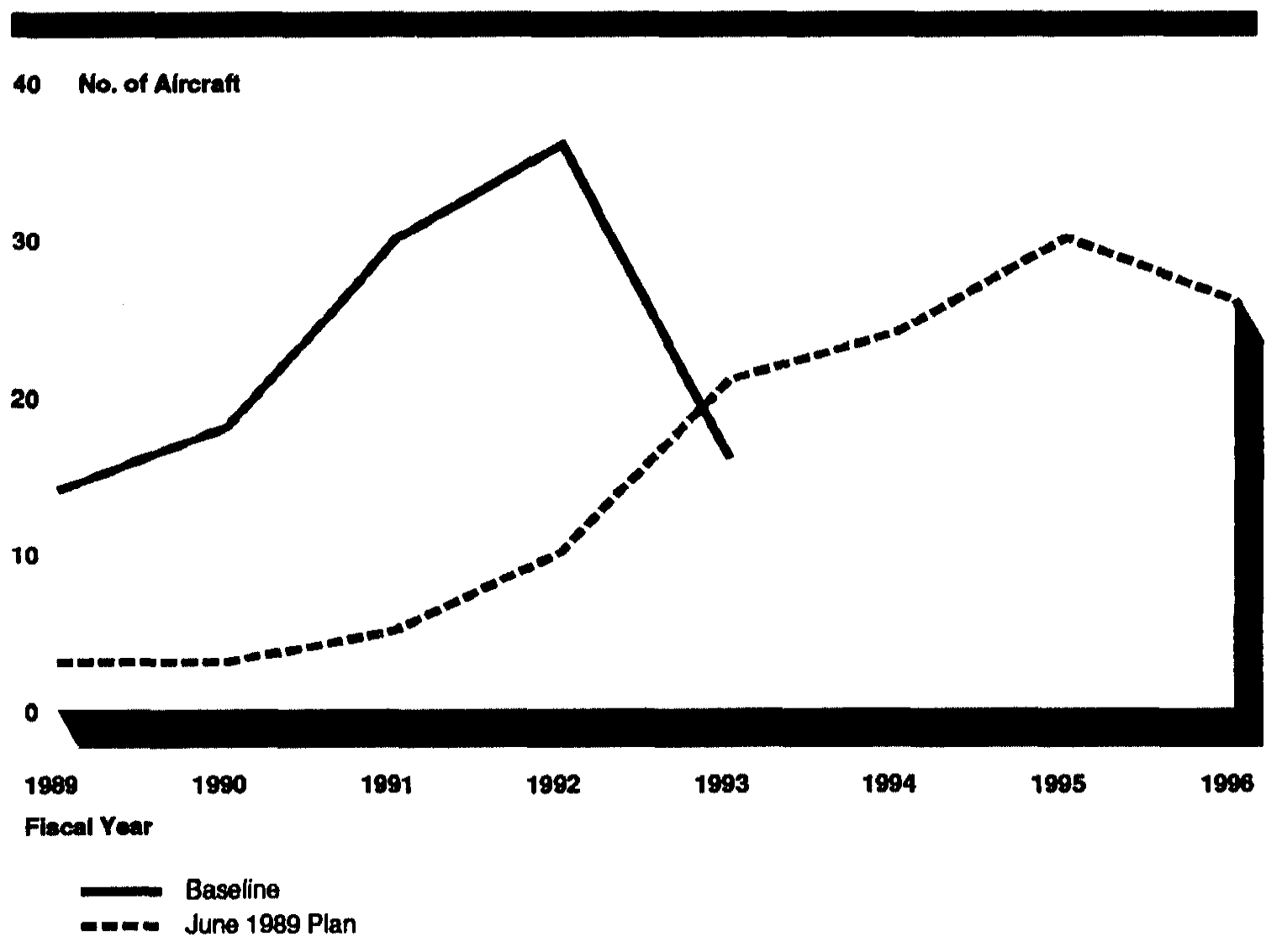
The B-2 program schedule has changed each year since the 1986 baseline. For example, as shown in table 3.1, in the 1986 estimate all 127 production aircraft were planned to be ordered and 52 aircraft were planned to be delivered by 1993, but in the June 1989 estimate only 47 production aircraft, or 37 percent, were planned to be ordered and only 9 aircraft were planned to be delivered by that time.
Table 3.1: Order and Delivery Schedule Comparison for Production Aircraft |
|||||||||||||
|
1986 Estimate (FY 1987 budget) |
FY1988 and prior |
FY1989 |
FY1990 |
FY1991 |
FY1992 |
FY1993 |
FY1994 |
FY1995 |
FY1996 |
FY1997 |
FY1998 |
FY1999 |
Total |
|
Order |
13 |
14 |
18 |
30 |
36 |
16 |
|
|
|
|
|
|
127 |
|
Delivery |
|
|
2 |
9 |
17 |
24 |
35 |
36 |
4 |
|
|
|
127 |
|
1987 Estimate (FY 1988 budget) |
FY1988 and prior |
FY1989 |
FY1990 |
FY1991 |
FY1992 |
FY1993 |
FY1994 |
FY1995 |
FY1996 |
FY1997 |
FY1998 |
FY1999 |
Total |
|
Order |
9 |
10 |
14 |
16 |
29 |
35 |
14 |
|
|
|
|
|
127 |
|
Delivery |
|
|
2 |
9 |
12 |
23 |
32 |
36 |
13 |
|
|
|
127 |
|
1988 Estimate (FY 1989 budget) |
FY1988 and prior |
FY1989 |
FY1990 |
FY1991 |
FY1992 |
FY1993 |
FY1994 |
FY1995 |
FY1996 |
FY1997 |
FY1998 |
FY1999 |
Total |
|
Order |
5 |
5 |
7 |
15 |
16 |
17 |
24 |
24 |
14 |
|
|
|
127 |
|
Delivery |
|
|
|
4 |
5 |
5 |
13 |
24 |
24 |
24 |
24 |
4 |
127 |
|
1989 Estimate (FY 1990 budget) |
FY1988 and prior |
FY1989 |
FY1990 |
FY1991 |
FY1992 |
FY1993 |
FY1994 |
FY1995 |
FY1996 |
FY1997 |
FY1998 |
FY1999 |
Total |
|
Order |
5 |
4 |
5 |
10 |
21 |
24 |
30 |
28 |
|
|
|
|
127 |
|
Delivery |
|
|
|
2 |
5 |
6 |
10 |
24 |
36 |
36 |
8 |
|
127 |
|
1989 Estimate (Secretary of Defense's plan) |
FY1988 and prior |
FY1989 |
FY1990 |
FY1991 |
FY1992 |
FY1993 |
FY1994 |
FY1995 |
FY1996 |
FY1997 |
FY1998 |
FY1999 |
Total |
|
Order |
5 |
3 |
3 |
5 |
10 |
21 |
24 |
30 |
26 |
|
|
|
127 |
|
Delivery |
|
|
|
|
3 |
6 |
5 |
8 |
18 |
30 |
36 |
21 |
127 |
Figure 3.1 compares the number of aircraft orders under the 1986 baseline and June 1989 schedules. Specific data for the 1988 and prior years are classified.
|
Figure 3.1: B-2 Production Aircraft Order Schedule Comparison
|
The changes made to aircraft order and delivery schedules have changed program milestones. We used the 1986 schedule as a baseline to measure milestone changes. The first flight milestone was accomplished 19 months after originally scheduled. Other program milestones shown in figure 3.2 are projected to slip approximately 2 years. The third aircraft delivery milestone is important to the test program because this aircraft resembles the production aircraft more closely.
|
Figure 3.2: B-2 Program Milestone Changes
NOTE: The Air Force first established the multiyear procurement milestone in 1987 to support the President's fiscal year 1988 budget request |
In addition, the required assets available milestone, which replaced the initial operational capability milestone and establishes the date that 15 aircraft have been delivered to the Strategic Air Command, has been delayed 37 months.
The June 1989 schedule changed the low-rate initial production, full-rate production, and multiyear procurement strategy. The full-rate production decision was delayed until 1991. This change added two aircraft to the low-rate production program and extended the last year of production orders from 1995 to 1996.
Although the Secretary of Defense approved a 1-year delay to the production program, concurrency between flight testing and production remained essentially the same because the changes were made to accommodate delays to the first flight.
Schedule changes have affected previously negotiated fixed-price options for production aircraft subsystems, subsystem delivery requirements, and contractor tooling requirements.
Fixed-price options between Northrop and various subcontractors for B-2 subsystems are affected by the aggressive schedule originally planned for the program. Northrop's full-scale development contracts with other subcontractors contain options for future purchase of B-2 components at fixed prices. These options were negotiated based on the earlier production schedule. As the production schedule is slowed, it places the fixed-price options at risk because the options cannot be exercised below a preestablished minimum production quantity. Northrop has estimated the cost of not exercising these options could be as high as $2.6 billion. We have not examined the assumptions on which this estimate was based.
Also, the new schedule affects the pace at which avionic subsystems are required, produced, and delivered for aircraft integration. The contractor is changing the manufacturing sequence of the B-2 radar and navigation subsystems based on funding availability rather than manufacturing requirements. Limited development funds combined with the availability of production funds have prompted the contractors, with the Air Force's approval, to manufacture production radar and navigation units before the delivery and testing of development units.
Contractor plans for the quantity and timing of tooling and facilities are also affected by schedule changes. For example, Boeing has stated that the monthly production rate of aircraft will determine the number of major assembly tools it will need to keep pace with the production schedule. It has estimated tooling needs based on 1.8, 2, and 3 aircraft per month. At a rate of three aircraft per month, Boeing's analysis indicates it may need at least three additional major assembly tools. Adding these tools may also affect facility requirements.
The Air Force has planned a 3,600-hour flight test program to demonstrate B-2 performance capabilities over approximately 4 years. This test program includes development and some initial operational test activities. To date, 1 percent of the flight hours in this test program have been completed. As development aircraft deliveries are delayed, the flight test program must also be adjusted.
The Air Force planned to complete the test program in 1993. It now appears that the completion of testing could slip into 1994 as a result of delays in delivering the development aircraft. The first 1-1/2 years of flight testing will be primarily to demonstrate basic flying qualities and provide preliminary data on the low observable features of the aircraft. Approximately 6 months of this time the aircraft will not be flown while planned modifications are made. The pace of testing will increase as the remaining five development aircraft become available during 1990 and 1991. More critical operational testing, including integrated offensive and defensive avionics, is scheduled to begin in 1992.
The B-2 program schedule has changed each year since 1986. These changes affect program milestones, the overall procurement strategy, and the test program. Schedule extensions also increase program cost estimates. Additional schedule changes will contribute to the instability and uncertainty that have characterized the B-2 program since 1986. Also, the flight test program has just begun. If current schedules are met, it will be at least 3 years before critical performance requirements are proven. In view of these uncertainties, as well as changing world conditions, we believe that alternative acquisition strategies should be considered.
There has been much debate on whether the Department of Defense can realistically expect to receive the funding levels it has projected for the B-2 program. Because of this and the fact that critical testing is several years away, the Congress may wish to require the Secretary of Defense to provide an analysis of alternative acquisition plans for the B-2 program, including various annual funding levels. This analysis would provide the Congress with information on options for future funding decisions and their related impact on the B-2's cost and schedule.
We used several key indicators to measure the B-2's manufacturing status, such as the amount of work transferred to final assembly, defects, and manufacturing inefficiencies. These indicators show that in 1989 the manufacturing process had improved, but not as much as planned. Also, a large number of engineering changes continue to hinder manufacturing improvements.
Department of Defense officials told us that the manufacturing problems discussed in the following sections have been considered in making the $70.2 billion program cost estimate. The officials agreed, however, that continued inability to meet planned improvements and schedule milestones may cause further cost estimate increases.
We previously reported that the Air Force had authorized contractors to transfer manufacturing work planned to be completed at the Northrop, Boeing, and Vought factories to the final assembly site. The transfer occurred because the contractors were not able to accomplish their work and still maintain the scheduled delivery date of December 1987 for the first development aircraft. Despite the transfer of work, the first aircraft was not delivered until July 1989, 19 months late. The Air Force and the contractors believed that the amount of work transferred to the final assembly site would subside because the contractors would begin to achieve a more efficient manufacturing process with each aircraft delivered.
The contractors have reported a reduction in the amount of work transferred to final assembly, but not as much as planned. In September 1988 the Air Force extended the development schedule by 9 months to minimize the amount of work transferred to final assembly. This extension was designed to provide Northrop, Boeing, and Vought enough time to install various systems into major aircraft sections before they were shipped to final assembly. Despite this extension, plus an additional 5-month delay to the scheduled completion of the fifth and sixth development aircraft, the contractors are not expecting to finish installing all planned systems before the sections are shipped to final assembly.
Work transferred from the contractors' factories to the final assembly site is inefficient because it forces workers to travel to the site to complete installation of the systems. This creates inefficiencies because more personnel are working on the aircraft at the same time, which makes the aircraft structure less accessible. Table 4.1 shows the change in the projected amount of work transferred to final assembly, expressed in standard hours [*], between September 1988 and August 1989. The amount of work has decreased significantly between the second and third aircraft. Nevertheless, the contractors' August 1989 estimate of the amount of work transferred to final assembly for the first six development aircraft increased from the September 1988 estimate.
[* – A standard hour is an engineering estimate of labor hours required to accomplish a task. Early in the development program, because of labor inefficiencies, it takes many actual labor hours to accomplish a standard hour of work.]
Table 4.1: Number of Hours of Work Transferred to Final Assembly |
||
|
Aircraft |
September 1988 estimate |
August 1989 estimate [*] |
|---|---|---|
|
1 |
18,620 |
19,431 |
|
2 |
14,211 |
17,258 |
|
3 |
3,712 |
4,525 |
|
4 |
3,204 |
3,500 |
|
5 |
2,284 |
3,000 |
|
6 |
1,600 |
2,900 |
|
[* – The current estimate for the first aircraft is final.] |
||
A manufacturing defect is a flaw on the aircraft that may result in extra work to correct the defect or replace the defective part. In 1988 we reported that the Air Force had projected the number of defects for the first 2 aircraft to be approximately 160,000. [*] These defects were largely attributable to improperly drilled holes and difficulties in sealing the fuel tank. Even though manufacturing defects are expected during the fabrication and assembly of an aircraft, the number of defects should decrease as the workers gain experience and the aircraft design stabilizes.
[* – The defect quantities discussed in this section do not include any defects incurred during final assembly.]
The Air Force currently projects 190,000 defects on the first two aircraft. Although the total for the first two aircraft is more than previously projected, the number is expected to decrease from approximately 110,000 on the first aircraft and 80,000 on the second to approximately 60,000 on the sixth aircraft.
The two major causes of defects to date relate to improperly drilled holes and Boeing's difficulty in meeting Northrop specifications for sealing the fuel tank in the wing section of the aircraft. This is the primary cause of Boeing's work being transferred to final assembly. Air Force officials have stated that this is a temporary problem that will not affect future aircraft.
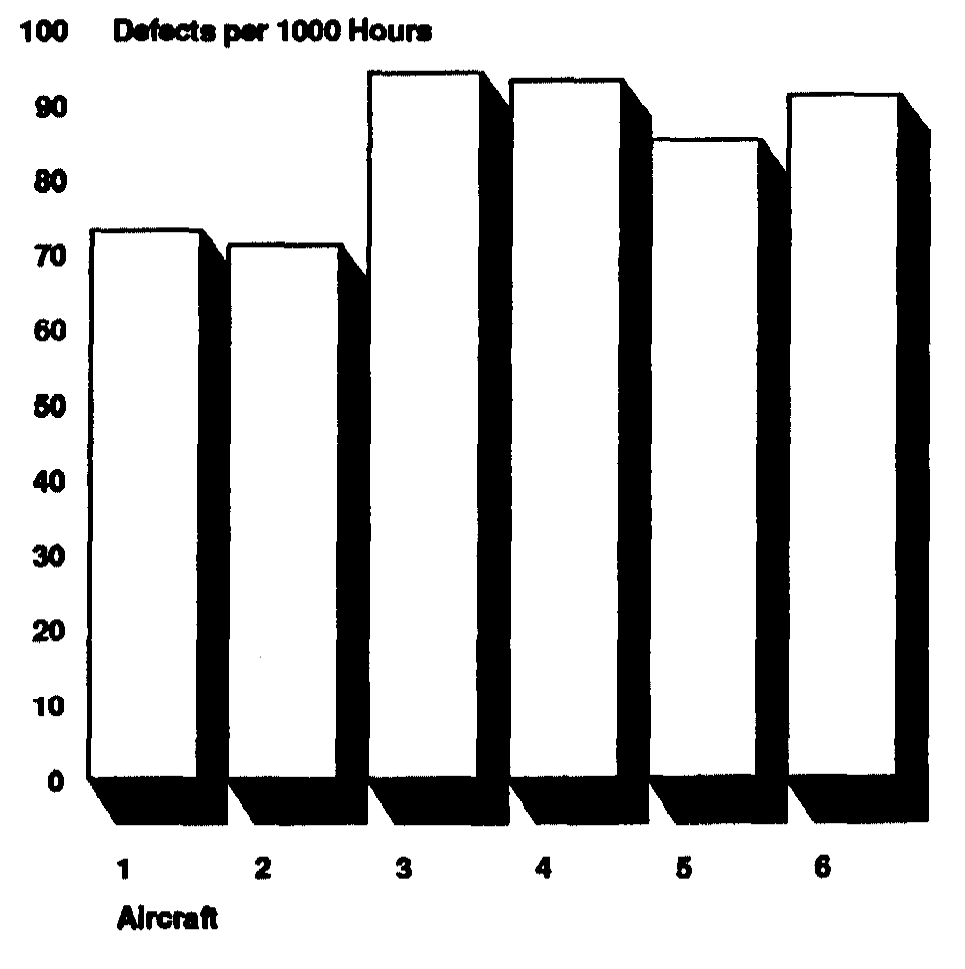
However, as shown in figure 4.1, quality in the manufacturing process has not improved. Data from the program office show that the rate of defects per 1,000 hours of work is about the same for the third through the sixth development aircraft but is greater than the rate for the first and second aircraft.
|
Figure 4.1: Development Aircraft Defects
|
In August 1988 we reported that continuing design problems were causing labor inefficiencies that increased the amount of manufacturing time required to build the aircraft. The actual hours needed to complete the first aircraft significantly exceeded the contractors' estimates.
Air Force and contractor officials told us that as workers learn the manufacturing process, they would become more efficient and the difference between the planned and actual hours would decrease. Recent data indicate that even though the contractors are reporting using fewer hours to complete subsequent aircraft, they have not been able to reduce the difference between the planned and actual labor hours.
Table 4.2 compares the contractors' planned labor hours with the number of projected hours the Air Force estimates will be needed to assemble the major sections of the first three development aircraft. As indicated, the percent difference between the planned and projected labor hours is increasing.
|
Table 4.2: Comparison of Planned and Actual Labor Hours |
|||
|
Aircraft |
Planned hours |
Actual hours |
Percent difference |
|
1 |
819,408 |
1,505,774 |
84 |
|
2 |
603,123 |
1,124,059 |
86 |
|
3 |
406,998 |
789,713 |
94 |
Engineering drawings are critical to the manufacturing process because they are the basis for all parts, tooling, and manufacturing plans. When engineering drawings are released late, planning, parts, and tooling needed to fabricate and assemble the aircraft are delayed and the manufacturing process is disrupted, causing worker inefficiency and schedule delays.
The contractors originally expected to release all engineering drawings (approximately 8,400) by early 1986. As of March 1989, more than 20,000 had been released. In addition, changes to released engineering drawings were taking place at approximately 2,000 per month through early 1989. The contractors and Air Force officials have stated that they expect the number of drawings and changes to decrease as the third development aircraft nears completion in 1990.
As with manufacturing defects, engineering changes are expected in a development program, but the number of changes should decrease as the design matures. Air Force officials have stated that the current rate of changes is not unusual.
Manufacturing problems delayed the first flight of the B-2 aircraft by 19 months. These problems were caused by the initiation of manufacturing activities before the B-2 design was stabilized. This immature design led to parts shortages, tooling problems, and a transfer of manufacturing activities to final assembly. Because workers were receiving engineering drawings late or were not able to use existing drawings, they were forced to wait on new drawings and new parts. As a result, the number of labor hours required to build the aircraft increased significantly.
The contractors have reported some improvements in each of these areas. These improvements, however, are less than anticipated. Also, design stability, which is important to improving the manufacturing process, may be hindered by continuing changes to engineering drawings.
National Security and International Affairs Division, Washington, D.C.
Joseph C. Bohan, Assistant Director
Cincinnati Regional Office
Robert P. Kissel, Jr., Issue Area Manager
Robert L. Repasky, Evaluator-in-Charge
Michael J. Sullivan, Evaluator
Matthew B. Lea, Evaluator