|
|
|
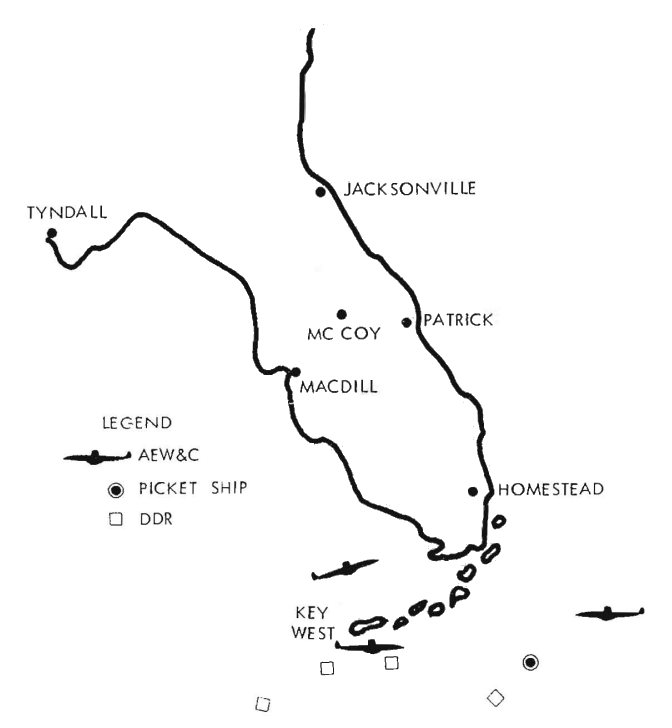
TYNDALL AFB 20 x F-106 HOMESTEAD AFB 24 x F-102 IMESON (JACKSONVILLE) ANG 15 x F-102 MCCOY AFB 3 x TF-102 KEY WEST NAS 8 x F6A MACDILL AFB 3 x TF-102 PATRICK AFB 24 x F-106 |
Historical Reference Paper
No. 8
1 February
1963
Directorate of Command History
Office of
Information
HEADQUARTERS, CONAD
– – – – – – – – – – – – – – – – – – – – – –
I - BACKGROUND
CINCLANT AND CINCONAD OPLANS
SEA QUARANTINE
AIR QUARANTINE PLANNING
II - AUGMENTATION OF THE FLORIDA FORCES
THE PRE-CRISIS FORCE
HISTORY OF THE BUILD-UP OF FORCES
SUMMARY
RULES OF ENGAGEMENT
FAA AIR TRAFFIC RESTRICTION
TASK FORCE 32
III - ALERT AND DISPERSAL
SYSTEM-WIDE
MONTGOMERY SECTOR
BANGOR SECTOR
EFFECT OF ALERT AND DISPERSAL
IV - CRISIS TERMINATION
RETURNING TO NORMAL CONDITIONS
PROPOSALS FOR PERMANENT SOUTHERN FLORIDA FORCES
SOURCES
– – – – – – – – – – – – – – – – – – – – – –
The possibility of there becoming a much greater threat from Cuba was long recognized in the United States and planning and preparation for such an eventuality had long been underway. However, of interest to this study is the crystallization of this threat and CONAD's participation in meeting it. Of immediate interest, therefore, is CINCLANT Operations Plan 312-62, dated 4 September 1962.
This plan provided for quick retaliation or pre-emptive air strikes against Cuba. Operations were to begin 6, 12, or 24 hours subsequent to the receipt of orders to execute. In October, CONAD was advised that Commander, Tactical Air Command, had been designated Commander-in-Chief Air Forces Atlantic (CINCAFLANT) with the responsibility for developing the detailed plans for this operation. CINCAFLANT Operations Plan 312 was prepared primarily to initiate pre-emptive air strikes. The AFLANT concept was to launch air strikes to eliminate all missile sites, missile ships, and the Cuban Air Force. If the massive air strikes failed to eliminate all resistance and bring about the complete surrender of Cuba, then CINCAFLANT Operations Plan 316E (Employment) was to be implemented.
This consisted of air dropping two airborne divisions into six drop zones near Havana. The troop carrier forces were to be pre-positioned at seven bases in Florida. Naval/Marine forces would be conducting amphibious landings at other sections of Cuba simultaneously with the airborne operations.
The CONAD mission throughout these operations was to:
1. Defend the continental U.S.
2. Defend all AFLANT staging bases.
3. Defend troop carrier routes from staging bases to the Dry Tortugas marshalling area.
On 1 October, CINCLANT requested all commanders responsible for execution of these plans to take all measures necessary to assure maximum readiness to execute by 20 October. CONAD prepared Operations Plan 1-62, dated 18 October 1962, to carry out its responsibilities. An intelligence annex was published on 25 October and a revision to the basic plan was issued on 7 November. The intelligence annex listed three IRBM launch sites and six MRBM sites. It also stated there were 22 IL-28 (Beagle) bombers in Cuba. It was later determined that there were at least 42 IL-28's in Cuba.
CONAD OPLAN 1-62, as revised, provided responsibilities for the task organizations (USAF ADC, ARADCOM, 32d CONAD Region, and the Montgomery CONAD Sector), the concept of operations, identification procedures, and rules of engagement. CONAD stated its mission as follows:
a. Conduct increased air defense operations in the southern Florida area with priority of defense to Homestead AFB, McCoy AFB, MacDill AFB, and Key West NAS.
b. Conduct air defense operations of Dry Tortugas marshalling area and air corridors from troop carrier staging bases if and when directed.
c. Provide two additional AEW&C stations for the operational control of CINCLANT during daylight hours commencing D-Day (the day on which the plan(s) were to be executed) until D+2 days.
Under the concept of operations, CONAD stated that it would assume an increased air defense posture in Florida on 20 October. This improved capability would be maintained until completion of CINCLANT operations unless reduced by CINCONAD. CONAD would provide air defense protection of CINCLANT deployed forces and employment bases. If airborne/amphibious operations were conducted after the air strikes, air defense protection of troop carrier aircraft would be provided. CONAD would be responsible for CONUS air defense within the limits of the surveillance system until S-Hour (the actual hour the first ordnance was dropped on Cuba). At that time, AFLANT would assume responsibility for Joint Zone Cuba.
Because of the vast amount of air traffic after D-Day, it was planned to suppress all non-essential flights in the Florida area. A military emergency zone (MEZ) and a security control of air traffic (SCAT) program was to be implemented. To control and identify friendly forces (troop carriers, air resupply support aircraft, air strike forces, and reconnaissance aircraft), a system of corridors and control points was to be set up and special identification procedures established. CONAD's plan also included a special set of rules of engagement which were to supplement the instructions in NORAD Regulation 55-6. Engagement was authorized with non-nuclear weapons only.
CINCLANT was directed by the JCS on 22 October to prepare immediately for blockade of Cuba. The objective was to prevent entry into Cuba of offensive weapons and ultimately to bring about the withdrawal of such weapons from the island. CINCLANTFLT established a sea quarantine, effective 1400Z (10 A.M. EDT) 24 October. An interception area was established composed of two 500 nautical mile arcs, one centered on Havana and the other centered on Cape Maysi at the eastern tip of Cuba. The first interception was of an oil tanker, the Bucharest; the first boarding of a ship was of a Lebanese freighter under Soviet charter, the Marucla, at 1200Z, 26 October. It had no prohibited material.
An air quarantine was planned but never established. On 22 October, in the same directive pertaining to a sea blockade, the JCS directed CINCLANT to prepare plans to prevent aircraft enroute to Cuba believed to be carrying prohibited material from reaching their destination. In response, CINCLANT prepared Operations Plan 308-62, 24 October, which provided for a limited air quarantine of Cuba. [1] This plan assigned to CONAD responsibility to assist CINCLANT by intercepting, diverting, and, if required, destroying suspected aircraft that flew within the coastal ADIZ or range of the CONAD system and to pass to CINCLANT information on the movement of suspected aircraft. CINCLANT's plan provided that the northwestern flank of the quarantine would be secured by CONAD forces operating from CONUS bases.
CONAD responded with Operations Plan 2-62, 26 October. [2] This covered CONAD's planned participation and provided instructions to region and sector commands and USAF ADC for carrying out the quarantine. Detailed plans were then prepared by the regions and sectors.
But on 29 October, the JCS issued a new directive which, in effect, cancelled CINCLANT's and CONAD's plans for a limited quarantine. The JCS now directed CINCLANT, CINCONAD, and CINCSAC to prepare supporting plans to implement an air quarantine when directed by the JCS. CINCLANT and CINCONAD, assisted by CINCSAC, were to establish an air quarantine of Cuba. CONAD was assigned responsibility for enforcing the quarantine along the route Northern Europe to Gander to Cuba. CINCLANT was to enforce the quarantine along the southern Transatlantic and Caribbean routes.
For its part, CONAD prepared Operations Plan 3-62, 5 November (CONAD rescinded its 2-62 shortly after 3-62 was issued). 3-62 provided instructions to the 26th and 32d Regions and Goose and Bangor Sectors for implementing the quarantine when directed. It also provided procedures for CONAD/SAC cooperation and rules of engagement. SAC was to provide long-range pacer/surveillance aircraft at East Coast SAC bases on 30 minute call to flight-follow suspect aircraft, report positions, and assist in interception.
CONAD's plan also spelled out the position of Canada on overflights or landings by Soviet bloc aircraft in Canada. No further landings in Canada or overflights of Canadian territory would be granted to Soviet aircraft enroute to Cuba. For flights between Soviet bloc countries and Cuba, steps had been taken to ensure that inspection and other procedures in accordance with Canadian laws and the provisions of the ICAO Convention were fully complied with to ensure that no warlike materials were being carried through Canada to Cuba. Search and inspection provisions were set up for all aircraft, regardless of ownership, on flights to Cuba from Soviet bloc countries on landing in Canada.
On 20 October, CONAD began a build-up of its force in the southern Florida area. The day before, CONAD had 24 fighter-interceptor aircraft consisting of 12 F4B's of VF-41 at Key West NAS, 8 F6A's of VF(AW)-3 at Key West NAS, and 4 F-102's of the 482d FIS at Homestead AFB. There was one picket ship and one AEW&C station being manned off the coast. There were prime land-based radars at Key West NAS and Richmond AFS and gap-fillers at Naples, Long Key and Jupiter. Further north, at about central Florida, there were prime radars at Patrick AFB and MacDill AFB with a gap-filler between the two. CONAD control centers at Key West NAS, Jacksonville NAS and Tyndall AFB reported to the SAGE Direction Center at Gunter AFB, Alabama, Montgomery Sector.
On 17 October, the JCS directed that action be taken without delay to augment the air defenses of the southeast U.S. CONAD replied with recommended actions that could be completed by 20 October. [1] These included deployment of 18 F-102's to Homestead AFB, 12 F-106's to Patrick AFB, 18 F-102's to Tyndall AFB, and 6 AEW&C aircraft to McCoy AFB; retaining VF-41 and VF(AW)-3's detachment and augmenting the latter with additional crews; assuming operational control of 8 F8U's at Key West NAS; having Tyndall AFB be prepared to augment the defenses with assigned F-101's, F-102's, and F-106's, as required; and placing a Hawk battalion at Key West.
The JCS approved the above, on the same date, except moving aircraft to Tyndall AFB, which was saturated, operational control of the F8U's, and the Hawk battalion. The JCS asked CINCLANT's comments on operational control of the F8U's. CINCLANT replied that these aircraft were required for escort of reconnaissance flights, cover for surface units, and similar missions. However, by local agreement, they could be made available to CONAD when required in an air defense emergency.
The authorized forces were in place by 20 October (see table on page 10 for units and places). Included were eight additional crews for the VF(AW)-3 detachment. And some 60 interceptors at Tyndall AFB were placed on alert. Aircraft in the Florida area under CONAD operational control were to be armed with conventional weapons only.
On 19 October, the JCS authorized the movement of a Hawk battalion from Ft. Meade, Maryland, to Key West. CONAD then requested ARADCOM to arrange with CONARC for movement of this unit. This was the 6th Missile Battalion, 65th Artillery (Hawk), with four batteries.
CONAD submitted additional recommendations on 21 October -- one on aircraft and another on missile units. CONAD asked to move 18 more F-102's to Homestead AFB and 12 more F-106's to Patrick AFB, and for federalization of certain Air National Guard units. [2] The JCS approved the aircraft deployment, turned down the Guard federalization.
In the second submission, CONAD stated its requirements for Hawk -- eight battalions for adequate defense, 3½ battalions to meet only its first priority, plus minimal protection for its second and third priorities. The priorities were: first, Homestead, Patrick, and MacDill; second, population contiguous to these bases; and third, population at Houston, New Orleans, Mobile, and Jacksonville. The JCS, on 23 October, directed the Army to provide a Hawk battalion (the second approved for CONAD) and CINCSTRIKE to provide a Hercules battalion for temporary assignment to southeast U.S. Defenses. [4] CONAD was directed to make the best possible deployment in the Miami-Homestead area.
CONAD requested deployment, the next day, of the 8th Missile Battalion, 15th Artillery (Hawk) from Ft. Lewis, Washington, to Florida. Two of its batteries were to go to Homestead, and one each to Patrick and MacDill. Also, CONAD requested movement of the 2d Missile Battalion, 52d Artillery (Nike Hercules) from Ft. Bliss, Texas, to Homestead. The latter was missing one battery (B) which was at Johnston Island on a special mission.
CONAD also got another ADA unit unexpectedly. This was a 40mm battery from Ft. Bliss. On the 21st of October, ARADCOM asked about 40mm units because of a query it had gotten from CONARC. CINCONAD said he wanted anything available that would improve his capability. CONAD then told the JCS it wanted 12 battalions of 40mm. [5] The JCS concurred in CONAD's desire to provide 40mm for low altitude defense, but said that 12 battalions were more than could be made available. Priority considerations were to be given to Key West, Miami, and Homestead. CONAD again submitted its recommendations and again the JCS asked for a re-evaluation. By this time, however, the one 40mm battery had been moved to Homestead by CONARC. CONAD had been unaware of its movement and was surprised by its arrival but took immediate steps to integrate it. [6] CONAD replied to the JCS that it recognized 40mm guns had only limited capability but felt they could make some contribution and would employ whatever was made available. [7] CONAD also asked for more Hawk units (which were not approved).
On 28 October, CONAD replaced the F-102's of one unit at Homestead AFB, the 331st FIS from Webb AFB, Texas, with the F-102's of another unit, the 325th FIS from Truax AFB, Wisconsin, to get aircraft carrying 2.75" rockets. Those of the 331st were equipped with missiles only. The purpose was to improve low-altitude intercept capability. ADC was also directed to deploy all available TF-102 rocket aircraft to Homestead. TF-102's were also placed at McCoy AFB, MacDill AFB, and Patrick AFB.
In the meantime, late on 23 October, communications were established from the Key West control center to four Navy DDR's in the Florida Straits. [8] Their primary mission was navigational reference for CINCAFLANT strike aircraft, but they were in position to provide low-altitude early warning coverage as a secondary mission. They were some 30 miles apart approximately on Latitude 24 north, centered directly south of the Key West center. Navy WF-2 aircraft began manning a third AEW station parttime on 24 October. This had been arranged by CONAD with CINCLANT. [9] The unit, VAW-12, Detachment 14, began operations at Jacksonville NAS, but moved to Key West on 26 October.
A final action was the establishment by the Air Force of an improvised missile early warning system. This system, which was given the project name of "Falling Leaves" by the 9th Aerospace Defense Division, consisted of three radars. [10] These were: (1) an AN/FPS-49 at Moorestown, New Jersey, which was reoriented south and operated for missile coverage of Cuba on 24 October; (2) an AN/FPS-78 at Laredo, Texas, which began missile detection operation on 26 October; and (3) an AN/FPS-35 at Thomasville, Alabama, which began missile detection operation on 30 October. A communications net was established connecting the three radars with the NORAD COC, the USAF and SAC command posts, and each other.
The Moorestown tracker, which was RCA-owned and operated under contract to the Air Force, was the only site of the three with a computer. Missile detection was handled there by a detachment from the 9th Aerospace Defense Division. A USAF message directing action on all three radars on 26 October, stated that NORAD would have operational control of these facilities for Spacetrack, but the primary function and responsibility was to provide 24-hour surveillance over Cuba for ballistic missile detection. [11] Later, ADC investigated the use of FPS-16's in Florida, but use was held up pending tests and they were never employed for this purpose.
ARRIVAL OR EMPLOYMENT OF FORCES IN SOUTHERN FLORIDA |
||||
|
DATE |
FORCE |
BASE |
UNIT |
COMMENT |
|
20 Oct |
18 F-102's |
Homestead |
482d FIS, Seymour-Johnson |
14 added to 4 there |
|
20 Oct |
12 F-106's |
Patrick |
48th FIS, Langley |
|
|
20 Oct |
12 F4B's |
Key West |
VF-41 |
|
|
20 Oct |
8 F6A's |
Key West |
VF (AW) -3 Det |
8 crews added |
|
20 Oct |
12 RC-101's (1 station) |
McCoy |
|
6 added to 6 there |
|
20 Oct |
60 Acft (approx) (F-101/F-102/F-106) |
Tyndall |
73d Air Div |
Acft placed on alert |
|
20 Oct |
1 Picket Ship (land-based prime and gap-filler radars) |
|
USS Consult |
|
|
22 Oct |
36 F-102's (Status raised to) |
Homestead |
482d/331st, Webb |
18 added from 331st |
|
22 Oct |
24 F-106's (Status raised to) |
Patrick |
1st Ftr Wg, Selfridge/48th |
12 added from 1st FW |
|
22 Oct |
14 F4B's (Status raised to) |
Key West |
VF-41 |
2 added by CINCLANT |
|
22 Oct |
2 AEW&C stations (Status raised to) |
|
|
|
|
23 Oct |
4 DDR's |
|
|
Began providing radar surveillance as secondary mission |
|
24 Oct |
6 WF-2's |
Jacksonville (To Key West, the 26th) |
VAW-12, Det 14 |
Manned third AEW station part time. |
|
24 Oct |
40mm Btry (16 fire units) |
Homestead |
B Btry, 1st Gun Bn, 59th Arty (40mm), Ft, Bliss |
Btry opnl 26 Oct |
|
25 Oct |
Hawk Bn (4 btrys) |
Key West |
6th Msl Bn, 65th Arty (Hawk), Ft, Meade |
Bn partly opnl 28 Oct |
|
31 Oct |
Hercules Bn (3 btrys) |
Homestead |
2d Msl Bn, 52 Arty (Nike Herc), Ft, Bliss |
|
|
2 Nov [*] |
Hawk Bn (4 btrys) |
Homestead 2 btrys - A, C Patrick 1 btry – B MacDill 1 btry - D |
8th Msl Bn, 15th Arty (Hawk), Ft, Lewis |
Completed CONAD deployments D btry opnl - 7 Nov, others - 10 Nov |
|
* – Additional TF-102's had arrived by this time and were being used on strip alert at Homestead, Patrick, McCoy, and MacDill. |
||||
By 22 October, when the President announced his intention to quarantine Cuba, CONAD had built up the interceptor force in Florida under its operational control to about 150 aircraft. This remained the approximate number under CONAD control throughout the crisis period. [*] By 24 October, off-shore radar coverage had been improved by the manning of two additional AEW stations and communications tie to four DDR's. The first ADA unit arrived 24 October, the last one on 2 November which completed all CONAD deployments. At that time there were three Hercules batteries, eight Hawk batteries, and one gun battery for a total of 12 batteries. Also by that time, a three-station missile detection system was operating.
[* – The reported totals varied considerably from time to time throughout the period, but generally the figure was around 150. From around 45 to 60 of these aircraft were those already at Tyndall AFB which were placed on alert. Twenty-four other aircraft were in place previously in Florida; the balance were moved in.
|
|
|
TYNDALL AFB 20 x F-106 HOMESTEAD AFB 24 x F-102 IMESON (JACKSONVILLE) ANG 15 x F-102 MCCOY AFB 3 x TF-102 KEY WEST NAS 8 x F6A MACDILL AFB 3 x TF-102 PATRICK AFB 24 x F-106 |
On 20 October, the JCS approved rules for engagement of Cuban/Sino-Soviet tactical aircraft which had been submitted in September by CONAD. These rules were issued as CONAD Supplement 1 to NORAD Regulation 55-6, 9 December 1959 (Rules of Engagement) with a date of 22 October. [*] It applied to all U.S. military forces assigned, attached or otherwise made available to CINCONAD except those operating in Canada and Greenland. The rules provided that if a CONAD region/sector commander positively identified an aircraft as a Cuban/Sino-Soviet tactical aircraft in flight toward CONUS airspace, he would first attempt diversion and then, if unsuccessful, would engage and destroy the aircraft upon penetration of CONUS airspace. Engagement was authorized with non-nuclear weapons only.
[* – Initially, this was designated Supplement 2. Another proposed supplement 1 had been sent to the JCS in September 1961 and was never acted upon. Thus, this supplement, the first published, became number 1.]
A second set of rules of engagement was included in CONAD Operations Plan 1-62 (Annex D), which was in support of CINCLANT Operations Plan 312. Since the latter was not implemented, these rules were never put into force. The JCS stressed that their approval of the Supplement 1 (above) did not constitute approval of the 1-62, Annex D, rules. [12] The latter rules, they stated, were authorized only upon establishment of the Military Emergency Zone and implementation of SCAT. These provisions were to be implemented only when CINCLANT's OPLAN 312-62 or any of its options were ordered executed. [13]
As with the approved Supplement 1, the OPLAN 1-62 rules were intended to supplement NORAD Regulation 55-6. The latter was to apply prior to implementation of these rules. After implementation, these rules were to remain in effect until S-Hour (the actual hour the first ordnance was dropped on Cuban soil). After this time, the procedures in NORAD Regulation 55-6 were to be applicable.
These rules were to apply to CONAD forces and forces committed to the support of CONAD in the CONAD areas of responsibility. These rules, when implemented, would have delegated authority to declare airborne objects hostile to the Montgomery CONAD Sector Commander and the senior CONAD officer at the Key West CONAD Control Center. This authority was to remain in effect until the objective area was secured, at which time CINCONAD was to rescind this authority.
As in the Supplement 1 rules, these rules provided that nuclear weapons would not be used. On 26 October, CONAD told the JCS that in the event of an IL-28 raid, it was considered imperative to use weapons with a maximum kill. [14] Therefore, CONAD asked for clarification of authority and use of nuclear weapons both before and after CINCLANT OPLAN 312-62 was implemented should a raid from Cuba penetrate the ADIZ or boundaries of the U.S. The JCS explained in reply that CONAD authority in NORAD Regulation 55-6 was not changed by the contingency plans for Cuba. [15] A threat presented by hostile aircraft from the Cuban area should be evaluated with the pattern of hostile actions apparent elsewhere in the NORAD/CONAD system. If the pattern proved that a Cuban or Sino-Soviet attack was in progress, nuclear weapons could be used to destroy hostile aircraft. However, the JCS continued, the rules of engagement in CINCLANT contingency plans for Cuba were not changed by this message. Non-nuclear weapons would be used.
As pointed out in the first chapter, the Military Emergency Zone and Security Control of Air Traffic, were provided for in CONAD's Operations Plan 1-62. These were never implemented; however, a sort of modified SCAT program was established on 24 October because the problem of identifying and controlling the large numbers of aircraft in southern Florida reached such proportions.
Effective at 1800 hours EST, 24 October, the FAA implemented a special civil air regulation which prohibited operation of any civil aircraft in southern Florida unless it was operating under an approved flight plan and had navigational equipment and two-way communications equipment. [16]
To provide senior CONAD representation for discharging CONAD responsibilities in support of CINCLANT operations, Task Force 32 was established at the Key West CONAD Control Center by 32d Region general order 11, 21 October. The commander was Colonel Theo R. Diltz who arrived 20 October. His staff was a lieutenant colonel operations officer (E. J. Kirschbaum) and the control center staff. Lieutenant Colonel E. E. McTaggart was assigned as commander of the control center just prior to the crisis along with four additional majors. The latter were to provide an experienced major as senior controller on duty at the control center around the clock.
Early (at 1745Z - 1045 hours MST), on 22 October, CONAD raised its weapons readiness from Alpha, DEFCON 5, the normal peacetime condition, to Delta, DEFCON 5. [1] CONAD, except for the Montgomery Sector, remained on alert status for the next 36 days, 6 hours, and 10 minutes (until 2355Z, 27 November). This was the longest period of increased readiness in the history of post-war air defense.
Delta, which required all aircraft and missiles to be on five-minute status, was achieved by 1915Z on the 22d. At that time, there were 140 interceptors on five-minute status in Florida and 715 in the rest of the system. Modified Charlie status was declared for all regions, except the 32d, at 2100Z.
The JCS directed that DEFCON 3 be established for U.S. forces world-wide effective 2300Z, 22 October (also continued to 27 November). [2] All CONAD regions had attained DEFCON 3 by 2343Z. CONAD directed all regions, except the 32d, to go to Normal Charlie at 2135Z on the 23d (see section below on the Montgomery Sector).
On 24 October, Canada declared DEFCON 3. Following this declaration, at 1722Z, NORAD declared DEFCON 3. [3] NORAD/CONAD weapons status (except for the 32d Region) was lowered to Bravo on 3 November which was held until 27 November.
In the meantime, at 1900Z on 22 October, CONAD ordered all CONUS regions to disperse one-third of their possessed aircraft to the interim dispersal bases listed in Annex O, of ADC's OPLAN 20-62. [4]
CONAD directed that dispersal be accomplished in a quiet, low-key fashion. This accorded with JCS instructions on the 22d which authorized CONAD to disperse its aircraft. [5] The JCS advised earlier that the Secretary of Defense had authorized the flying of nuclear weapons when dispersal was directed. CONAD, therefore, ordered all aircraft to be loaded with primary armament.
No dispersal was made to Canadian bases. The latter could not be used because of restrictions on overflying Canada with nuclear weapons until declaration of DEFCON 1 or higher. The Bangor Sector presented a special problem resulting from dispersal and other CONAD crisis actions (see section below). The Alaskan CONAD Region also dispersed aircraft to its alert bases.
Dispersal in the continental U.S. was completed by 0040Z, 23 October, five hours and 40 minutes after it was ordered. [6] Approximately 155 aircraft were dispersed (including those in Alaska but not including aircraft moved to Florida) to 20 bases. [7]
ADC requested authority to rotate aircraft and on 24 October, CONAD authorized region commanders to approve rotational flights to exchange aircraft and crews. The frequency was to be left to the region commanders. Primary weapons had to be down-loaded and placed on the new aircraft unless the weapons had to be returned for inspection or maintenance. In this case, procedures established by CONAD for ferrying nuclear weapons had to be followed.
A few days later, in response to a CONAD request, the JCS authorized a reduced and random dispersal consistent with a combat-ready posture and inspection and maintenance requirements. [8] CONAD then asked for recommendations from each region, except the 32d, on necessary reductions. Three regions, the 26th, 28th, and 30th, reported no problems and no reductions necessary at that time. The 28th had withdrawn the aircraft from one of its dispersal bases on 26 October (7 F-102's of the 82d FIS, Travis, from Siskiyou). Three other regions asked for slight reductions. The 25th asked that six of 12 aircraft sent to Paine be recalled because of crowded facilities and other problems at Paine. The 29th wanted to pull back four of 12 F-101's at Billings because this was too many to guard and maintain. The Alaskan Region also wanted to return a few aircraft from its alert bases. All of these changes were approved. [9] Including the earlier withdrawal by the 28th, some 20 aircraft were returned. Most moved back during the first two weeks of November.
While the problems were few at this time, the regions forecasted difficulties when very cold weather set in. Dispersal bases, for the most part, lacked heated facilities. The 29th Region, for example, recommended that all of its aircraft be returned when steady sub-zero weather set in. In reporting back to the JCS, NORAD said that it could keep its new posture without loss of combat capability until the onset of extremely cold weather in the northern U.S.
The forces in the Montgomery Sector, being directly and immediately involved in protecting against the Cuban threat, maintained the highest alert posture and stayed on alert longer (from 22 October to 3 December - 42 days) than forces in other areas. Except for the first day of this period, the alert posture for the Florida area was graduated up or down according to the time of day. The highest alert was established for the dawn period (the most favorable time for attack); it was slackened somewhat during the day and night periods. An air patrol was maintained all during the crisis period. As required, the air patrol or strategic orbit points manned were increased or reduced, units were moved from Charlie to Delta status, and aircraft were placed on "sling-shot" (engines running) in the early stages of the crisis or "battle stations" (crews in aircraft near runway ready to be airborne in a minimum of time but less than five minutes). [*]
[* – On 26 October, NORAD established alert requirements for Hawk and 40mm, as follows: A Hawk platoon was to be considered as a fire unit for purpose of alert. For Hawk defenses with more than two fire units, requirements under Alpha, Bravo and Delta are the same as those prescribed for Nike Hercules defenses with more than two fire units. Under Charlie status, the following applies: 25% on 5 minutes, 25% on 15 minutes, and 50% on 30 minutes. For Hawk defense with only two fire units, requirements under Alpha, Bravo, and Delta are the same as those prescribed for Nike Hercules defense with only two fire units. Under Charlie status, the following applies: 50% on five minutes, 50% on 30 minutes. For 40mm: Under all states of alert, 100% of the fire units manned with skeleton crews from one hour before daylight until one hour after sunset. During other periods, no manning is required other than normal security guard.
The above was modified on 29 November to bring Hawk units into line with other ADA units. A Hawk battery was to be considered a fire unit for purposes of minimum alert requirements. Hawk defenses with only one fire unit were to maintain the unit on a 15 minute status under Alpha, Bravo, and Charlie, and on a 5 minute status under Delta. The 40mm requirement was also changed to manning from 15 minutes before daylight to 15 minutes after sunset.]
The air alert for southern Florida was directed by CONAD OPLAN 1-62. This plan provided for the manning of Strategic Orbit Points (STOPS) at points over key areas and off the coast of Florida. The plan stated that this was required because of the massing of large forces into a relatively small area. STOPS were to be manned 24 hours per day. Four points were listed, with the normal manning being one aircraft each. In a change to the plan issued on 7 November, seven more STOPS were added and the normal manning raised to two aircraft each.
STOP manning began the morning of 22 October and from the start more STOPS than listed in the 18 October plan were manned. Ten aircraft were manning STOPS -- two on each of the original four, plus one each at Patrick and Homestead/Miami. [10] In addition, two aircraft were kept on sling-shot and two on battle stations at Key West, Homestead, and Patrick. This was in addition to the Delta status. On 23 October, CONAD advised that the airborne alert manning could be reduced from ten to four interceptors beginning at 1545Z and that special STOPS at Patrick and Homestead could be covered by aircraft on battle stations. [11] CONAD noted that at the time designated, four DDR's would be in position to pass low level target information to the Key West CCC.
After this, the 32d placed in effect a dawn, day and night type alert. Beginning the 24th, from one hour before until one hour after the first light, seven STOPS were manned with two aircraft each. And two fighters were put on sling-shot and two on battle stations at Key West, Homestead and Patrick until after recovery of the STOP aircraft. Also, the 32d put its interceptor and ADA units on Delta status during the dawn period.
In the days following, the alert scheme was modified a number of times with some slackening. For example, on 26 October, NORAD advised that sling-shot was no longer necessary but could be resumed if required, and that straight Charlie status was appropriate except when necessary.12 On the 27th, the alert was changed to the following: early morning hours - seven of eleven STOPS manned with two aircraft each at random, plus Delta status and four aircraft on battle stations at Homestead and Key West; daylight - random manning of five STOPS plus Charlie status and two aircraft on battle stations at Homestead and Key West; and darkness - the same as daylight except STOPS manned cut to two.
On this same date, the 32d Commander stated that his alert plus scramble for identification required 120 sorties daily. [13] The commander said he could support this if his present supply priority was maintained and all periodic inspections were accomplished at home stations and replacement aircraft provided. CONAD checked with ADC and found that these requirements were being met, that no change was needed, and that the 32d had the necessary support for its plan. [14]
Somewhat of a conflict in authority occurred in the Bangor Sector as a result of the U.S. unilateral action at the outset of the crisis and the unusual situation in this sector. [*] A reorganization on 15 September 1962 shifted the boundaries of the Bangor NORAD Sector to place it almost entirely within Canadian, Northern NORAD Region, territory. A bit of the sector area extended into the U.S. in northern Maine. The sector had previously been within and under the 26th Region. Along with the boundary change, the command assignment was changed from the 26th to NNR. To further complicate matters, there was also a Bangor CONAD Sector, but its territory included only that portion of the Bangor NORAD Sector that lay within U.S. territory. Its command assignment was changed on 15 September from the 26th CONAD Region to Headquarters CONAD.
[* – The Goose NORAD Sector Commander was also Goose CONAD Sector Commander and, as such, responsive to CINCONAD, but no particular problems arose. The alert was applied to forces outside Canada, at Thule, and no dispersal was made of Goose NORAD forces.]
The situation that was common to CONUS air defense forces of there being two different channels of control, NORAD and CONAD, became a problem with the forces in Maine. First, CONAD ordered alert of its units, including those in the Bangor CONAD Sector, on 22 October. The rest of the Bangor NORAD Sector did not go on the same alert until some 48 hours later when NORAD ordered increased alert. Secondly, CONAD ordered dispersal of its interceptors in the CONUS, including the Bangor CONAD Sector aircraft. The 26th was told to move aircraft from this sector to U.S. bases. Ten interceptors were moved out (six to Olmstead AFB and four to Niagara). Thus, interceptors which were under the operational control of Northern NORAD Region were removed from that region by CONAD order.
The resulting discrepancies and confusion were pointed out by A/V/M J. B. Harvey, NNR Commander, in a letter to the NORAD Deputy Commander-in-Chief, A/M C. R. Slemon, on 15 November. As A/V/M Harvey stated, two channels of control were operating in his region and being exercised unilaterally which limited the operational control of the region and sector commanders and created confusion. He said that dispersal from the Bangor Sector affected his regional defense posture. He said he felt that these aircraft were still assigned to him, however, and continued to carry them on his tote board as did the Bangor NORAD Sector as part of the NNR contribution to NORAD DEFCON 3 Bravo. He also pointed out that the CONAD supplement to NORAD Regulation 55-6 on rules of engagement were binding on the Bangor CONAD Sector only.
At any rate, A/V/M Harvey emphasized that the attainment of the best possible defense posture had not been hindered by an endeavor to go by the "book" or "split hairs." He had ensured, he said, that the common aim was kept in view at all times. However, he felt, and the 26th Region commander agreed, that there was room for study of this matter to make certain that the channels through which executive authority for the exercise of control over operational forces were clearly understood by all concerned. His recommendation was that:
The inter-relationship between NORAD, CONAD and USAF ADC executive authorities as it affects Northern NORAD Region and in particular Bangor NORAD Sector be examined and suitable direction be given to avoid overlapping or conflicting direction to sectors and units to ensure Commanders at these levels can most effectively carry out their responsibilities.
On 12 November, the JCS requested a statement on the impact on the CONAD system of continuation of the current alert posture in regard to degradation of readiness and hardships on personnel. [15] NORAD then queried the regions. Replies indicated that the reduction in training would eventually result in a deterioration in effectiveness. Another major problem was long hours required from personnel because of the alert and dispersal. The 28th said that the work week was on the order of 80-110 hours. NNR said its crews averaged 80 hours per week. The regions felt that the long hours would eventually affect efficiency. Problems mentioned by the 32d were the long period of TDY and crowded conditions. The 26th and 29th Regions were especially concerned over the coming of very cold weather. Dispersed units would require cover and heat to maintain efficiency.
USAF ADC advised that the current Bravo status could be sustained for a short period, some 45 days, without difficulty. [16] Beyond that, aircrew fatigue and loss of skill from reduced training would become serious. ADC felt that continuous dispersal would further degrade training and personnel fatigue until there was adequate support. As for the Florida deployment, ADC said that the current posture could be maintained indefinitely, but if the current sortie rate was continued, a spares and engine shortage would result. ADC stated that TDY was inefficient and costly and that establishment of a permanent squadron was a solution.
In its reply to the JCS, CONAD covered all of the above: [17]
Maintaining the present alert posture indefinitely will cause some degradation of our general war capability primarily because of the following: (a) Individual aircrew, ground environment, and battle staff personnel will gradually lose proficiency due to reduced training. (b) Currently approved manpower allocations in both aircrew and support personnel require long work weeks which will eventually affect morale and efficiency. (c) Continuous dispersal of interceptor aircraft adversely affects training, quality of maintenance, and induces personnel fatigue and hardship because of lack of adequate facilities at dispersal locations. This is particularly true at our northern bases.
CONAD recommended that the dispersed forces be recalled and that one-third of the interceptor force be kept on a 15-minute alert at home bases, which would provide for quick flushing or dispersal. CONAD proposed keeping the forces in the 32d Region as currently deployed. If the activity rates were adjusted as required by the tactical situation, CONAD said, the current posture could be maintained (see page 27). Finally, CONAD wanted to restore individual proficiency training to normal and resume unit training on a selective basis. CONAD concluded that it could maintain the resultant posture indefinitely without degradation of capability or undue personnel hardship.
By 10 November, aerial surveillance and checks at sea had established that Soviet ships had removed 42 offensive missiles from Cuba. Later, Russia gave assurances that the IL-28 bombers would be removed also. The U.S., therefore, lifted its quarantine on 21 November. Between the 5th and 7th of December, 42 IL-28's were shipped out.
In air defense, the major actions in returning to a more normal condition were these: (1) 17 November, dispersed aircraft authorized to return to home stations; (2) 27 November, NORAD and CONAD, except the Montgomery Sector, resumed DEFCON 5 Alpha; (3) 3 December, Montgomery Sector resumed DEFCON 5 Alpha and a large part of the aircraft (including AEW) released from Florida. The detailed phase-down is covered chronologically below.
As shown previously, CONAD recommended returning the dispersed aircraft in response to a JCS query on the impact of alert and dispersal. On 17 November, the JCS approved this request and NORAD issued instructions to its regions the same day. [1] The forces in Florida were not affected. Bad weather held up the return of the dispersed aircraft, in most cases, however, and the movement was slow. By 22 November, most aircraft had been returned.
In its instructions to recall aircraft, NORAD directed that Bravo status be maintained at home bases. NORAD also directed that a Phase II capability be maintained at the dispersal bases in accordance with ADC's Operations Plan 20-62. USAF ADC then sent instructions to its divisions on establishment of this capability. [2] These included making training flights into dispersal bases. After DEFCON 5 Alpha was resumed, on 30 November, NORAD cancelled its requirement for maintenance of a Phase II capability. [3]
In the meantime, the flying rate was reduced in the Florida area. The Air Force F-102's and F-106's and Navy F4B's had been flying some three to four times the programmed rate. F-102's and F-106's had been averaging 75 hours per month and the F4B's 89 hours per month, according to the NORAD Directorate of Operations. [4] This far exceeded normal supply and maintenance capability. CINCLANT complained about the high sortie rate for F4B's to CINCONAD on 14 November and asked that the rate be cut to about 27 hours per month per aircraft to permit adequate materiel support. ADC had indicated that 35 hours could be supported for its aircraft. NORAD directed the 32d Region to find an optimum daily activity rate that could be sustained for an indefinite period, staying within a 27/35 hour per aircraft per month rate for normal conditions. [5] The region was also to provide a capability to increase the defensive posture as required.
In response, the 32d Region prepared a plan for sustained operations. This was brought to NORAD on 19 November. Verbal approval was given and the plan was implemented the next morning. [6] The 32d's plan contained five options or plans for operations under all conditions. Plan A, for example, was for one-third of the interceptor force on 15 minutes or less and no STOP manning. Plan E required Delta status and six STOP areas manned. The plan selected was to be based on the threat and the region commander's estimate of the situation and during normal conditions was to be within the capability of the forces to sustain for an indefinite period.
At this time also, CONAD agreed to release from operational control all the F-101 and F-106 aircraft of the 73d Air Division at Tyndall AFB. [7] ADC asked for this release by 1200Z, 18 November, so that weapons training and test programs could be resumed at Tyndall. [8] ADC said that the 73d would continue to provide five F-102's and three TF-102's in support of the 32d Region strip alert and five F-102's as a maintenance back-up pool for all TF-102's in southern Florida.
Following this, in response to a JCS query on phase-down of the southeast forces, CONAD recommended, on 21 November, that forces currently deployed be maintained except the 40mm battery. [9] DEFCON 3 should be continued for the Montgomery Sector, CONAD said, and the balance of NORAD/CONAD returned to DEFCON 5. The same day, CONAD also recommended that the FAA suspend the provisions of its special civil air regulation over Florida immediately with the provision that the 32d could reinstitute it if a military necessity arose. The JCS passed this on to the Air Force.
On 27 November, the JCS advised that DEFCON 5 could be resumed world-wide except as otherwise specified at the discretion of the commander-in-chiefs. At 2355Z, 27 November, NORAD and CONAD declared DEFCON 5 Alpha, with the exception of the Montgomery Sector which was to remain on DEFCON 3 Charlie (Modified). [10]
A start, although small, on the dismantling of the Cuban crisis temporary force was made the next day. CONAD advised VF(AW)-3 that the eight crews brought in to augment its Florida detachment could be sent home. [11] And the Moorestown and Laredo radars were returned to their primary SPADATS mission at 1700 MST. [12] The JCS had agreed to a NORAD request to return the Moorestown radar on this date with a 15-minute recall capability and the Laredo radar without a specific recall capability. NORAD asked that the Thomasville radar be kept on its "Falling Leaves" mission for a 30-day period. [13]
The JCS directed that 20 F-102's remain at Homestead AFB pending determination of the permanent air defense requirements in the 32d Region. So on 29 November, CONAD directed ADC to redeploy to home bases all aircraft except 20 F-102's at Homestead and the 48th and 71st Squadrons at Patrick AFB. All other forces, including AEW, were to remain in place until further notice. [14] ADC's Operations Plan 26-62, 21 November, established a 60-day rotation plan for the 20 F-102's to be kept in Florida.
On 3 December, the last of the increased alert was terminated and the temporary force released insofar as possible pending a decision on what the permanent southeast force was to be. At 2200Z, CONAD established DEFCON 5 Alpha for the Montgomery Sector. CONAD directed the 48th and 71st Squadrons to be returned home and released ADC's added RC-121's and the Navy's WF-2's, ordering resumption of normal one-station AEW manning. [15] NORAD had said earlier that it did not need the 40mm gun battery which had been moved from Ft. Bliss to Homestead AFB. On 4 December, following JCS approval, NORAD asked ARADCOM to have the unit returned. [16] This left the three-battery Hercules battalion, two four-battery Hawk battalions, 20 F-102's, 8 F6A's, and 14 F4B's in southern Florida.
A message commending the NORAD forces was sent by the Commander-in-Chief on 3 December: [17]
...although the Cuban crisis is not a closed issue, I wish to pass to all concerned my congratulations on the efficient and thoroughly professional manner in which NORAD forces reacted to the crisis. That this was well done testifies to the leadership, energy and initiative displayed at all levels, particularly in view of the special nature of the Cuban situation.
To insure that this command returns as soon as possible to the highest state of readiness for its primary mission, I desire that commanders take action to eliminate any degradation resulting from the recent extended period of increased readiness. Deferred training and maintenance, suspended evaluations and modification programs, will be made good as a matter of priority. With recognition to the special nature of the Cuban crisis, and within your capabilities, weaknesses and deficiencies which came to light during its course will be corrected. Call on this headquarters for assistance in matters beyond your capabilities.
CONAD responded to a JCS request for re-examination of air defense forces in the southeastern U.S. with a report on 30 November containing recommended short and long range proposals. For the short range, that which could be implemented up to 1965, CONAD proposed there be four batteries of Nike Hercules in the Miami-Homestead area, an undetermined number of Hawk in southern Florida, one 18-24 aircraft interceptor squadron of the F4 type at Homestead-Key West, one flight of F-102's at Homestead, and FST-2 (SAGE) equipment for Key West. [18] Long-range proposals had been submitted earlier in NADOP 64-73, 1 March 1962, and a report to the Secretary of Defense. These included one IMI squadron at Charleston, South Carolina, in the 1967-1968 time period, seven Nike Zeus locations in the southeast in the post 1970 period, the short range requirements listed above (less Hawk), and integration of Key West in the TRACE (Transportable Automated Control Environment) system.
On delivering these proposals, it was learned that two follow-up actions were required. [19] This was because there was not only a requirement to retain units in Florida for air defense on a permanent basis, but also the JCS had stated a requirement for a continuing capability to execute CINCLANT OPLAN 312-62 in a relatively short time. Therefore, the JCS required CONAD's proposals for currently, or soon, available equipment in specific detail (i.e., short range requirements). Also, an immediate recommendation for the interim retention of ADA units was required. These units had to be in place if they were to be able to react to OPLAN 312 in a short time.
On 7 December, thus, CONAD asked for retention of the current Hawk and Hercules units until the details of permanent requirements were submitted. The JCS concurred and asked for the permanent requirements by 2 January 1963.
CONAD's 2 January proposals were nearly the same as those in the 30 November letter, but provided specific numbers and methods of meeting the requirements, including various options. The requirements were: [20]
a. One Nike Hercules battalion deployed about the Homestead-Miami area.
b. Two Hawk battalions, one at Key West and one at Homestead.
c. One FIS stationed at Homestead and maintaining an alert detachment at Key West (an ADC F4B squadron of 18 aircraft was the first option).
d. Integration of the Key West CONAD Control Center into the SAGE environment by providing FST-2 equipment.
e. Construction of adequate maintenance and support facilities at Homestead AFB if an FIS was to be stationed there.
Final JCS approval had not been received by the time this paper was completed. Many changes were to be made in the interceptor force in February, however. NORAD agreed to release of the VF(AW)-3 detachment at Key West NAS on 1 February 1963. VF-41 was to be replaced on the same date with a Marine squadron of 12 F4B's (VMF(AW)-531). And NORAD advised the JCS that the F-102 force was to be cut to six aircraft at Homestead because of the impending move of an ADC squadron. This squadron, the 319th, was to move from Bunker Hill AFB to Homestead in March without aircraft or crews and start equipping with F-104's. It was to have six aircraft and be able to assume a minimum alert by mid-April and be operationally ready and able to assume the full alert commitment on 15 June 1963. Because Homestead's facilities could not support the F-102's and the F-104 build-up, the F-102 force was to be reduced to six aircraft on 15 February. F-102 strength was to remain at this figure until 15 June.
1. Msg, CINCLANT to JCS, 24/2130-2147Z Oct 1962.
2. Msg, CONAD to Rgns, COOP-P X-488, 26 Oct 1962.
1. Msg, CONAD to JCS, COOP-P-TS-459, 18 Oct 1962.
2. Msg, CONAD to JCS, COOP-P-TS-1022, 21 Oct 1962.
3. Msg, CONAD to JCS, COOP-O-TS-470, 21 Oct 1962.
4. Msg, JCS 6913, 23 Oct 1962.
5. Msg, CONAD to JCS, COOP-O-TS-478, 22 Oct 1962.
6. COOP, COC Operations Log.
7. Msg, CONAD to JCS, COOP-O/NCRC-C-60, 26 Oct 1962.
8. Msg, 32d Rgn to CONAD, CCRC-C-45, 25 Oct 1962; TACAFLANT CP to AFCP, DOCP-CU-87, 24 Oct 1962.
9. Msg, CONAD to 3rd CR, CCRC-C-11, 23 Oct 1962.
10. 9th Aerospace Def Div, OPS PLAN 62-68, 30 Oct 1962; Wkly Act Rept, NOCC to NOPS, 26 Oct 1962; Msg, USAF to ADC, AFORQ 93033, 24 Oct 1962.
11. Msg, USAF to ADC, AFOOP 93232, 26 Oct 1962.
12. Msg, JCS 6860, 22 Oct 1962.
13. Msg, JCS 6887, 23 Oct 1962.
14. Msg, CONAD to JCS, X-076, 26 Oct 1962.
15. Msg, JCS 7057, 28 Oct 1962.
16. Memo prepared by COOP-P, ca. 27 Nov 1962; JCS 6968, 25 Oct 1962.
1. COC (COOP) Operations Log.
2. Msg, JCS 6864, 22/1809Z Oct 1962; CONAD to Rgns, Components, COOP-P-TS 1027, 22/ 1945Z Oct 1962.
3. COC (COOP) Log; COC Controllers Log.
4. COC (COOP) Log; Msg, CONAD to Rgns, CONAD 22-10-120, 22 Oct 1962.
5. Msg, JCS to CONAD, JCS 6858, 22 Oct 1962.
6. COC (COOP) Log; CRC Report #4, 23 Oct; Msg, 29th Rgn to CONAD, 29 CRC MLP 68-62, 23 Oct 1962.
7. CRC Report #4, 24 Oct 1962; Msgs from Rgns on Dispersal, 23 Oct; 9 Nov; and 17 Nov 1962.
8. Msg, JCS to CONAD, JCS 7091, 29 Oct 1962.
9. COC (COOP) Log; Msg, CONAD to 25th CR, 31 Oct 1962; Msg, NORAD to 29th NR, 31 Oct 1962; Msg, CONAD to ACR, 31 Oct 1962.
10. COC (COOP) Log.
11. Msg, CONAD to 32d CR, CCRC-C-11, 23 Oct 1962.
12. Msg, NORAD to 32d NR, NCRC-C-65, 26 Oct 1962.
13. Msg, CONAD to JCS, CCRC-C-81, 27 Oct 1962.
14. M/R to above message, dated 28 Oct 1962.
15. Msg, JCS 7369, 12 Nov 1962.
16. Msg, ADC to CONAD, ADOOP-CP-381, 13 Nov 1962.
17. Msg, CONAD to JCS, CCRC-C-TS 176, 13 Nov 1962.
1. Msg, JCS 7440, 17 Nov 1962; COC (COOP) Log; Msg, NORAD to Rgns, NCRC-C-181, 17 Nov 1962.
2. Msg, ADC to Divs, ADODC 62-400, 18 Nov 1962.
3. Msg, NORAD to ADC, NOOP-O X-552, 30 Nov 1962.
4. DF, NOOP-O to NOOP-T, "Communication to the COSC," 21 Nov 1962.
5. Msg, NORAD to 32d NR, NOOP-O X-526, 16 Nov 1962.
6. DF, NOPS to NHCS, "Proposed Air Defense Plan for Sustained Operations," 20 Nov 1962.
7. Msg, CONAD to ADC, COOP-O-481, 20 Nov 1962.
8. Msg, ADC to CONAD, ADODC 3144, 14 Nov 1962.
9. Msg, CONAD to JCS, COOP-A, TS 535, 21 Nov 1962.
10. COC Controllers Log.
11. Msg, CONAD to VF(AW)-3, COOP-X-549, 28 Nov 1962.
12. Wkly Act Rept, NOCC to NOPS, 26-30 Nov 1962.
13. Msg, NORAD to JCS, NOOP-E-542 (TS), 23 Nov 1962; Msg, JCS 7468, 27 Nov 1962.
14. Msg, CONAD to ADC, ARADCOM, 32d CR, COOP-P-TS-554, 29 Nov 1962.
15. Msg, CONAD to ADC, CINCLANT, 32d CR, COOP-P-TS-559, 3 Dec 1962.
16. Msg, NORAD to ARADCOM, NOOP-O-X-561, 4 Dec 1962.
17. Msg, CINCNORAD to AIG 949, Component Commands, et al., NOOP-E-X-531, 3 Dec 1962.
18. CONAD to JCS, "Air Defense of Southeastern United States," 30 Nov 1962.
19. DF, COPS to CHCS, "Air Defense of Southeastern U.S.," 6 Dec 1962.
20. CONAD to JCS, "Air Defense of the Southeastern United States," 2 Jan 1963.
– – – – – – – – – – – – – – – – – – – –
DISTRIBUTION
JCS 12
HQ
CONAD 8
TOTAL 20
REDISTRIBUTED BY HQ CONAD
CHCR 1
COPS 1
COOP 1
CNCH 5