This page contains excerpted passages from the official NORAD/CONAD history that are of interest; because the full document (200+ pages) is too long to OCR exhaustively.
If you wish to see the original document, its available at this link: 14.4 MB PDF
- - - - - - - - - - - - - - - - - - - - - - - - - - - - - - - - - - - - - - - - - - - - - - - - - - - - - - - - - - - - - - - - - - - - - - - -
- - - - - - - - - - - - - - - - - - - - - - - - - - - - - - - - - - - - - - - - - - - - - - - - - - - - - - - - - - - - - - - - - - - - - - - -
(S) INTERCEPTOR FORCE
Regular:
38 Squadrons, 688 Aircraft
F-101: 15
F-102: 5
F-104: 2
F-106: 13
CF-101: 3
Augmentation (Category I):
21 ANG Squadrons, 380 Aircraft
F-89: 7
F-100: 2
F-102: 12
(S) MISSILE FORCE
8 BOMARC B Squadrons – 238 B Missiles, 238 Launchers
83 RA Hercules Fire Units, 48 ARNG Fire Units - 1977 Missiles, 1311 Launchers
8 RA Hawk Fire Units - 288 Missiles, 48 Launchers
(S) SURVEILLANCE AND CONTROL
Surveillance:
Long Range Radars: 177
Gap Filler Radars: 89
ALRI Stations: 4 off East Coast (EC-121H acft.)
AEW&C Stations: 1 off Key West (EC-121D acft.)
5 off West Coast (EC-121D acft.)
DEW Line – Land Based Segment: 29 Stations
DEW Line – Aleutian Segment: 6 Stations
DEW Line – Greenland Segment: 4 Stations
G-I-UK Barrier (under operational control of CINCLANT): 2 Iceland-based radars report through DYE Main
BMEWS: 3 Stations
SPADATS:
Space Defense Center
USN Space Surveillance System
USAF Spacetrack System
Canada - Baker-Nunn Camera; Tracker Radar (Prince Albert, Sask.) as required/as available.
NASA, Eastern Test Range, Western Test Range and Pacific Missile Range, data as available and/or upon request
NBC Systems:
Bomb Alarm System:
99 Instrumented Areas
12 Display Facilities
6 Master Control Centers
NUDETS: Phase I System
Chemical and Biological Warning System: Interim Manual System
Control:
1 Combat Operations Center
1 Primary and 1 Secondary ALCOP
7 Region Combat Centers
1 Region without a combat center (32d)
18 Sector Direction Centers
1 Sector without a direction center (Hudson Bay)
32 NORAD Control Centers
1 CONAD Control Center
6 Missile Masters
18 BIRDIE
1 TSQ-38
2 FSQ-34
(S) MANPOWER AUTHORIZATION
NORAD Headquarters: 935
NORAD Region and Sector Headquarters: 1074
(U) To establish the general principles and objectives for command and control of ballistic missile defense, NORAD issued Policy Memorandum No.6, 16 August 1965. This was to provide guidance for all concerned and was to be used as a reference for NORAD review of integration and interface requirements of all service component ballistic missile defense command and control systems during development, acquisition and operation.
(C) The first participation letter of some 22 planned was sent to the Army Chief of Staff on 8 September 1965. This letter, which concerned the Nike X Ballistic Missile Defense System, covered the degree of participation desired by CONAD and stated that NORAD interest extended to deployment and,operation. Following an exchange of correspondence between DA and CONAD, a meeting was arranged for 8-9 March between representatives of CONAD, ARADCOM, Department of the Army, and the Nike X Project Manager at Redstone Arsenal, Alabama, to define responsibilities arid requirements.
BACKGROUND
(S) As an outgrowth of a June 1961 directive from the Secretary of Defense having the purpose of providing more system survivability, a SAGE backup system, termed BUIC (Backup Intercept Control), was approved by DOD in March 1962 for implementation in two phases. The first phase, or BUIC I, completed by the end of 1962, provided manual control using NCC's, NGCI's, and surveillance stations. The second phase, or BUIC II, program was to provide semiautomatic control at 34 NCC's originally, each of which was to have the AN/GSA-51 computer.
(S) To provide a more survivable system in place of the primary system, SAGE, and because BUIC II was limited, NORAD proposed a transportable system that it called TRACE. However, a Secretary of Defense-directed Air Force study, Continental Air Defense Study, 10 May 1963, recommended a fixed Improved BUIC system. An Air Force PCP for Improved BUIC was deferred by the Secretary of Defense without prejudice. NORAD and ADC proposed another system called PAGE (Primary Automated Ground Environment). An Air Force PCP for PAGE was concurred in by the JCS, but OSD (DDR&E) introduced a SAGE/BUIC III system concept. On 30 November 1964, the Secretary of Defense approved BUIC III.
(S) BUIC III was essentially BUIC II with increased capabilities. The DOD guidance provided for an interim deployment of 14 BUIC II's (13 operational and one training) in FY 1966-1967 and a phase-in of 19 BUIC III's in FY 1968-1969 replacing the BUIC II's. Twelve SAGE direction centers were to be kept as the primary system. The DOD guidance also provided for phasing out two combat centers and four direction centers (see Chapter I). Two sector direction centers were to be closed on 1 April 1966. One of these was the Reno Sector, Stead AFB, Nevada, which provided remote input to the Hamilton AFB (28th Region) combat center. The DOD guidance provided for keeping the Reno DC facility as a BUIC III to drive the Hamilton center.
(S) USAF was directed to submit a PCP for the SAGE/BUIC III program by 15 March 1965. The PCP, which included the ADC/NORAD position, proposed complete closing of the Reno facility, installation of an AN/GSA-51 at Hamilton, and a twentieth BUIC III at Fallon NAS, Nevada (Z-156). On 13 May 1965, by separate Format B, the Secretary of Defense approved a GSA-51 computer for Hamilton. But an OSD Format A review of the PCP recommended only 19 BUIC III's, including one at Fallon, but eliminating one for Waverly, Iowa (Z-81). USAF had stated prior to submitting the PCP that if the twentieth computer was not approved , Fallon would stay in the program and Waverly be deleted. This was also the ADC/NORAD position, but ADC and NORAD still wanted a twentieth BUIC III at Waverly for the critical Chicago-Omaha area.
STATUS
(S) On 31 August 1965, the Secretary of Defense decision / guidance (Format B) to the USAF command, control and communication program approved 19 BUIC III's instead of 20, 14 of which were to be operational in FY 1965 rather than 11 as proposed by USAF. The 19 sites in the program at the end of 1965 included Fallon (Z-156) as site 19. USAF submitted a reclama on the twentieth site, Z-81 (Waverly)
(C) Canadian Forces Headquarters advised that the Canadian Cabinet had approved on 18 August the installation of BUIC III at two of the three sites proposed in Canada. These were C-5, St. Margarets, N. B., and C-8, Senneterre, Quebec. BUIC III for C-153, Kamloops, B. C., was not approved. The CADIN agreement was to be amended to extend its provisions to the BUIC III program. Site Z-40, Othello AFS, Washington, was substituted for C-153.
BUIC III HARDWARE COSTS
(S) A meeting was held in August at MITRE, Corporation, Bedford, Mass., which included NORAD representation, to evaluate the Burroughs Company BUIC III proposal. The Burroughs cost estimate for BUIC III was $27.8 million which exceeded the ESD planned cost by approximately $13 million. ESD, MITRE and Burroughs met to determine cost cutting actions that could be taken without reducing the operational effectiveness of the BUIC III system. One method, resulting in substantial savings, was a new deployment schedule for BUIC III. Although the new schedule retained the original IOC, January 1968, and FOC, June 1969, it required a return to a manual back up configuration in the Portland and Phoenix Sectors for six months and ten months, respectively. As a result of these cost cutting actions, a new Burroughs proposal was presented at a second meeting in November with an estimated cost of $15.6 million. This was still approximately $1.4 million over the original estimated cost but was considered by ESD to be within acceptable bounds. The hardware letter contract was signed by the Air Force and sent to Burroughs on 12 January 1966 for signature.
AIR DEFENSE ARTILLERY DIRECTOR (ADAD) CONSOLES
(S) ARADCOM stated a requirement for an ADAD data display console at ten BUIC III sites. The program called, however, for seven sites to have eleven data display consoles, one of which was to be an ADAD console. The remaining sites were to have ten consoles. On 10 September 1965, NORAD wrote to ADC that ten BUIC III NCC's would have a requirement to accomplish coordination with Army air defense weapons. NORAD asked that distribution of data display consoles be reviewed to provide the three additional consoles needed. NORAD reaffirmed the requirement for ten ADAD consoles on 13 October in response to an ADC letter pointing out certain problems in distribution of consoles.
(S) By mid-November, ADC had identified two more consoles for this purpose. However, on 10 January 1966, NORAD told ADC that the requirements had changed as a result of the decision of the Secretary of Defense for inactivation of twenty-two Nike Hercules batteries and shifts in ARADCOM site requirements and that the matter was under study.
CO-MANNING OF BUIC II AND BUIC III SITES
(S) On 9 December 1965, NORAD asked its 25th, 26th, 29th, 30th and Northern NORAD Region commanders for recommendations on co-manning BUIC sites which would assume control of both U.S. and Canadian tactical units under Mode III operations. NORAD listed ten sites that might require RCAF co-manning and the two Canadian sites that might need USAF co-manning. NORAD pointed out that it might not be possible to get additional RCAF and USAF authorizations so spaces were to be indicated that could be used to offset any recommended requirements. NORAD's message resulted from a recommendation from the 25th Region to co-man the BUIC site at Blaine, Washington. The matter was to be studied after the replies had been received.
BUIC II PROGRESS
(S) There were to be 13 operational BUIC II sites to back up 14 SAGE DC's. There was also a training site at Z-198, Tyndall AFB, Florida. The first operational site, Z-10, North Truro, Massachusetts, became operational on 1 September 1965. As of 1 January 1966, three more sites had become operational. By this date, installation of the AN/GSA-51 computer had been nearly completed at the remaining sites. All BUIC II sites were scheduled to become operational by 1 April 1966.
BACKGROUND
(S) In December 1963, DOD approved replacement of ARADCOM's Missile Masters, AN/FSG-1, in FY 1966 with ten AN/ TSQ-51 Fire Distribution Systems. This was a greater capacity system that would be more economical and more survivable than Missile Master. The Hughes Aircraft Company was awarded a contract , for the AN/TSQ-51 in June 1964 for the production of ten systems to be delivered by December 1966.
(S) Originally there had been ten Missile Masters. Two were phased out in September 1963, however, to meet DA-directed cuts to provide spaces for higher-priority projects. Two more were closed in late 1964. ARADCOM had at the end of 1964 six Missile Masters, 18 BIRDIE's and one TSQ-38. There was also an AN/MSQ-18 (Modified) system in Alaska. NORAD wanted to replace the Missile Master and selected BIRDIE's with the AN/TSQ-51 and to replace the AN/TSQ38, being used in Florida, with a BIRDIE set when available. NORAD felt that since the MSQ-18 was tailored especially for Alaskan requirements, it should be kept as long as the Alaskan defenses remained unchanged.
STATUS
(S) As scheduled at the end of 1965, the first system was to be delivered in May 1966 at Fort Bliss, Texas. The first operational system, system two, was to be placed in the Chicago-Milwaukee Defense with IOC scheduled for 1 September 1966.
(S) Background. In December 1964, the Secretary of Defense approved a Navy proposal to phase out its radar-equipped picket ships for patrolling off both coasts of the U. S., and airborne early warning aircraft for extending the DEW Line across the sea west to Midway Island and east to the U. K. At that time, ten picket ship stations were manned (five off each coast). One other station, off the East Coast, was unmanned. Two stations were manned by Navy EC-121P aircraft on the Greenland-Iceland-United Kingdom (G-I-UK) Barrier. Four Navy EC-121C aircraft patrolled the Pacific Barrier.
(S) CONAD had objected in June 1964 to a Navy proposal to phase out these forces. CONAD told the JCS that the loss of the barrier forces and picket ships would seriously weaken its capability to defend against the manned bomber threat. On 28 December 1964, after the decision to phase out the forces had been announced, CONAD again objected. It repeated to the JCS the effect the phase outs would have on defense against the manned bomber. CONAD asked the JCS to try to delay the phase outs until replacements, such as over-the-horizon (OTH) radar and the airborne warning and control system, were available.
(S) CONAD's protestations were to no avail, however. Between 27 January and 30 June 1965, all of the picket ships were withdrawn from their stations. On 1 May 1965, flight operations ended on the Pacific Barrier. Coverage on the G-I-UK airborne stations was reduced on 1 July and flight operations ended 1 September 1965.
(S) West Coast AEW&C Test. Shortly after the impending phase down was announced, NORAD began to look for ways to offset these losses. In December 1964, NORAD asked its regions and component commands to suggest ways to minimize the loss of Navy units. In January 1965, representatives of the 25th and 28th NORAD regions met to find out what effect this loss in radar coverage would have on them. They estimated that they would lose three hours in threat warning time and 40 minutes in tactical warning. To give more warning time, it was suggested to NORAD that a new AEW&C employment concept be adopted. At that time, there were five seaward airborne stations off the West Coast manned by USAF's 552d AEW&C Wing.
(S) After NORAD officials had studied all proposals and talked with representatives of ADC and the regions concerned, on 14 June 1965 NORAD directed the 25th and 28th regions to test three AEW&C employment options. These were the five-station plan in current use, a four-station plan, and a three-station plan, called Option I, II, and III, respectively. The test was named Samoset Union. Its objectives were to find the option giving the best defense capability, whether high-frequency single sideband was practical as primary communications, and if any extra equipment or modifications would be needed.
(S) Testing was held and the results and recommendations were sent to NORAD in late August 1965. Both regions said that Option II was best and should be adopted, but with some changes. These changes included adding one more station, for a total of five, and locating three stations farther seaward. Both regions also recommended using high-frequency single sideband radio. They wanted each AEW&C aircraft equipped with two SSB radio systems and SSB radio for BUIC NCC seaward extension needs. It was found that Option II gave extended tracking continuity, about 45 to 50 minutes of tactical warning, and increased both the interceptor control area and the limits of the air battle area.
(S) On 28 December 1965, NORAD approved the use of Option II, as changed by the regions' recommendations. NORAD said that its employment study and the region test results "definitely indicated that the greatest air defense capability can be obtained from AEW&C aircraft if they are deployed outboard of current positions using an Option II employment concept." Under this concept, the four northernmost stations would be located about 385 nm off the West Coast -- about 215 nm farther seaward than they were currently located. NORAD also approved the following recommendations:
1. Continue testing to refine station locations and procedures;
2. Continue manning stations on a 30 per cent random basis;
3. Prepare to man all stations at DEFCON 3;
4. Retain inboard stations and UHF communications for backup;
5. Use AEW&C training stations for interceptor/controller training activities and consider aircraft on these stations as meeting readiness/alert requirements of NORAD Reg. 55-3;
6. Use SSB as primary communications with HF AM backup until one more SSB system could be put in each aircraft. [*]
[* – (S) USAF approved in October 1965 the diverting of SSB radio equipment from ALRI-equipped aircraft on the East Coast. This equipment was to be put in 25 EC-121D aircraft assigned to the West Coast and installation had started before the end of 1965.]
Several minor problem areas, including BUIC NCC seaward communication needs, were marked for further study.
(U) NORAD asked for the earliest date that the new concept could be put into effect. On 21 January 1966, the 28th Air Division said the official date would be 1 March 1966. However, until that date, the 552d AEW&C Wing was authorized to man either the new primary stations or inboard training stations. The new primary stations and their locations were:
|
Station |
Location |
|
1 |
50 00N - 136 00W |
|
3 |
45 25N - 132 25W |
|
5 |
40 30N - 131 50W |
|
7 |
35 50N - 130 00W |
|
9 |
31 50N - 125 50W |
(S) AEW&C/ALRI Alert Status Change. On 21 June 1965, NORAD had told those concerned that AEW&C/ALRI alert status requirements would be reevaluated after the results of Samoset Union were known. Until a re-evaluation was made, NORAD said it was making the following interim changes effective 1 July 1965 under DEFCON 3 condition:
1. Immediate preparations would be made to man all primary AEW&C/ALRI stations;
2. CINCNORAD or his Deputy would decide if all primary stations were to be manned.
(S) After the results of the AEW&C testing were evaluated, these changes were made permanent. On 5 January 1966, they were added to NORAD Reg. 55-3.
(S) Surveillance Augmentation from Navy Ships. During a visit to the 28th NORAD Region in July 1965, CINCNORAD was briefed on techniques for integrating Navy ships in contiguous waters into an early warning network. In August, NORAD asked for more details and an approximate starting date.
(S) The 28th Region answered on 31 August that it was coordinating with the Commander, Naval Defense Forces Eastern Pacific, on a plan for using the basic concepts that the radar picket ships had used. Under this plan, ships engaged in emergency deployment or dispersal during increased DEFCON's would pass early warning information on approaching hostile aircraft to seaward extension shore stations. This information would then be relayed to the appropriate direction center for manual inputs to the computer.
(S) The 28th Region also said that communications procedures had been exercised recently with the heavy cruiser, USS St. Paul, and results were excellent. It said that an implementation date could not be given, however, because more study, coordination, and tests would be needed before formal procedures could be set up. The region told NORAD that it felt these manual procedures were only an interim solution. "Automation of these procedures," it said, "would increase completeness of content, timeliness of submission, and better equip NORAD to fight the air battle." NORAD was to be kept informed of any progress.
BACKGROUND
(S) In October 1962, ADC sent USAF a qualitative operational requirement for an Airborne Surveillance and Control System. The recommendation for such a system and Improved BUIC to replace SAGE was included in the report of an Air Force study, Continental Air Defense Study, 10 May 1963. USAF published SOR 206 for an Airborne Warning and Control System in June 1963, which included the requirements of the Tactical Air Command and ADC.
(S) NORAD also supported the need for AWACS. In its 1963 NADOP, 1965-1974, NORAD stated a requirement for deploying an advanced airborne radar on ten stations by FY 1969. In NADOP 1967-1976, 15 October 1965, NORAD said it needed 14 AWACS aircraft by end FY 1970, building up to 42 aircraft by end FY 1972. However, it said the final number of aircraft needed would depend on radar and airframe development. This latter NADOP described NORAD's objective to get:
….a highly flexible and survivable long-range detection, tracking, weapon control, communications, and battle management capability for employment of current and improved manned interceptors beyond, or in conjunction with, contiguous ground-based radar coverage at all altitudes, regardless of terrain features, in an ECM and nuclear environment.
(S) In support of its objective, NORAD sent a Qualitative Requirement for an AWACS (NQR 3-64), 16 November 1964, to the JCS. The NQR was generally compatible with SOR 206 except for the radar detection range. The SOR specified a 200 nm range. NORAD asked for a 400 nm range. On 18-December 1964, the JCS asked NORAD for a comparison of the military worth of a 400-mile detection range versus a 200 mile range.
(S) NORAD made an analysis and sent its findings to the JCS on 5 April 1965. NORAD said the results showed that the 400 nm range radar had several advantages over the shorter range radar. These advantages included a substantial increase in warning time and surveillance and control coverage; a better detecting and tracking capability against the small radar cross section air-to-surface missile threat; greater flexibility in deployment; and a better capability to deal with an evolving threat. Therefore, NORAD recommended that the JCS approve an AWACS having the greater range radar. NORAD pointed out, however, that its requirement should not prevent early development and use of an AWACS with a shorter range radar, as an interim capability, if the system would have the growth potential to meet NORAD's needs.
(S) In May, the JCS indicated that they supported AWACS but felt that specific radar detection range objectives should be delayed until more conclusive technical data on radar capabilities were available.
STATUS
(S) In July 1965, ADC sent changes that it was proposing to SOR 206 to NORAD for comment. One of the changes was to revise the radar detection range from 200 nm against a one square meter target to 280 nm against a four square meter target. NORAD told ADC on 16 August that it believed a better radar capability could be gotten. To resolve the differences between the SOR and the NQR, NORAD proposed a joint review of the two documents to get an agreed NORAD/ADC position. No NORAD/ADC review was held; however, in late December 1965, ADC met with TAC and USAF representatives to revise the SOR.
(S) In the meantime, programs were underway that could lead to an operational system. The firms of Boeing, Douglas, and Lockheed were making system definition studies that were expected to be finished in the spring of 1966. A communications study of command and control interface was expected to be completed in mid-1966. And a radar development program, expected to last four years, was being conducted. It was expected that a System Program Office for AWACS would be set up under AFSC's Aeronautical Systems Division in March 1966.
BACKGROUND
(S) In 1964, USAF and the Navy were directed to make studies of over-the-horizon (OTH) radar for use in off-shore missile launch detection. These studies were to be sent to DDR&E for evaluation of OTH radar versus a line-of-sight system. DOD had deferred a program to modify certain SAGE FD radars that would give NORAD an off-shore missile attack warning system.
(S) USAF finished its study in July 1964 and found that SAGE FD modifications were too sophisticated and expensive for the current threat. It also found that they were inadequate for both cruise missiles and the future threat. The study concluded that while serious consideration should be given to getting an OTH prototype, the current threat should be met with an inexpensive modification to line-of-sight radars.
(S) NORAD concurred with the main conclusions of the study. On 31 July 1964, NORAD recommended to USAF that funds for an austere interim system be limited to the minimum needed to insure warning for SAC. For the future, longer-range threat, NORAD recommended approval of a CONUS backscatter OTH prototype with concurrent planning for a complete OTH system. In August 1964, NORAD called to the JCS' attention, as it had in 1962 and again in March 1964, the possibilities of OTH radar. NORAD told the JCS that an OTH radar system should be deployed, but it wanted an interim capability based on modifications or use of current surveillance systems.
(S) On 5 November 1964, DDR&E approved the interim line-of-sight system concept and made $20.2 million available for development. Using guidance provided by DDR&E, NORAD, AFSC, and the 416N SPO (416N was the system program designation), met to discuss system configuration. It was decided that first priority of SPO effort should be to modify FD radars. After that, the FPS-49 Spacetrack radar at Moorestown, N. J., and the FPS-85 phased-array radar at Eglin AFB, Fla., would get second and third priority, respectively.
STATUS
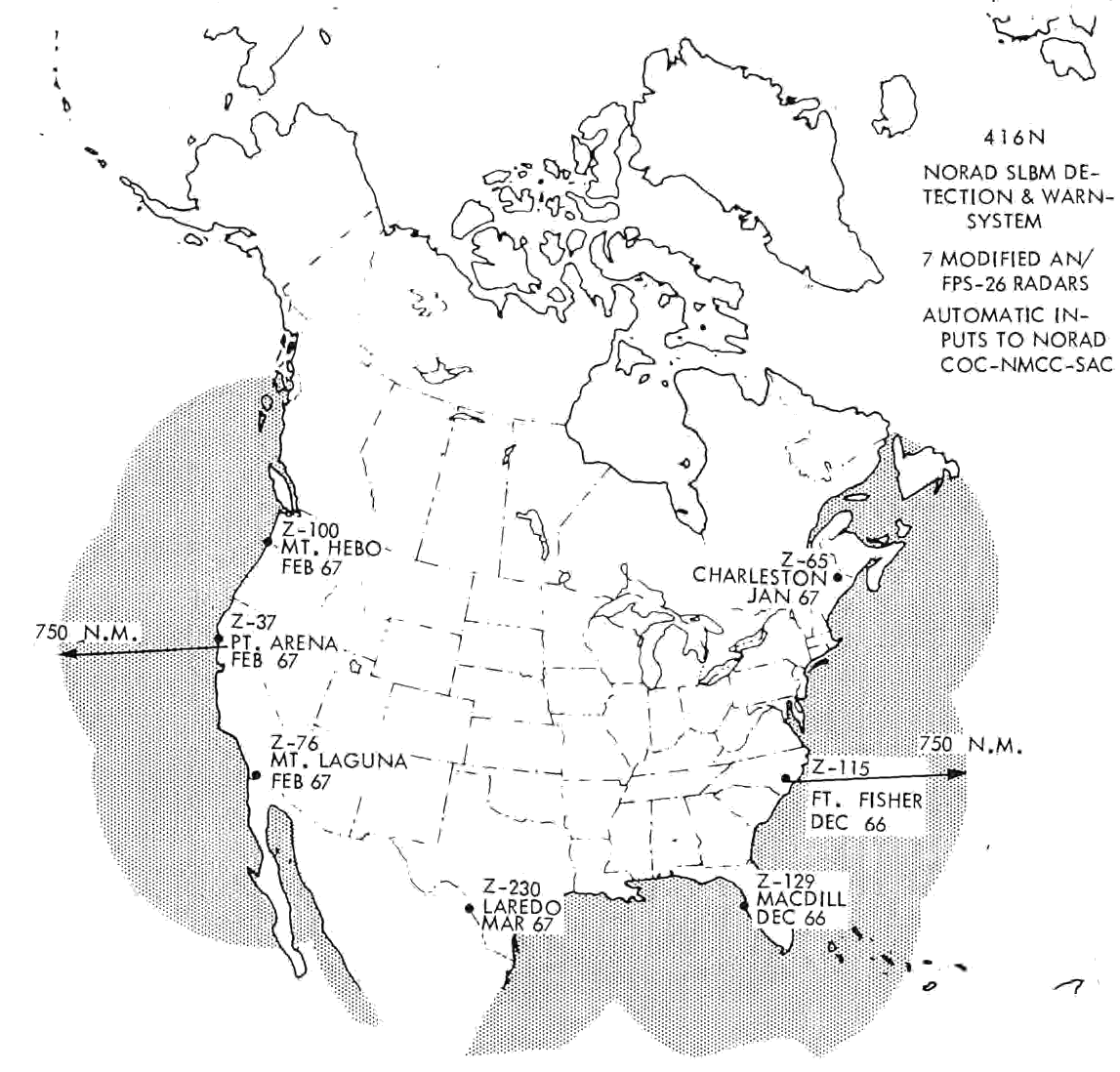
(S) Sites Selected. Requests for system proposals were sent to contractors in March 1965. By mid-1965, with NORAD representation, the SLBM Contractor Selection Board had evaluated proposals and recommended the selection of the AVCO Corporation. In July 1965, DDR&E approved AVCO's plan to modify FPS-26 height finder radars at six prime sites and to install one at Laredo AFB, Texas (Laredo would then be designated site Z-230). Radars were to be modified at the following sites:
Z-37 Point Arena AFS, California
Z-65 Charleston AFS, Maine
Z-76 Mount Laguna AFS, California
Z-100 Mount Hebo AFS, Oregon
Z-115 Fort Fisher AFS, N. Carolina
Z-129 MacDill AFB, Florida
(S) It was expected that the system would be operational by the end of 1967. It was to be designated the AN/GSQ-89 and the modified radars were to be termed AN/FSS-7's. The radars were to give seaward coverage of about 750 nm and were to have three basic modes of operation: search, acquisition, and track. ADC described the method of operation in these terms:
The missile enters the beam and is detected in the search mode. Acting on command of the computer, the radar stops and returns to the designated target position and begins acquisition scan. The computer then directs the radar into the track mode. Tracking is maintained for 6 to 10 seconds, which is sufficient time to permit impact prediction which is at best within a 150 NM CEP. The radar then returns to search mode at the command of the computer. A warning and impact message is generated for transmission to the central processor at the Cheyenne Mountain Complex within 50 seconds from initial detection. At maximum detection range, this provides approximately 7 to 10 minutes of warning.
(S) On 9 December 1965, ESD awarded the contract for the system to AVCO. The system performance specifications indicated that the FPS-85 at Eglin AFB would also be a part of the system and the FPS-49 at Moorestown would be available on an "on-call" basis.
(S) Loss in Radar Coverage. Because the FPS-26 radars would be diverted from SAGE, ADC foresaw an operational problem. On 24 November 1965, ADC pointed out to NORAD that after the radars were converted to SLBM detection and warning there would be some loss in height coverage to SAGE. ADC said these radars could be switched back to the SAGE mode at CINCNORAD's direction with some delay and coverage loss. To offset this loss, ADC suggested resiting the other height finder radar at each site or installing another one. However, ADC said it did not recommend either approach, except for Z-100, because of the cost involved. ADC asked NORAD if a more detailed study should be made with the aim of reducing or eliminating this loss in radar coverage.
(S) On 16 December, NORAD told ADC that it supported "the position that the use-option of the modified AN/FPS-26 radars will be based upon CINC NORAD's estimate of the priority of the threat against North America." NORAD said that after the system gave warning of SLBM launches it should be available for use against the manned bomber threat. In case of a simultaneous attack by bombers and SLBM's, NORAD said CINC NORAD would decide which threat the system would be used against. But NORAD felt that lack of height inputs to SAGE during critical periods would be unacceptable. For this reason, NORAD asked for site surveys at Z-37, Z-76, Z-100, and Z-129 to find out if it was practical to make up for this loss in coverage.
(S) Communications. In the meantime, the JCS were acting on NORAD's communications requirements for the SLBM detection and warning system. On 10 May 1965, NORAD had sent the JCS a request for dual full period dedicated data circuits for sending computer refined data from the sites to the COC. Voice and teletype circuits were to use existing military communication systems such as AUTOVON and AUTODIN. Valid warning data would be sent from the COC to SAC, the National Military Command Center, and the Alternate NMCC over BMEWS circuits.
(S) In December 1965, NORAD learned that the JCS had approved its request and had recommended that CINCLANT and CINCPAC be included as users of the system. The JCS asked USAF to coordinate with NORAD and DCA for including NORAD and Navy communications needs in the system.
One of the most important issues in the anti-bomber defense area was the deployment of a new manned interceptor [*]. A USAF Program Change Proposal (#65-66) was submitted to OSD on 12 August 1965 proposing an increase of $21.6 million in RDT&E funds for FY 1966 and a total obligational authorization for FY 1967 of $205.6 million for continued development and limited procurement of the F-12. The force structure was not proposed at this time. The program was slated to deliver one aircraft a month, starting in FY 1969, to provide an IOC in FY 1969 or early FY 1970.
[* – (U) See Historical Reference Paper #6, "NORAD's Quest for Nike Zeus and a Long-Range Interceptor," 1 July 1962.]
(S) In NADOP 1967-76, dated 15 October 1965, NORAD recommended that funds be provided for the initial production of the F-12 in FY 1967 and for 12 squadrons (18 UE) for U. S. forces and three squadrons (12 UE) for Canadian forces during the FY 1969-70 period. The 1967-76 NADOP also recommended a gradual phase-out of century-series fighters, keeping the best aircraft until the IMI force achieved desired operational capability.
(S) USAF, in a message to SAC, NORAD, and ADC on 26 November 1965, proposed a meeting of the Designated Systems Management Group at USAF on 1 December 1965. USAF indicated that it hoped for a unified position from these commands to wholeheartedly support the Secretary of the Air Force in his position to keep the option to produce and deploy the F-12.
(S) The USAF PCP (#65-66) on the F-12 was disapproved on 11 December 1965.
(U) In his statement on strategic defensive forces, before the Senate Subcommittee on DOD appropriations on the FY 1967-71 defense program and 1967 defense budget, the Secretary of Defense said he proposed to continue the YF-12A flight test program with the three aircraft available. The allocation was $23 million to the YF-12A program in the current fiscal year, plus $5 million for the F-12 program for certain improvements in the ASG-18/AIM-47 fire control and missile system [*]. The Secretary of Defense also indicated that the allocation for FY 1967 would be $20 million for the YF-12A test program and $10 million for continuing the F-12 program.
[* – (U) The ASG-18/AIM-47 system could be used on either the F-12 or the F-111 interceptor.]
BOMARC CIM-10B
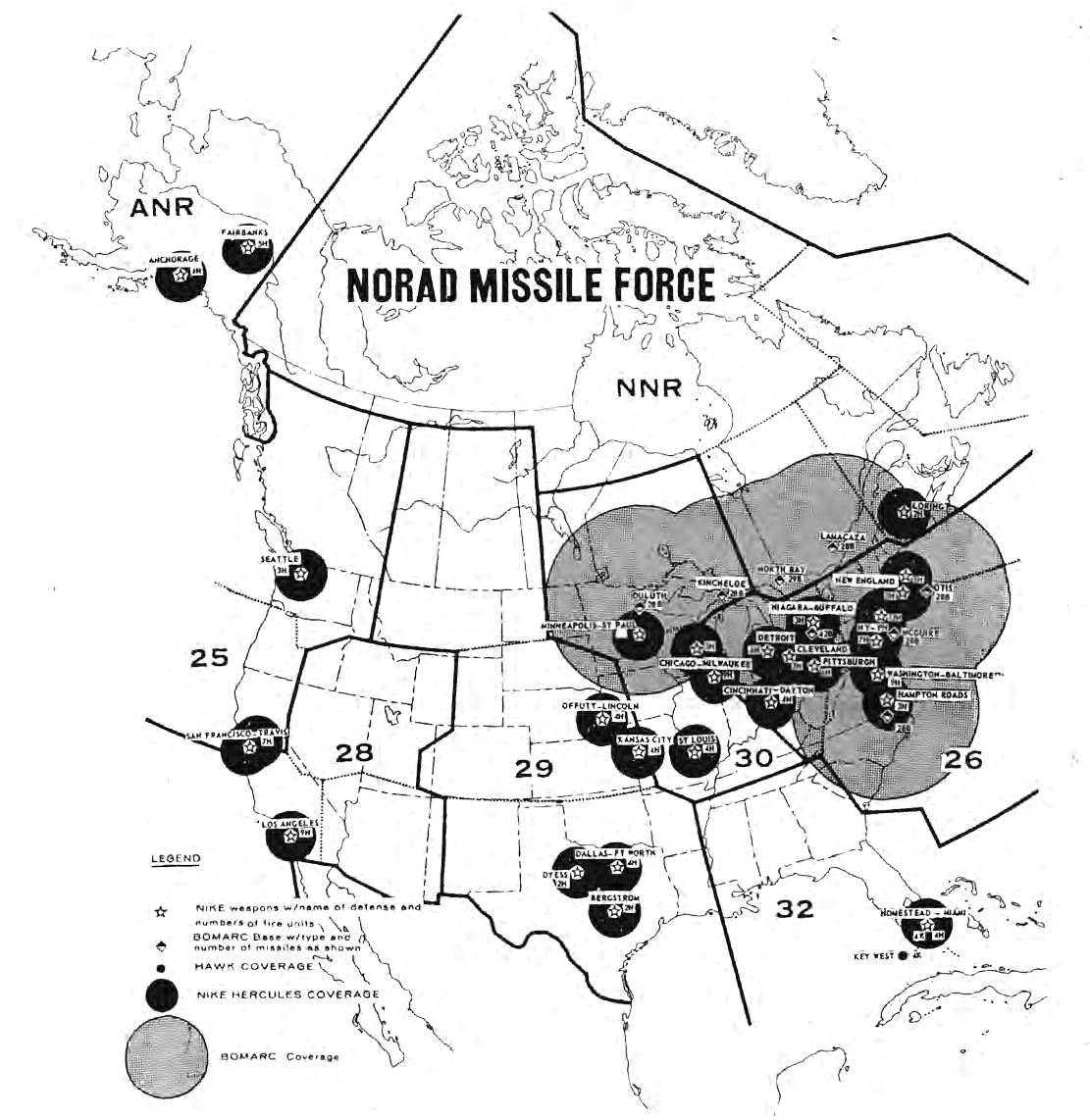
(S) The NORAD BOMARC inventory was cut by two missiles during the first half of FY 1966 as a result of the Combat Evaluation Launch (CEL) Program [*]. By 1 January 1966, NORAD had seven squadrons with 28 missiles each and an eighth, the 35th ADMS, Niagara AFMS, with 42 missiles.
[* – (U) For a description of the CEL Program, see NORAD / CONAD Historical Summary, July-December 1964, pp. 77-80 .]
(S) In a message to ADC and NORAD on 3 December 1965, USAF said that OSD had approved USAF PCP #65-157 on 29 November 1965. This PCP had requested authority and funding for regular RCAF participation in the BOMARC B CEL Program. NORAD said on 6 December 1965 that each of the eight BOMARC Squadrons would process and fire one missile each year under the current program. NORAD also indicated that the next 15 missiles committed to firing would come from the Niagara BOMARC squadron. At the conclusion of the phase, Niagara would have the same number of missiles (28) as the other seven squadrons. Thereafter, a gradual reduction of each BOMARC squadron was anticipated.
NIKE HERCULES REDEPLOYMENT
(S) Background. NORAD had recommended the redeployment of 18 Hercules units from nine soft SAC bases and four units from Thule AFB since 1962. NORAD proposed that the 22 units be redeployed to unprotected urban/industrial areas.
(S) A CONAD study of the redeployment question, on 24 March 1965, confirmed NORAD's position, as well as suggesting new sites, numbers of fire units and programmed time periods. The four units from Thule were withdrawn from NORAD operation by 1 June 1965 with their future disposition not decided. During May 1965, the JCS studied an Army proposal to delete the 22 Hercules units from the Five Year Force Structure and Financial Plan during FY 1966. At this same time, the JCS requested any additional comments from CINCONAD. CINCONAD confirmed the position that the 22 Hercules units be kept and redeployed as recommended in the March 1965 study.
(S) On 27 May 1965, the JCS recommended to the Secretary of Defense that eight Hercules units be used for USARSTRIKE and Guam requirements and that the remaining 14 units be deactivated in FY 1966. Adoption of this course of action would remove all 22 units from the NORAD terminal defense force.
(S) Status. In August 1965, NORAD reaffirmed its position as well as pointing out that it desired to resite five batteries in the Washington-Baltimore defense area to enhance the defenses of hardened command and control centers in that area.
(S) However, the Secretary of Defense decided to inactivate all 22 fire units. On 8 December 1965, the Secretary of Defense announced plans to consolidate, reduce, or discontinue certain Department of Defense activities to produce additional annual savings. Part of these plans included the inactivation of the following Nike Hercules defenses:
3rd quarter FY 1966
Barksdale AFB Defense
Fairchild AFB Defense
Turner AFB Defense
Robins AFB Defense
4th quarter FY 1966
Loring AFB Defense
Lincoln-Offutt AFB Defense
Dyess AFB Defense
Bergstrom AFB Defense
(S) There were two fire units at each of these bases except for Lincoln-Offutt AFB Defense where there were four, making a total of 18 fire units. The four units which had been withdrawn from Thule in June 1965 were also permanently deleted from NORAD's inventory.
(S) In a message to NORAD on 15 December 1965, ARADCOM set out the following dates for the units to be declared non-operational:
22 December 1965 for units to be inactivated 3rd quarter FY 1966.
1 March 1966 for units to be inactivated 4th quarter FY 1966. [*]
[* – (S) The original non-operational date for these units was 1 April 1966, but was moved up by NORAD on 28 February 1966.]