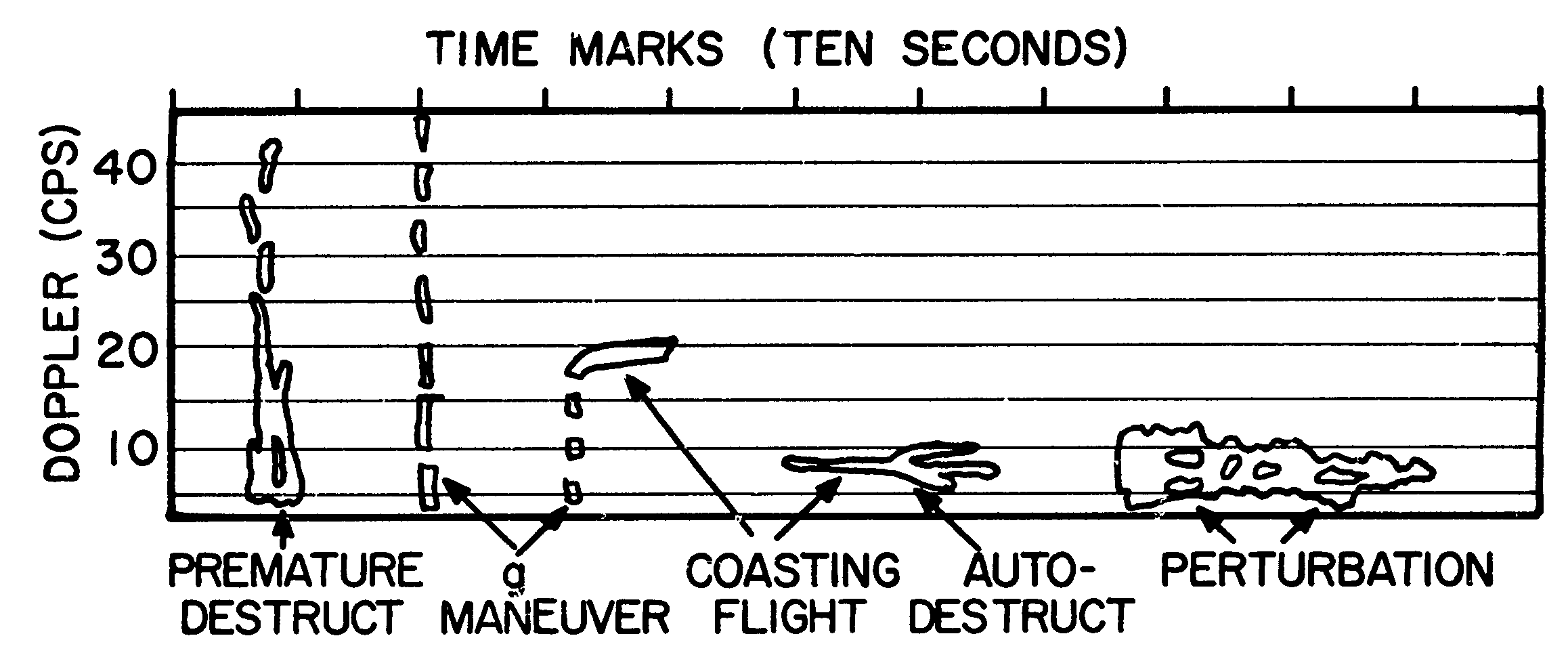
Fig. 1 - Some features of the Sprint missile radar signature
NRL Memorandum Report 1939
Copy No. 41 of 100
Copies
F. H. UTLEY, C. B. TESAURO, W. C. HEADRICK,
J. M.
HEADRICK, AND F. E. WYMAN
Radar Techniques Branch
Radar Division
and
R. J. SCHWEITZER
General Electric Company
October 1968
U.S. NAVAL RESEARCH LABORATORY
Washington, D.C.
SECRET
Downgraded at 12 year intervals;
Not automatically
declassified.
– – – – – – – – – – – – – – – – – – – – – – – – – – – – – – – – – – – –
This document contains information affecting the national defense of the United States within the meaning of the Espionage Laws, Title 18, U.S.C., Sections 793 and 794. The transmission or revelation of its contents in any manner to an unauthorized person is prohibited by law.
In addition to security requirements which apply to this document and must be met, it may be further distributed by the holder only with specific prior approval of the Director, Naval Research Laboratory, Washington, D.C. 20390.
– – – – – – – – – – – – – – – – – – – – – – – – – – – – – – – – – – – –
Abstract
Problem Status
Authorization
INTRODUCTION
RADAR EQUIPMENT
MISSILE CHARACTERISTICS
MISSILE RADAR SIGNATURE
TEST RESULTS
CONCLUSIONS
ANTICIPATED WORK
SOURCES OF REFERENCE DATA
FINAL FLIGHT TEST REPORTS ON SPRINT MISSILE
– – – – – – – – – – – – – – – – – – – – – – – – – – – – – – – – – – – –
In an attempt to determine the feasibility of OTH detection of ABM devices the Naval Research Laboratory commenced observations in July 1967, of Sprint missile launches from the White Sands Missile Range. For these tests the NRL backscatter radar was deployed in a coherent pulsed mode with transmitter power above 1MW peak on radio frequencies near and above 20 MHz. Of 10 tests monitored 8 have yielded detected signals that seem related to the launch event. System insensitivity in one instance and launch abort in the other precluded significant results on the other two tests.
Real time countdown information for each test has been supplied by phone to the NRL radar site. Digital processing has permitted 60 dB dynamic range, high resolution velocity analysis. Range sampled doppler/time analysis has permitted real time assessment of target returns as well as a means for signal-to-noise enhancement in post flight study. All tests records have been subjected to much scrutiny to identify target echoes that evidence good correlation in two characteristics; one, slant range to the echo and two, real time agreement with a missile function such as staging, "g" maneuvers, free flight or flight termination either in a premature cessation or in a planned end of flight autodestruct. These two correlations have been the sole criteria for target identification to date. Each of the signature types are discussed. A full understanding of the mechanism for each type is not yet in hand. Free flight cross sections are indicated to be at least 10³m².
Speculation as to how hypervelocity vehicles at low altitudes generate detectable cross sections provokes further investigation. Studies are now in progress along the lines of doppler matching, (based on better post flight information), aerodynamic drag computations and E-region perturbations. Other investigators of atmospheric physics have indicated upper atmosphere disturbances due to Mach shock waves (vertically propagated), a likely occurrence. This possibility is being studied. Other findings will be reported to the community as soon as they are available.
This is an interim report; work on the problem is continuing.
AUTHORIZATION
NRL Problem R02-23
Project RF
001-02-41-4007
– – – – – – – – – – – – – – – – – – – – – – – – – – – – – – – – – – – –
(S) Considering the growing interest in anti ballistic missile (ABM) technology, it was determined to deploy the Naval Research Laboratory's over-the-horizon (OTH) radar against Sprint missile launches from the White Sands Missile Range. In an attempt to characterize the ABM launch signature, these observations were initiated during the summer of 1967 and have continued to date. Thus far, of ten attempted detections significant signal-to-missile correlations have been achieved for eight launches.
(S) Observations have been implemented with real time launch count-down information relayed to NRL by personnel of the Naval Ordnance Missile Test Facility at WSMR. The Sentinel Systems Command at Huntsville, Alabama has furnished NRL with comprehensive post-flight reports, which have permitted preliminary analyses of the various tests to be made. Preliminary analysis consists of an attempt to match received radar signals with missile behavior in both slant range and time of occurrence. Several types of missile-related signals have been tentatively identified which, subject to further confirmation, may constitute a unique radar signal characteristic for ABM launches. This report will describe these signals. A description will be given of the radar equipment used. The nominal performance of a Sprint-type missile will be outlined. Observational results will be presented in the form of range-gated doppler frequency vs time records. Missile-related signals will be specified as to their time and character of occurrence. Future work intended at NRL will be indicated.
(S) The NRL OTH radar is a coherent, pulse-doppler system operating in the high frequency (HF) band (3 to 30 Mc) and utilizing ionospheric refraction for remote site illumination. For the Sprint launches considered, the transmitter was operated in the megawatt (1 to 2 Mw peak power) region. The antenna used for transmitting and receiving consists of two colinear elements in a corner reflector at an elevation of approximately 220' above the earth. One-way antenna gain realized was on the order of 13 to 18 db for operation near 23 Mc.
(S) The radar was normally operated at a 90 pps repetition rate. The transmitted radio frequency pulse was of a cos² wave form with base length of 650 to 700 microseconds. Receiver gating excluded local (less than 100 naut. mi.) aircraft and permitted the maximum sensitivity for targets in the slant range segment from 1350 naut. mi. to 1800 naut. mi. The ground range from the radar site to the Sprint launch site at WSMR is approximately 1500 naut. mi. The expected slant range to the area of interest will vary from 1550 to 1650 naut. mi. depending upon propagation mode and ionospheric refractive layer height. The skip distance was generally such as to permit unambiguous ranging. Earth backscatter returns normally began at slant ranges of the order of 950 to 1000 naut. mi.
(S) The Sprint missile is launched on a northerly bearing of 353° true. The radar look bearing is 265° true, presenting a nearly broadside geometry in the plan view. The elevation angle of arrival of the radar signal at the missile will modify this included angle slightly as will the missile angle of attack. Typical elevation angle of arrival is within about 5 degrees of the horizontal. The effect of the nearly orthogonal geometry is to greatly reduce the missile velocity vector component in the direction of the radar. This permits more manageable doppler frequency analysis which has been especially helpful in this early investigation.
(S) Received signals were processed through the recently installed, 60-db dynamic range velocity processor. The doppler-time analysis format was used. Typical doppler-time records were of 110-second length. Some time records to be presented began 10 or more seconds before Sprint missile launch time, while others commenced at lift-off. The records are marked to make this apparent. All records have been processed through a 0.6-cps doppler filter unless otherwise noted.
(S) The Sprint missile is the follow-on vehicle in the Nike-X program of intercept technology. It is presently being tested at the White Sands Missile Range. Firings normally take place from silos near Launch Complex 50. The Sprint is a two-stage, solid-fueled, high acceleration vehicle intended for short range warhead intercept application. The missile length is approximately 27', with the first stage being 12' and the second being 15' long. The first stage diameter is 42 inches; the second stage, 30 inches.
(S) First stage steering is dependent on the injection of freon into the engine throat for thrust vector control. The second stage is guided with the assistance of hydraulically driven aerodynamic vanes. The vane control system exhibits very rapid response (200 millisecs) to G maneuver commands. Most maneuvers (except first stage pitch-over) are programmed to occur either during or after second stage powered flight. In early tests the maneuvers consisted solely of pitch commands, either soar or dive. In more recent tests the missile has also been exercised in lateral accelerations in addition to maneuvers in the pitch plane.
(S) The typical flight achieves a maximum altitude in the range of 40,000 ft. to 60,000 ft. in a flight time which might vary from 11 to 16 seconds. Normally flights are terminated either after a preset time or when the second stage descends through 5000 feet altitude. The mechanism of termination is autodestruct in which a separation charge "blows" the second stage into 3 or more separate pieces, the larger pieces being the missile guidance section (MGS), the warhead section and the motor and aft skirt section. These pieces then continue their descent to the earth on slightly different trajectories from that of the second stage prior to autodestruct. Nearly all the pieces of the entire missile are recovered in a routine search and survey. Second stage pieces carry to a range of 120,000 to 140,000 ft. for a normal flight.
(S) The following table specifies nominal thrust, acceleration and burnout velocity for the two stages and the free flight acceleration.
|
|
Burn Time Seconds |
Thrust K lbs. |
Acceleration G |
Velocity ft/s |
|---|---|---|---|---|
|
first stage |
1.8 to 2.0 |
600 to 750 |
130 due to 1st stage boost |
5,500 |
|
second stage |
2 |
150 |
90 due to 2nd stage boost |
9,500 to 10,200 |
|
free flight |
|
|
10 to 60 impressed in pitch & lateral maneuvers. |
|
(S) Intense interaction between the atmosphere and the hypervelocity vehicle throughout most of the flight is evident in that the recovered pieces show ablation erosion of fractional parts of an inch. Second stage heat shield material is often torn off in sizeable pieces. It is possible that this ablative character of the vehicle lends enhancement to the HF radar cross section of the vehicle in flight.
(S) Figure 1 depicts by way of a simple sketch some features of the Sprint missile radar signature. Time advances left to right from start to end of each signal but sequence and time spacing of the several signals are not necessarily as shown. The elements are intended to be representative of signals that have been correlated with actual missile event times such as g maneuvers, free flight and autodestruct. Not all of these types of signal are seen on each and every test; on some tests perhaps only one of the five types of signals has been detected. A larger number of observations and detections would lend confirmation to the signal characterization. Each individual type of signal has been apparent in at least two tests. Although the signals are not referenced to a launch event on the time scale, typical signal persistence can be estimated. The doppler extent of the signals can also be estimated with reference to the doppler scale. The maximum unambiguous doppler resolvable is 45 cps (as shown) for 90 pps pulsed operation. The doppler extent and time duration of the signals are essentially as viewed on a given test. A brief explanation will be given of each element of the signature as well as the related missile behavior.
(S) Premature Destruct - The premature destruct of the missile is caused by a malfunction in guidance or a failure in one of the two motors of the missile or some other air frame breakup. In at least one recent test the target intercept computer (TIC), which performs the guidance function for the vehicle, commanded an improper maneuver which resulted in missile structural failure. A multitude of telemetry-type sensors aboard the vehicle constrain it to operate within limits. When any of the flight parameters are violated the flight safety sequence is triggered and the flight is terminated. Often the missile has destructed itself before the flight safety procedure for flight termination has been completed. In the process of inadvertent self-destruct the vehicle may very likely pass through very extreme maneuvers (e.g. guidance control has vehicle locked in a dive) prior to actual destruction. This behavior represents perhaps a high-g maneuver. An echo from a vehicle in such a maneuver would possess a very wide band doppler character.
(S) The first echo shown in Figure 1 is an approximation to a signal detected for a vehicle which was known to have failed shortly after second stage ignition. It is noted that signals are present almost throughout the unambiguous doppler bandwidth (45 cps). The signal appears to endure for a longer period of time at lower doppler frequencies, the total extent in time being of the order of a few seconds, say 3 to 6. The higher doppler glints appear to be of shorter lifetime; this is thought to be due to the higher acceleration being of much shorter duration.
(S) The premature destruct is a fatal flight event which prohibits, with one exception to be mentioned below, the occurrence of the later signals shown.
(S) G Maneuver - The second signal seen in Figure 1 seems to be related to vehicle maneuvers by reason of time coincidence. The stippled or blob-like appearance occurs generally at the time a g maneuver is either commanded on or commanded off. The rise and fall times of the missile response to such commands are very short, of the order of 200 milliseconds. It is tentatively believed that the fast entry into and emergence from g maneuvers give a characteristic vertical stack of blips of apparent periodicity in doppler. The blip spacing in doppler seems related to the transient time (that is, frequency side lobes due to the short event time). Modest confirmation of this phenomenon has been achieved with simulated signal studies.
(S) The lower doppler portion (below 15 cps) of the third signal also shows the characteristic cobblestone effect due to a g maneuver.
(S) Coasting Flight - Parts of the third and fourth signals evidence a discrete constant doppler frequency for a certain duration of time. These signals have been apparent in the test records for times during which the second stage was not being maneuvered but was in coasting flight. Generally this period of nearly constant velocity of flight is terminated by the next programmed command, either a maneuver or autodestruct. The constant velocity target is best matched to the velocity form of analysis and offers the optimum in terms of detectability. There are many instances in the test records when a near-constant velocity target should have been detected and was not. This is probably due to missile orientation relative to the intercepting radar ray or due to vagaries of ionospheric illumination. When this signal is discernible it normally represents a radar cross section appreciably larger than its physical dimensions. This enhancement in echoing area is explicable in terms of local ionization or, perhaps to a smaller degree, ionospheric focusing. When this type of signal is detected its times of onset and cessation agree favorably with missile event times. The duration of this signal will vary from 3 to 10 seconds.
(S) Autodestruct - The latter part of the fourth signal type in Figure 1 represents the signal that has been correlated with the missile autodestruct function. The autodestruct function is triggered at a preset time or with an altimeter switch when the second stage descends through 5,000 feet. If triggered at a preset time autodestruct can occur at a somewhat higher altitude, perhaps up to 15,000 to 20,000 feet. The autodestruct function serves the purpose of separating the second stage complex into three major pieces. Often more than three free bodies result. The separation somewhat lessens impact damage to the second stage units. At separation the pieces assume slightly modified ballistic trajectories, with perhaps slightly different velocities relative to the radar. It is only conjectured at this point that the multiple doppler lines which emanate from a low frequency centroid at autodestruct time are related to the various velocity elements present. An attempt is now in process to relate the duration of the multiple echoes to the elapsed time between autodestruct and impact.
(S) It is worthy of note that the premature destruct signal differs appreciably from the autodestruct signal. Information communicated from the Sentinel Systems Command at Huntsville is that the two destructs are mutually preclusive. If there was a premature destruct there won't be an autodestruct and conversely if there is a flight ending autodestruct then it is obvious that there was no premature destruct. Successful flights might endure 30 to 40 seconds before the autodestruct function occurs. The autodestruct signal normally appears centered on a low doppler frequency which seems to be consistent with a lower velocity (less than 2500 ft/s) at the conclusion of the flight.
(S) Perturbation - The last signal to be seen in Figure 1 is representative of a signal which is believed to be caused by a disturbance in an ionospheric layer through which the radar rays penetrate. This signal has its onset in the time frame 80 to 120 seconds after missile launch. It appears centered about a low doppler frequency and has a duration typically of from 10 to 30 seconds. The duration of one such signal, however, was greater than 2 minutes. The doppler spread of the echo apparently diminishes to a discrete non-zero frequency prior to the signal's disappearance, such a frequency being appropriate for ionospheric wind velocity. The records to be shown do evidence meteor echoes, both of nose and of trail.
(S) It is suggested that a possible mechanism for the perturbation signal might be the transportation of missile-shorn debris to the E layer of the ionosphere. Whether this debris presents a source of mechanical agitation or chemical additives is not certain. However, preliminary machine computations of ballistic trajectory with zero drag do indicate that particles of matter separated from the vehicle between T + 3 and T + 7 seconds and having a high weight-to-drag ratio may impinge upon or pass through the E layer (110 km) in the time frame 80 to 120 seconds. In fact, the no-drag computation indicates that particles ejected at certain critical times may apogee above 150 km altitude. Further analysis is being pursued to test the effect of atmospheric drag on these particles. Because ballistic coefficients are uncertain, an assortment of coefficients will be examined. Present understanding is that the events giving rise to the perturbation signal happen early in the flight. If so, the perturbation signal may well be observed subsequent to a premature destruct.
(U) It is hoped that this brief introduction to these types of signals will somewhat ease missile event signal recognition in the actual test records which follow.
(S) The criteria for recognition of a Sprint-related radar echo have developed in a cumulative fashion through the comparison of the early test records with subsequent observations. The prominent requisites for signal identification are its time and slant range of appearance. Substantiated detections are based on these considerations. This section will include a summary of test results as well as a treatment of each observation from which the summary has been drawn.
(S) Table 1 lists the prominent detection results deduced from ten observations beginning in July of 1967 and continuing through April 1968.
(S) Concerning missile fate, the missile is adjudged to have been a failure if it did not fly its complete course to an autodestruct function in the neighborhood of 30 to 40 seconds into the flight. Even though these vehicles did not have a complete flight, many of the intended test objectives were satisfied. From the standpoint of the Sentinel Systems evaluators even a short flight is of much value. From the standpoint of NRL interest all flights are of great value in the attempt to characterize the uniqueness of ABM launch activity.
(S) The five columns under the heading of correlated missile signature represent the five types of signals depicted in Figure 1 and described in the preceding section "Missile Radar Signature". The notation at the bottom of the table gives meaning to the marked and blank slots in the table. A few of the elements of the table are shown to need further confirmation. This matter will be discussed in the later section "Anticipated Work."
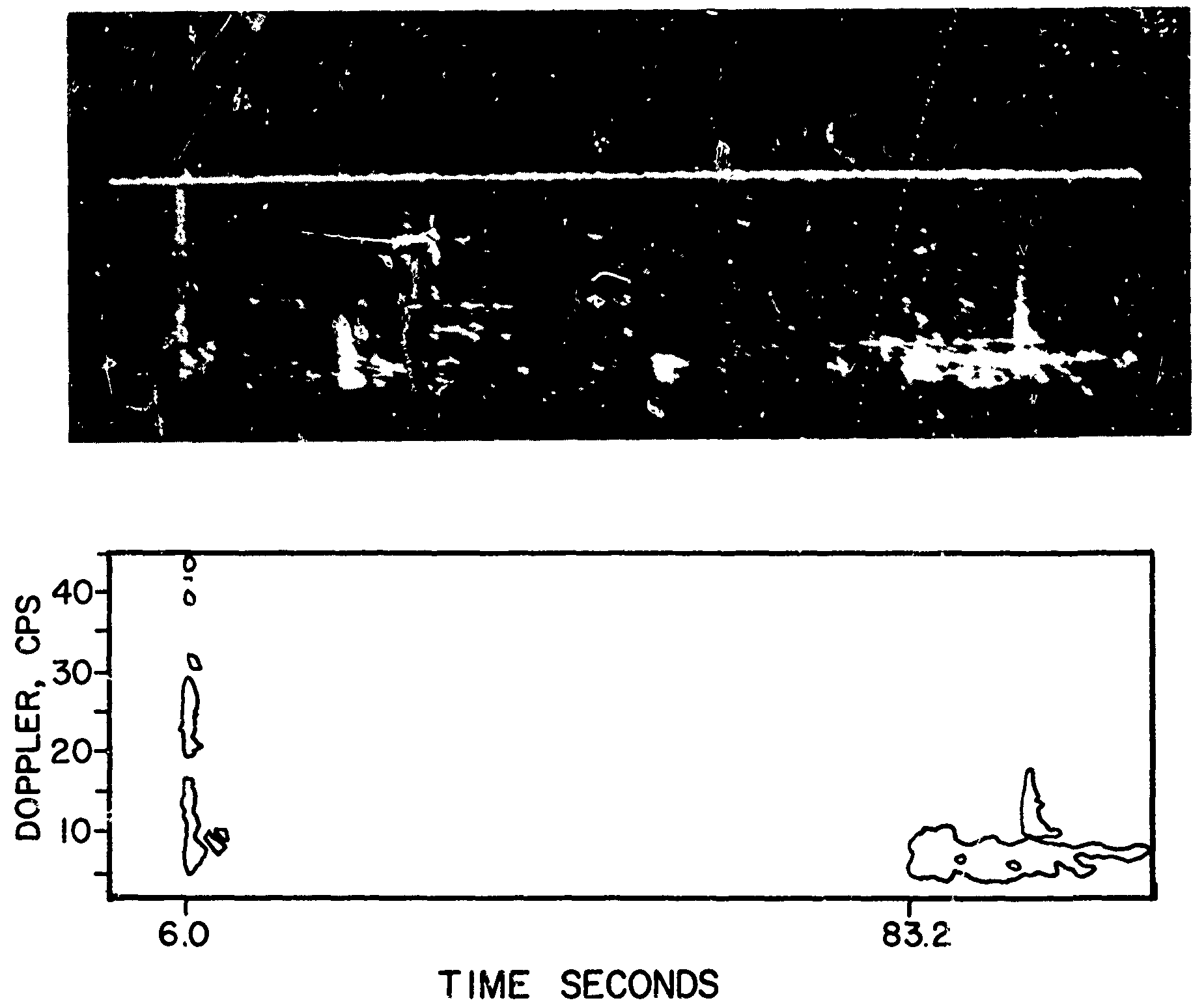
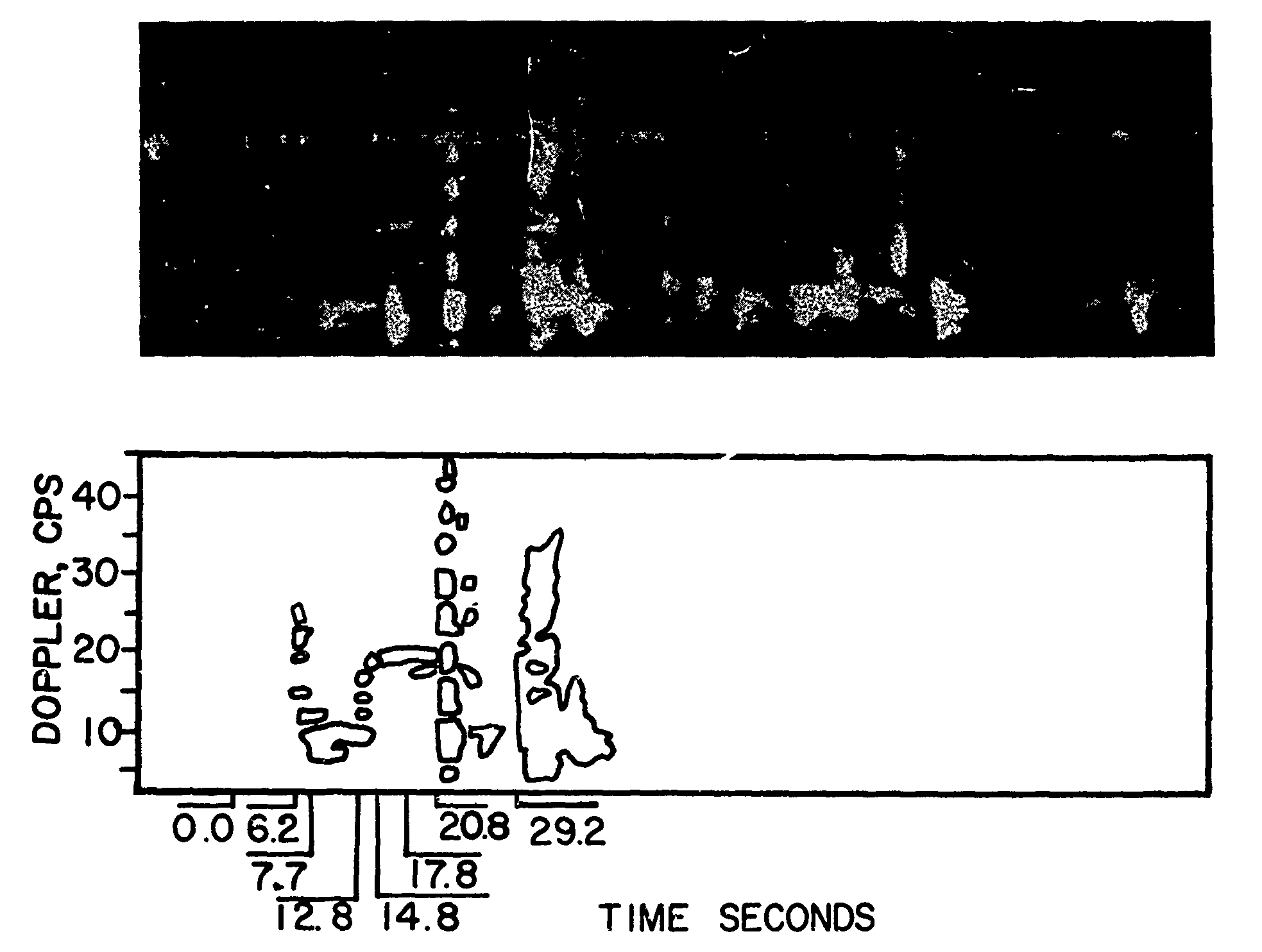
(S) In the figures that display the test results the upper part of each figure will be a photo reproduction of the actual radar doppler time record and the lower part will be a line drawing which is intended to show, by selective extraction from the photo, those signals deemed to be missile related. The neglected signals which seem similar in character to those extracted have been omitted because of lack of time and/or range conformation. Each doppler time record is a picture taken from a cathode ray tube type readout with signals appearing as intensity modulation. The video is comprised of either one sample or the average of two samples in range depending on which rendered the best signal-to-noise ratio. The range samples are spaced 20 naut. mi. apart. The analysis time measurements made within a given doppler time record are good to a fraction of a second, but time resolution is set by filter bandwidth and signal-to-noise ratio. The actual time of record initiation is, however, variable within ± 1.0 second.
(S) The test records have been scrutinized for slant range agreement with that predicted. Various elements of a missile related signature, for a given test, often appear in adjacent range samples but normally not with range extent greater than the transmitted pulse. The perturbation signal, understandably, doesn't always appear at the same point in range as a maneuver signal for example. Similar echoes for two different tests might well occur at dissimilar ranges. This difference is no doubt due to the geometry of propagation for the given times being compared.
(S) Interfering signals in contrast, do not indicate preferential ranges but rather appear in nearly all ranges simultaneously. It has sometimes happened that a missile related signal, perhaps weak, has been detected in only one range sampling.
(S) The heavy variegated line that appears at 30 cps doppler in nearly all of the doppler time records is a spurious system response due to 60 cps. Below the line drawing for each test the salient missile behavior will be described in a table of times for given functions. Nearly all doppler time records are of 110-second duration.
(S) 18 July 1967 - Figure 2 shows the radar results obtained for this test. Signals acquired are likely to be associated with a premature destruct and an E layer perturbation. It can be noted from the table that the missile was destroyed at T0 + 4.3 seconds. The spread doppler signal has its onset at T0 + 6.0 seconds. A perturbation-type signal appears with onset at 83.2 seconds. The presence of a perturbation signal, as envisioned at this time, seems to be dependent on the magnitude of the vertical component of the velocity achieved by the missile in the first few seconds of flight (3 to 7 seconds). This vehicle even though destroyed reasonably early in flight had a vertical velocity of more than 7100 ft/sec just prior to missile breakup. This velocity is sufficient to permit ejected pieces to come to apogee above the E region of the ionosphere. So, it seems entirely feasible to have a premature destruct and still detect a later perturbation signal if in fact missile hardware, etc., is the perturbing mechanism of the E region. The signal that appears in the reproduced picture at approximately 23 seconds is probably a meteor echo.
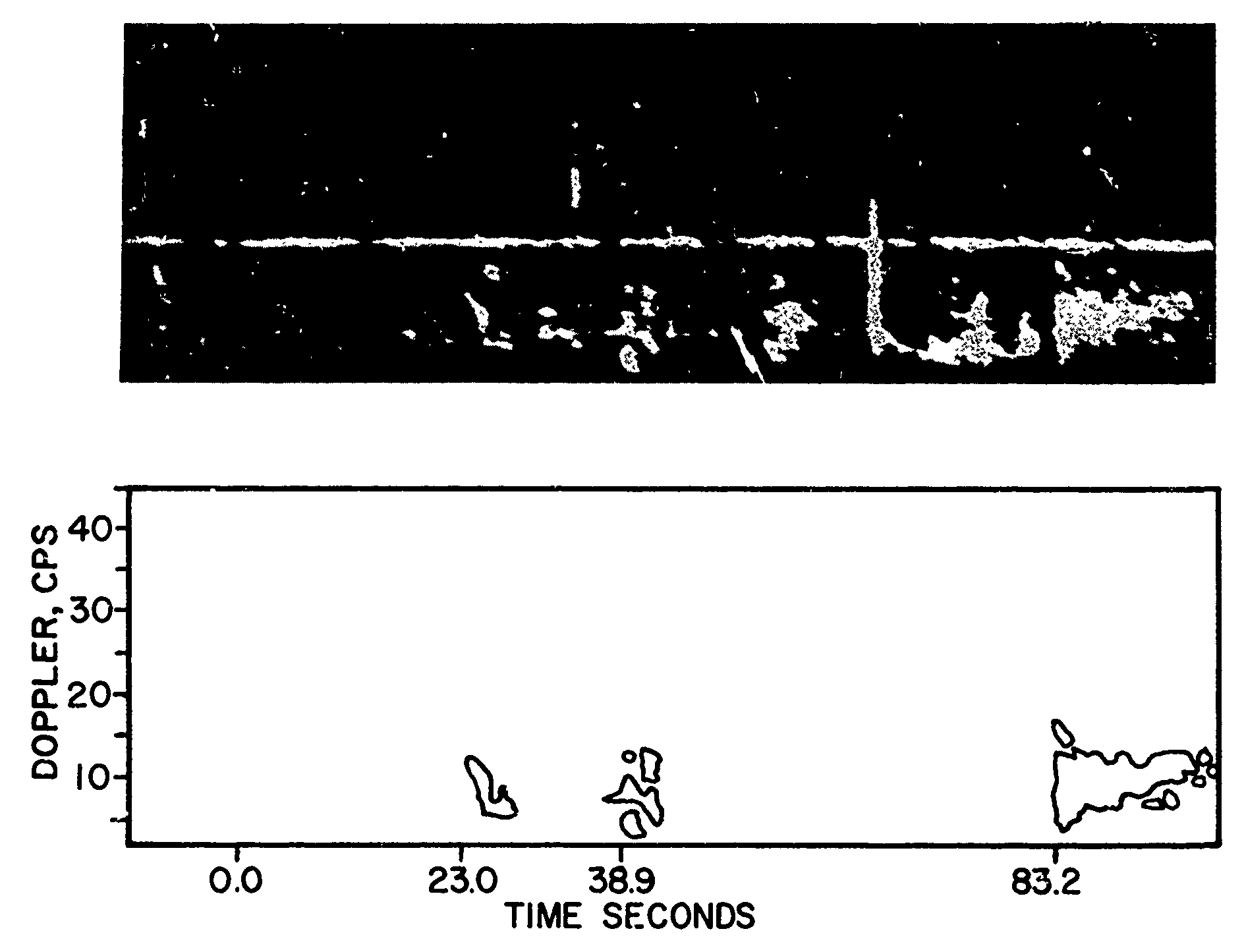
(S) 8 August 1967 - Figure 3 shows test results for this date. This flight was successful and flew well until intended autodestruct at T0 + 39.8 seconds. Signals of note are an unidentified echo starting at 23 seconds, a group of echoes beginning at 38.9 seconds and a perturbation like signal with onset at 83.2 seconds. The autodestruct signal seems consistent with missile behavior. The perturbation signal lasts for about 17 seconds.
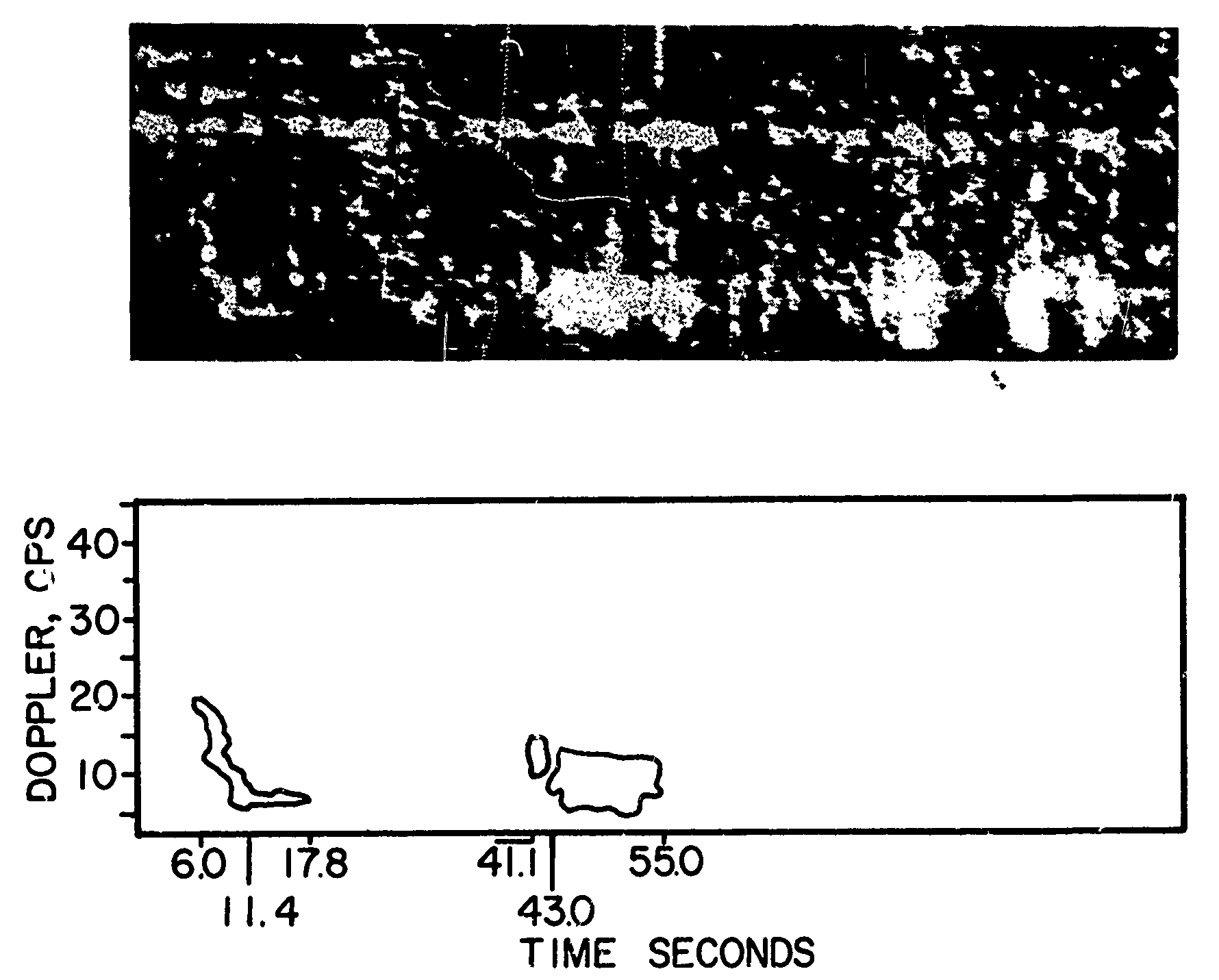
(S) 10 October 1967 - Figure 4, which exhibits the results for this date, shows a rather complex signal beginning at T0 + 6.0 seconds and continuing until 17.8 seconds. The early part of this signal, until 11.4 seconds, possesses a changing doppler while the later part evidences a constant velocity of about 6 cps. In comparing this signal with the missile functions it is seen that some time coincidence exists for the early part with a 41 g maneuver beginning at 5.4 seconds and terminating at 10.7 seconds. After 10.7 seconds the vehicle is in coasting flight until 23.6 seconds. This very well accommodates the constant velocity line from 11.4 to 17.8 seconds.
(S) A modest time discrepancy is apparent in the time of onset of the autodestruct signal as compared with the autodestruct time. This difference may be resolved when more information is available about the scattering cross section of the second stage composite after it is separated into several pieces. This matter is under study at this writing.
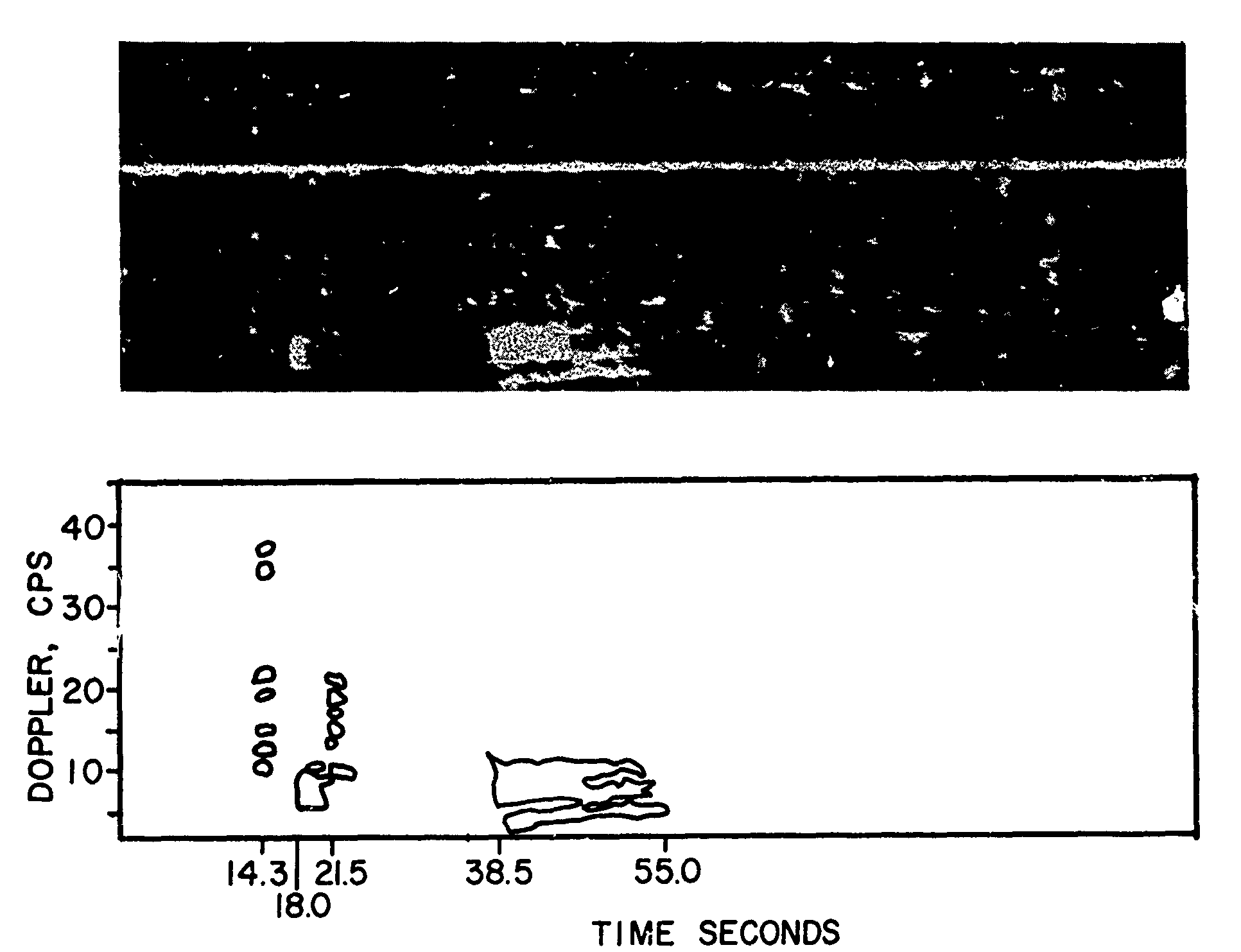
(S) 31 October 1967 - The results of this date are shown in Figure 5. Maneuver echoes seem to be correlated for signals at 14.3 and 21.5 seconds. The 14.3 second signal bears association with a 30 g maneuver commanded at 14.2 seconds. Most of the g maneuvers are impressed and released in a step function fashion with response rise and fall times of the order of 200 millisecs. The maneuver impressed on the vehicle at 14.2 seconds in fast response fashion was not removed the same way but rather was "ramped off" to zero g beginning at 21.5 seconds. The maneuver was completely removed by 24.2 seconds. The 21.5 second signal seems to be identified with the initiation of the maneuver ramp off.
(S) The signal that begins at 18.0 seconds doesn't eviden.. [ILLEGIBLE] relationship with missile parameters now known. It is believed to be related to the missile in some way due to its character and time of occurrence. In the past in observations of other types of missiles there have appeared from time to time enhanced signals when the vehicles passed through orthogonality with the radar beam. Determination of this broadside time requires precise trajectory data. When these are in hand an examination will be made of the possibility that signals not otherwise explained relate to the momentary orthogonal aspect of the vehicle.
(S) Also present in Figure 5 is a quite strong signal at moderately low dopplers that has its onset 6 seconds after the autodestruct function time. This time difference is similar to that for the test on 10/10/67. Even though there exist several mechanisms for this behavior the particular explanation is not yet available.
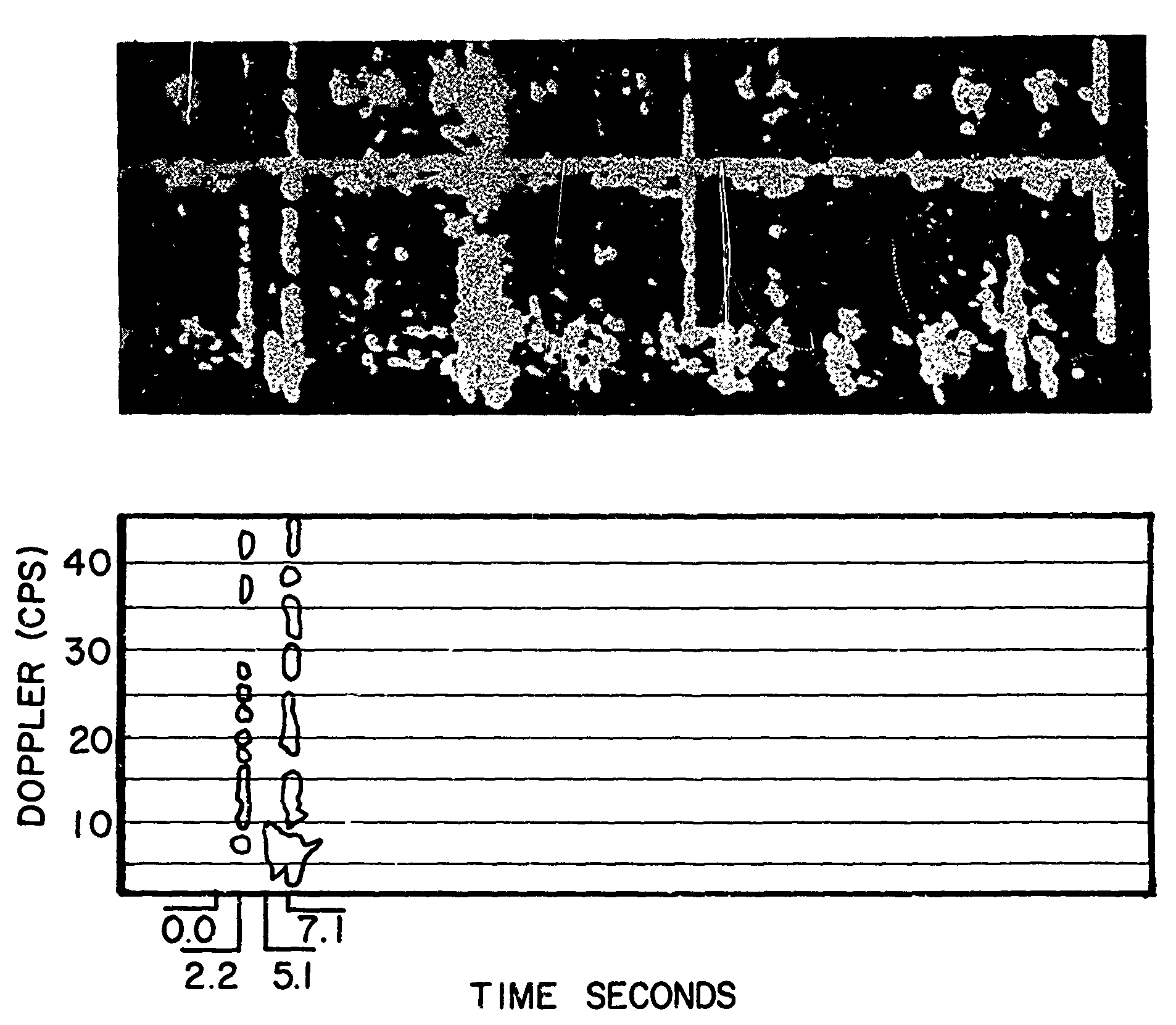
(S) 20 November 1967 - Figure 6 shows the data obtained for this test, which had an early failure. The missile was destroyed shortly before 7 seconds into the flight. Of all the tests observed, this record is the only one that seems to have a signal that corresponds to staging, i.e., separation of the first and second stages. Sentinel System people have indicated that there is some short term g disturbance associated with staging. The agreement in time is quite good. In general the second stage is normally ignited shortly after staging (within 200 ms). This particular flight was programmed, however, to delay second stage ignition for approximately 3.5 seconds to 5.6 seconds. A radar signal appeared at 5.1 seconds and continued until 7.1 seconds when a maneuver type signal appeared. This signal was due to the premature destruct. It bears resemblance to a maneuver type signal because the missile was subjected to a severe lateral maneuver of 218 g prior to missile breakup. No perturbation was evidenced for this test. Premature destruct precluded normal end of flight autodestruct.
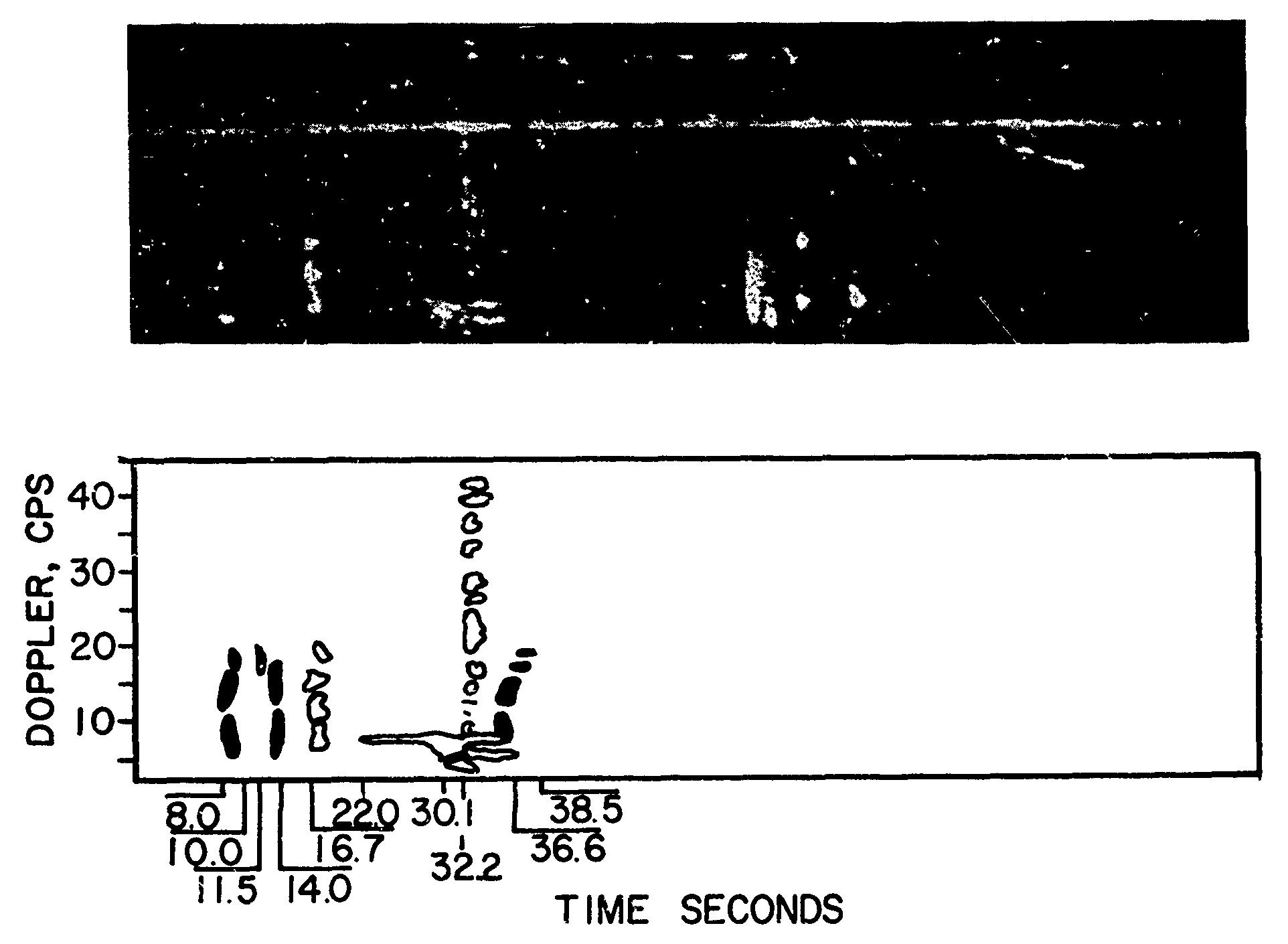
(S) 11 December 1967 - Figure 7 embodies the results for this test showing evidence of maneuver, free flight and autodestruct signals. The line drawing is a composite of signals extracted from two separate doppler time records. Only one photo record is shown. The signals of the two film records are shown differently in the line drawing; one is open and the other is filled in. This test was a highly successful one. The second stage sustained five maneuvers ranging from 32 g to 63 g.
(S) This record shows striking coincidences for the second and third maneuvers at 8.0 to 10.0 seconds and 11.5 to 14.0 seconds. A signal also appears at 16.7 seconds which seems to correspond with the turnoff of the last maneuver. The second stage is apparently seen in a coasting condition from 22.0 seconds to the autodestruct time of 32.2 seconds. It maintains a fairly constant doppler frequency through the time interval. There appears to be some doppler broadening prior to autodestruct. Insufficient information is available at the present time to attempt an explanation. There exists a wide band doppler (42 cps) signal at the approximate time of autodestruct. After this time the simple constant doppler line splits up into at least 3 separate traces, perhaps indicative of three separate scattering cross sections traveling at slightly different velocities. A peculiar echo exists that begins at about 8 cps at 35 seconds and increases doppler up to approximately 20 cps by 38.5 seconds. It is believed this is related to missile behavior. The possible perturbation signal referred to in Table 1 begins at about T0 + 119 seconds, at a range slightly nearer than the above described signals, and persists for approximately 14 seconds.
(S) Another item of interest is the radar return from what is construed to be an aircraft. This track appears to the right in the film record (it is not redrawn in the line drawing.) It begins at a doppler of 28 cps and shows a diminishing doppler for 12 seconds down to 23 cps. This track is not unlike others detected for an aircraft executing a turn.
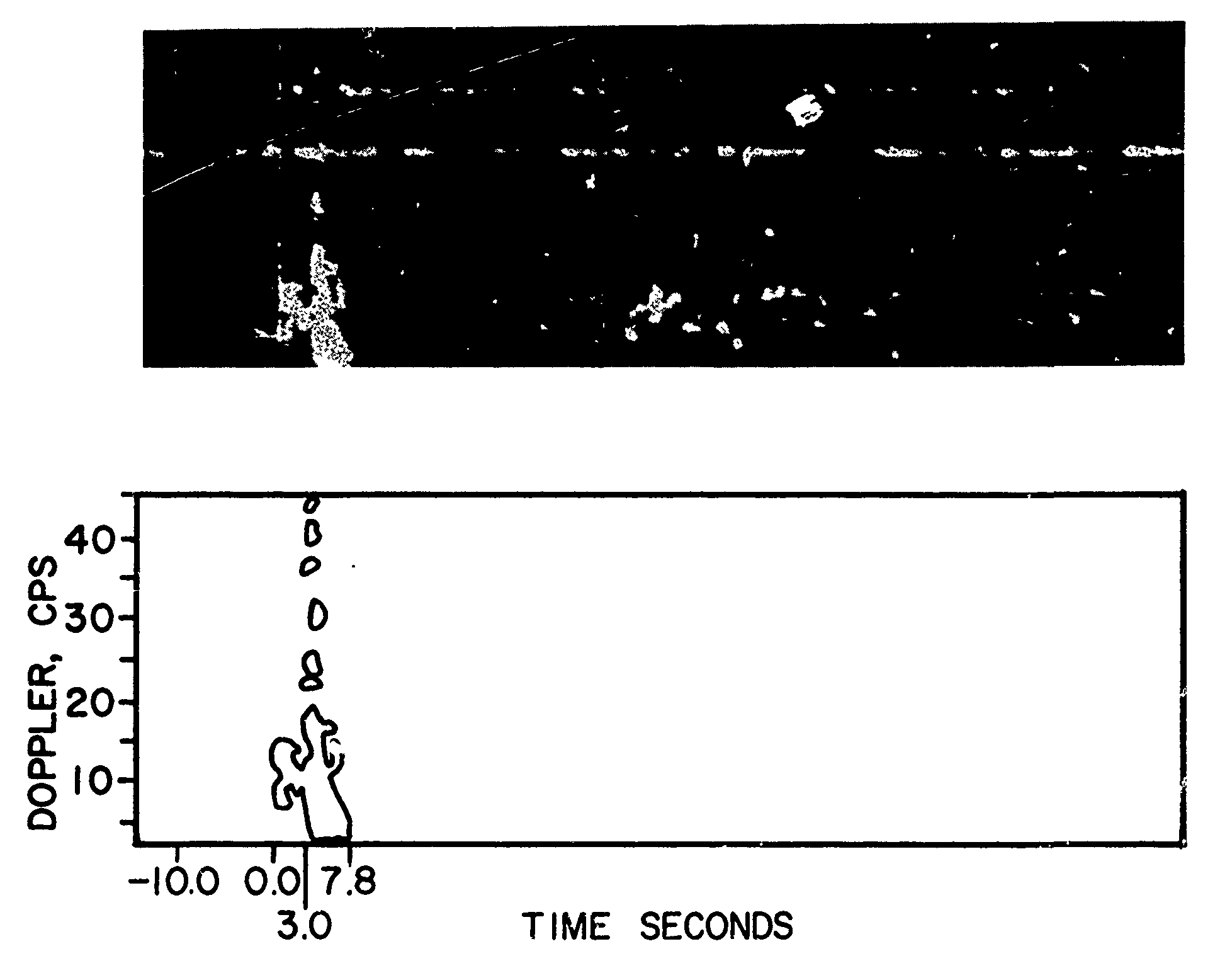
(S) 5 February 1968 - Figure 8 displays a reasonably noise free record for this test. This particular missile suffered an early malfunction and was destroyed at 2.7 seconds shortly after 2nd stage ignition. The post flight report indicates that the vehicle sustained an inadvertent 109 g maneuver prior to missile destruction. There appears to be a missile related signal beginning at T0 and extending to T0 + 7.8 seconds. The part of the signal prior to 3.0 seconds seems related to the full term 1st stage burn and to the abbreviated second stage burn. The signal from 3.0 seconds to 7.8 seconds is no doubt related to the missile destruct phenomenon. For obvious reasons the autodestruct signal fails to make an appearance.
(S) 26 February 1968 - Figure 9 represents the test results. This test was a successful flight. The observation of it resulted in some excellent data. The left hand edge of the photo and the drawing is represented on the time scale as lift off minus 9 seconds. The right hand edge is T0 + 101 seconds. There seems to be evidence in the radar data of a g maneuver at 6.2 seconds. This perhaps agrees with the maneuver commanded at 5.8 seconds. A rather large unidentified low doppler signal persists from 6.2 to approximately 15 seconds. This may be in some way related to the flight of the ballistic first stage. The vertical line of video blips at 12.8 seconds seems to be associated with the 10 g maneuver commanded on at 12.4 seconds. At 14.4 seconds this maneuver is removed and the second stage enters coasting flight. A constant velocity line follows closely on the heels of the 10 g maneuver cessation at 14.4 seconds. The coasting signal begins at 14.8 seconds and continues until 20.8 seconds at which time a maneuver type signal appears. Post flight data indicated that the second stage lost a piece of heat shield at 16.3 seconds. A short term signal pops in at 17.8 seconds on the low frequency side, yet very near to the second stage velocity line. It is conceivable that this transitory echo was generated by energy scattered from the heat shield and its environs. Further confirmation is needed as to the physical size of the heat shield as it relates to the mechanism for cross section enhancement. The maneuver type echo at 20.8 seconds is in all probability related to the 30 g maneuver that was impressed upon the vehicle at T0 + 19.5 seconds and removed at 20.5 seconds. It is interesting to note that the video blip spacing in cps for the 30 g maneuver is approximately 3 times as great as the blip spacing in doppler for the 10 g maneuver imposed at 12.4 seconds.
(S) The autodestruct signal looks somewhat different from the signals for the same missile function on other tests. This particular test was concluded in a slightly different fashion than some of the earlier tests. As noted in the function table in Figure 9 the second stage was commanded into a 47 g attitude at 24.3 seconds and was left in that attitude until autodestruct. Other tests have generally come to autodestruct with the vehicle in free flight. It is speculated that the continuous 47 g maneuver was in some way responsible for the appearance of the large signal commencing at 29.2 seconds.
(S) Figure 10 is the doppler time record showing the perturbation signal detected for the launch of 26 Feb. 1968. The time history is 220 seconds long with the left hand edge representing T0 + 100 seconds and the right hand edge being T0 + 320 seconds. The processor gain was increased 6 db midway through the record as the signal was fading out. The onset time for the perturbation signal is 107 seconds after missile lift off. Some vestiges of the perturbation appear to linger for nearly three minutes. It can be seen that the diffuse signal trails off at a non zero doppler frequency. The vertical smears in the diffuse signal for the last 110 seconds of the record are due to meteor nose ionization. Also in the latter half of the record can be seen the system calibration signal as it is programmed through various amplitude steps, at a doppler frequency of 20 cps.
(U) Thus the catalog of test results is concluded. It is hoped that somewhat better signal-to-noise ratios may be realized in future analysis. With the imminent installation, in the 60 db system, of improved display amplifiers it is hoped that the photo takeoff will yield more significant results.
(S) The preceding test results do indeed indicate the feasibility of detection of anti-ballistic missile launches at remote locations (≈1600 naut. mi.) with an over-the-horizon pulse-doppler radar. Substantial detection has depended on sophistication of signal analysis. Real time count down and comprehensive post flight reporting has made meaningful analysis possible.
(S) From these preliminary analyses it is somewhat apparent that the OTH radar signature for an ARM launch is unique. Particular signal structures have been reasonably well identified with intended and anomalous features of vehicle flight. Correlation in slant range has been good. With a somewhat larger sample of observations than has been presented here it seems possible that blindfold recognition criteria might evolve.
(S) Only the initial phase of ABM launch phenomenology has been studied. The early detections described generate many yet unanswered questions. Intensive investigations are being carried out simultaneously in several areas. Real time observations with post flight analysis will continue. Items for further investigation are as follows:
1. Target cross section:
a. In level flight
b. In acceleration maneuvers; also entrance and exit from same
c. Autodestruct - multiple scatterer behavior
2. Perturbation signal mechanism:
a. WSMR ionosonde records are being studied for E layer anomaly
b. A spectrum of items with varying ballistic coefficients are being submitted to aerodynamic drag computations in order to extract the span of apogee altitudes and times
3. Doppler matching:
a. More precise vehicle position data have been requested. When these become available it will be possible to generate a doppler history for the entire flight including the separated first stage. Aspect sensitivity will also be discernible
4. Propagation geometry - An attempt to determine the degree of illumination will lend itself perhaps to the explanation of vehicle cross section variability. Illumination or non illumination of the E layer perturbation region will be ascertained.
5. Low altitude vehicle-atmospheric interaction will be studied as it affects:
a. Vehicle erosion
b. Mach cone shock ionization
comprehensive reporting of all the above areas of study will be forthcoming.
(S) Due to the brevity of this reporting no attempt has been made to reference a bibliography. Such will be included in a later report. However, it is no doubt of value to mention the documents, that have been consulted for background on each of the flights observed. Post flight reports are not yet in hand for the tests of 25 March 1968 and 22 April 1968. The post flight reports are generated by the Bell Telephone Company in conjunction with the Martin Company. They are forwarded to the U.S. Naval Research Laboratory from the Sentinel Systems Command Office (formerly the Nike-X Office) at Huntsville, Alabama. The documents made available to NRL are as shown in List 1.
– – – – – – – – – – – – – – – – – – – – – – – – – – – – – – – – – – – –
LIST 1
|
|||
|
Vehicle designation |
Flight date |
Report date |
Report No. |
|---|---|---|---|
|
FLA-8 (Flight 9) (U) |
18 July '67 |
Aug. '67 |
OR 6879-9 |
|
FLA-11 (Flight 1) (U) |
8 Aug. '67 |
Sept. '67 |
OR 6879-10 |
|
FLA-7 (Flight 13) (U) |
10 Oct. '67 |
Nov. '67 |
OR 6879-12 |
|
FLA-14 (Flight 13) (U) |
31 Oct. '67 |
Dec. '67 |
OR 6879-13 |
|
FLA-15 (Flight 14) (U) |
20 Nov. '67 |
Jan. '68 |
OR 6879-14 |
|
FLA-13 (Flight 15) (U) |
11 Dec. '67 |
Jan. '68 |
OR 6879-15 |
|
FLA-16 (Flight 16) (U) |
5 Feb. '68 |
March '68 |
OR 6879-16 |
|
FLA-17 (Flight 17) (U) |
26 Feb. '68 |
April '68 |
OR 6879-17 |
– – – – – – – – – – – – – – – – – – – – – – – – – – – – – – – – – – – –
TABLE INRL RESULTS ON SPRINT MISSILE LAUNCHES BASED ON PRELIMINARY ANALYSES |
||||||
|
Test Date |
Correlated Missile Signature |
|||||
|---|---|---|---|---|---|---|
|
Missile Fate |
Premature Destruct |
Maneuver |
Constant Velocity |
Autodestruct |
Perturbation |
|
|
7/18/67 |
Failure |
X |
|
|
|
X |
|
8/8 /67 |
Success |
|
X? |
|
X? |
X |
|
10/10/67 |
Success |
|
X |
X |
X |
|
|
10/31/67 |
Success |
|
X |
|
X |
|
|
11/20/67 |
Failure |
X |
|
|
|
|
|
12/11/67 |
Success |
|
X |
X |
|
X? |
|
2/5 /68 |
Failure |
X |
|
|
|
|
|
2/26/68 |
Success |
|
X |
X |
X |
X |
|
3/25/68 |
Failure |
No 1st stage ign., vehicle emerged from silo, pitched forward 390°, fell to ground. |
||||
|
4/22/68 |
Failure |
No detection, poor system sensitivity, vehicle destroyed shortly after 2nd stage ign. |
||||
|
X – means fair-to-good correlation in slant range and time with actual missile events. X? – means possible correlation with missile events, further confirmation needed. |
||||||
– – – – – – – – – – – – – – – – – – – – – – – – – – – – – – – – – – – –
Fig. 1 - Some features of the Sprint missile radar signature
– – – – – – – – – – – – – – – – – – – – – – – – – – – – – – – – – – – –
|
Time (Sec) |
Function |
|
2.4 |
Staging |
|
2.6 |
Sec. Stg. Ign. |
|
4.3 |
Premature Destruct |
– – – – – – – – – – – – – – – – – – – – – – – – – – – – – – – – – – – –
|
Time (Sec) |
Function |
|---|---|
|
3.6 |
Sec. Stg. Ign. |
|
6.3 |
30g Maneuver On |
|
16.7 |
30g Maneuver Off |
|
39.8 |
Autodestruct |
Fig. 3 - Test results for FLA - 11, launched August 8, 1967, at 1123:20.600 MDT. Displayed sample is at 1544 NM slant range and shows 110 second record.
– – – – – – – – – – – – – – – – – – – – – – – – – – – – – – – – – – – –
|
Time (Sec) |
Function |
|---|---|
|
2.7 |
Sec. Stg. Ign. |
|
5.4 |
41g Maneuver On |
|
10.7 |
41g Maneuver Off |
|
23.6 |
30g Maneuver On |
|
25.6 |
30g Maneuver Off |
|
37.0 |
Autodestruct |
Fig. 4 - Test results for FLA - 7, launched October 10, 1967 at 1059:57.415 MDT. Displayed sample is at 1554 NM slant range and shows 110 second record.
– – – – – – – – – – – – – – – – – – – – – – – – – – – – – – – – – – – –
|
Time (Sec) |
Function |
|---|---|
|
2.8 |
Sec. Stg. Ign. |
|
5.2 |
Sec. Stg. B.O. |
|
5.5 |
30g Maneuver On |
|
11.2 |
30g Maneuver Off |
|
14.2 |
30g Maneuver On |
|
24.2 |
30g Maneuver Off |
|
32.5 |
Autodestruct |
Fig. 5 - Test results for FLA - 14, launched October 31, 1967, at 0929:59.271 MST. Displayed sample is at 1534 NM slant range and shows 110 second record+
– – – – – – – – – – – – – – – – – – – – – – – – – – – – – – – – – – – –
|
Time (Sec) |
Function |
|---|---|
|
2.02 |
1st. Stg. B.O. |
|
2.04 |
Stage Seperation |
|
5.60 |
Sec. Stg. Ign. |
|
6.70 |
38.5g Maneuver On |
|
6.95 |
Premature Destruct |
Fig. 6 - Test results for FLA - 15, Launched November 20, 1967, at 0959:237 MST. Displayed sample is at 1626 NM slant range and shows 110 second record.
– – – – – – – – – – – – – – – – – – – – – – – – – – – – – – – – – – – –
|
Time (Sec) |
Function |
|---|---|
|
3.6 |
50g Maneuver On |
|
4.7 |
Sec. Stg B.O. |
|
5.9 |
50g Maneuver Off |
|
7.9 |
50g Maneuver On |
|
9.9 |
50g Maneuver Off |
|
11.9 |
50g Maneuver On |
|
13.9 |
50g Maneuver Off |
|
14.4 |
32g Maneuver On (Soar) |
|
14.9 |
63g Maneuver On (Dive) |
|
16.5 |
32g Maneuver Off (Soar) |
|
32.4 |
Autodestruct |
Fig. 7 - Test results for FLA - 13, launched December 11, 1967, at 1025:00.450 MST. Displayed sample is at 1718 NM slant range and shows 110 second record.
– – – – – – – – – – – – – – – – – – – – – – – – – – – – – – – – – – – –
|
Time (Sec) |
Function |
|---|---|
|
2.2 |
First Stg. B.O. |
|
2.3 |
Staging |
|
2.5 |
Sec. Stg. Ign. |
|
2.7 |
Premature Destruct |
Fig. 8 - Test results for FLA - 16, launched February 5, 1968, at 1015:00.781 MST. Displayed sample is at 1606 NM slant range and shows 110 second record.
– – – – – – – – – – – – – – – – – – – – – – – – – – – – – – – – – – – –
|
Time (Sec) |
Function |
|---|---|
|
4.9 |
Sec. Stg. B.O. |
|
5.8 |
40g Maneuver On |
|
10.2 |
40g Maneuver Off |
|
12.4 |
10g Maneuver On |
|
14.4 |
10g Maneuver Off |
|
16.3 |
Partial Heat Shield Loss |
|
19.5 |
30g Maneuver On |
|
20.5 |
30g Maneuver Off |
|
24.3 |
47g Maneuver On |
|
32.4 |
Autodestruct |
Fig. 9 - Test results for FLA - 17, launched February 26, 1968, at 1000:00.825 MST. Displayed sample is at 1697 NM slant range and shows 110 second record.
– – – – – – – – – – – – – – – – – – – – – – – – – – – – – – – – – – – –
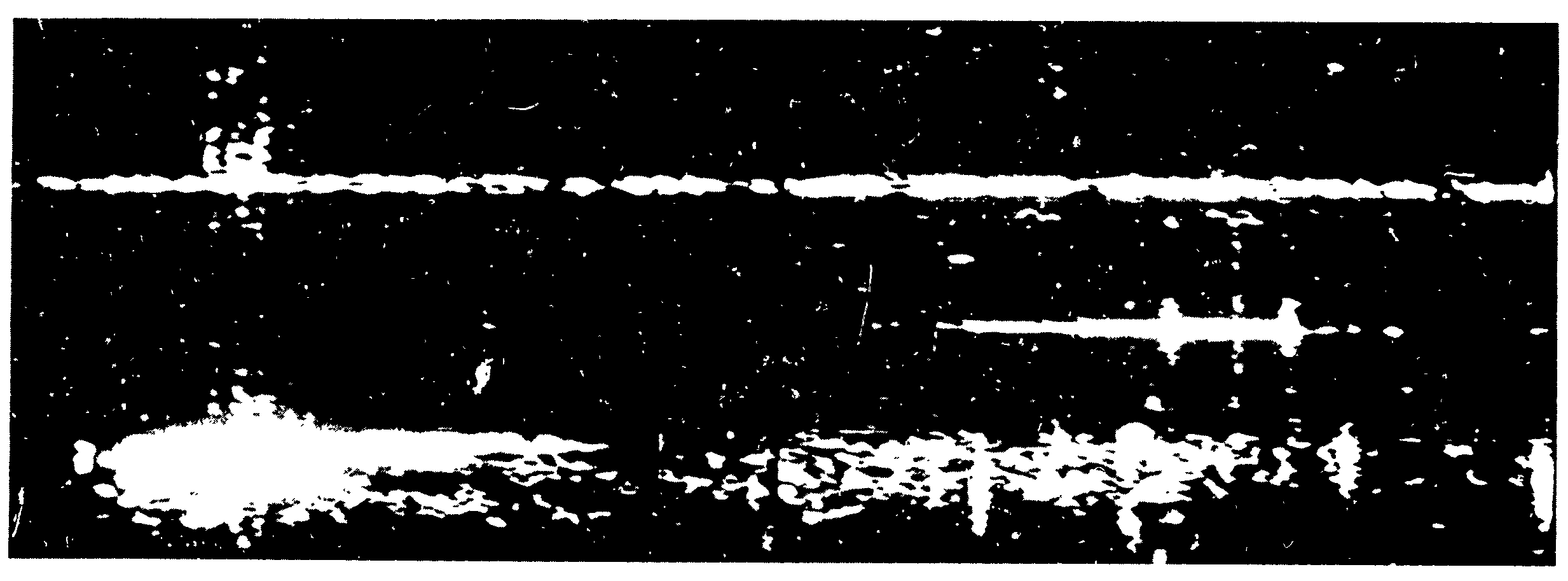
Fig. 10 - Perturbation signal observed following launch of FLA - 17 on February 26, 1968, at 1000:00.825 MST. Displayed sample is at 1595 NM slant range and shows 220 second record beginning at T0 + 100 seconds.
– – – – – – – – – – – – – – – – – – – – – – – – – – – – – – – – – – – –
|
SECRET DOCUMENT CONTROL DATA - R & D 1. ORIGINATING ACTIVITY (Corporate author) 2a. REPORT SECURITY CLASSIFICATION 2b. GROUP 3. REPORT TITLE 4. DESCRIPTIVE NOTES (Type of report and inclusive dates) 5. AUTHOR(S) (First name, middle initial, last name) 6. REPORT DATE 7a. TOTAL NO OF PAGES 7b. NO OF REFS 8a. CONTRACT OR GRANT NO 8b. PROJECT NO. 9a. ORIGINATOR'S REPORT NUMBER(S) 9b. OTHER REPORT NO(S) (Any other numbers that may be
assigned this report) 10. DISTRIBUTION STATEMENT 11. SUPPLEMENTARY NOTES 12. SPONSORING MILITARY ACTIVITY 13. ABSTRACT (Secret) Speculation as to how hypervelocity vehicles at low altitudes generate detectable cross sections provokes further investigation. Studies are now in progress along the lines of doppler matching, (based on better post flight information), aerodynamic drag computations and E-region perturbations. Other investigators of atmospheric physics have indicated upper atmosphere disturbances due to Mach shock waves (vertically propagated), a likely occurrence. This possibility is being studied. Other findings will be reported to the community as soon as they are available. 14. KEY WORDS |
|
MEMORANDUM 20 February 1997 Subj: Document Declassification Ref: (1) Code 5309 Memorandum of 29 Jan. 1997 Encl: (a) Code 5309 Memorandum of 29 Jan. 1997 1. In Enclosure (a) it was recommended that the following reports be declassified, four reports have been added to the original list: Formal: 5589, 5811, 5824, 5825, 5849, 5862, 5875, 5881, 5903, 5962, 6015, 6079, 6148, 6198, 6272, 6371, 6476, 6479, 6485, 6507, 6508, 6568, 6590, 6611, 6731, 6866, 7044, 7051, 7059, 7350, 7428, 7500, 7638, 7655. Add 7684, 7692. Memo: 1251, 1287, 1316, 1422, [DELETED], 1500, 1527, 1537, 1540, 1567, 1637, 1647, 1727, 1758, 1787, 1789, 1790, 1811, 1817, 1823, 1885, 1939, 1981, 2135, 2624, 2701, 2645, 2721, 2722, 2723, 2766. Add 2265, 2715. The recommended distribution statement for the these reports is: Approved for public release; distribution is unlimited. 2. The above reports are included in the listings of enclosures (b) and (c) and were selected because of familiarity with the contents. The rest of these documents very likely should receive the same treatment. /S/ Copy: |