|
LARGE POST-SATURN LAUNCH VEHICLES: WHY? WHEN?
WHAT?
by
WILLIAM G. HUBER
National
Aeronautics and Space Administration
Huntsville, Alabama
AIAA Paper
No. 64-279
1st AIAA Annual
Meeting
Washington, D. C. June 29 — July 2, 1964
|
LARGE POST-SATURN LAUNCH VEHICLES:
WHY? WHEN? WHAT?
William G. Huber
Special Assistant to the
Director
Future Projects Office
Research and Development
Operations
George C. Marshall Space Flight Center
National
Aeronautics and Space Administration
Huntsville, Alabama
I. INTRODUCTION
The United States is presently committed to landing a man on the
Moon within this decade. This is a formidable goal; however, to the
National Aeronautics and Space Administration (NASA) it is not a
final objective - it is just a beginning of real space exploration.
Besides the major effort required by the APOLLO Program, it is
necessary for NASA to start initial planning for the future, more
ambitious missions.
Launch vehicles continue to be one of the major pacing items in
the progress of space exploration. The largest launch vehicle now
under development is the SATURN V; however, planning is underway for
a Post-SATURN vehicle, which could greatly increase our capabilities
for planetary exploration.
This planning effort must first determine under what conditions a
Post-SATURN is justified. In other words, what is the size of space
programs beyond which it is desirable to develop a launch vehicle
larger than SATURN V. Then by having some indication of the future
program, the questions of why we need a Post-SATURN,
when we need it, and what is the best
concept can be answered. The study effort presently underway is aimed
at providing the necessary data to attempt to answer these questions.
Because of the uncertainty in the development timing of the next
large launch vehicle, a broad approach has been taken. The vehicle
concepts under study are divided into four categories or classes.
Each class is defined on the basis of the advancement in technology
required to demonstrate technical feasibility or soundness of
approach. This, of course, gives a wide range of possible
availability dates - from 1974 to 1985.
II. POSSIBLE VEHICLE
CONCEPTS
Conceptual design effort is being accomplished in all vehicle
classes. The approach has been to start with all possible concepts in
each class and narrow them down through further study and
comparisons. In this manner, we can focus on the most promising
concepts in each vehicle class. In order to proceed with the missions
analysis work in parallel with the vehicle design effort,
representative or baseline configurations were selected in each
class. The selection of these baselines does not mean they are best
in their class - only representative of the technology and
availability offered by the class. It is then possible to make
certain interclass comparisons with these baseline concepts.
Class I contains the concepts using current technology and are
essentially within the present state-of-the-art. The configurations
are expendable and use propulsion systems currently under
development. These include the M-1, the large solid, and the F-1 or
an uprated version of the F-1. The selected baseline for Class I is
shown in Figure 1. This vehicle has 18 F-1 type engines (rated at 1.8
x 106 pounds of thrust) in the first stage and three M-1
engines in the second stage. The first stage diameter is 65.5 feet;
the second stage diameter is 60 feet; and the vehicle height is
approximately 460 feet including payload. Both stages use separate
tanks and are expendable.
Figure 1
POST-SATURN CLASS I BASELINE
VEHICLE
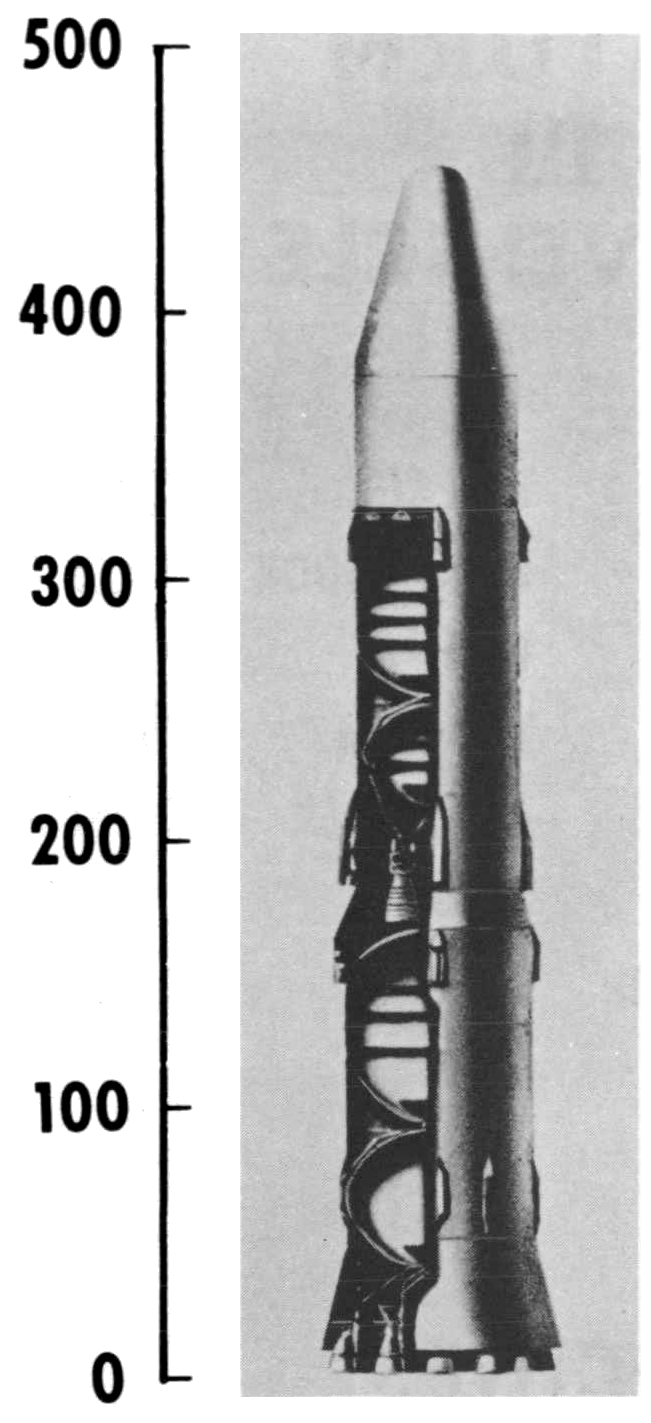
Image dynamically scaled down for screen, save to view at full resolution
|
|
ENGINES:
|
18 F-1A / 3 M-1
|
|
THRUST:
|
32.4M
|
|
LAUNCH WEIGHT:
|
25.2M
|
|
PAYLOAD:
|
980,000
|
|
PROP. MASS FRACTION:
|
0.920 / 0.904
|
|
GROSS WEIGHT/PAYLOAD:
|
25.7
|
Class II represents concepts using advanced technology. The
principle areas of advancement are propulsion and recovery. New
propulsion systems are considered using such features as high chamber
pressure, up to 3,000 psia, and unconventional nozzles, achieving
some degree of altitude compensation. Numerous trade off studies have
shown the most attractive concepts in this class are two stage
vehicles with a recoverable first stage. Recovery and reuse of the
first stage can offer almost a 40 percent improvement in cost
effectiveness for a launch rate of about 10 per year. Recovery of the
second stage can offer further improvement of about 8 percent;
however, the technical problems associated with recovery of items of
this size from near orbital velocities are serious and at this time
are not considered worth the potential gains for the Class II
Post-SATURN.
Advanced propulsion concepts in themselves will improve the cost
effectiveness of Class II over Class I in the order of 15 percent.
This gain, combined with recovery, results in an improvement of cost
effectiveness of about 50 percent going from Class I to Class II. The
most desirable advanced propulsion system has not been determined to
date, since a great deal of required experimental work is needed to
verify the performance assumptions that have been used in the
studies. A typical Class II concept is shown in Figure 2. Each stage
is 70 feet in diameter, and the vehicle height is about 420 feet. The
improvement in gross weight to payload ratio of this concept over the
Class I baseline should be noted.
Figure 2
POST-SATURN CLASS II BASELINE
VEHICLE
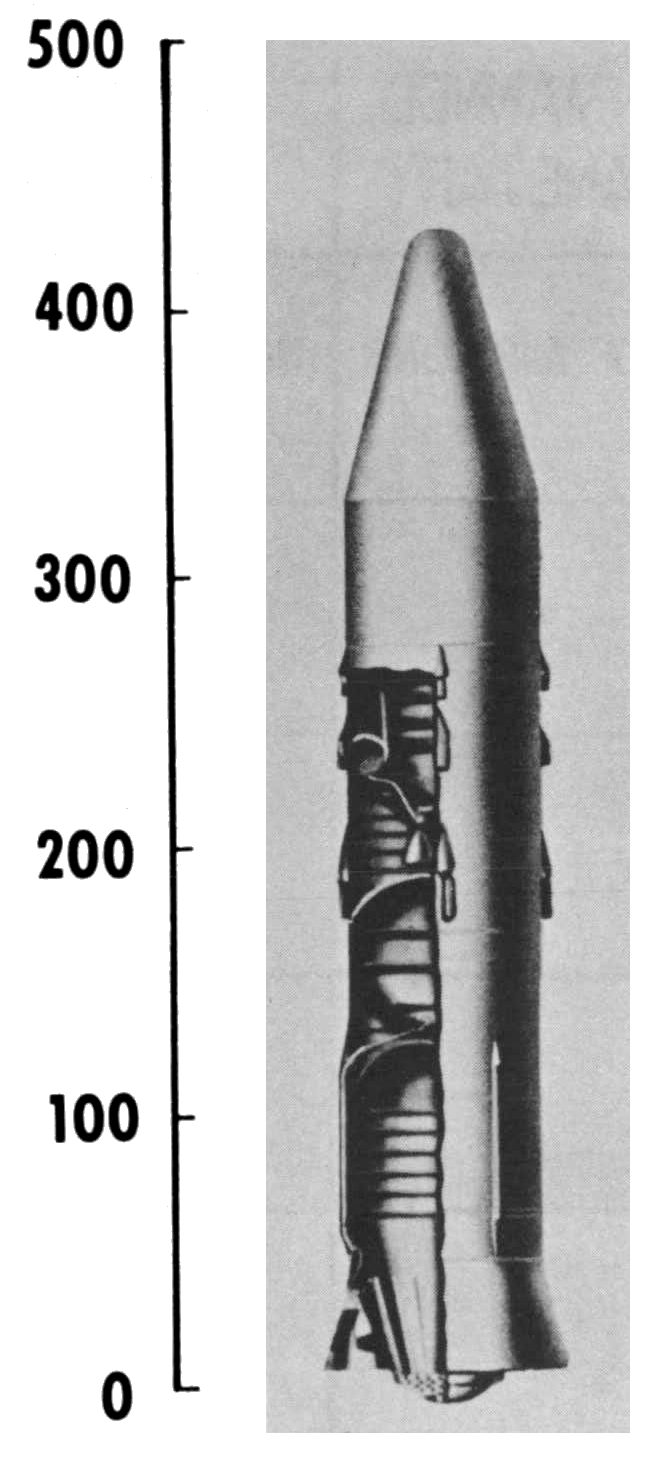
Image dynamically scaled down for screen, save to view at full resolution
|
|
ENGINES:
|
18/2 @ 1000K
|
|
THRUST:
|
18M
|
|
LAUNCH WEIGHT:
|
14.4M
|
|
PAYLOAD:
|
942,000
|
|
PROP. MASS FRACTION:
|
0.897 / 0.883
|
|
GROSS WEIGHT/PAYLOAD:
|
15.3
|
Class III concepts utilize very advanced technology, particularly
in the areas of propulsion, structures, and recovery from near
orbital velocity. The ideal Class III concept is a single stage to
orbit, fully recoverable vehicle. Several configurations have been
studied; however, analyses have shown the vehicle performance to be
extremely sensitive to specific impulse and dry stage weight
assumptions. At the present time, our confidence in the existing data
is relatively low, because of the lack of experimental data to verify
the assumptions made in the studies. In attempts to eliminate this
sensitivity, several alternate concepts have been studied. These
include expendable tanks, solid and liquid JATO units, flourine
substitution, and expendable second stages. Conclusions concerning
the most attractive concept cannot be made at this time.
One of the possible features of a Class III Post-SATURN vehicle
could be a variable payload capability. This capability is of
interest, since it would provide greater payload design and mission
planning flexibility. However, at this time it is not possible to
determine the desirability of this feature, since the specific
mission requirements cannot be defined. For the purposes of the
mission analysis studies, a representative Class III configuration
was selected and is shown in Figure 3. This is a basic single-stage
to orbit, fully recoverable concept with 826, 000 pound payload
capability. For larger payload missions, an expendable second stage
can be added, which gives a 1, 250, 000 pound capability. The vehicle
is about 120 feet in diameter and 220 feet high with second stage and
payload.
Figure 3
POST-SATURN CLASS III BASELINE
VEHICLE
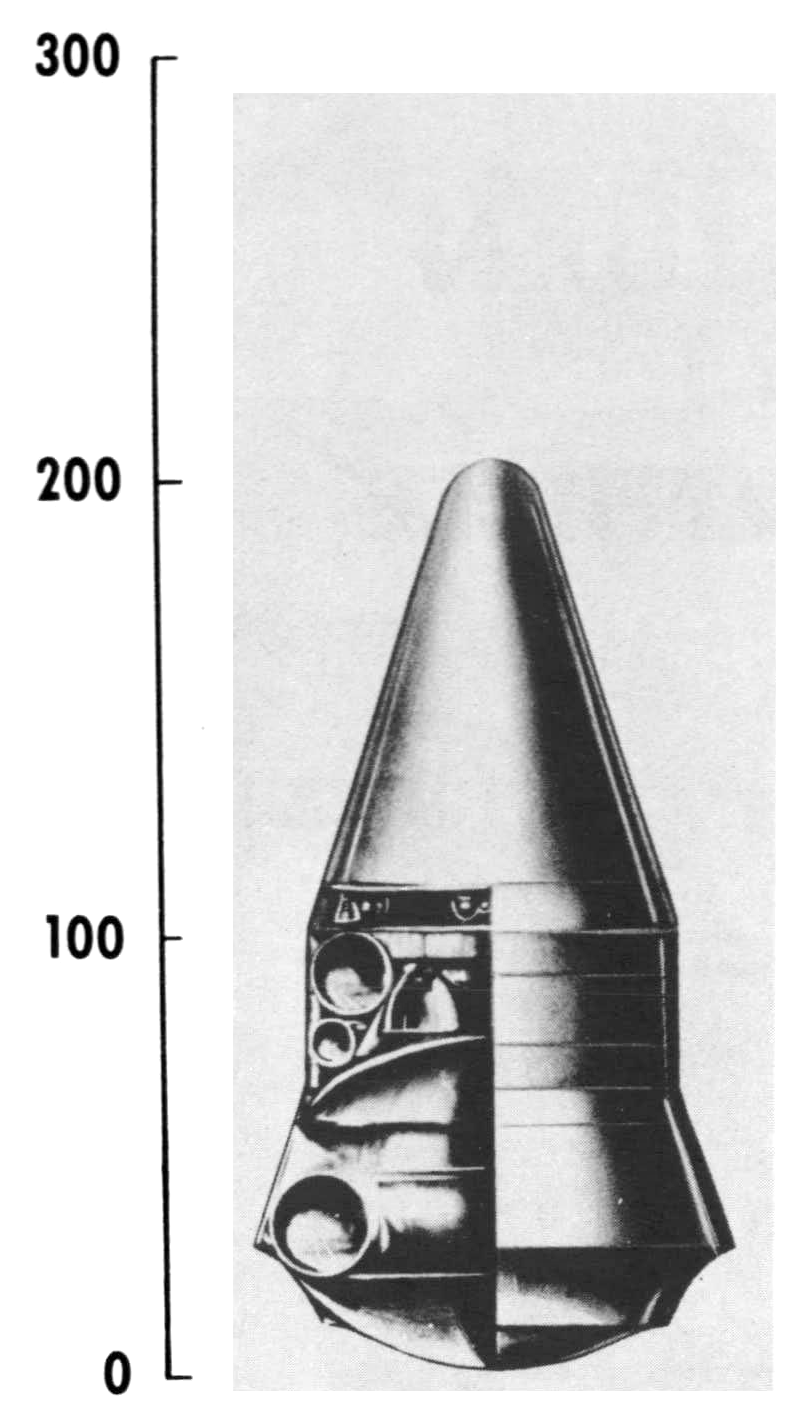
Image dynamically scaled down for screen, save to view at full resolution
|
|
|
1 STAGE
|
2 STAGE
|
|
ENGINES:
|
18 @ 1000K
|
18/3 @ 1000K
|
|
THRUST:
|
18M
|
18M
|
|
LAUNCH WEIGHT:
|
12-14.4M
|
14.4M
|
|
PAYLOAD:
|
460K-826K
|
1,250,000
|
|
PROP. MASS FRACTION:
|
0.93
|
0.928 / 0.922
|
|
GROSS WEIGHT/PAYLOAD:
|
14.5
|
11.3
|
Class IV represents the combination of a Class II or Class III
chemical first stage with an advanced nuclear upper stage. The
application of these configurations is primarily two-stage to Earth
escape. The work in this area has been aimed at determining the
capability of the Post-SATURN chemical first stage to accommodate
solid core, gaseous core, and nuclear pulse upper stage when, and if,
they become available.
III. MISSION ANALYSIS
To this point the question of what possible configurations of a
large Post-SATURN vehicle are of interest has been discussed. The
questions of why and when do we need it can only be answered after
some potential missions and schedules are established. In order to
attempt to determine the role of a Post-SATURN vehicle, four
different mission plans or models were developed. These represented a
large space program on an optimistic schedule, a large program on a
pessimistic schedule, a minimum space program on an optimistic
schedule, and a minimum program on a pessimistic schedule. These were
developed in such a manner as to try to bracket the actual space
program for the future which, of course, cannot be defined at
present.
The missions assumed covered the orbital, lunar, and both the
manned and unmanned planetary categories, and were constructed to
represent possible follow ons to existing programs. The time period
under study is 1970 to 1990.
Figure 4 is included to give an indication of the magnitude of the
small and large programs without going into detail. Besides varying
the number of missions, the size of each mission was varied in the
manned planetary area. As an example, the initial manned Mars landing
was assumed to be with a fleet of four ships for the large programs
and only two ships for the small programs.
Figure 4 – ASSUMED MISSION OBJECTIVES
|
|
|
ORBITAL – NO. OF MANNED SPACE STATIONS
|
LUNAR – MAX. SIZE OF BASE (NO. OF MEN)
|
UNMANNED PLANETARY – NO. OF MISSIONS
|
MANNED PLANETARY – NO. OF MISSIONS
|
|
LARGE PROGRAM
OPTIMISTIC SCHEDULE
|
24
|
80
|
37
|
11
|
|
LARGE PROGRAM
PESSIMISTIC SCHEDULE
|
24
|
80
|
37
|
7
|
|
SMALL PROGRAM
OPTIMISTIC SCHEDULE
|
10
|
12
|
18
|
8
|
|
SMALL PROGRAM
PESSIMISTIC SCHEDULE
|
10
|
12
|
18
|
5
|
Shown in Figure 5 is the effect of schedule on the programs. For
simplicity the two extremes are shown. It shows, for example, on the
optimistic schedule a Venus flyby which was assumed in 1973. For the
programs on the pessimistic schedule, the time was 1979. It can be
seen that there is the same variation of the selected missions with
schedule. For example, a Mars capture mission was assumed for the
small programs, but not for the large ones. For the small programs,
the most ambitious mission selected was a manned Mars landing. Both
the large programs included a Mars Synodic Base, and for the one on
an optimistic, schedule, another even more advanced mission was
assumed.
Figure 5
Manned
Planetary Missions
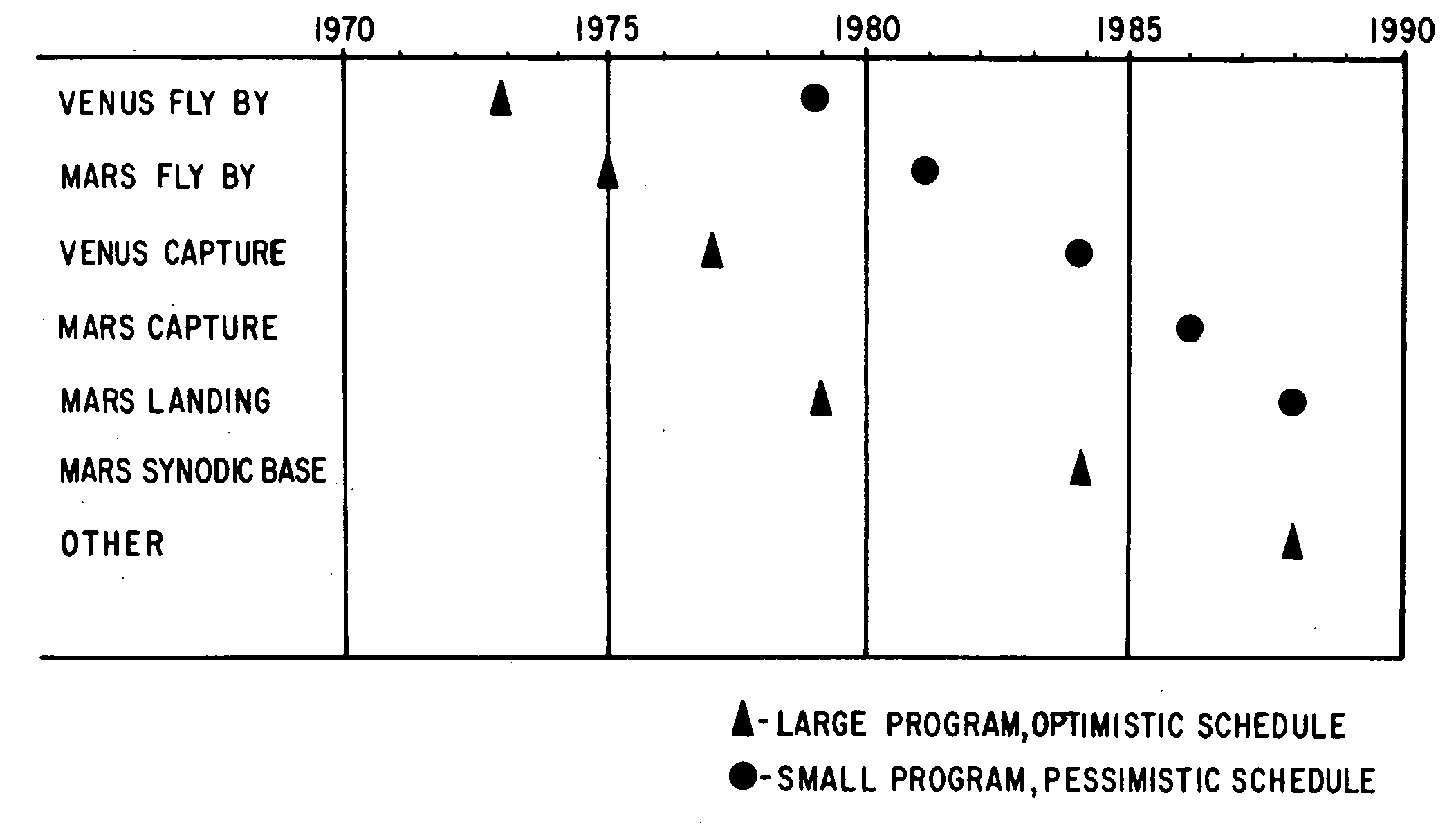
Image dynamically scaled down for screen, save to view at full resolution
|
Each set of assumed mission objectives was then accomplished with
four different combinations of present and future launch vehicles.
All vehicle mixes used the SATURN IB, SATURN V, and the 10-passenger
reusable orbital transport, which was assumed to be available in 1978
for the optimistic schedule programs and 1982 for the pessimistic. An
improved capability of 300, 000 pounds to orbit was assumed for the
SATURN V vehicle.
The following are the vehicle mixes used:
No. 1 - SATURN IB, SATURN V, 10-passenger
No. 2 - No. 1 and Post-SATURN Class I
No. 3 - No. 1 and Post-SATURN Class II
No. 4 - No. 1 and Post-SATURN Class III
With these combinations, it should be possible to determine the
role of a Post-SATURN launch vehicle in the overall space program.
The flow diagram shown in Figure 6 shows the logic used for the
calculations.
Figure 6
Generalized
Flow Diagram
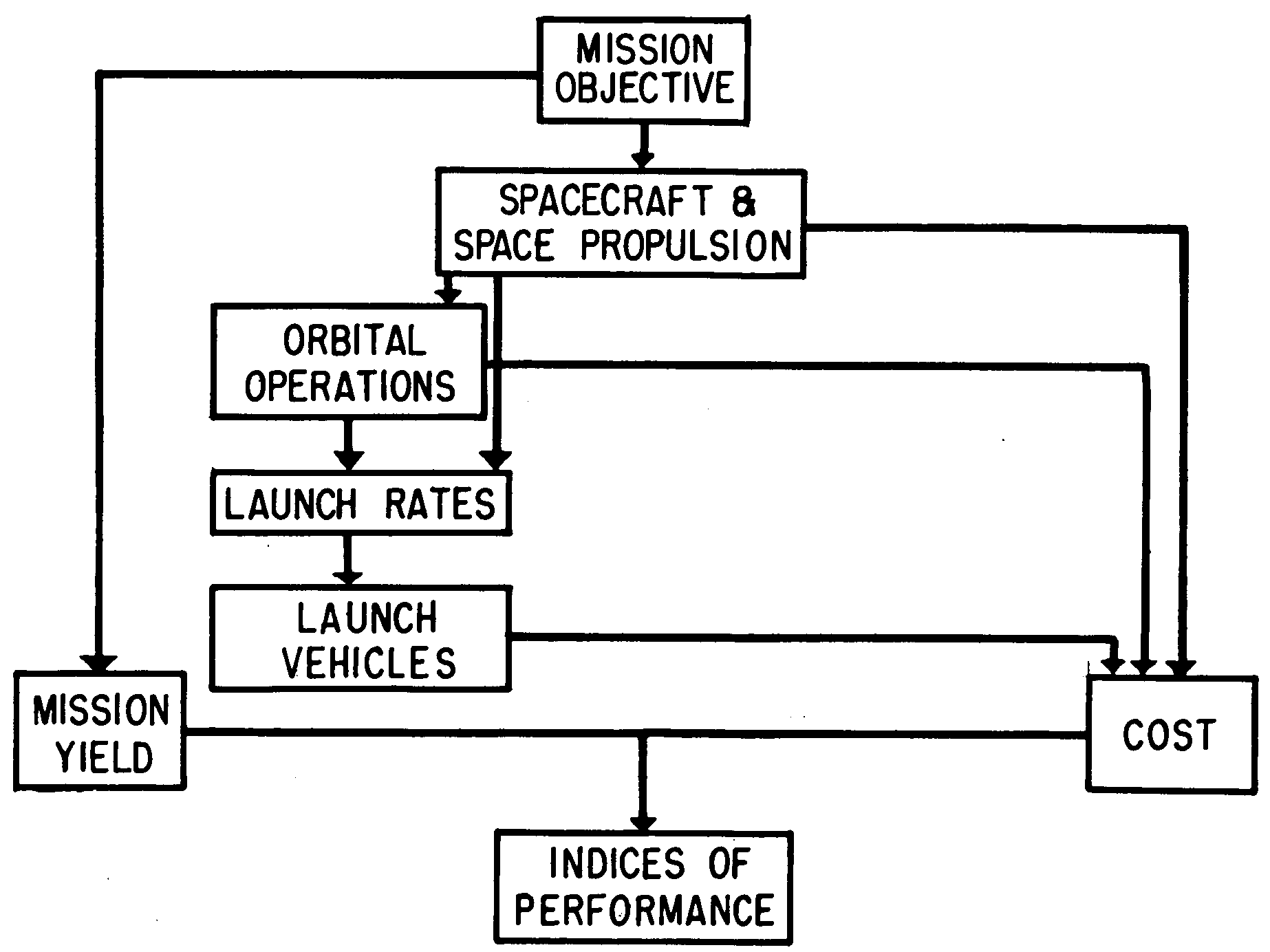
Image dynamically scaled down for screen, save to view at full resolution
|
For each mission objective, the spacecraft and the required space
propulsion systems were identified, sized, and costed. A mode of
accomplishment was then selected, i.e., either a direct flight, as in
the case of the lunar missions, or via orbital operations, as in the
case of most manned planetary missions. Orbital operations burden
rates were then assessed to those missions through orbit. The sum of
the direct flights, the mission flights to orbit, and the flights
needed for orbital support gives the total launch requirements versus
time. From these launch rates the number of launch vehicles could be
calculated. For expendable vehicles, of course, the launch rate
equals the number required; however, for reusable vehicles suitable
reuse rates, turn around time, and refurbishment cost were assumed.
The program cost was determined by adding the spacecraft and space
propulsion costs, the launch vehicle costs, and the orbital
operations support costs. This was done on both a direct operating
and total operating cost basis; the latter including development and
facilities.
From the mission objectives and the proper reliability analysis
the mission yield in terms of number of pounds delivered, number of
men, number of manyears, etc., are known. By combining these yields
with the appropriate cost, the various indices of performance are
determined. Following this procedure for various mixes of launch
vehicles and various mission objectives, produces sets of indices of
performance, which can then be compared to determine the most
efficient vehicle or vehicle mix for each set of mission objectives
or space programs.
IV. RESULTS
The average yearly expenditure for the small program ranged from
$3.3 billion to $3.9 billion depending on schedule and vehicle mix.
For the large program the range was from $4.6 billion to $7.0
billion. These expenditures appear to bracket the FY 64 NASA budget
for the portion of the overall program under consideration in this
paper. The variation of this average annual cost, as a function of
vehicle mix, is shown in Figure 7.
Figure 7
AVERAGE ANNUAL EXPENDITURE
(IN BILLIONS OF
DOLLARS)
|
|
MIX
|
SPACE PROGRAM
|
OPTIMISTIC SCHEDULE
|
PESSIMISTIC SCHEDULE
|
|
1
|
LARGE
|
6.97
|
5.37
|
|
2
|
LARGE
|
6.67
|
4.95
|
|
3
|
LARGE
|
6.13
|
4.60
|
|
4
|
LARGE
|
6.27
|
4.64
|
|
1
|
SMALL
|
3.33
|
3.40
|
|
2
|
SMALL
|
3.88
|
3.62
|
|
3
|
SMALL
|
3.78
|
3.51
|
|
4
|
SMALL
|
3.76
|
3.55
|
Since the mission yield is relatively constant for each
combination of launch vehicles, these costs represent a measure of
effectiveness. For the large program on either the optimistic or
pessimistic schedule, the combination of SATURN V and a Class II
Post-SATURN (Mix No. 3) appears to be the most efficient. The large
program is too large for SATURN V only. The Class III Post-SATURN
(Mix No. 4) is closer to the minimum cost for the pessimistic
schedule, since its late availability comes closer to matching the
manned planetary mission schedule. The more the mission schedule is
compressed, the more off-minimum the Class III vehicle mix.
For the small programs, the SATURN V only (Mix No. 1) represents
minimum cost because of the reduced number of mission requirements.
However,, on the pessimistic schedule, the Class II Post-SATURN (Mix
No. 3) is not far from the minimum cost, since its availability is
more compatible with the planetary missions.
Another aspect to be considered is the resulting launch rates
needed to meet the assumed mission objectives . These are shown in
Figure 8 in terms of average annual requirements. For the large
programs, SATURN V only (Mix No. 1) results in very high launch
rates. The addition of any Post-SATURN can greatly reduce these
rates. In all cases the SATURN V requirements increase, when the
introduction of a Post-SATURN capability is delayed from Class I to
Class II to Class III.
Figure 8
AVERAGE ANNUAL LAUNCH
REQUIREMENTS
|
|
MIX
|
SPACE PROGRAM
|
OPTIMISTIC SCHEDULE
|
PESSIMISTIC SCHEDULE
|
|
SATURN V
|
POST-SATURN
|
SATURN V
|
POST-SATURN
|
|
1
|
LARGE
|
62.7
|
0
|
47.0
|
0
|
|
2
|
LARGE
|
8.9
|
11.2
|
4.0
|
9.1
|
|
3
|
LARGE
|
8.9
|
11.9
|
5.7
|
9.3
|
|
4
|
LARGE
|
11.9
|
10.0
|
8.8
|
7.7
|
|
1
|
SMALL
|
20.4
|
0
|
15.0
|
0
|
|
2
|
SMALL
|
4.4
|
35
|
3.0
|
2.9
|
|
3
|
SMALL
|
4.6
|
4.0
|
3.2
|
3.0
|
|
4
|
SMALL
|
6.1
|
3.3
|
4.9
|
2.3
|
As a last point of consideration, the cost effectiveness of the
various vehicle mixes is of interest. In an attempt to put all
programs on an equal basis, an orbital equivalent cost effectiveness
was calculated. This represents the cost effectiveness of the various
transportation systems, if all launches were made to Earth orbit. The
results are shown in Figure 9 in terms of both direct operating cost
(DOC) and total operating cost (TOC), which includes facilities and
development.
Figure 9
EQUIVALENT ORBITAL
COST EFFECTIVENESS
(dollars per pound)
|
|
MIX
|
SPACE PROGRAM
|
OPTIMISTIC SCHEDULE
|
PESSIMISTIC SCHEDULE
|
|
DOC
|
TOC
|
DOC
|
TOC
|
|
1
|
LARGE
|
116.5
|
141.3
|
123.3
|
150.3
|
|
2
|
LARGE
|
107.6
|
152.8
|
109.4
|
161.6
|
|
3
|
LARGE
|
70.3
|
114.6
|
65.8
|
117.1
|
|
4
|
LARGE
|
76.4
|
122.8
|
69.8
|
124.9
|
|
1
|
SMALL
|
100.2
|
129.4
|
156.6
|
195.6
|
|
2
|
SMALL
|
129.1
|
208.5
|
133.3
|
238.3
|
|
3
|
SMALL
|
89.0
|
168.7
|
91.6
|
190.8
|
|
4
|
SMALL
|
95.1
|
182.9
|
107.0
|
217.5
|
The numbers shown represent the average of the combination of
vehicles in each mix. For example, the effectiveness of Mix No. 4 is
an average of all the SATURN IB, SATURN V, and Post-SATURN Class III
vehicles required to meet the assumed mission objectives. The
10-passenger reusable orbital transport vehicle flights have been
excluded in the calculation, since they are used to carry personnel
and not cargo. For the large program, Mix. No. 3 (Post-SATURN Class
II) is favored from both the direct and total cost effectiveness
standpoint. It can be seen that the direct cost effectiveness becomes
greater for Mixes No. 1 and 2 with a stretch out in schedule, whereas
it improves for Mixes No. 3 and 4. This is because the stretched out
programs are more compatible with the later availability of the Class
II and III Post-SATURN. The SATURN V only is the most effective from
a total cost standpoint for the small program on an optimistic
schedule, even though the Post-SATURN Class II mix is best on a
direct cost basis. If the small program schedule is stretched, then
Mix No. 3 becomes the most efficient.
V. CONCLUSIONS
The preliminary data available at this time and summarized in this
paper cannot be used to answer explicitly the questions of Why,
When, and What about Post-SATURN;
however, some interesting trends are apparent. It appears that a
Post-SATURN capability is desirable, if we are going to have manned
planetary exploration. Even the small program on a stretched out
schedule showed Post-SATURN to be the most effective .
The questions of When and What should
be considered together. The Class I type vehicle did not look
favorable for any of the programs studied. This is true for two
reasons: (1) it does not offer sufficient cost effectiveness over
SATURN V, and (2) it was available prior to the planetary mission
requirements. The Class II concept gave the best direct cost
effectiveness under all programs considered and the best total cost
effectiveness in all but the small program on an optimistic schedule.
This class offers significant improvement over SATURN V and at a time
that is compatible with the planetary missions. The Class III vehicle
did not,produce favorable results because of its late availability.
Programs with more pessimistic schedules would permit better
utilization of Class III, and would therefore produce better cost
effectiveness.
It can be concluded that with a relatively large space program,
there is a role for Post-SATURN. The exact size and composition of
the,program that economically justifies a large launch vehicle remain
to be determined. The exact vehicle concept eventually selected will
depend on the state-of-the-art at the time of development initiation,
but will probably include some degree of advanced propulsion and some
form of recovery and reuse.