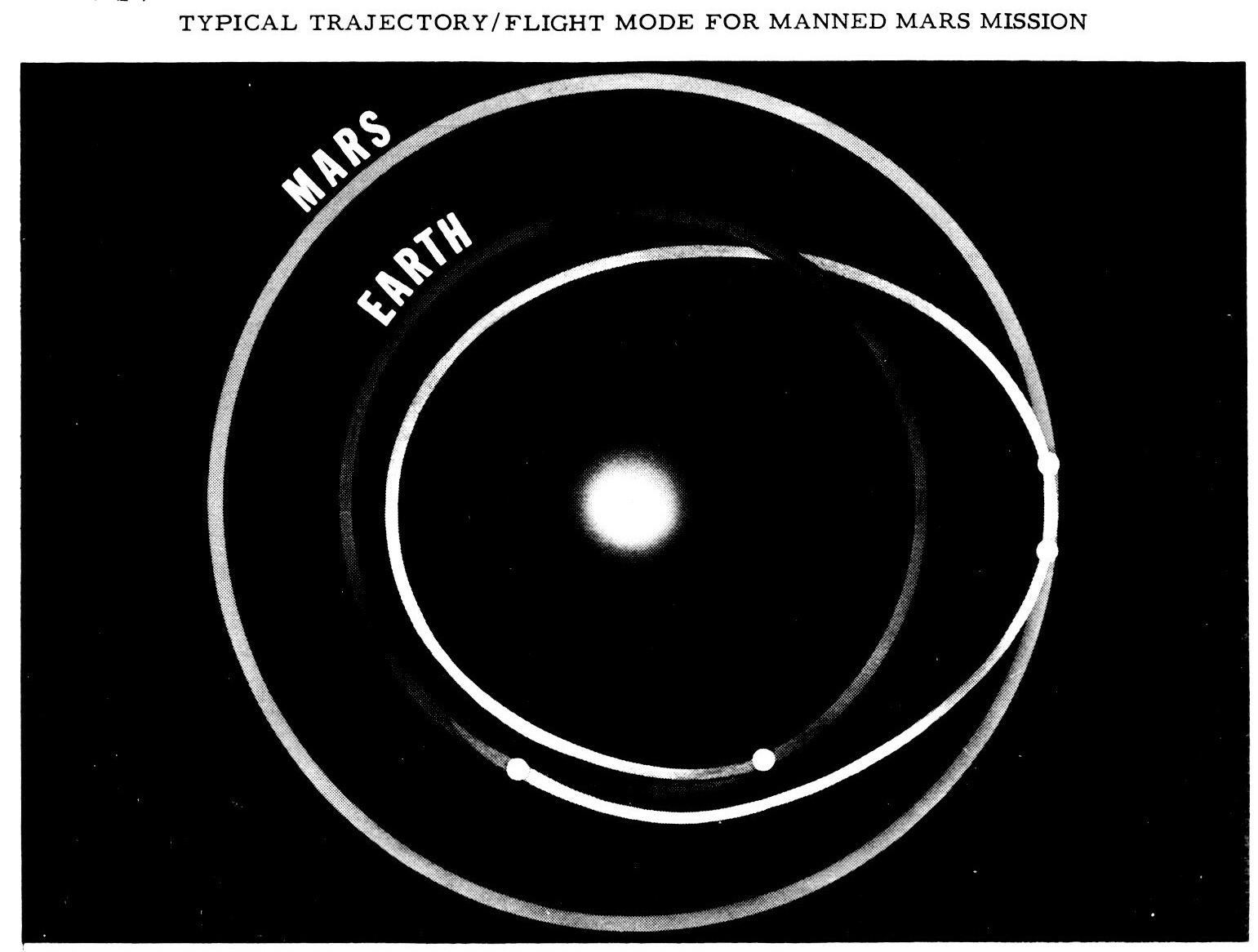
Figure 1
EXCERPTED FROM:NASA TM X-50121PROPULSION AND POWER GENERATIONPresented at the Manned Planetary Mission Technology Conference, Lewis Research Center, Cleveland, Ohio, May 21-23, 1963 |
FOREWORDThis document comprises material presented during one session of the Manned Planetary Mission Technology Conference, Lewis Research Center, May 21, 22, and 23, 1963. In order to expedite release to the conferees, the papers are being published with minimum editing and retyping of the original manuscripts. Thus the usual NASA format and style have been compromised. The purpose of the conference was to explore the possibilities and problems of manned planetary space flight. The results and contemplations of the individual papers should in no sense be regarded as a part of NASA plans and programs. For this reason, the contents of this document are limited for the present to NASA personnel. |
The objectives of this paper are to give a brief insight into the launch vehicle implications for a manned Mars expedition and follow-on exploration; and secondly, to show the effects of such a mission requirement on the launch vehicle system. Due to the complexity and intricacy of the overall mission, vehicle system, and their interrelationships, only the very broad and salient points will be discussed.
The George C. Marshall Space Flight Center (MSFC) has, over the past three years, conducted numerous in-house as well as contracted studies in the area of launch vehicle systems and missions analysis. Of these approximately 100 studies, which have either been completed or are in progress, about 25 have dealt with the question of launch vehicles and missions including space systems design and investigations relating to manned planetary explorations. Although the prime mission of MSFC is development and operation of launch vehicle systems, it is necessary to study overall missions and space system designs in order to properly assess the launch vehicle implications and determine design requirements of such launch vehicle systems.
The major source of the data presented in this paper was inhouse and contracted investigations including the following:
1. NOVA Launch Vehicle System Studies being conducted in-house at MSFC and by General Dynamics/Astronautics Division and Martin-Marietta Corporation, Baltimore Division (Ref. 1 and 2).
2. NOVA Launch Facilities Studies being conducted by the Launch Operations Center (LOC) and by Martin Marietta Corporation, Denver Division (Ref. 3).
3. Early Manned Planetary-Interplanetary Roundtrip Expedition (EMPIRE) Studies being performed by General Dynamics/Astronautics Division, Lockheed, and Ford/Aeronutronics Division (Ref. 4, 5, and 6).
To a lesser degree, some data were used from the Advanced Lunar Transportation Studies being conducted in-house at MSFC and by contractors (Ref. 7 and 8) . Also, some information from the Orbital Operations Studies under the direction of MSFC was used (Ref. 9).
Two of the first questions which must be answered, when studying the manned Mars mission from the launch vehicle standpoint are; (1) How does one get to and return from Mars, i.e., the trajectory or flight mode? (2) What vehicle or weight is required for the space vehicle system to make such a flight? Figure 1 illustrates a typical trajectory or flight mode which might be used for a manned Mars mission. Although there are various modes that could be used, but for this paper, the one illustrated has been assumed. In general, the illustration represents roughly a 14-month total mission duration - - originating in an Earth orbit, departing and arriving at the vicinity of Mars in approximately 4 months, a 2-month staytime on the surface or in the vicinity of Mars, and a return trip of approximately 8 months duration.
Figure 2 illustrates, in more detail, some of the basic assumptions as well as the base vehicle requirements and philosophy.
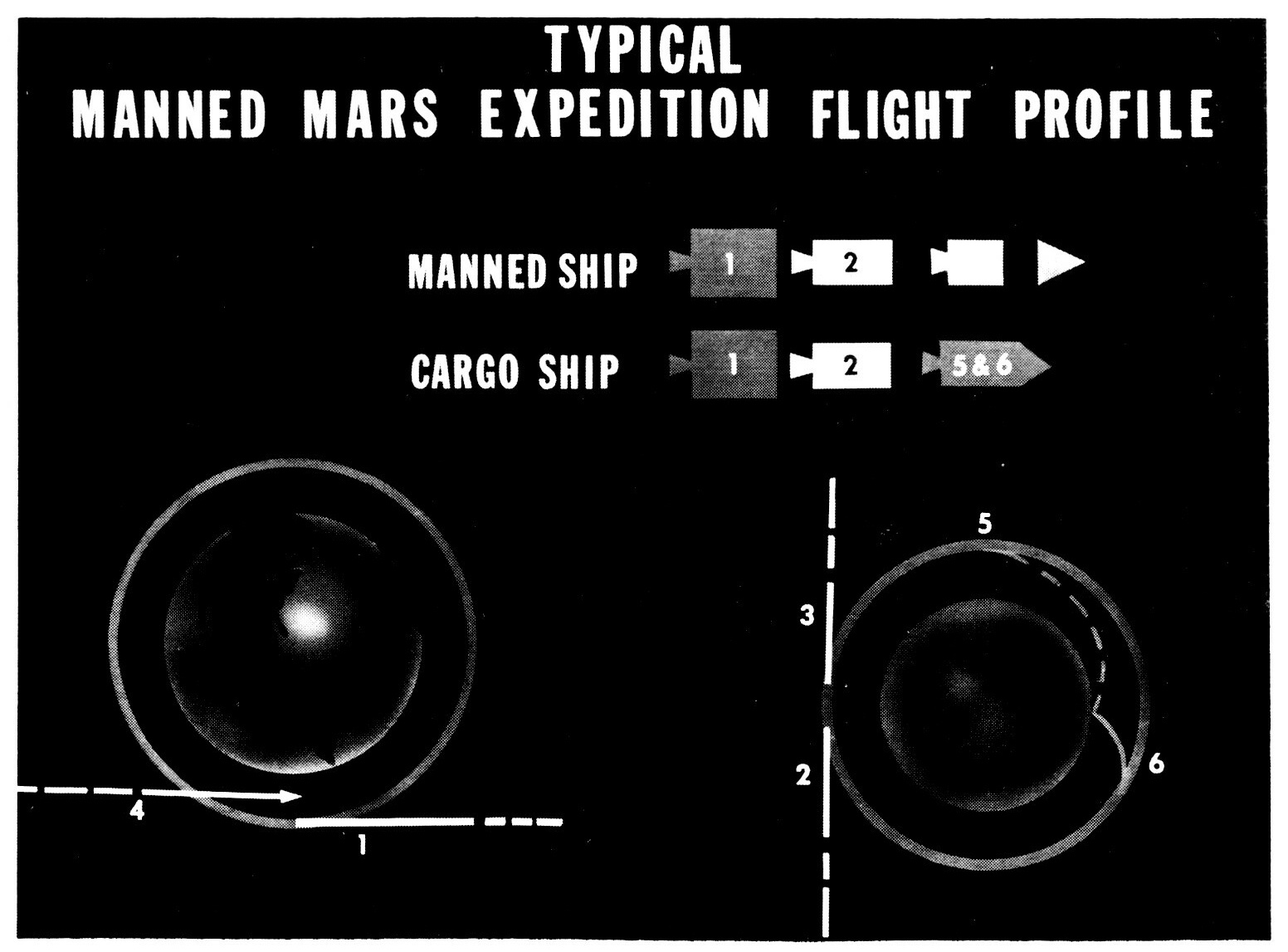
In order to provide landing capability on the surface of Mars, a cargo ship was assumed to be required, based on the typical example illustrated in Figure 2. The cargo ship, as in the case of the manned ship, would use a rocket propulsion stage (Unit 1) to escape the Earth's gravitational field, and a propulsion stage (Unit 2) for braking maneuver into a Mars orbit. The payload for the cargo ship was assumed to be a Mars excursion module, i.e., the vehicle which would provide the capabilities for a manned landing on the surface of Mars as well as return to a Mars orbit and, of course, rendezvous with the manned spacecraft. As illustrated in Figure 2, this would be maneuvers or Units 5 and 6. Based on the assumptions regarding propulsion, i.e., nuclear propulsion for Units 1 and 2 for both ships and Unit 3 for the manned ship, and chemical propulsion for Units 5 and 6, it has been determined that the useful weight (payload) arriving in a Mars orbit for both manned and cargo ships would be approximately equal. Also, Units 3 and 4 of the manned ship would be equal in weight to Units 5 and 6 of the unmanned ship. For the purpose of this paper, it was assumed that Units 1 and 2 for both ships would be identical. The landing capability provided by the cargo ship would depend very largely on the following considerations: The type of propulsion used for Units 5 and 6; the characteristics of the Mars atmosphere; the vehicle designed; the number of people to be transported per ship; the redundancy required in terms of one ship as well as standby ships; the staytime on Mars; and the characteristics of the Mars surface. Preliminary studies indicate that, with the assumed payload to be delivered to Mars orbit by the cargo ship, the following could be accommodated:
1. Two, two-man Mars excursion vehicles, each with a two to three week surface staytime.
2. Several small probes that could be launched from orbit into the Mars atmosphere to obtain scientific data as well as for Mars surface exploration.
The weight required in an Earth orbit for one ship is illustrated in Figure 3.
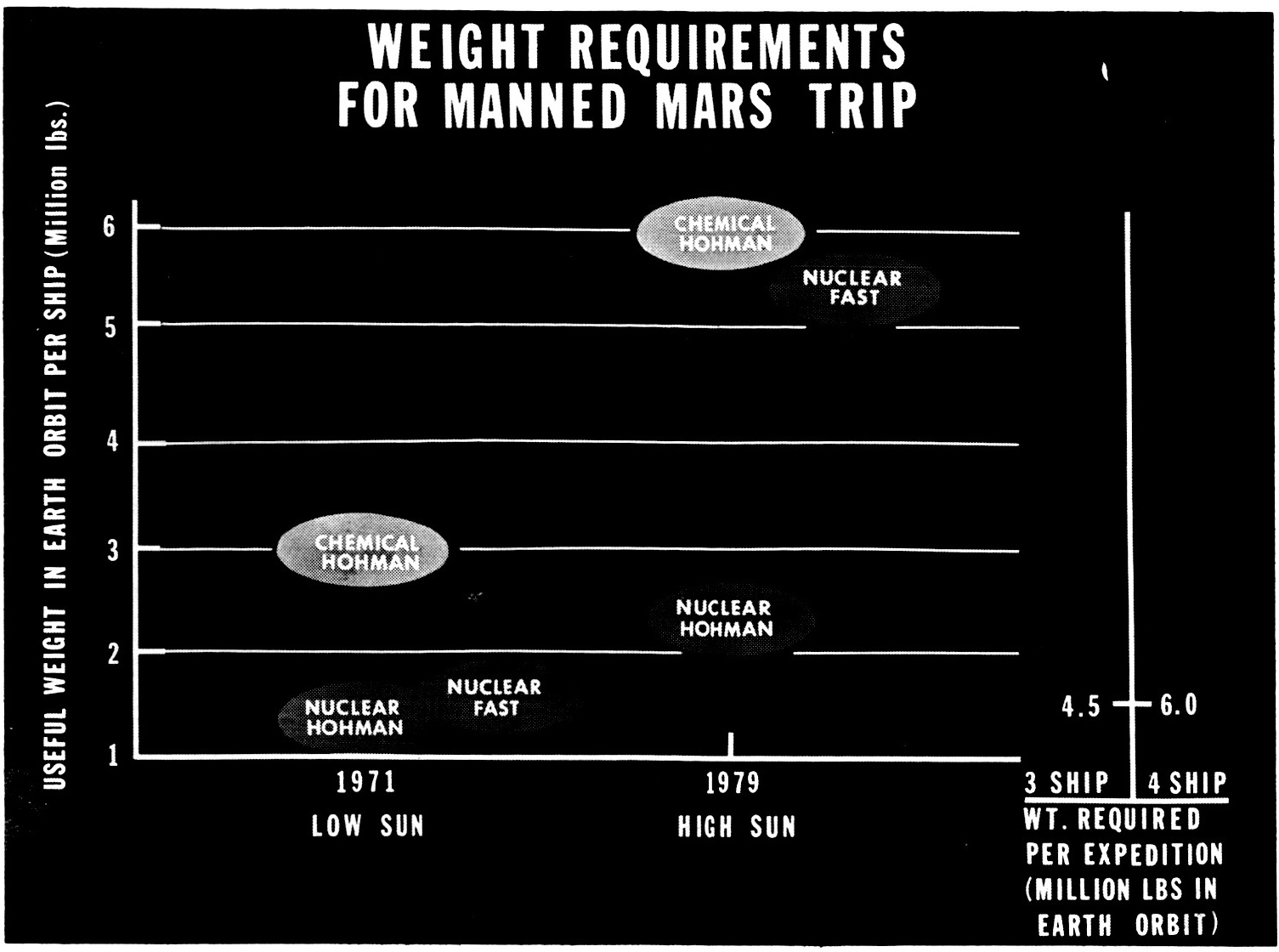
In view of the extended flight time, mission complexity, and the hazardous environment involved in such a trip, certain redundancies are considered necessary. As can be seen in the illustration, the weight of the ships would vary with time as well as the amount of solar activity which would be encountered over the years. For 1971, when a low solar activity is expected, the weight of the ship varies from approximately 1.0 million lb, or a little over, for a nuclear system using a Hohmann type flight mode to approximately 3.0 million lb for a chemically propelled system using Hohmann transfer. For the purpose of this paper, it was assumed that each ship would weigh approximately 1.5 million lb, which corresponds to a ship in the 1971 time period using nuclear propulsion stages and a relatively fast transfer (14 months total trip time) as illustrated in Figure 1. Also shown are the weight requirements for a ship in 1979 where not only increased velocity is required, but additional shielding is required due to the high solar activity which is anticipated during that time period. On the right of Figure 3, are given the assumptions used for this paper in terms of weight required in an Earth orbit of approximately 300 nautical miles altitude for a manned Mars landing and return. Certain redundancies will be required: Three ships are considered near minimum and four ships would constitute a desirable exploration, thus yielding 4.5 million lb for the minimum and 6.0 million lb in orbit for a nominal expedition.
The establishment of launch vehicle requirements at this time is considered premature. Due to uncertainties in the mode selection, trip time, type of propulsion to be used and weight of the space ship for a Mars exploration, only typical or representative requirements (or desirements) can be established. Since the launch vehicle to be used for the Mars trip will also have other missions, they too must be taken into consideration in establishing requirements. Unfortunately these other missions, such as lunar base, orbital operations, global logistics, etc., are not well defined either and, therefore, tend to complicate the "launch vehicle requirement" picture even further.
Of all the missions (or desirements) analyzed to date, the Mars mission is the most critical and places the highest requirement on very large (1.0 million lb or more) payload capabilities for the launch vehicle. Past studies in the area of economics and optimum sizes of future launch systems have indicated that "the largest vehicle is not normally the most economical, particularly if only a small number of total flights are required (approximately 100 or less) ."
It was concluded that launch vehicles of the 0.7 to 1.0 million lb payload capability should be considered as the most promising next system for development and operation after SATURN V. The logic for this conclusion is the economic considerations mentioned earlier and the fact that very large vehicles (approximately 2.0 million lb payload capability) would require extensive advances in technology and considerable time and cost to achieve.
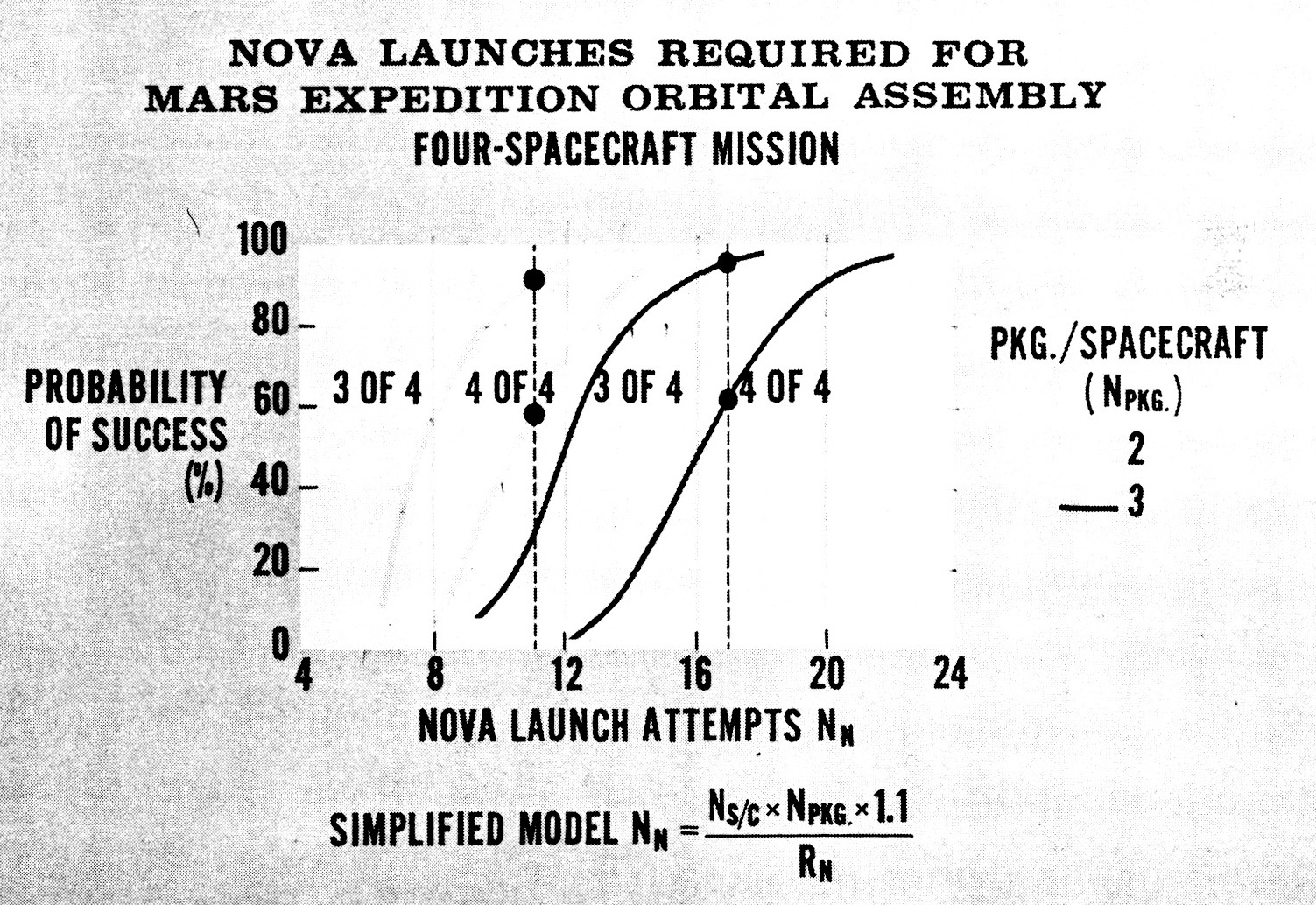
Figure 4 shows the launch attempts required versus probability for success for two sizes of NOVA vehicles: First, a vehicle which could place a 1.5 million lb spacecraft into orbit with two successful launches and, second, a vehicle which could place a 1.5 million lb ship into orbit with three successful launches. The payload capability for two packages per spacecraft would be from 900,000 to approximately 1.0 million lb per vehicle. This would provide roughly a 10 percent contingency in the launch vehicle system, as well as take into consideration the fact that each ship cannot be broken down into two identical parts. A similar contingency was assumed in the case of the three packages per Mars ship. A payload capability per launch was computed to be between 700,000 and 800,000 lb. Considering first the two successful launches per Mars ship, eight launches would be the minimum required to place four ships into orbit. As can be seen in Figure 4, the probability of success would be extremely low, roughly 10 percent. The probability of success illustrated is that of successful launch, orbital rendezvous, docking, and checkout of the spaceship itself, but does not include launch from orbit or the remainder of a manned Mars mission. Eight launches would, however, provide roughly a 60 percent probability of success that three out of the four ships would be checked out in orbit and available for launch. Due to the expense, not only of the launch system and transportation, but of the Mars ships, it is felt that a 60 percent probability would be too low. Assuming that a 90 percent probability of 3 out of the 4 ships would be a minimum, then as shown in Figure 4, 11 launches would be required. This would also indicate the probability that all of the four ships would be available for the expedition. Using NOVA vehicles with 700,000 to 800,000 lb payload capability, 17 launches would be required to provide the same probability of success as the 9 launches of the 1.0 million lb capability NOVA. To provide a bare minimum manned Mars landing and return capability, based on the two-ship scheme, it can be seen in Figure 5 that seven NOVA (1.0 million lb capability) launch attempts would be required. This would provide a 90 percent probability that two ships could be successfully assembled and checked out in orbit - - one cargo and one manned ship.
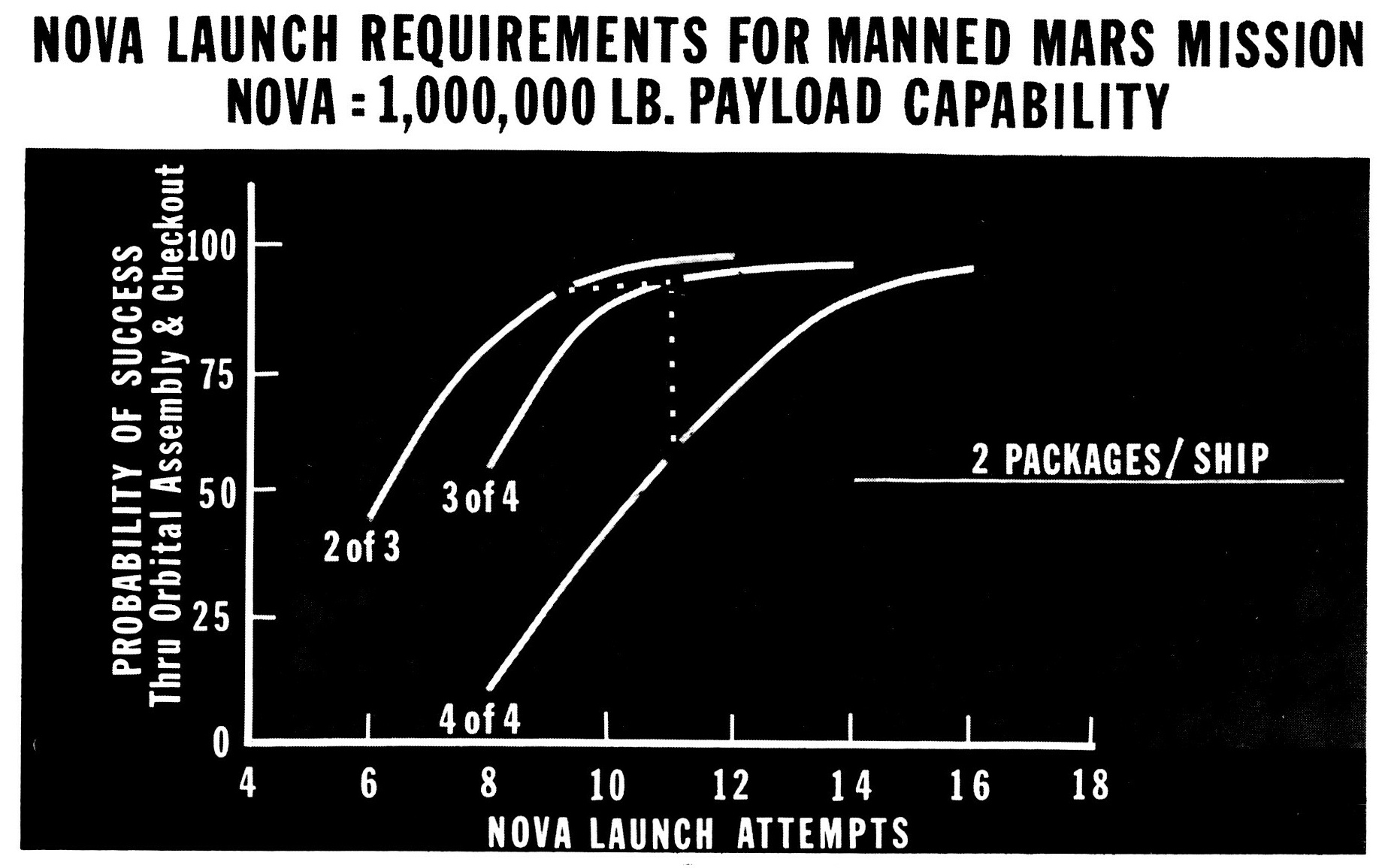
Such an operation would provide no gross redundancy and is considered by the author at this time to be too marginal for consideration. Three ships are considered minimum, viz., two manned ships and one cargo ship. As shown in Figure 5, only two additional launch attempts would be required to provide the same probability of success. Such an investment is considered desirable.
Since the launch vehicles to be used for manned planetary exploration will also have other applications, a mission model has been developed in order to assess the implications of the varied mission requirements for a NOVA class vehicle.
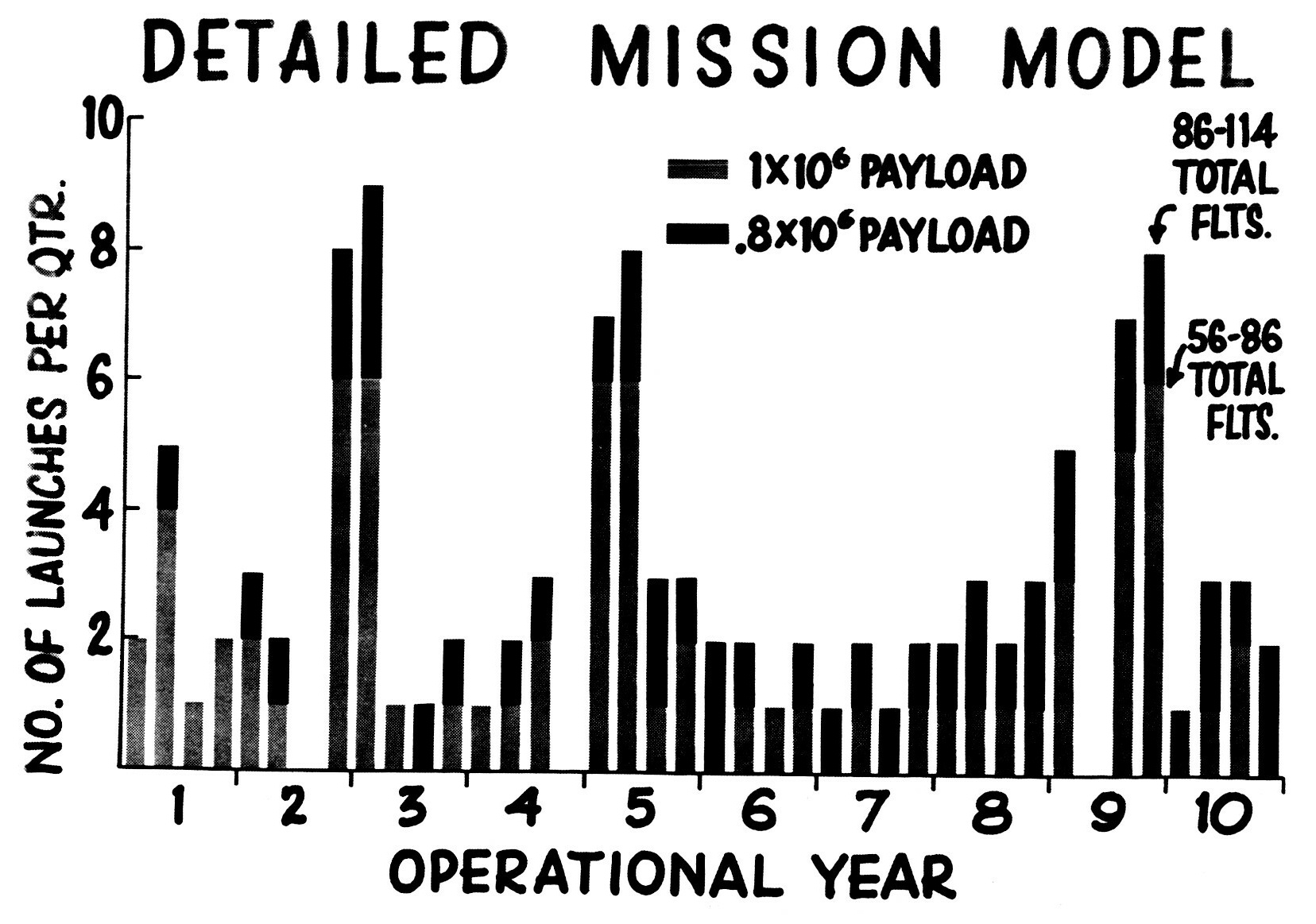
Figure 6 illustrates a typical mission model over a 10-year operational period. This mission model includes 3 manned planetary expeditions over the 10-year period. This is illustrated by the tall bars in the second to third operational year, fifth operational year, and ninth operational year. Other missions assumed were the establishment and support of a 20- and 50-man lunar base, test launchings of the manned Mars ship, as well as various orbital operations required to support the Mars ship development, and the manning of the Mars exploration. Since the manned Mars requirement places the most demanding tasks on the launch systems and facilities, it has been assumed that the manned lunar base launch requirements, the development of the Mars ship, as well as orbital operation flights, would be spread over the 10 years so as to not coincide or conflict with the manned Mars expedition. As can be seen, these other requirements, based on the assumptions made, do not result in an even launch rate over the 10-year operational period. This is primarily because of the very high launch rate required for the manned Mars mission, and the basic assumption that the overall accumulation of the Mars ship and checkout would be accomplished within a six-month period. The assumptions for the larger mission model (larger number of flights) would include 3 3-ship expeditions to Mars, the development and support of a 50-man lunar base, 3 large space stations, and the development of the Mars ships over a 10-year period. This would result in 86 launches of a 1.0 million lb payload capability NOVA and 114 launches of a 800,000 lb payload capability NOVA. The cost of such a launch vehicle program, including development, facilities, and operational flights would be on the order of $15 billion (FY 63 dollars in zero inflation rate) thus constituting a rather sizeable program. Even with the program of that magnitude, the manned Mars mission requirements are extremely critical.
The Mars mission launch facility requirements necessitate a very high launch capability which would not be fully utilized by the remainder of the mission desirements during the overall program. Based on the assumptions used, approximately one-third utilization will be made of the facilities over the complete 10-year period.
A wide range of launch vehicle systems has been studied by MSFC during the past three years. The following vehicle descriptions will include only four of those presently under consideration. The vehicles have been broken down into three classes. Class I is made up of state of the art vehicles and is illustrated in Figure 7.
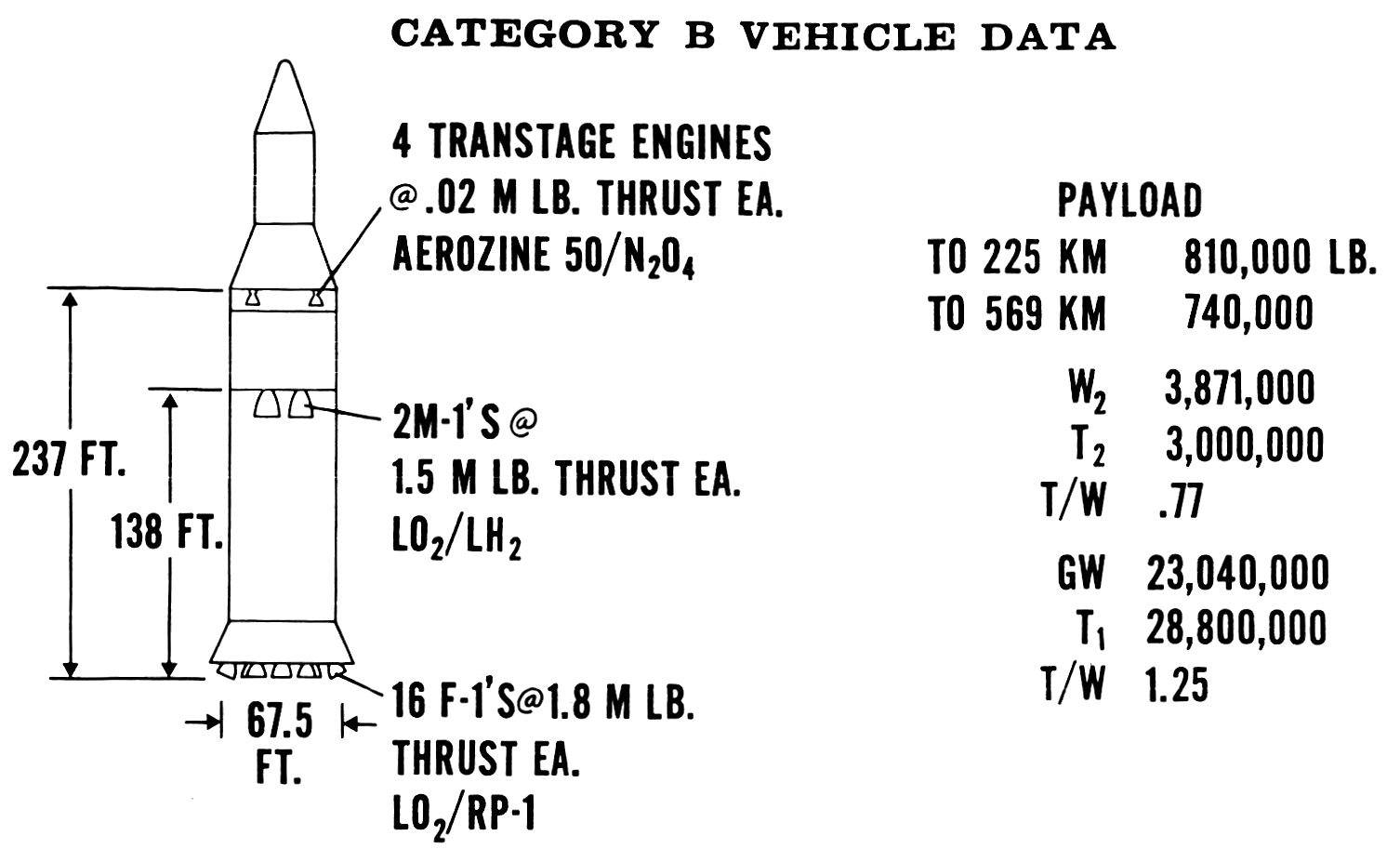
This vehicle would utilize 16 up-rated F-1 engines in the first stage, burning liquid oxygen and kerosene. Each of the up-rated F-1's would have a sea level thrust of 1.8 million lb. The first stage would be approximately twice the diameter of the present SATURN V first stage. The second stage would utilize two M-1 engines, each with a thrust of 1.5 million lb (vacuum), burning liquid oxygen and liquid hydrogen. The overall vehicle, including the transtage, would be approximately 240 feet high. Above this would be either a payload which would be transported to orbit or a chemical or nuclear third stage, plus payload. For orbital flights, studies have indicated that a transtage would be the most desirable solution for final velocity vector control, payload attitude control, rendezvous, and docking and, as shown in Figure 7, utilizes small aerozine 50/N2O4 engines. The transtage would also be utilized to house the guidance and control systems, instrumentation, and telemetry for flight development. The vehicle would have the payload capability on the order of 750,000 lb to orbit and, if used, would require three successful launches to place the required 1.5 million lb Mars ship into orbit with the contingencies mentioned earlier. The vehicle lift-off weight (23 million lb) represents a vehicle which is optimized for orbital transportation with two stages, plus a transtage and incorporates a propulsion section recovery system. After first stage burnout, the engines and thrust structure with associated equipment would be separated from the first stage tank and follow a ballistic trajectory. A drag parachute would be used for stability during re-entry. After reaching subsonic velocity, large parachutes would be deployed and just prior to water impact retro rockets would be fired to minimize impact velocity. Studies have shown a considerable economic saving with propulsion system recovery. A cut-away drawing of the F-1/M-1 vehicle is shown in Figure 8. Numerous studies have been performed on tank configurations, such as the multi-cell tank arrangement in both first and second stages shown in the illustration.
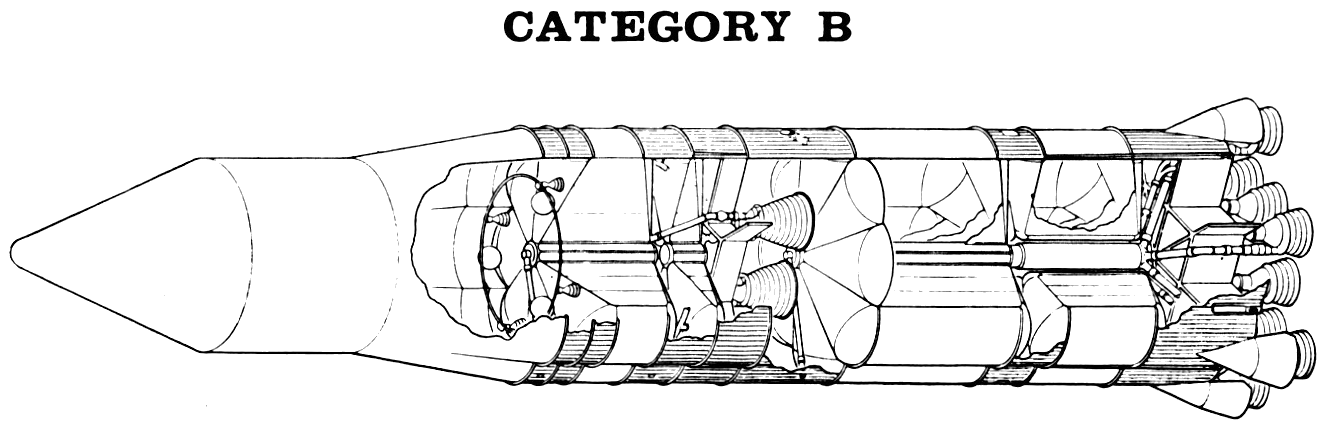
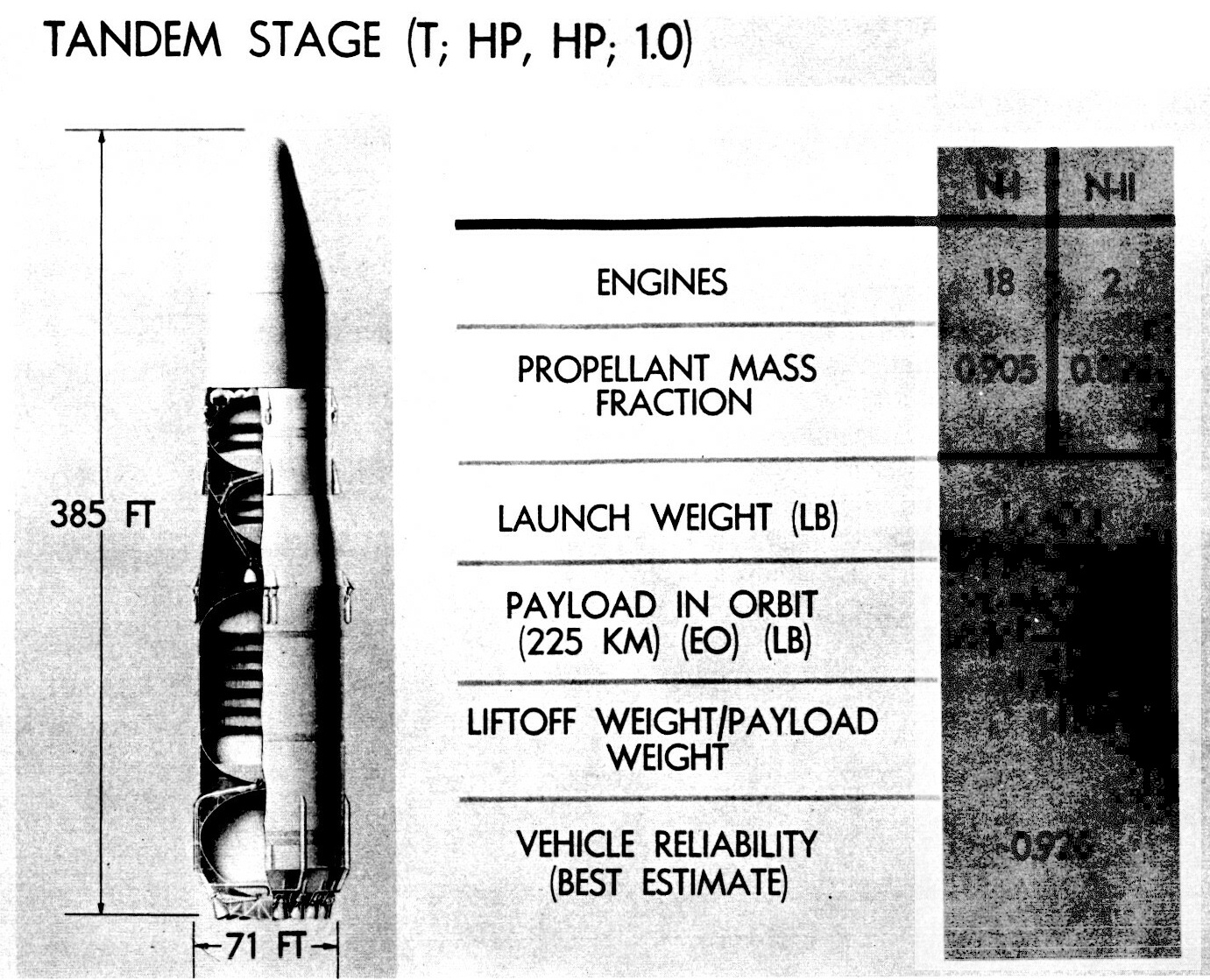
Figure 9 illustrates an advanced NOVA vehicle concept for Class II. Such a vehicle would require the development of new engine and propulsion system concepts. This vehicle utilizes 1.0 million lb thrust liquid oxygen/liquid hydrogen engines with high combustion chamber pressure (3,000 psi) in both stages. The first-stage would consist of 18 of the engines wrapped around a zero length or up to 10 percent length truncated plug. Two identical engines would be used in the second stage; however, they would be used as individual modules here. The advantage of the plug concept, if proven successful, would be altitude compensation during flight. In effect, this gives a variable expansion ratio and provides specific impulse gains during the atmospheric as well as vacuum portions of the ascent trajectory. This vehicle with its approximately 14 million lb lift-off weight, incorporating full first stage recovery by parachutes, retro rockets, and water landing is the lightest of the NOVA vehicles presently under consideration, having 1.0 million lb of payload capability.
Another Class II vehicle, which is presently being investigated in more detail, is illustrated in Figures 10 and 11.
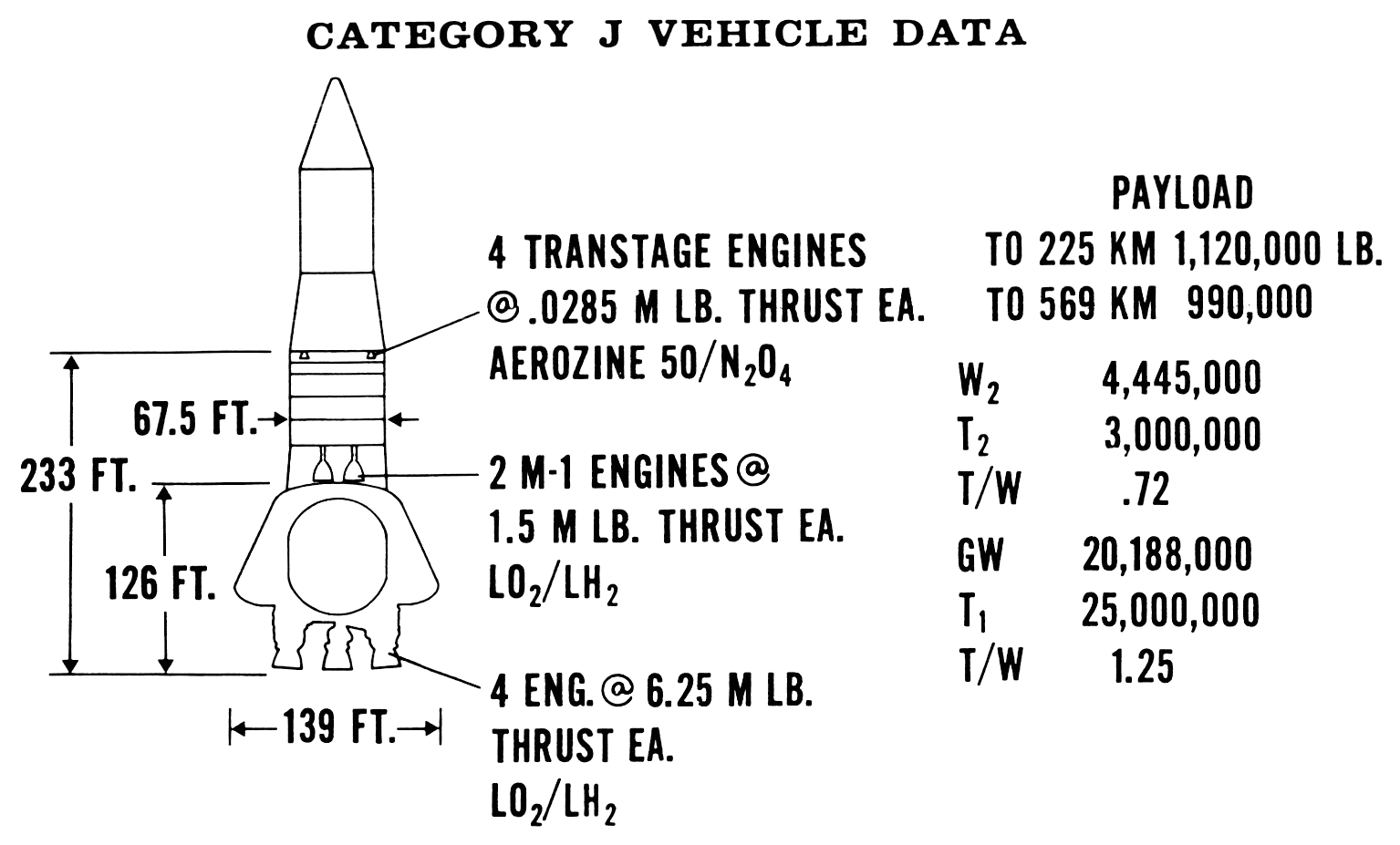
This is a two-stage to orbit vehicle with a fully recoverable first stage. This concept utilizes a shaped first stage for ballistic water recovery. It incorporates 4, 6.25 million lb thrust bell nozzle, liquid oxygen/liquid hydrogen engines with a 3,000 psi combustion chamber pressure. Such a first stage would be approximately 140 feet in diameter and 125 feet tall. This first stage concept is also under study utilizing different engine systems, i.e., forced deflection type nozzles, as well as the plug engine concept. Each of these other engine concepts results in a shorter first stage, as well as provides advantages in terms of center of gravity location for recovery dynamics. The vehicle uses two M-1 engines in the second stage and is sized for approximately 1.0 million lb payload capability into a 300 nautical mile orbit.
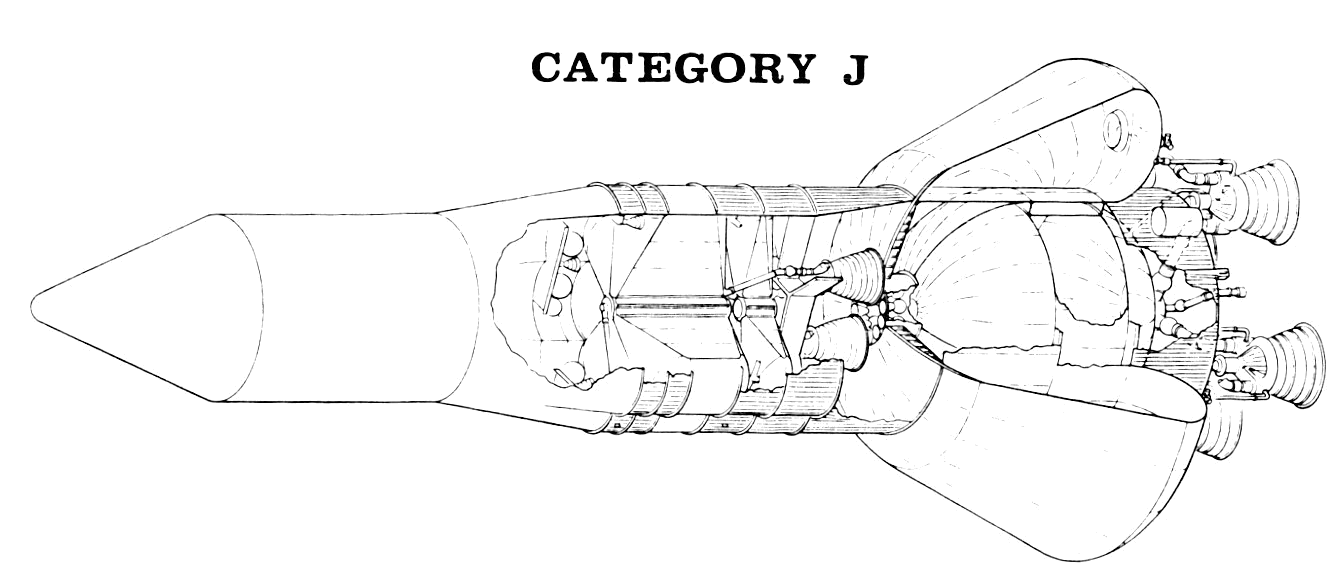
Figure 11 shows a cut-away view of the vehicle. The first stage has a large spherical oxygen tank in the center with a toroidal oxygen tank wrapped around the liquid oxygen tank. The first stage would burn out at a velocity of approximately Mach 5 to 6 and the re-entry environment for the first stage would be such that no heat protection would be required for the alluminum type structure. Parachutes would be deployed after reaching subsonic velocity and retro rockets are included in the nose of the first stage to reduce the landing velocity prior to water impact. Weight has been assumed for salt water protection of the overall stage, although it would not be required for the re-entry environment. The vehicle first stage would float up-right with only 15 to 20 percent of the nose being submerged in the water. Such a configuration would keep the engine and critical elements of the stage high above the ocean surface, thus protecting them from the very hostile environment. The stage would be returned to a refurbishment and checkout site prior to re-launch.
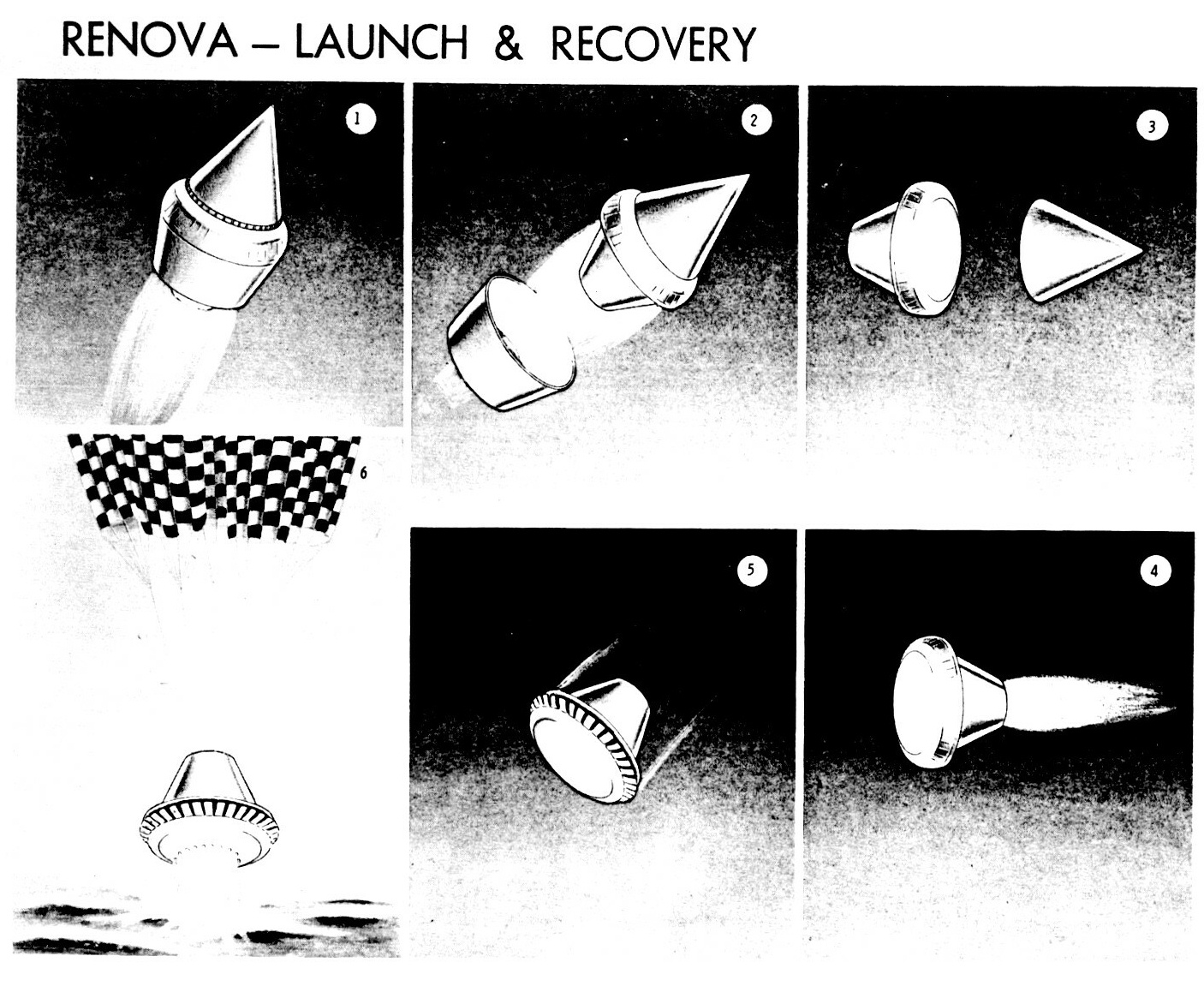
Figure 12 shows a flight profile of a Class III NOVA concept. This vehicle, an advanced unconventional system, utilizes air-augmentation during the atmospheric portion of the ascent trajectory. Air is taken in and mixed with the rocket exhaust during the early portion of the atmospheric flight as illustrated in
View 1 of Figure 12. After leaving the sensible atmosphere the mixing ring is jettisoned as shown in View 2. After achieving orbital velocity the conical payload is separated as shown in View 3. The stage effects a retro maneuver as illustrated in View 4 and re-enters ballistically as shown in View 5. By the use of large parachutes and retro rockets, the vehicle will be landed in the water as illustrated in View 6.
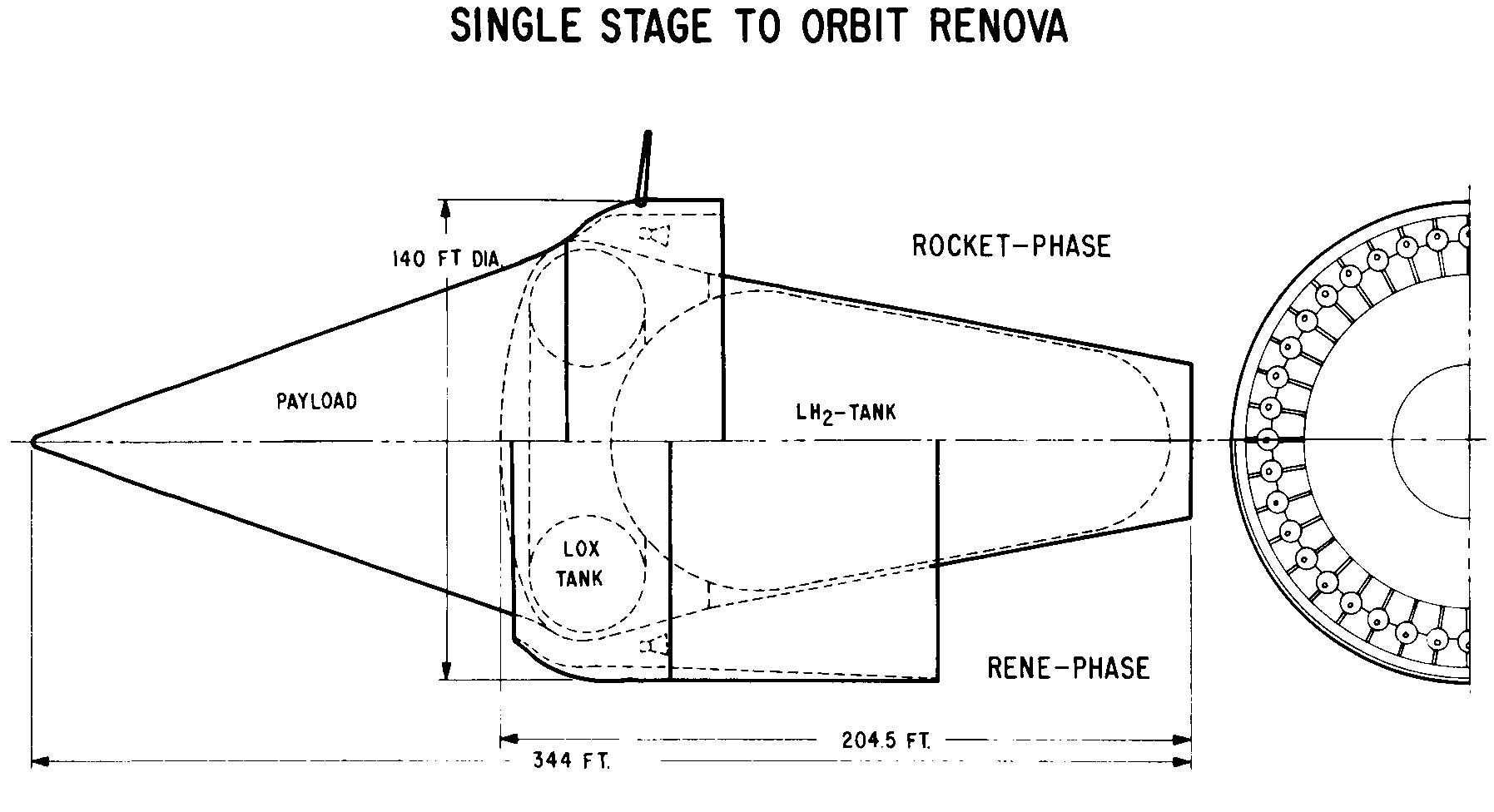
A view of the Class III concept is shown in Figure 13. It is basically a single-stage to orbit vehicle utilizing liquid oxygen and hydrogen as propellant with air-augmentation. Although numerous configurations are possible, the one illustrated is considered representative and employs a large liquid hydrogen tank in the rear portion of the vehicle. The toroidal liquid oxygen tank with a plug type cluster of small engines are wrapped around the periphery of the vehicle. A conical payload is shown since it provides good inlet aerodynamics. The lower half of the figure illustrates the configuration during aerodynamic ascent with the air inlet coming into a mixing chamber at the exhaust plane of the engine nozzle. In the mixing chamber aft of the engine the intake air is mixed with the rocket exhaust, thus providing thrust as well as specific impulse augmentation. Additional tradeoffs are being made for pure mixing, partial mixing and burning as well as true after-burner type concepts. Although additional thrust, as well as specific impulse augmentation can be obtained by burning rather than mixing, a much greater design problem must be solved in order to take advantage of the additional gain. Design and performance data presently available indicate that pure mixing of the rocket exhaust gases with the intake air would be sufficient to make the performance of the concept attractive. The mixing ring would be jettisoned and the air inlet duct closed at approximately Mach 6 and the vehicle would have the configuration shown in the upper half of Figure 13 during the remainder of the ascent trajectory. Very high expansion ratios can be obtained by such a configuration, thus providing very high specific impulses for the liquid oxygen/liquid hydrogen rocket engine systems.
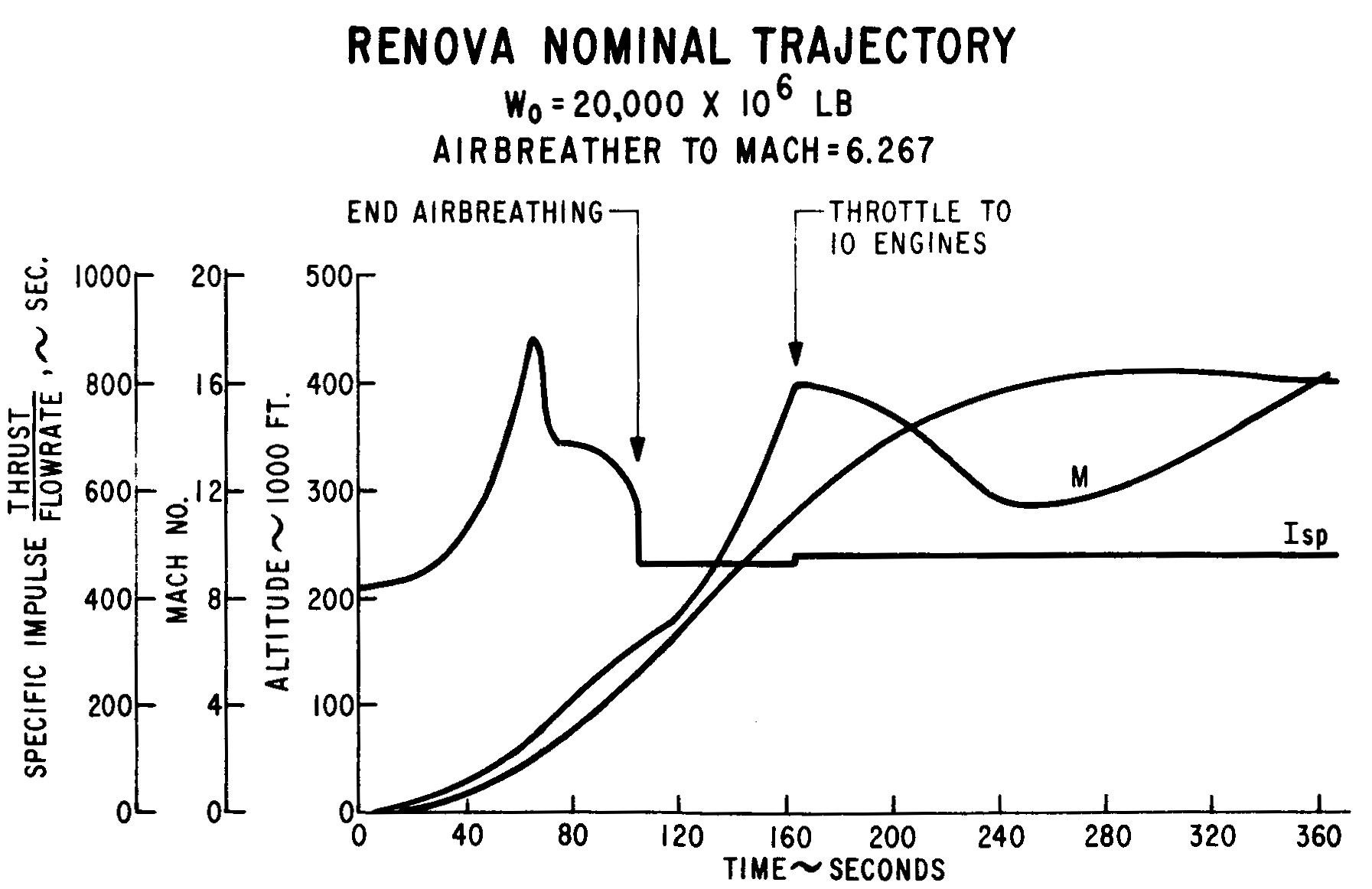
Figure 14 presents nominal trajectory data on the Class III concept. The average specific impulse over the complete ascent trajectory, as shown, would be approximately 500 seconds.
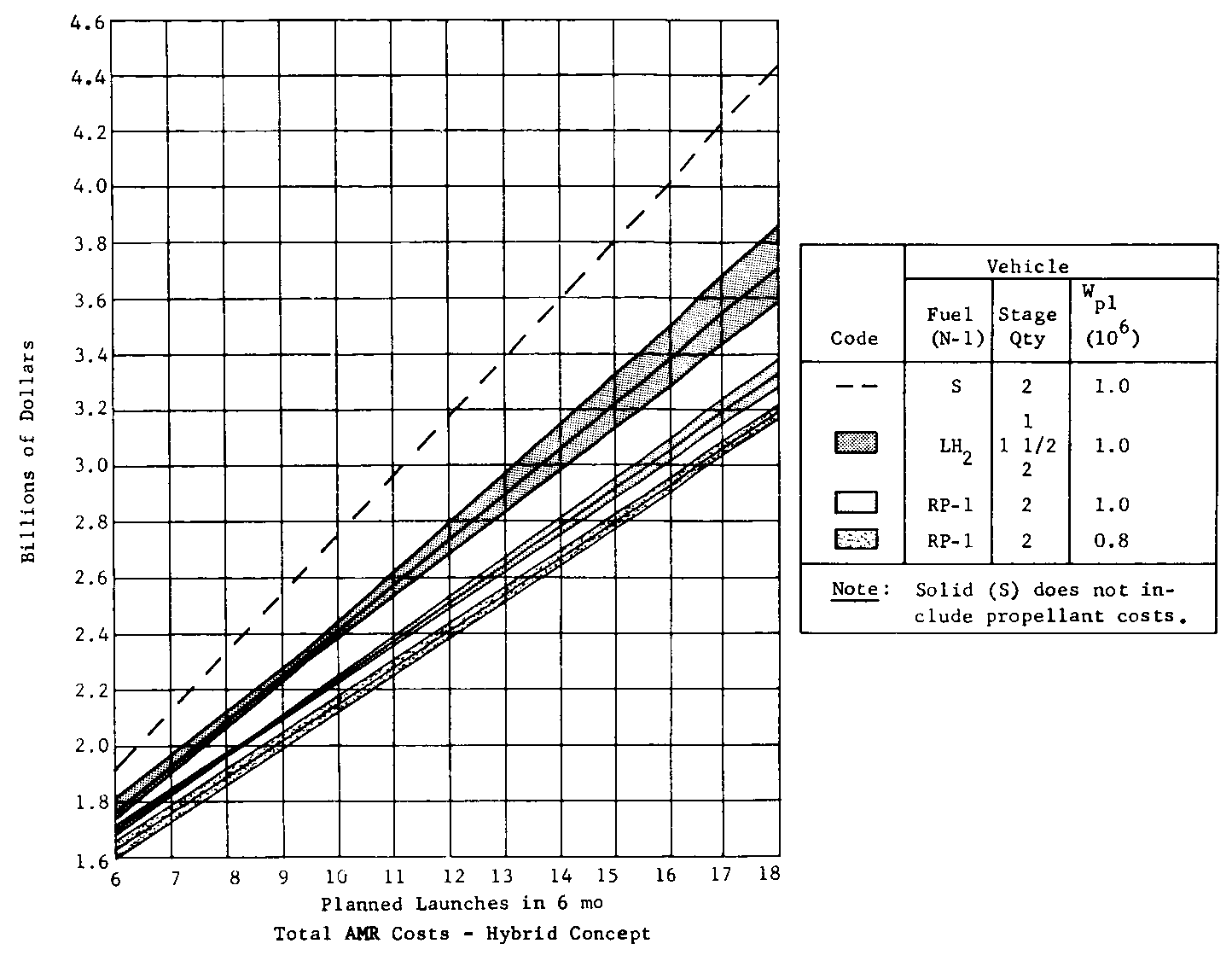
Figure 15 shows the total cost for launch facilities and operation for various types of vehicles and includes development, as well as the operational portion of the overall launch systems lifetime. As can be seen, the launch rate capability designed into the Atlantic Missile Range (AMR) facility has a dynamic influence on the overall AMR cost. As was shown in Figure 6, approximately 86 launch attempts would be required to satisfy the numerous missions for the NOVA vehicle over a 10-year period. If launch facilities were constructed to satisfy the 861aunches over the 10-year period on a level launch rate basis, a capability of some 4 launches per 6 months would be required. As can be seen, the total AMR cost for such a constant launch rate would be on the order of 1.5 billion dollars. However, to satisfy the manned Mars mission, as assumed, a launch capability of some 12 launches in a 6 month period would be required for a 1.0 million lb payload capability NOVA. The requirement would raise the total AMR cost to roughly 2.5 billion dollars or impose a 1.0 billion dollar increase for AMR cost. This would represent approximately seven to eight percent of the total NOVA launch vehicle system costs to satisfy the manned Mars mission high launch rate requirements .
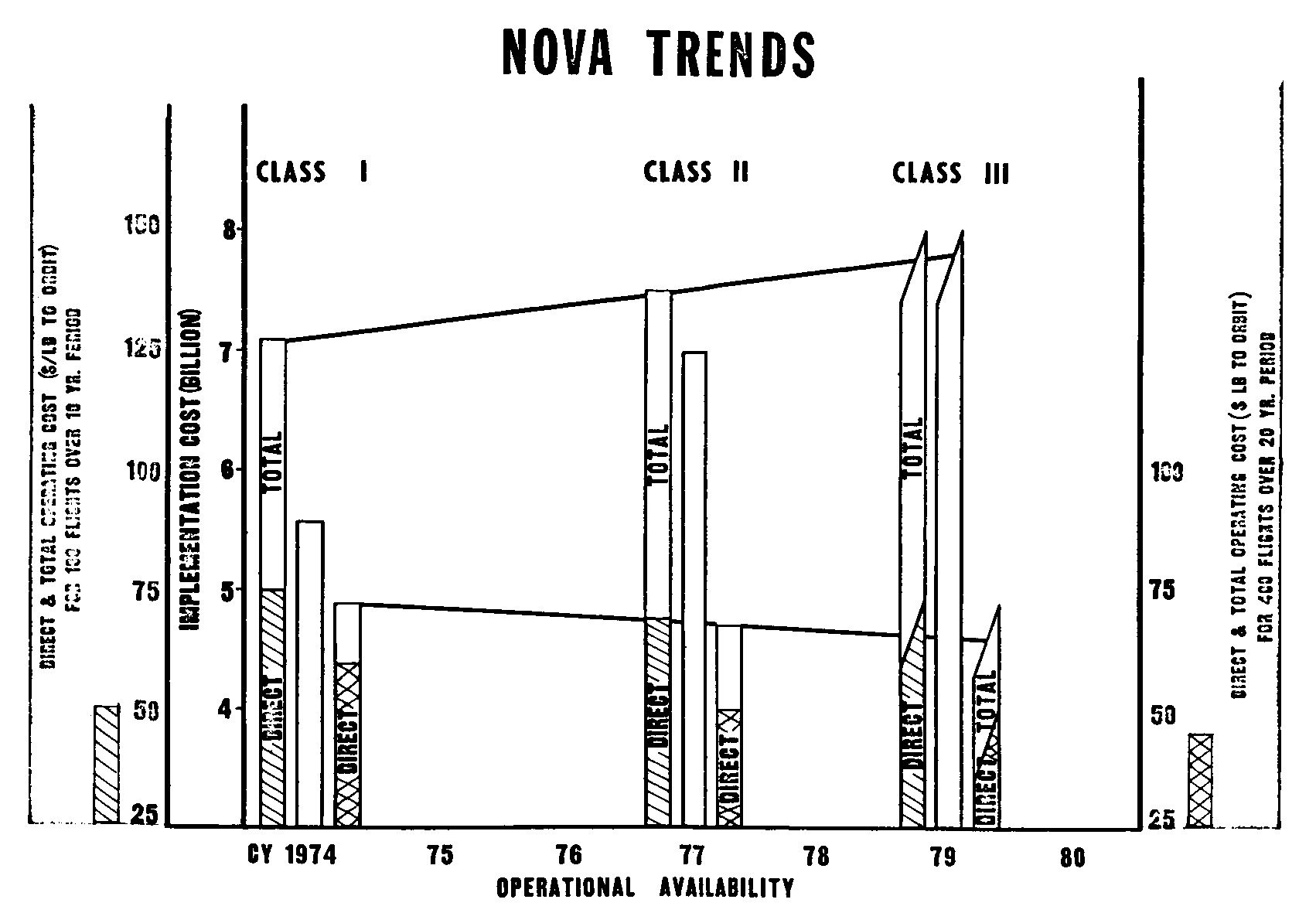
In summary, Figure 16 shows trends of launch vehicle cost parameters for various classes of vehicles. Definitions of Class I, II, and III vehicles are:
Class I - F-l , M-l engines with recoverable first stage propulsion section.
Class II- Two-stage to orbit pure rocket system with a fully recoverable first stage.
Class III-An unconventional single-stage to orbit fully recoverable system utilizing air-augmentation.
Each of the classes are presented in terms of their operational availability and are 1974, plus or minus one year; 1977, minus one plus two years; and 1979, minus one year plus two years, respectively. The implementation cost which includes research and development, facilities, and GSE range from 5.5 billion dollars for Class I to approximately 8.0 billion dollars for Class III. The direct and total operational cost for each of the classes of vehicles are given for two program levels. The direct cost would be the cost necessary to procure,test, checkout, and launch a developed vehicle. The total cost includes the amortization of the implementation cost over the operational period, i.e., in the case of Class I the amortization of 5.5 billion dollars over 100 launch attempts during the 10-year period. The left bar for each of the classes of vehicles gives the direct and total cost for 100 NOVA launch attempts over a 10-year period. As shown for a program of this magnitude, (12 to 15 billion dollars), the Class I or earlier vehicle is the most attractive from an economic standpoint. Not only would it be the least expensive system, but it would also be available much earlier. The right bar for each class illustrates the cost associated with a program approximately four times as large, i.e., 400 flights over a 20-year period. Such a program would result in approximately a 30 billion dollar expenditure for launch vehicle systems. One factor that has not been included in Figure 16 is the cost associated with postponing the availability of the NOVA capability, i.e., what cost should be set aside for the later availability of a NOVA and the mission capabilities which it would provide the U.S.
After numerous studies in the majority of the areas associated with manned Mars expeditions, a large number of conclusions can be drawn. No attempt will be made here, however, to do so. On the basis of the brief data, and this paper, a few highlights in the area of conclusions can, however, be stated, as well as several critical or problem areas that relate to the overall system or mission. It should be understood that no attempt has been made to list all or even critical problem areas associated with technology or research, relative to elements of the overall manned Mars expedition system. Some conclusions and remarks relative to problem areas are listed below:
1. A launch vehicle of the NOVA class is technically feasible and could accommodate the manned Mars mission, as defined, or of the order indicated.
2. The development time for NOVA will be from 7 to 9 years after system definition and program approval. This would yield an operational system by around 1974, for a state of the art configuration, or an advanced unconventional configuration by around 1979.
3. In order to justify a NOVA vehicle, one or more of the following requirements will probably have to materialize:
a. A large lunar base.
b. Manned planetary landings and/or exploration.
c. Large civilian and/or military orbital operations.
4. Of all the missions studied to date, the manned planetary is the most complex and the most demanding on the launch vehicle. From the overall mission standpoint, it is considered necessary, however, to accept additional complexities in the launch vehicle to simplify the total mission.
5. The transportation cost to deliver a Mars expedition into orbit will range from 0.75 billion dollars, assuming a very large overall NOVA program, to 1.5 billion for a large (100 launch) NOVA program. It will probably be closer to 1.5 billion dollars unless we send a lot of people to Mars. This does not include the development of the Mars ships or their procurement along with spares and assumes a lot of other people use NOVA.
6. Two critical problems from the launch vehicle system standpoint are:
a. Definition of Mars ships (wt., vol., etc.).
b. Total time allowable to accumulate ships in orbit.
1. NOVA Vehicle Systems Study, Part I Conceptual Design Study, Report No. AE 63-0096, Volumes I - VIII, General Dynamics/ Astronautics Division, San Diego, California, April 1, 1963.
2. NOVA Vehicle Systems Study, Part I Conceptual Design, Engineering Report 12590-1 through -IV, Martin-Marietta, Space Systems Division, Baltimore 3, Maryland, April 3, 1963.
3. NOVA Launch Facilities Study, Phase I Report No. NASA-GR-63-7, Volumes I through III, Martin-Marietta, Aerospace Division, Denver, Colorado, March 1963.
4. A Study of Early Manned Interplanetary Missions, Report No. AOK 63-0001, General Dynamics/Astronautics Division, San Diego, California, January 31, 1963.
5. Manned Interplanetary Mission Study, Lockheed Missiles and Space Company, Sunnyvale, California, March, 1963.
6. A Study of Early Manned Interplanetary Missions, Final Report No. U-1951, Ford/Aeronutronics Division, Newport Beach, California, December 21, 1962.
7. Comparative Study of Advanced Lunar Transportation Systems, Final Report No. 00.159, Chance-Vought, Astronautics Division, Dallas, Texas, January 28, 1963.
8. Advanced Lunar Transportation Study, Final Report No. LMSC-B007322, Lockheed Missiles and Space Company, Sunnyvale, California, January 28, 1963.
9. Orbital Launch Operations, Phase II Progress Report, Volumes I through VI and Appendix I and II, Chance-Vought, Astronautics Division, Dallas, Texas, January 16, 1962.