FOURTH SYMPOSIUM
|
ORION SPACE PROPULSION
(TECHNICAL STATUS AND
MISSION POTENTIAL) (U)
Part I
TECHNICAL STATUS
by
Mr. J. C. Nance
General Atomic Division
General
Dynamics Corp.
All steady-state nuclear propulsion systems now under development are limited in performance by allowable temperatures in the engine structures. Performance, or ISP, increases as √T, other things remaining equal. In solid-core nuclear rockets the fuel elements must remain structurally intact at temperatures in excess of the maximum propellant temperatures, implying propellant temperatures never exceeding about 3,000° K. The various gas-core concepts propose to circumvent this limitation by insulating the structure from the high-temperature fissioning energy source by means of a gas which upon heating becomes the propellant. If any one of the proposed gas-core concepts prove to be feasible, a considerable improvement in exhaust temperatures and hence ISP can be expected.
A second approach to improved performance may be achieved by pulsing the nuclear energy source. Early calculations indicated that application of nuclear pulse techniques would permit reducing the engine "operating" times (or the time during which the propellant created by each explosion interacts with the engine structure) to a few hundred microseconds. During this short period useful momentum could be transferred, although thermal waves would not have time to penetrate the engine structure.
The general notion that nuclear explosions could be used in this manner for propulsion occurred independently to a number of people shortly after the first nuclear device was detonated in New Mexico in 1945. The idea was particularly attractive because of the enormous energies released in a nuclear explosion for a very small amount of expended mass involved.
Ten years passed before any consideration serious enough to justify detailed calculations was given to the problem. In 1955 Ulam and Everett of the Los Alamos Scientific Laboratory made the first attempt to foresee possible solutions to the problems associated with handling in a tolerable way the heat and pressures arising from a nuclear explosion [*].
[* – Ulam, S. M., and C. J. Everett, On a Method of Propulsion of Projectiles by Means of External Nuclear Explosions, Los Alamos Scientific Laboratory Report LAMS-1955, August 1955 (S/RD report).]
Their calculations were for a vehicle that would today be considered infeasibly small (12 tons). Furthermore, the mission considered was in the ICBM category where the concept is now known to be noncompetitive. Finally, accelerations imposed in the vehicle were computed to be very large, in the neighborhood of 10,000 g's.
Immediately after successful launch of the first earth satellite by Russia, Dr. T. B. Taylor addressed the problem of devising a practical space vehicle employing nuclear explosions aimed at leap-frogging the Soviet space effort [*].
[* – Taylor, T. B., Note on the Possibility of Nuclear Propulsion of a Very Large Vehicle at Greater than Earth Escape Velocities, General Atomic Informal report GAMD-250, November 3, 1957 (S/RD report).]
The ORION concept as we know it today stemmed from this effort. The major early contributions made by Taylor included the application of the concept to large vehicles (in the 1,000 to 10,000-ton class); the application to far more difficult space missions; a modification of nuclear devices to enhance momentum transfer and specific impulse; the use of an ablating surface on the pusher for heat protection; and the use of shock absorbers between the pusher plate and the vehicle payload compartment to degrade accelerations from the 10,000-g level to less than 10 g's.
Early in 1958 General Atomic was granted a contract to pursue the studies initiated by Taylor. The subsequent seven years of continuous and intensive analytical and experimental research have confirmed validity of the earlier calculations. Convincing technical arguments can now be made to substantiate the technical feasibility of the nuclear pulse concept in performance regimes which make possible economic manned space travel to practically any part of our solar system.
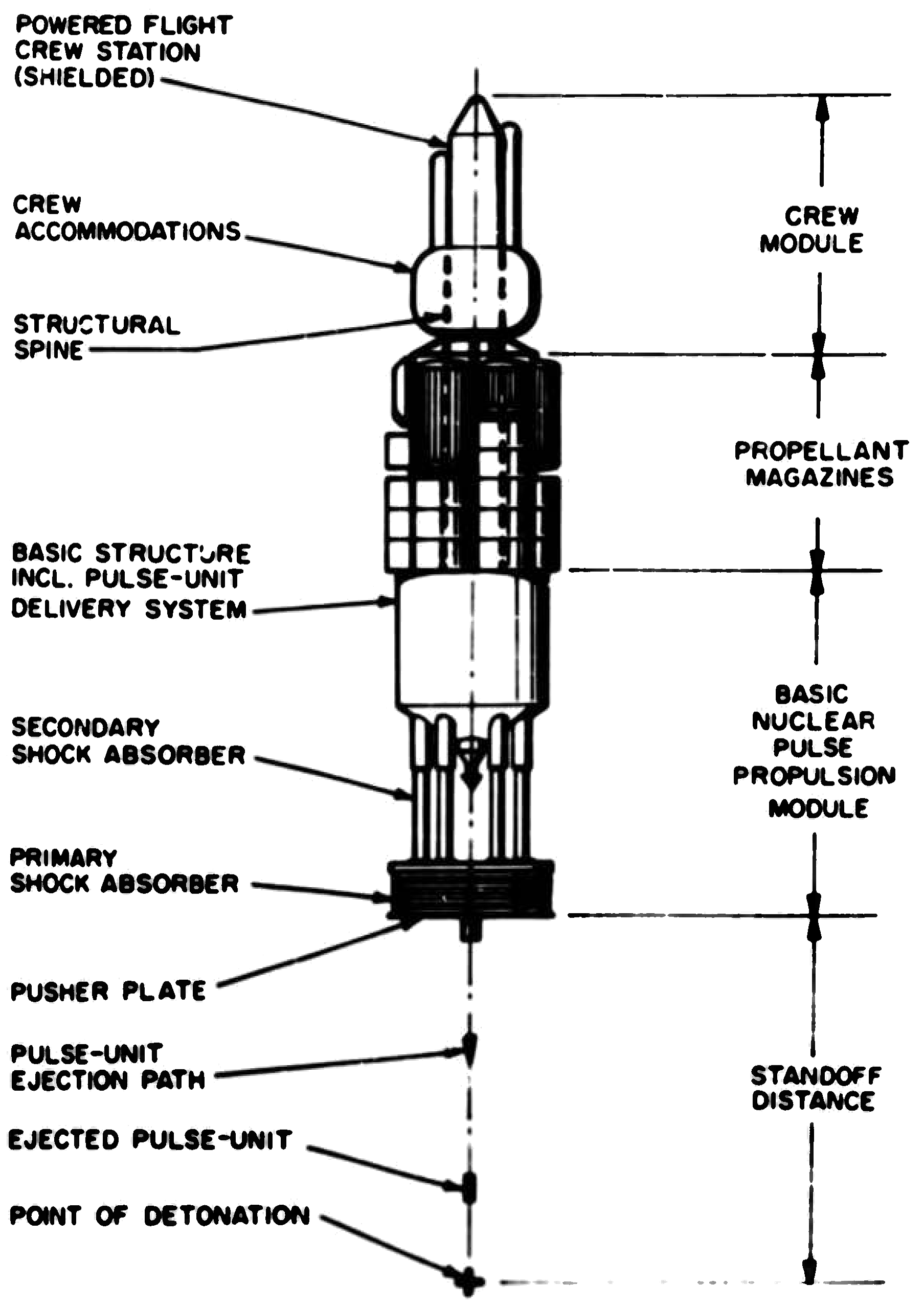
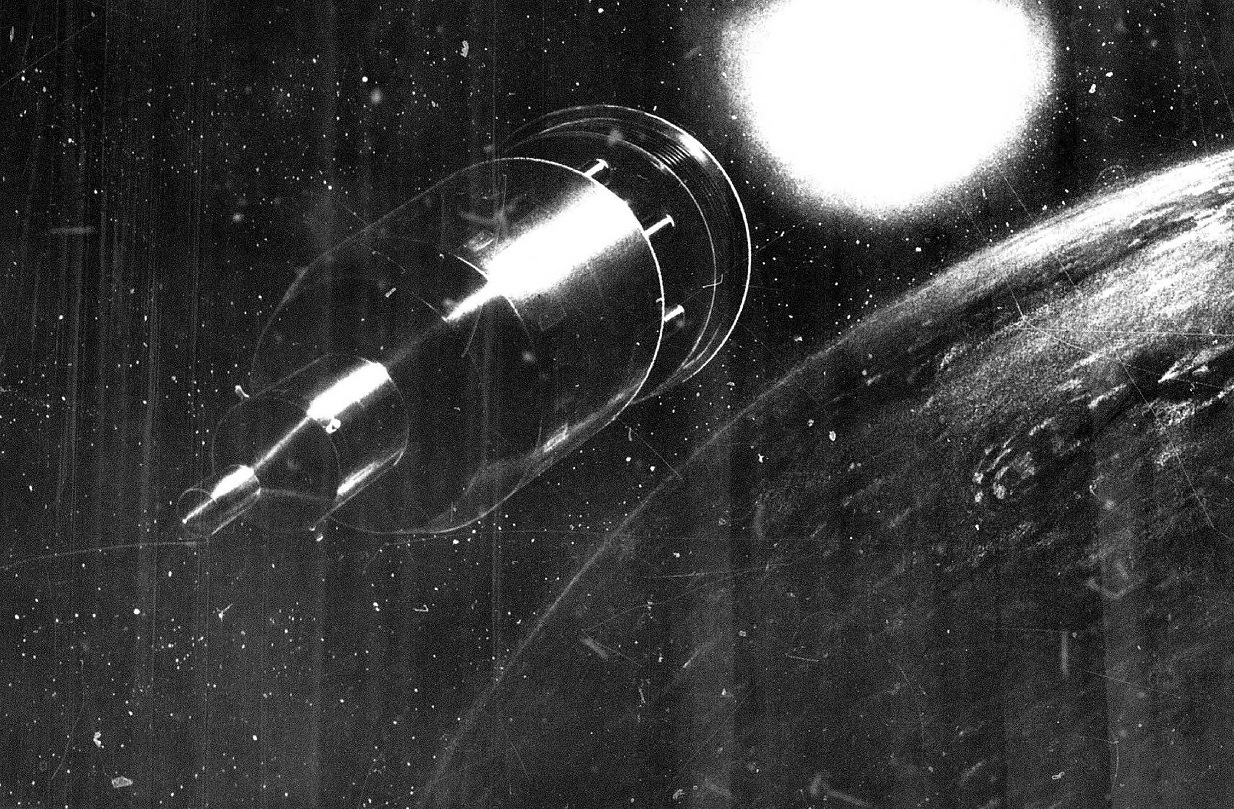
A reference nuclear-pulse-propelled vehicle is shown in Fig. 1. Briefly, the propulsion system operates as follows: A large number of low-yield nuclear pulse units stored in the module are delivered and detonated, sequentially, external to and below the vehicle. Ejection to the detonation point is by means of an auxiliary hot vapor system. A substantial fraction of the mass of each pulse unit--the inert propellant--is directed toward the bottom of the vehicle as a high-velocity, high-density plasma which is intercepted by a large circular metallic plate--the pusher. The momentum of the propellant is transferred to the pusher and the resulting accelerations are smoothed out by shock-absorbing devices to peak levels of a few g's in the upper vehicle--well within human tolerances.
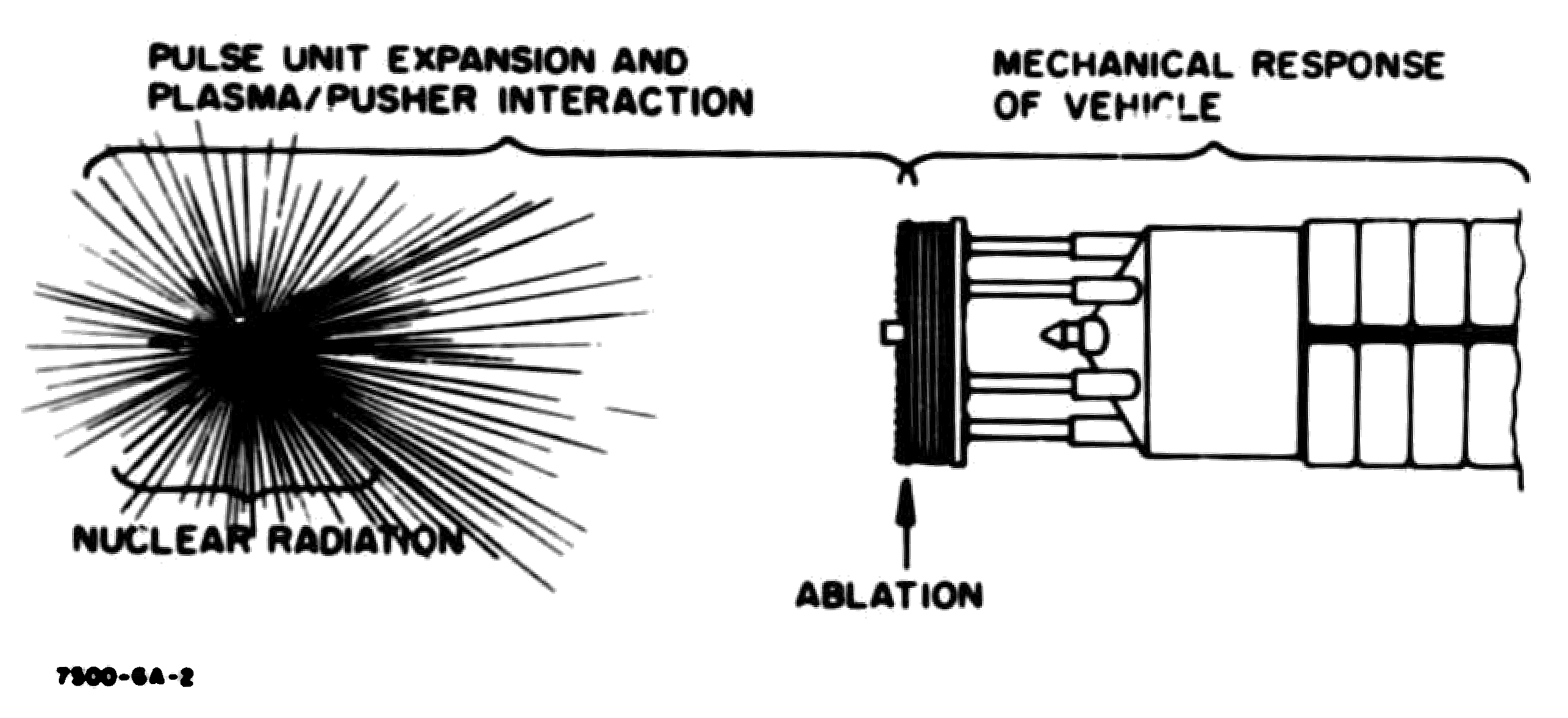
Figure 2 indicates in more detail the operating environments of the engine and identifies the major technical problems which have been under study. The neutron, gamma, and X-radiations produced by the explosion are largely shielded by the inert propellant which forms an integral part of each pulse unit. The fraction of the propellant cloud intercepting the pusher stagnates against it, creating plasma temperatures of approximately 120,000° K. These thermal conditions at the plate exist for a few hundred microseconds, during which time the momentum of the propellant is transferred to the plate. The pusher is driven forward, compressing the shock absorbers and then returns to its neutral position ready to accept the following impulse in times of about 1 sec. The shock absorbers may be either dissipative or non-dissipative and are cooled by ammonia or water. The steam or ammonia vapor created by cooling of shock absorbers is employed to eject the following pulse unit.
Any desired total vehicle velocity in a particular propulsive maneuver is obtained by varying the total number of pulse units expended. Typical engine "burning" times, at one impulse per second, may range upward to several hundred seconds. However, the propellant-pusher interaction times for even very high-energy missions will be substantially under one second.
From this general description one may then broadly identify the major technical problem areas inherent to the concept:
1. Pulse unit configuration and expansion characteristics, yield, mass, and radiation levels.
2. Interaction phenomena, temperatures, pressures, and resulting ablation.
3. Mechanical response of pusher and shock-absorber systems to repeated interactions.
4. Propulsion module integration, pulse-unit delivery systems, controls, and stability.
In addressing these problems there are certain classical features of ORION which have strong implications both to operational flexibility and, more importantly, to research and development philosophy and technical approach.
1. Nuclear radiation levels and effects in the engine during propulsion are low enough that they can be ignored or at least considered separately from the thermal and mechanical effects.
2. Nuclear (activation) levels immediately after operation are such that direct manned access to all parts of the engine is permitted.
3. High-temperature (ablation) effects are constrained to a "thin" ablating layer of the pusher surface, on the order of a few mils thick. The rest of the engine – including the pusher structure – operates at modest steady-state temperatures, less than about 600° F. This permits a clean separation of the thermal effects from the mechanical effects in studying engine problems.
This ability to largely separate nuclear, thermal, and mechanical problems and the relative insensitivity of the engine to the nuclear and thermal environments is of significant importance. As will be described later, the mechanical impulse transmitted to the pusher by the stagnating propellant can be accurately simulated in spatial and temporal detail, at full scale, and at the required impulse frequency with high-explosive techniques. Thus, in future development activities, a major reliance on nonnuclear testing techniques and facilities (together with limited nuclear underground experiments) is expected to result in gross simplification and savings and permit the engine to be carried to an advanced PFRT status short of commitment to a hardware flight test program.
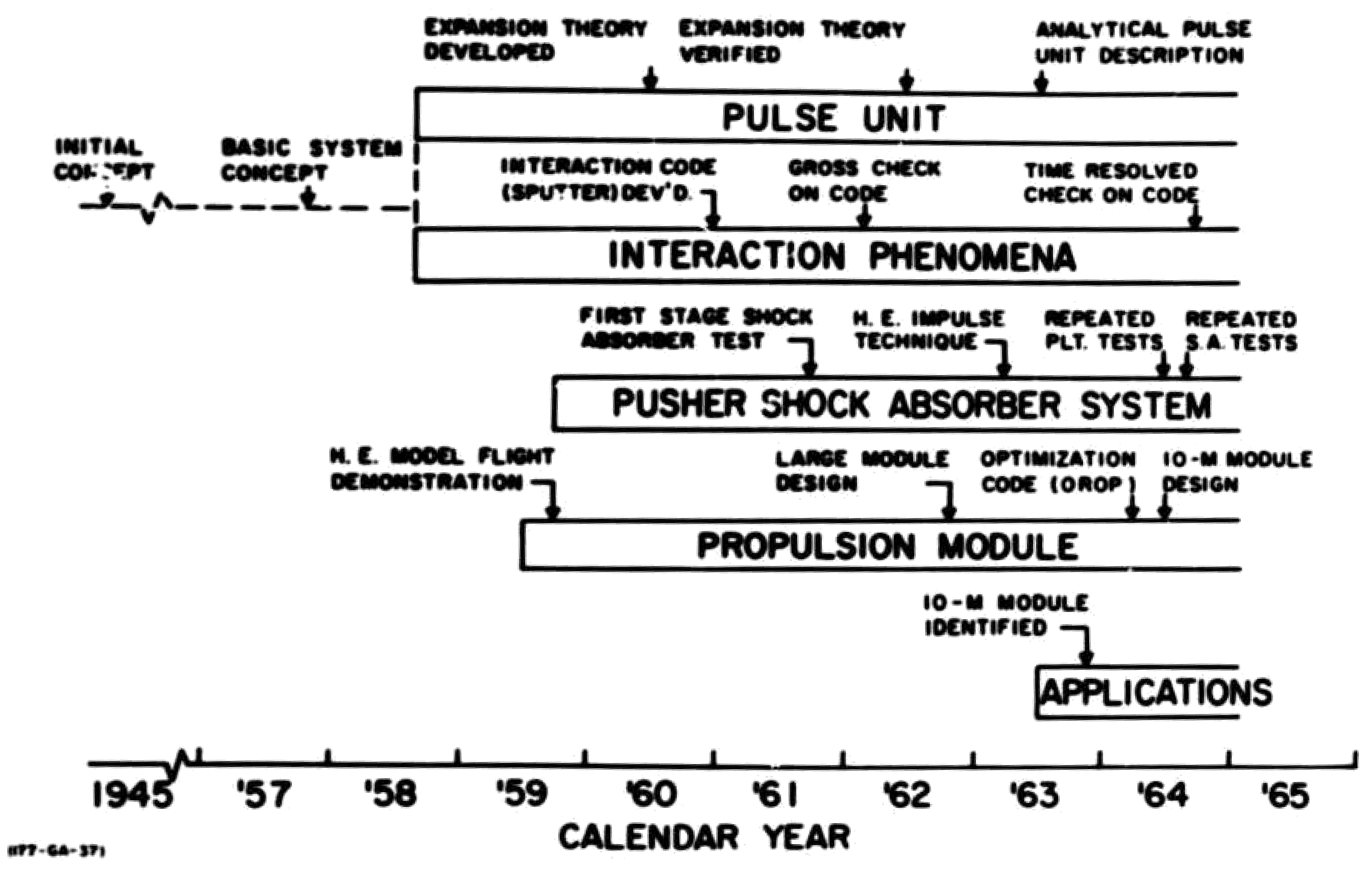
Figure 3 summarizes the principal milestones of the technology programs to date. The early years concentrated heavily on the basic systems physics. Theoretical descriptions of pulse unit expansion characteristics were developed (MOTET) by 1960. MOTET is a 2-D hydrodynamic digital computer code with radiation transport and is based on earlier nuclear weapons design work performed at the national weapons laboratories.
A most important and unexpected milestone was achieved during the 1962 weapons test series in the Pacific when one of the high-altitude tests (Starfish) demonstrated unusual and unanticipated expansion characteristics. Subsequent to this experiment the MOTET code was used to calculate the event. Its close prediction of what was actually observed in the test provided strong verification of the code's validity. In 1963 a simplified analytical model of the quite elaborate and complicated MOTET code was developed and is currently used to more rapidly provide information on pulse unit behavior.
A one-dimensional code describing the propellant-pusher interaction (SPUTTER) occupied a major fraction of the effort in the early years. This code treats hydrodynamics with multi-frequency radiation transport. By 1961 SPUTTER was operational and confirmed earlier calculations that ablation at the pusher plate would be tolerable. By early 1962 gross experimental confirmation of the code by means of high-explosive-driven plasma sources had been achieved. By 1964 the plasma source technique and instrumentation had been developed to the point that a time-resolved check on the SPUTTER code with microsecond resolution was achieved. While the plasma source currently in use provides a relatively good simulation of pressure, temperature, and interaction times, it falls short of providing plasma velocities in the range of interest. Nuclear underground experiments will be needed to resolve the ablation problem in the required detail.
By late 1959 sufficient confidence had been established in the basic physics to justify initiation of preliminary engineering studies on the pusher-shock absorber system. Early calculations, supported by measurements employing bulk high-explosives, indicated that energy storage capabilities of simple shock absorbing systems appeared adequate. Effort was then directed toward development of a high-explosive technique for generating impulses which accurately reproduced the pressure-time and pressure-radius profiles on the pusher.
Bulk high-explosives will not provide this capability. However, techniques employing shear-HE exploding through a foam attenuator were shown to provide the desired impulse profiles. During 1964 repeated mechanical impulse tests were successfully performed on T-1 steel pusher plate test specimens and primary shock-absorber systems.
Experiments to date have been on scaled engineering test specimens. However, pressures, accelerations, and stress levels have been kept the same as for the full-scale nuclear engines. Empirical results from these experiments indicate that high-explosive impulse techniques will be scalable up to full-size pusher-shock absorber assemblies. Test facility design studies indicate, further, that it is feasible to produce such impulses at the proper cyclic frequencies (i.e., once per second). This technique should provide a most powerful developmental tool as the entire propulsion system will respond the same whether high-explosive impulse generators or nuclear explosions are used to deliver an impulse.
Very early in the ORION research program an HE-driven flight demonstration model was constructed and flown to demonstrate inherent system stability. The model, weighing about 300 lb. was propelled by a series of five TNT charges to altitudes like 200 ft. The model consisted of an aluminum pusher plate, dissipative shock absorbers, and a charge storage, delivery, and firing system.
Little effort was expended on integral propulsion module designs until 1961 when sufficient physics and engineering knowledge had been assimilated to permit meaningful weight estimates and predictions of gross performance characteristics. The first vehicle for which an internally consistent set of engineering and physics calculations were performed, had a gross weight of approximately 4,000 tons, indicated an effective ISP of approximately 4,000 sec, and produced a thrust of approximately 10 million lb. The lengthy calculations and iterations involved in performing this design study made the problem amenable to use of high-speed digital computers. Correspondingly, attention was turned toward generating an optimization code (OROP) which would rapidly generate engine designs based on known engineering and physics inputs and constraints. This code became operational in early 1964.
In 1963 serious attention was turned, for the first time, toward the specific mission applications of nuclear pulse engines in an effort to determine their most competitive regimes of operation. A mission-oriented contract with the National Aeronautics and Space Administration's Marshall Space Flight Center provided the mechanism for performing these studies. [*]
[* – “Nuclear Pulse Space Vehicle Study,” General Atomic Report GA-5009, Vols. I-IV. under Contract NAS8-11053. 1964. S/RD report.]
Prior to this time the embodiment of ORION had been considered only in terms of very large and extremely high performance vehicles. The reluctance to consider small systems was based on two arguments:
1. ISP deteriorates as engine size becomes smaller, and
2. Only suborbital starts had been considered wherein overall vehicle thrust-to-weight ratios in excess of 1.0 were believed to be required, resulting in low payload fractions for small vehicles.
The NASA application study opened the consideration of orbital startup permitting substantially smaller vehicle thrust-to-weight ratios and correspondingly larger payload fractions. In spite of the fact that ISP decreased, smaller engine modules thus became very attractive. A specific engine, referred to as the "10-m" (or 10-meter) diameter engine, was identified which appeared to be more or less optimum for a broad class of interplanetary and lunar objectives. Early estimates of the performance of the 10-m engine were confirmed in mid-1964 by an integral propulsion system design study employing OROP. This study indicated that if restricted to current materials and nuclear technology, the propulsion system could deliver between 1,800 and 2,500 sec ISP with a total thrust of about 450,000 lb. The module would weigh under 200,000 lb and thus would be compatible with orbiting by a Saturn V launch vehicle.
Subsequent studies were completed in late 1964, again employing OROP but embodying conservative estimates of potential improvements in material capabilities and nuclear technology. These studies were based largely on the earlier 10-m design and treat potential improvements as perturbations in the basic module design constraints.
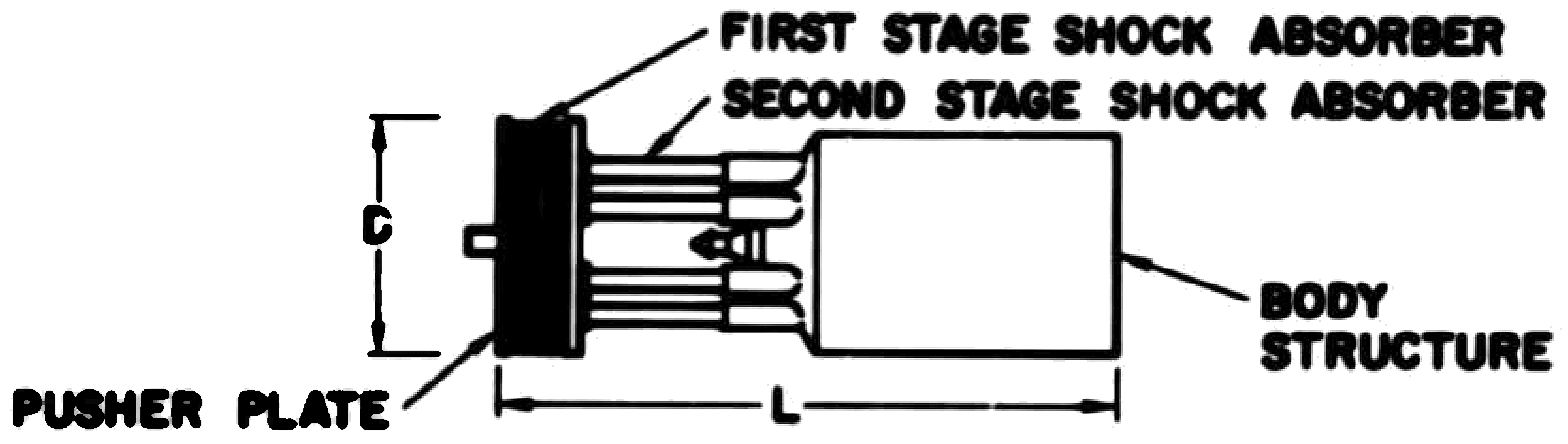
Point designs, summarized in Fig. 4, were performed at 8-m, 10-m, and 12-m engine diameters to indicate how performance characteristics scale about the basic 10-m design point. Note particularly the sensitivity of ISP to engine size. Scaling of the data either below 8-m or above 12-m is not valid without a careful reconsideration of the original 10-m design constraints.
|
|||
|
D (M) |
8 |
10 |
12 |
|
L (M) |
22.1 |
25.7 |
29.7 |
|
F (LB) |
530,000 |
780,000 |
970,000 |
|
ISP (SEC) |
2,720 |
3,300 |
3,670 |
|
WT (LB) |
180,000 |
240,000 |
380,000 |
– – – – – – – – – – – – – – – – – – – – – – – –
Systems studies of military missions have indicated the potential utility for a space propulsion system with capability beyond that of systems currently under development. Ideally, a maneuvering space system for military applications should have both high thrust to provide immediate response and high specific impulse to provide maximum performance capability. At the present time, there are three possible advanced concepts which might provide such maneuverability:
1. The gaseous-core-reactor rocket which is currently under investigation with respect to its technical feasibility and theoretical limits on performance. Some fundamental technical problems must be solved to demonstrate its basic technical feasibility.
2. The internal nuclear pulse propulsion concept, HELIOS, being pursued at a low level by the Lawrence Radiation Laboratory.
3. The external nuclear pulse propulsion concept (ORION) (Fig 1). I consider this concept to be technically feasible and to clearly offer the greatest potential.
ORION in its most rudimentary form will, I believe, satisfy the propulsion requirements for currently envisioned military missions in space. As you know, the Air Force supported studies of this concept and its potential application for several years. Unfortunately, there now exists no approved program for the continuation of this effort. It is, however, appropriate to review at this time the potential applications and advantages of the concept, which were developed during the past few years, as well as some of my own views which are not necessarily those of the Air Force or the Office of the Secretary of Defense.
When a quantum improvement in specific impulse at a high thrust is made available as I believe it can be in the case of ORION, the full implications of this increase in performance may not be immediately apparent. It is obvious that a tremendous increase in payload for previously considered military missions would be available. More important, however, a whole new spectrum of missions previously unattainable can be considered. Indeed, one has a whole new range of capability within which entirely new concepts can be evolved. Previous concepts of sophistication, design margin, redundancy, and reliability should be reexamined and reevaluated in the light of the greater performance available. Also, compared to more conventional systems now under development or consideration, the ORION system, due principally to its high specific impulse, is dramatically less sensitive to payload weight variations. This implies not only a system less sensitive to design changes, but a more flexible system with readily available growth potential.
In addition to offering both high thrust and specific impulse, the ORION propulsion system offers a number of unique characteristics which are of prime importance for military applications. Among these are high system density and inherent structural hardness which greatly enhance the vehicle's invulnerability to space debris and enemy impact weapons. Since only a single stage is required, after initial chemical boost at launch, the operational reusability and reliability of the over-all system are significantly improved. Compared to nuclear rocket systems, the ORION has a very low residual radioactivity and does not require after-cooling propellants. Further, the system is considered inherently easy to maintain and repair. Therefore, it offers a high degree of readiness and a comparatively long useful life.
In order to facilitate application studies of the nuclear pulse vehicles for military missions, the system performance was determined on a parametric basis. Since it would be desirable to exploit the nuclear pulse propulsion system to a maximum extent for most military missions, the nuclear pulse system was considered to be operated in a sub-orbital start mode. Accordingly, for convenience, the system performance was divided into two phases: (1) low altitude earth orbit delivery and (2) velocity capability beyond low altitude earth orbit.
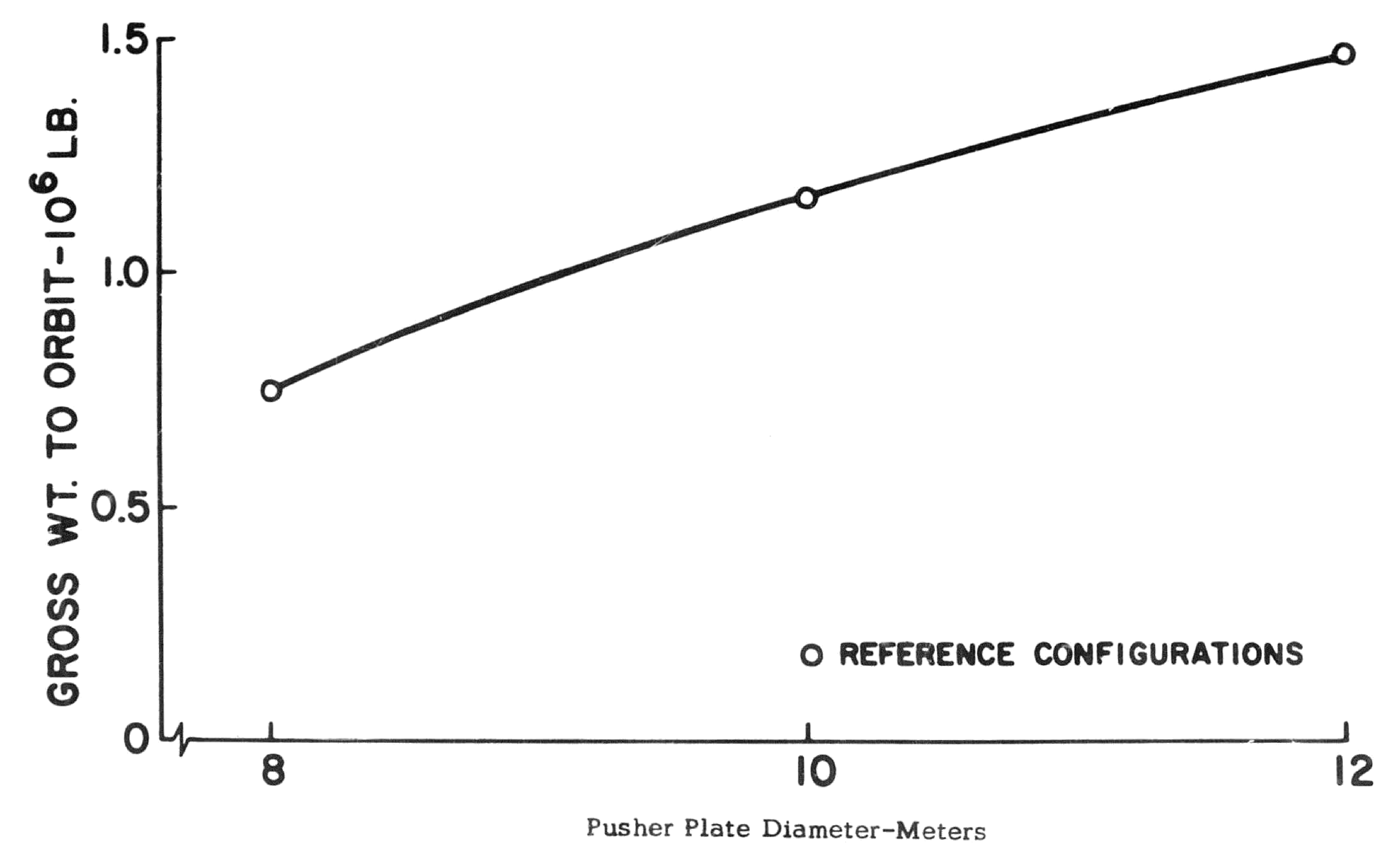
The gross weight to a 200-NM circular orbit as a function of propulsion module size is presented in Fig 2. The net payload weight to orbit can readily be determined by subtracting the propulsion module jettison weight from the gross weight given. (See Fig 4 of Part I, Technical Status.)
This performance was generated assuming a high energy boost using a cluster of solid propellant motors with a launch-thrust-to-weight ratio of approximately 1.8 and a stage propellant fraction of 0.76. With this booster, the vehicle attains an actual inertial velocity of approximately 9600 ft/sec and a staging altitude of about 250,000 feet. The nuclear pulse system is started with a thrust-to-weight ratio of about 0.55, a point at which substantial gravity losses are sustained. Maximum payload is achieved at this thrust-to-weight ratio, however, since the gravity losses are more than offset by the increased capability resulting from the higher gross weight of the nuclear pulse stage.
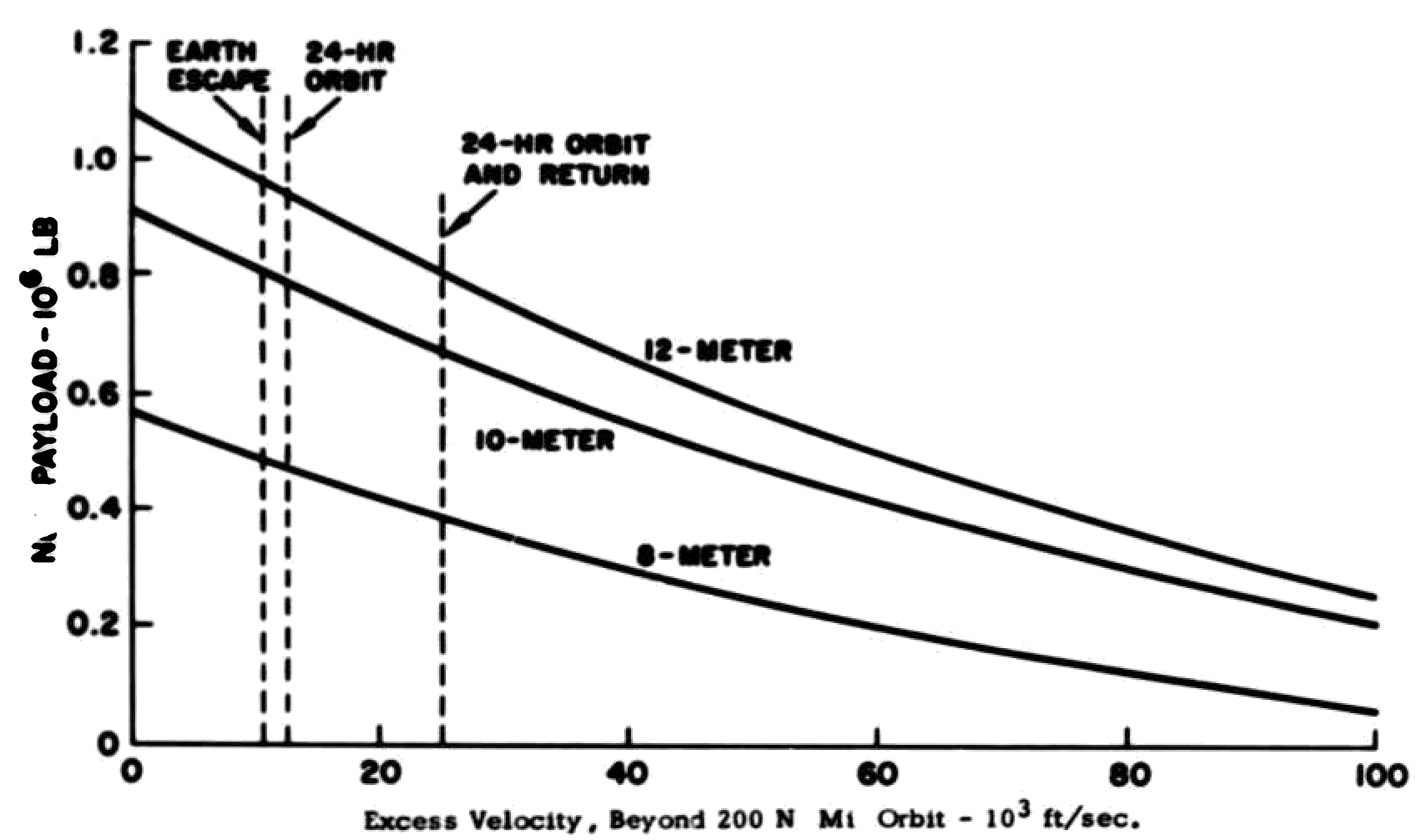
The performance capability of the reference systems for missions beyond the 200 NM circular orbit is shown in Fig 3. The net payload is shown as a function of excess velocity, the propulsion modules having been deducted from the final gross weight. It can be seen that the larger propulsion modules exhibit a disproportionately greater payload capability at the higher excess velocity requirements. This is attributable primarily to the higher specific impulse of the 10-m and 12-m modules as compared to the 8-m module. The basic characteristics of the ORION are fortuitously unique in that within limits the more demanding the mission, the better the ORION can perform it. At the same time, the ORION can very effectively perform missions which are less ambitious.
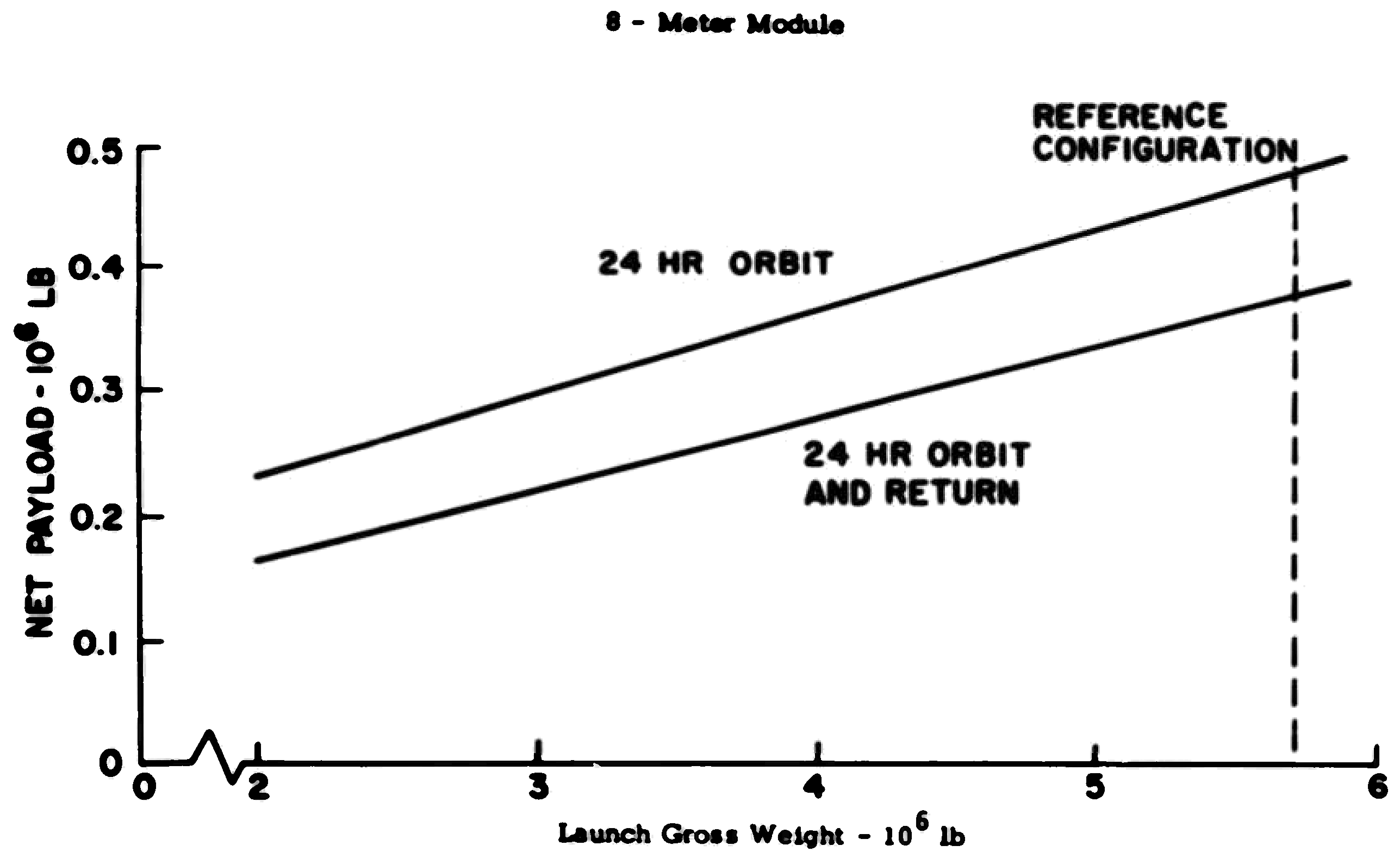
The effect of reduced mission requirements on the gross weight of the 8-m propulsion module is illustrated in Fig 4. By reducing the mass ratio of the boost stage, the staging velocity of the vehicle is decreased. This imposes a higher velocity requirement upon the nuclear pulse stage. It also results in higher gravity losses and a higher optimum thrust-to-weight ratio for the nuclear pulse stage. For the range of payloads of interest, the reduction in launch gross weight is linear with the reduction in payload. The system could be employed effectively for launch gross weights as low as about 2 million lb (i.e., about twice as heavy as the TITAN III). In this size range it still has a capability of about 200,000 lb in a 24-hour orbit.
In general, the space systems for potential military missions requiring advanced propulsion system capability can be categorized as space-stationed systems or earth-surface-stationed systems. In the case of space-stationed systems, maneuverability and survivability are of primary concern; while for surface-stationed systems, readiness is of primary concern.
Some typical missions are outlined in Table I. Many of these missions, such as orbit logistics and damage assessment, can be accomplished by lower performance systems on a minimal basis. For many conceivable situations, however, such systems may be marginal and the over-all effectiveness of the systems may be greatly improved with the use of a high performance propulsion system.
Table I Potential Missions |
|
|
EARTH SURFACE-STATIONED |
SPACE-STATIONED |
|---|---|
|
EMERGENCY COMMAND/CONTROL SPACE INTERCEPTOR DAMAGE ASSESSMENT SPACE RESCUE AND RECOVERY SATELLITE SUPPORT |
COMMAND/CONTROL STRATEGIC WEAPON DELIVERY SPACE DEFENSE ORBIT LOGISTICS LUNAR BASE LOGISTICS SPACE RESCUE AND RECOVERY SATELLITE SUPPORT SURVEILLANCE-RECONNAISSANCE R AND D LABORATORY |
In the discussions that follow, three of these missions have been selected—the earth surface-stationed command/control, space-stationed command/control, and space-stationed strategic weapon system—to illustrate potential applications for the various size modules previously indicated. Only the systems concepts are presented here, since much more effort is required to generate definitive systems for these missions.
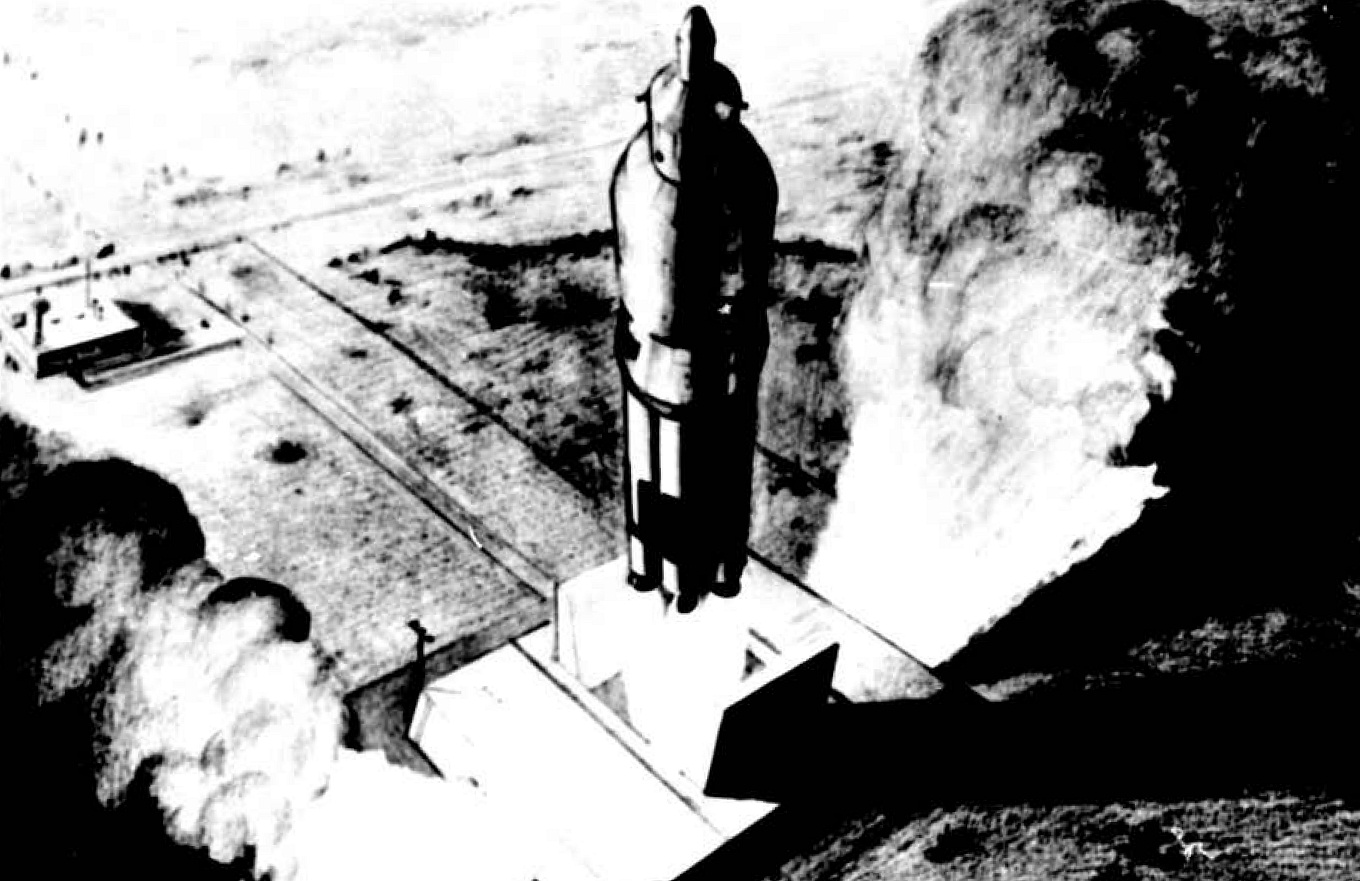
The ORION propulsion system, with its high thrust and specific impulse, can provide the velocity and payload capability necessary for an emergency command/control vehicle which can be stationed in a silo installation in a state of instant readiness (fig 5). Such a system could be launched under conditions of imminent attack, but would be designed as an underground installation to provide for sustaining a first attack in the event a delayed launching were desired.
An 8-m nuclear-pulse-propulsion module with a thrust of 530,000 lb and a specific impulse of 2750 sec could be employed for this mission. By boosting the system with a cluster of seven 120-in. solid propellant motors, a payload of 200,000 lb could be delivered to a 200 NM circular orbit with a velocity reserve of 60,000 ft/sec. Such a system would have a launch weight of 5.6 million lb. Its maximum diameter would be 30 ft and its overall height some 210 ft -- appreciably smaller than the SATURN V vehicle currently under development.
The emergency command/control vehicle was considered to be manned by a crew and command/control team of from 10 to 20 personnel. With the relatively large payload allowance, generous crew shielding as well as advanced equipment for earth surface surveillance and sophisticated communications equipment could be accommodated. Communications to the combat elements can be provided by optical transmission (either pulsed broadband or frequency modulated LASER beam) which is inherently secure from either interruption or jamming. Large auxiliary power sources could be provided to incorporate UHF voice, digital, and video links to all air, sea, and land elements of the national command/control systems.
The life-support system for the space ship could be designed for a nominal duty cycle of 30 days with capability of extending this to 60 days under extreme conditions. Crew accommodations and working spaces would likewise be designed for these limited mission times. System redundancy and modularization could be designed into the surveillance and communication systems and adequate spare modules could be carried onboard.
To provide protection against natural radiation environment and possible use of radiation weapons, fixed shielding on the order of 50 lb/ft² would be provided for all command/control and crew operating stations. In addition, structure, propulsion system fluids, and life support systems would provide a total equivalent shielding on the order of 100 lb/ft².
The basic structure and shell of the vehicle would be hardened to withstand the impact of micrometeoroids and the effects of close range impact weapons. Due to the high density and solid noncryogenic nature of the propulsion system, such protection can be provided to the system without undue weight penalties.
The emergency command/control system can be deployed in either a near-earth or, with the large excess velocity capability, in a remote orbit. In a near-earth orbit immediate coverage of enemy territory and maximum resolution are available for surveillance functions. The excess velocity capability can be exploited in providing orbit altitude and plane changes to provide the most effective coverage and evade interception attempts.
Remote employment may be desired to provide broader instantaneous coverage of the earth and to afford the command/control space ship with early warning of attack. In this case, the excess velocity capability of the system can be used to good advantage to minimize the time required to attain station and to provide for evasive maneuvering in the event of enemy attack.
The combination solid propellant booster and nuclear pulse upper stage vehicle result in a high density, instantly ready system ideally suited for the emergency command/control mission. It can be accommodated in silos only somewhat larger than the facilities for the ATLAS and TITAN ICBMs and only a limited number of these vehicles would provide the requisite capability.
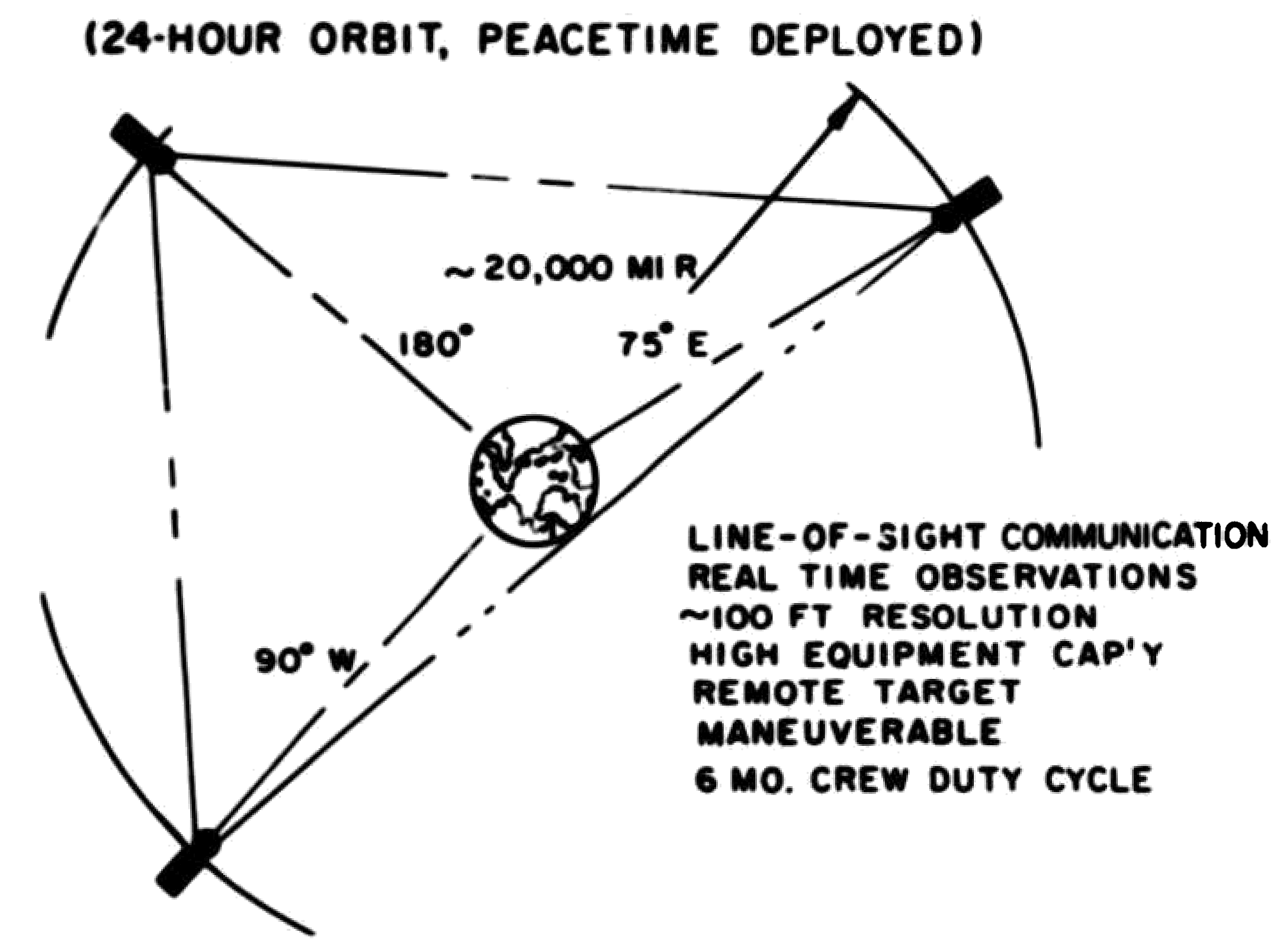
A continuous spaceborne alert can be maintained with a command and control system employing the nuclear pulse propulsion system. By deploying a number of vehicles in a high altitude orbit (fig 6) constant surveillance of the entire earth surface and continuous communication with the earthbound command/control system can be maintained.
A high payload capability is required to provide the surveillance and communication equipment, the personnel accommodations and shielding dictated by this mission. In addition, a high velocity capability is needed to attain station and provide for on-station maneuvering.
A 10-m nuclear propulsion module boosted by a cluster of four 156-in solid propellant motors could deliver approximately 300,000 lb to a 24-hour orbit with an excess velocity capability of 70,000 ft/sec. As indicated previously, the 10-m nuclear pulse propulsion module is assumed to have a thrust of 780,000 lb and a specific impulse of 3300 sec. The launch vehicle would have a maximum diameter of 33 ft and an overall height of 320 ft. This is the same diameter, but somewhat shorter than the SATURN V-APOLLO launch vehicle. It would weigh approximately 10 million lb, 85 per cent of which is the relatively inexpensive solid propellant motor cluster. By using smaller solid propellant boosters, a considerable decrease in launch gross weight can be obtained with only a modest decrease in capability.
The same mission can be accomplished using an uprated SATURN S-IC (F = 9 x 10⁶ lb) in lieu of the cluster of four 156-in solid boosters. Since this vehicle would normally be launched under less stringent operational requirements than, for example, the emergency command/control vehicle, use of the more sophisticated liquid booster might be desirable. Such a configuration would be slightly smaller and would have a launch weight of approximately 7.2 million lb.
Three vehicles on station could provide continuous real-time worldwide surveillance and communications through inter-ship relay. Such a deployment would provide redundant coverage from high altitude orbits, permitting the individual space ships to randomly change station within broad limits and thereby imposing a more difficult tracking problem on an enemy.
The space-stationed command/control ship could be provided with the same basic type of surveillance and communication equipment indicated for the emergency command/control system. Some additional redundancy would be required for longer on-station deployment. In addition, modularization could be employed to a greater extent (approaching 100 per cent) and an extensive stock of spare modules could be carried onboard.
The relatively sophisticated surveillance and communications equipment would require on the order of 3 MW of power with peak requirements several times as great during emergency conditions. These power requirements can be adequately supplied with a combined generating-storage system using a nuclear thermionic or other advanced power generating system as the primary source.
A crew of 20 to 30 could be accommodated in each ship. The primary command/control function could be located in one of the ships, but each ship could be an integrated system within itself and could assume the command/control function in the event of disability of the flagship.
As with the earth-launched emergency command/control vehicle, the basic vehicle could be hardened against micrometeoroids and impact weapons. Somewhat more shielding could be provided for the operating stations to protect the crew over the longer duty cycles.
Duty cycles will be determined by crew endurance which is a function of total weight and volume. With the high payload weight capability of the ORION, an earth-like shirt sleeve environment with artificial gravity systems could be readily provided. A target of 6 months per mission for unsupported operations under normal operating conditions does not appear to be unreasonable. Capability to function unsupported as long as a year under emergency conditions could be designed into the system. A semi-closed ecological system together with ample sleeping accommodations, exercise and recreation equipment, could be provided in the space ship. Minor fabrication as well as limited module repair facilities could be provided on board.
Once a space ship is deployed in orbit it could remain there for the duration of its effective lifetime, say 15 to 20 years. Crews could be trained on the ground and deployed alternately, similar to the Blue and Gold team concept used for the Polaris submarines. The ships could be independent of logistic systems for extended periods of time. Under normal conditions, however, special provisions, spare parts, individual crew replacements, and pulse units could be resupplied to the space ship as required.
It is anticipated that advancement of the state-of-the-art will render much of the equipment aboard the command/control space ships obsolete during the 15 to 20-year service life of the vehicle. Accordingly, the original system could be designed for not only modular replacement of subsystems but for the replacement of integrated systems as well. The communications/surveillance equipment section of the space ship could be designed basically as a chassis in which a wide variety of systems could be installed and replaced as appropriate. The command/control deck of the ship also could be designed for easy replacement of consoles and for increase or decrease in the number of operators as necessary.
The existence of a high-performance command/control system covering all areas of the globe in a state of continuous operation could serve as a highly effective deterrent against any potential aggressor.
I anticipate that an advanced strike capability will be required by the Strategic Air Command for the post-1975 time period. It appears that the United States will have to rely primarily on land and sea-based ballistic missiles for its retaliatory capability during this time period.
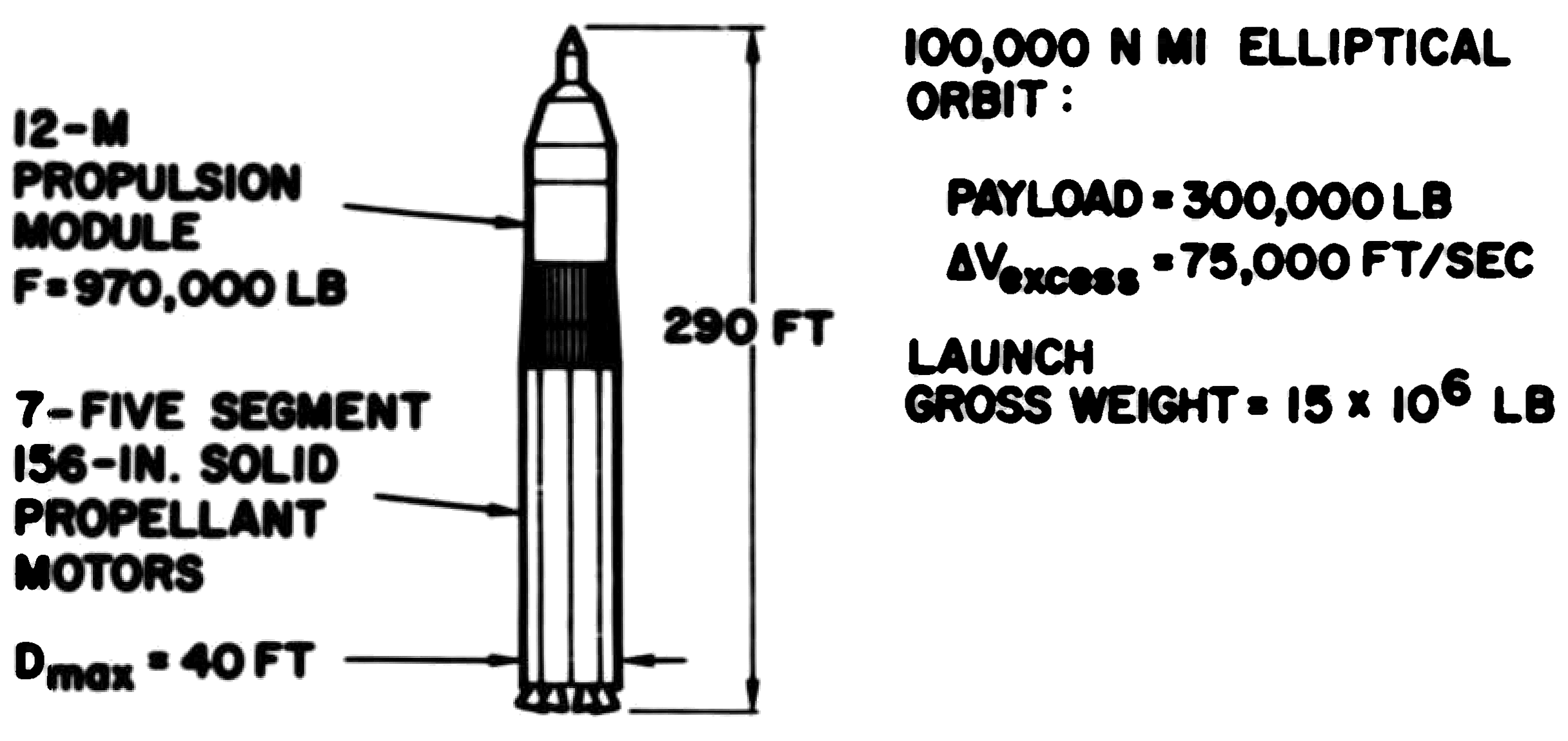
A space-stationed strategic weapon system using the ORION high-thrust, high-specific-impulse propulsion system has also been examined to provide this capability. The overall launch configuration of such a system is illustrated in Fig 7. The main propulsion system is a 12-m-diam nuclear pulse ORION system with a thrust of 970,000 lb and a specific impulse of 3670 sec. It could deliver a 300,000 lb payload into an elliptical orbit with a 100,000-NM perigee and provide an additional 75,000 ft/sec velocity capability beyond that point. The ORION system, which would have a gross weight of 1.75 million lb including payload, could be boosted with a high-energy first stage comprised of a cluster of seven 156-in. solid propellant motors. The system would have an overall launch weight of approximately 15 million lb. Dimensionally, the system would be only slightly larger than vehicles currently under development.
The vehicle could be boosted to an altitude of approximately 250,000 ft and a velocity of approximately 10,000 ft/sec with the solid propellant booster. From this point the ORION system could be employed for a direct ascent to a low altitude circular orbit. At the appropriate point the ORION system could be restarted and operated to provide the velocity required for a Hohmann transfer to an altitude of at least 100,000 NM. Upon reaching apogee of the transfer orbit, the nuclear pulse could again be utilized to achieve circular orbit. A fourth operation could then be employed to attain an elliptical orbit with apogee beyond lunar orbit.
As an alternative to the single launch concept, a single low altitude orbit rendezvous could be employed to reduce the size of the nuclear pulse module. By using two launch vehicles with 10-m propulsion modules, each boosted either by a cluster of four 156-in. solids or by an uprated SATURN S-IC, a space ship with approximately 670,000 lb payload could be delivered into a deep space orbit with an excess velocity capability of 75,000 ft/sec.
The space ship could be manned by 20 or more personnel, the exact manning levels being determined by the number required to permit 24-hr/day flight operations with near-normal crew watch schedules. As in the case of the space-stationed command/control system, a semi-closed ecological system could be provided permitting a duty cycle of approximately 6 months under normal conditions and up to a year under emergency conditions.
Like the command/control system, the space strategic weapon system would have its weapons stored internally with heavy structural protection, permitting easy, accessible checkout and maintenance of the individual weapons.
With the high payload capability of the nuclear pulse system, advanced navigation, guidance, and communication systems could be accommodated in the space ship. A large power supply system (on the order of 1 MW) would also be required by this equipment.
On the order of 20 space ships could be deployed on a long-term basis. By deploying them in individual orbits in deep space, maximum security and warning can be obtained. At these altitudes, an enemy attack would require a day or more from launch to engagement. Assuming an enemy would find it necessary to attempt destruction of this force simultaneously with an attack on planetary targets, initiation of an attack against the deep space force would provide a relatively long early warning of an impending attack against planetary forces. Furthermore, the space ships equipped with surveillance sensors could detect and track the attacking systems. With the relatively long transit time for attacking systems, the space ships could take evasive action, employ decoys, or launch antimissile weapons, providing a high degree of invulnerability of the retaliatory force.
Each space ship could constitute a self-sufficient deep space base, somewhat analogous to the ocean-based aircraft carrier, but without the vulnerability to submarine and aircraft attack. The space ship could be provided with an integrated mission capability with the means of defending itself, carrying out an assigned strike or strikes, assessing damage to the targets, and retargeting and restriking as appropriate.
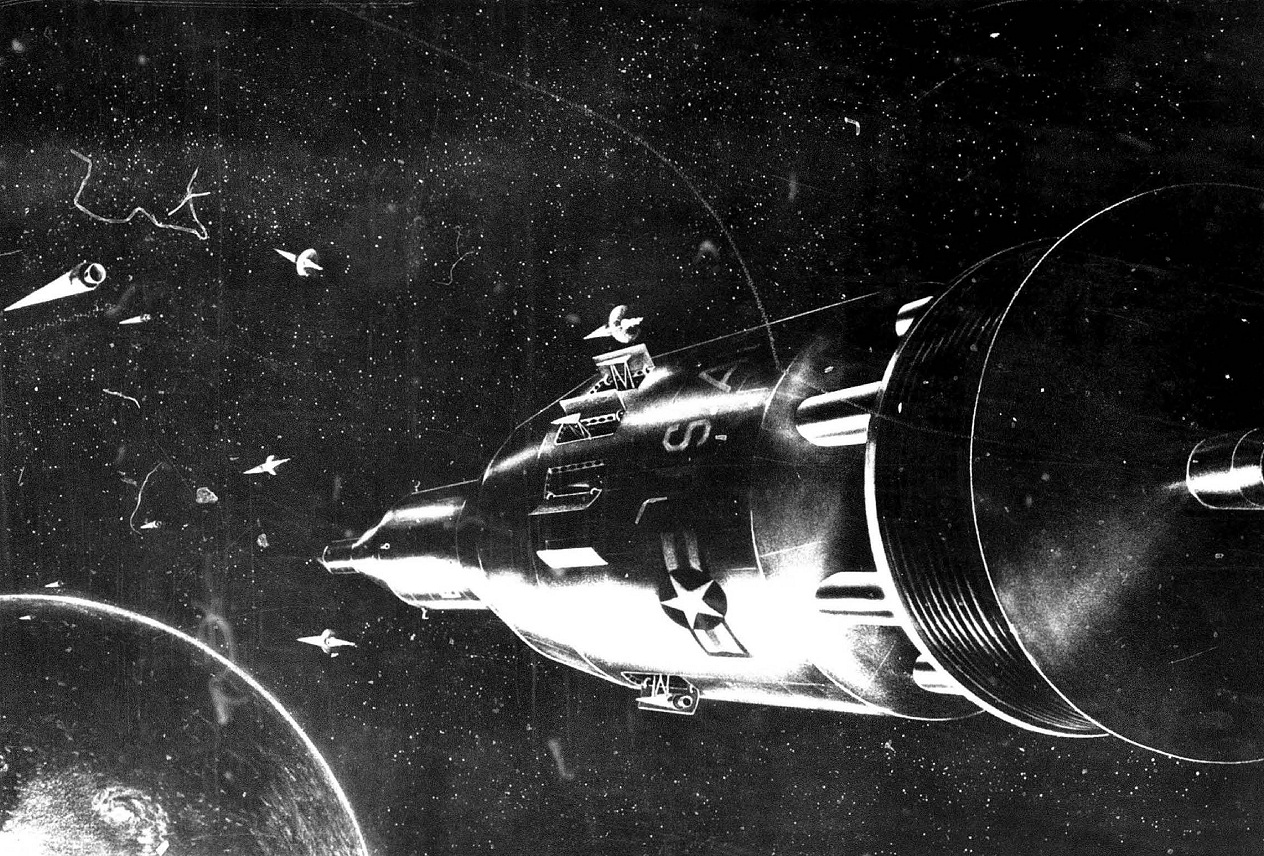
Options of weapons and weapon delivery techniques could be provided with the system conceived. Rocket propelled weapons could be launched directly from the space ships while in prehostility orbits. Such weapons could be kept under surveillance and course corrections provided by the space ship during transit to their targets. Alternately, the space ship could deorbit and depart on a hyperbolic earth encounter trajectory. At the appropriate time the weapons could be ejected from the space ship (Fig 8) with only the minimum total impulse required to provide individual guidance propulsion for the weapons. After ejection and separation of weapons, the space ship could maneuver to clear the earth and return for damage assessment and possible restrikes, or continue its flight back to its station in deep space.
It may be desired to employ a mixed command/control and strategic weapon force or to integrate the functions in a single space ship. In the latter case the nuclear pulse system can be readily scaled up to provide the increased payload capability requirement. In fact, the performance of the propulsion system tends to increase with size and only a modest increase in size would be required to accommodate substantially larger payloads or [BLANK].
In any space force the factors of speed, maneuverability, control, survivability, and operational reliability are a direct function of the three system parameters: payload, [BLANK], and acceleration. These parameters, in turn, are a direct function of the propulsion parameters: thrust, specific impulse, and thrust-to-weight ratio.
The ORION concept offers not only significantly higher performance than any other known concept but also a quantum improvement in the above characteristics. Its technical feasibility has been reasonably well established for about two years and its long range operational and economic practicality are now strongly indicated. I believe its development by any nation would represent a breakthrough of the first order in military space capabilities.
Soon, through programs such as MOL, man's potential capabilities in the space environment will be better defined. I believe it is imperative that we be prepared at that time to move toward exploitation of man's capabilities in the space environment by the development of a large high performance space vehicle such as would be possible with ORION.
In conclusion, I point out once again that the concepts I have presented are not necessarily endorsed by the Department of Defense or the Air Force.
– – – – – – – – – – – – – – – – – – – – – – – –
It is stated policy of NASA, as given by the National Space Act of 1958, and at various later times reiterated by national leaders, to engage in planetary explorations as part of the overall exploration and exploitation of space. The achievement of this objective has been and will continue to be constrained by the development of relevant technology. Up to the present time, this constraint has limited our planetary exploration to observations from the Earth and to probes of very limited capability (e.g., the Pioneer and Mariner vehicles). Just initiated is a much more elaborate and sophisticated probe program, the Voyager series, which will include flybys, orbiters, and landers. The little precedent that exists at the present time leads us to the conclusion that the objectives of space exploration can be fully met only by manned missions. Our efforts to explore the Moon are progressing as rapidly as possible toward a manned lunar landing, and various proposals for extended manned lunar exploration have been studied.
Manned missions to the planets will be enormously more expensive than the probe missions which are presently programmed. With the probable exception of planetary flyby missions, which it appears can be based largely on Apollo technology and hardware, manned planetary missions will overshadow even the Apollo program in scope, effort, and cost. For this reason, we must give serious consideration to the objectives of manned planetary missions and what it will take to accomplish these objectives in terms of exploration effort. It is beyond the scope of this paper to discuss at any length political reasons related to prestige and leadership for undertaking ambitious space missions. However, it should be recognized that these kinds of reasons can very well overshadow in overall importance the scientific reasons which will be discussed.
A rather obvious fact which sometimes almost seems to be overlooked in discussions of planetary exploration is that a planet is a very big place. The total land surface of the planet Mars (generally, the prime candidate in discussions of manned planetary missions) is quite comparable to the land surface area of the Earth. The difference in size of the two planets is approximately compensated by the larger water surface area of our home planet. Although it may be that Mars is pretty much alike all over, we would certainly not make that statement about the Earth, and it would seem reasonable that comprehensive exploration will require data from many locations on the surface of the planet. Scientific objectives of exploring Mars may be viewed as twofold: first, to obtain a substantial improvement in our understanding of the formation and evolution of planets and planetary systems, and second, more frequently discussed, the search for non-terrestrial life. There are at the present time vigorous disagreements in the scientific community regarding the likelihood of life on Mars, but these disagreements are more emotional than factual, as our understanding of life and our knowledge of the true environment on Mars are both much too meager to draw reliable conclusions. There is a rather good chance that life detection instruments contemplated for use in Voyager lander probes will give us a provisional "yes" or "no" answer about life on Mars. The "yes" answer will not be absolutely conclusive, and a "no" answer would be quite inconclusive as the lander will be sampling only a very small spot on a very large planet. Real understanding of Mars life (if it exists) can only begin with the landing of a highly skilled scientific team and some laboratory equipment on Mars to perform an in situ investigation. We should also not entirely ignore the possibility, however improbable, that intelligent life has at one time or another existed on Mars. The extreme improbability of this is offset by the great benefits to our knowledge which would accrue thereby.
Manned missions to the planets, and especially to Mars, have been the subject of a number of advanced system studies. The intent of these studies has been to bring into focus the general character and scope of such missions, to identify the technical advancements needed to make these missions practical, and to ascertain roughly the cost of the missions and in what time frame they might be feasible. Three general categories of manned planetary missions have been identified. The first category, outside the scope of this paper, is manned flyby missions to Venus and Mars. These appear to be attainable, as was noted, with modest extensions of Saturn/Apollo technology. The second category, first-generation manned landing missions, will require substantial advances in space technology. The third category, large-scale exploration, cannot be accurately forecasted with today's state of knowledge, but it is worthwhile to examine this category in general terms in order to gain a better perspective on the subject of planetary exploration programs. It is further not possible to determine with today's state of knowledge just how extensive an exploration will be desirable. This determination can only be derived from acquisition of further knowledge about the planets.
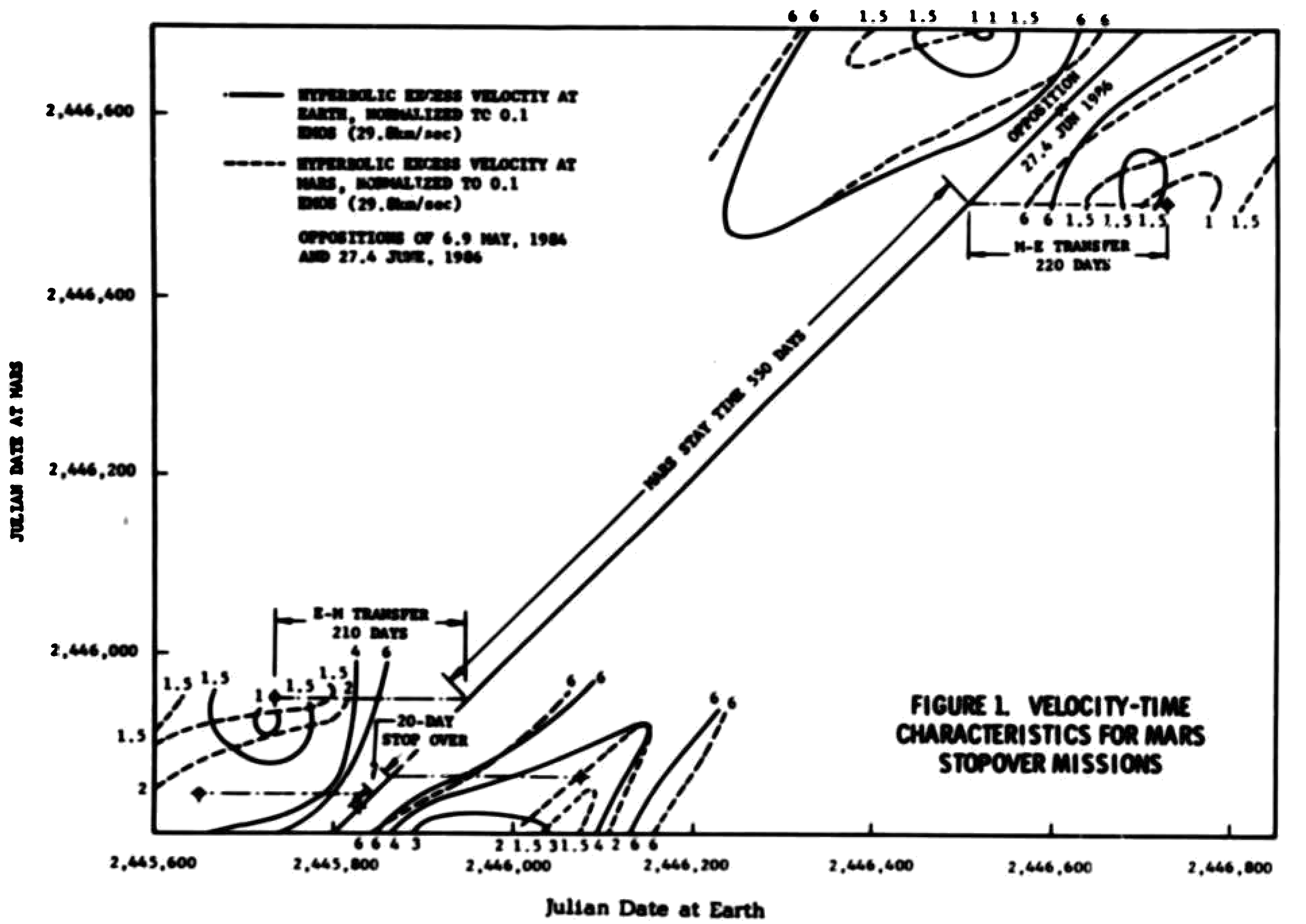
Many forms of propulsion have been investigated at one time or another for planetary missions. Early investigators used elliptic (Hohmann) transfer orbits which require long staytimes at the target planet, such that for Mars the total mission duration would typically be over three years. Since the late 1950's most investigations have concentrated on the NERVA type nuclear rocket for propulsion, and on a mission type called the opposition class, typically requiring about 450 days for a Mars stopover, and for which very short Mars staytimes are desirable (the optimum being zero). A rough idea of the difference between the three-year mission and the 450-day mission can be obtained from Figure 1. For the long mission, Earth departure occurs at the minimum energy point and transfer to Mars takes about eight months.
A long wait is then required (in excess of a year) before the next minimum energy point becomes available (i.e., the proper planetary alignment occurs). At this time Mars departure may be executed for another eight-month transfer back to Earth. The 450-day mission requires substantially more (about twice the delta-V) propulsive energy than the "slow" mission, in order to be able to launch toward Mars substantially in advance of the minimum energy point. With a very short staytime, it is then possible to "catch the tail end" of the earlier minimum energy point for transfer back to Earth. This procedure is the opposition class mission.
The nuclear pulse (Orion) concept is one of several advanced nuclear propulsion concepts considered by MSFC in studies of future systems. It is thought to be representative of a class of propulsion systems, one or more of which might be developed in the future. Advanced nuclear propulsion systems with very high performance are principally attractive for difficult missions such as manned planetary stopovers. Although the Orion system has been examined for lunar missions, its overall attractiveness there is not clear. Following development of the solid core nuclear rocket, which is now going on, it is presumed that an advanced nuclear system will be developed at some time in order to increase our capability to execute difficult missions. Performance characteristics of Orion can be predicted better than for other systems of its class (with the possible exception of electric propulsion). For this reason, it is fruitful to consider the mission potentials implied by these characteristics.
The Orion system concept considered in this paper was developed by the General Atomics Division of General Dynamics under Air Force contract. The characteristics of the system are given in Table I.
TABLE I
|
|
|
Engine Diameter |
10 meters |
|
Engine Mass, Dry |
91 tons (*) |
|
Engine Thrust |
205 tons |
|
Specific Impulse (conservative estimate) |
18,150 m/sec (1850 sec) |
|
Specific Impulse (optimistic estimate) |
32,400 m/sec (3300 sec) |
|
Pulse Unit Approx. Mass |
100-200 kg |
|
Pulse Unit Approx. Yield |
0.1-0.7 x 10¹² cal. |
|
* – "Tons" in this paper are metric tons, 1000 kg, 2204 lb |
|
The baseline mission chosen was a Mars stopover of the opposition class. Mars has always, as noted, been the prime candidate in studies of manned planetary stopover missions for several reasons:
1. Planets further from the sun than Mars will require either extremely high propulsion performance or very long mission durations. In addition, a landing on one of these planets (if they have definable surfaces) is not conceivable with foreseeable technology, so that a landing would have to be confined to one of the moons of these planets.
2. A mission to the planet Mercury would have to survive severe environmental effects produced by the sun. In addition, the propulsion energy required is quite high.
3. Essentially nothing is known about the surface of the planet Venus; and very little is known about its atmosphere except that it appears to be quite extensive. The combination of Venus' gravitational field (about the same as that of the Earth) and the apparently dense atmosphere would place extreme demands on a Venus excursion module. Consequently, although Venus would be the easiest planet to fly by or orbit, it would be extremely difficult to land there.
By process of elimination, we have arrived at Mars. Although its atmosphere is not well known, it would seem to be dense enough to allow atmospheric braking of the Mars excursion module, and the planet certainly has a defined surface. In order to make specific analyses of Mars stopover missions, it is necessary to define a "baseline" mission. The baseline mission chosen is fairly typical of those used in a variety of contemporary studies. It involves a relatively small proportion of the total mission time at Mars as dictated by the nature of the opposition class mission. Table II lists the principal characteristics of the baseline mission.
TABLE II
|
|
|
Crew size |
8 men |
|
Mission duration (nominal) |
450 days |
|
Mars surface staytime |
20 days |
|
Mars surface excursion crew |
4 men |
|
Mars excursion module mass (transported to Mars) |
36 tons |
|
Mission module* mass |
38 tons |
|
Earth re-entry capsule mass |
6.15 tons |
|
Mission year (a nominal "easy" year) |
1984 |
|
Maximum allowed Earth entry speed |
15 km/sec |
|
* – mission module provides living space and life support for crew during the mission. |
|
It was assumed that provision of artificial gravity (rotation) during the mission would not be required. The total payload is 70 tons of which 36 tons (the Mars excursion module) is not returned to Earth. Life support expendables were assumed to be jettisoned continuously. Assuming the conservative value for Orion specific impulse, the total mass required in Earth orbit is 367 tons, of which 191 tons are pulse units. Increasing the mass in Earth orbit to 522 tons by adding 136 tons of pulse units will allow the space vehicle to return to a 24-hour Earth orbit instead of using the direct entry mode, which requires abandonment of all of the vehicle except the Earth entry module at Earth return.
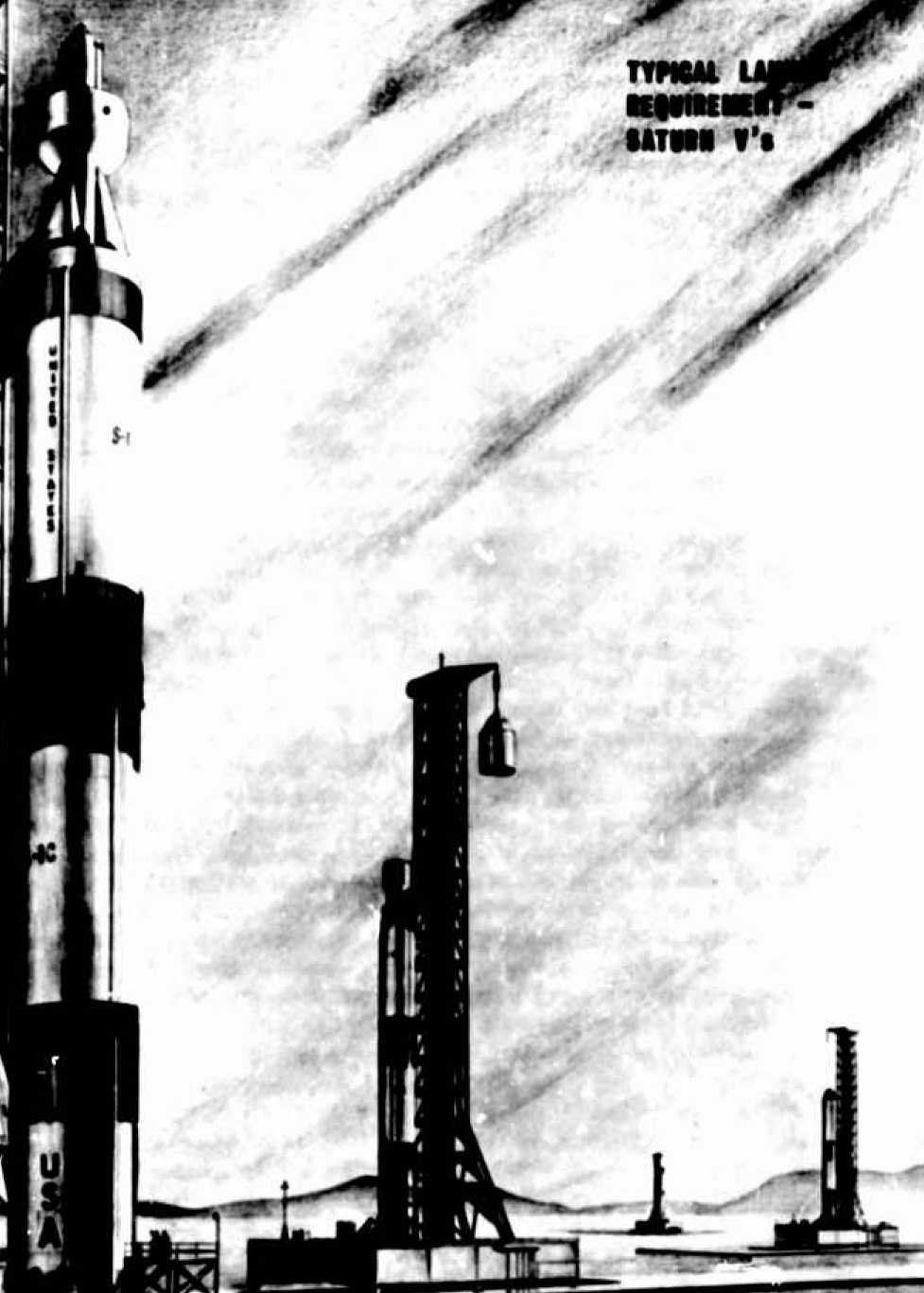
The system for the baseline mission can be assembled in Earth orbit with four Saturn V launches, plus orbital operations. The launches itemize as follows:
TABLE III
|
|
|
No. of launches |
Payload mass and description |
|
1 |
91 tons - ORION engine |
|
1 |
76 tons - Mission payload and support structure |
|
2 |
100 tons each - Pulse units and magazines |
Figure 2 illustrates schematically the launch requirements (launches would actually occur sequentially over a period of weeks).
Assembly of the space vehicle in orbit would utilize the "connecting" mode. No liquid propellant transfer is required; no cryogenics are involved.
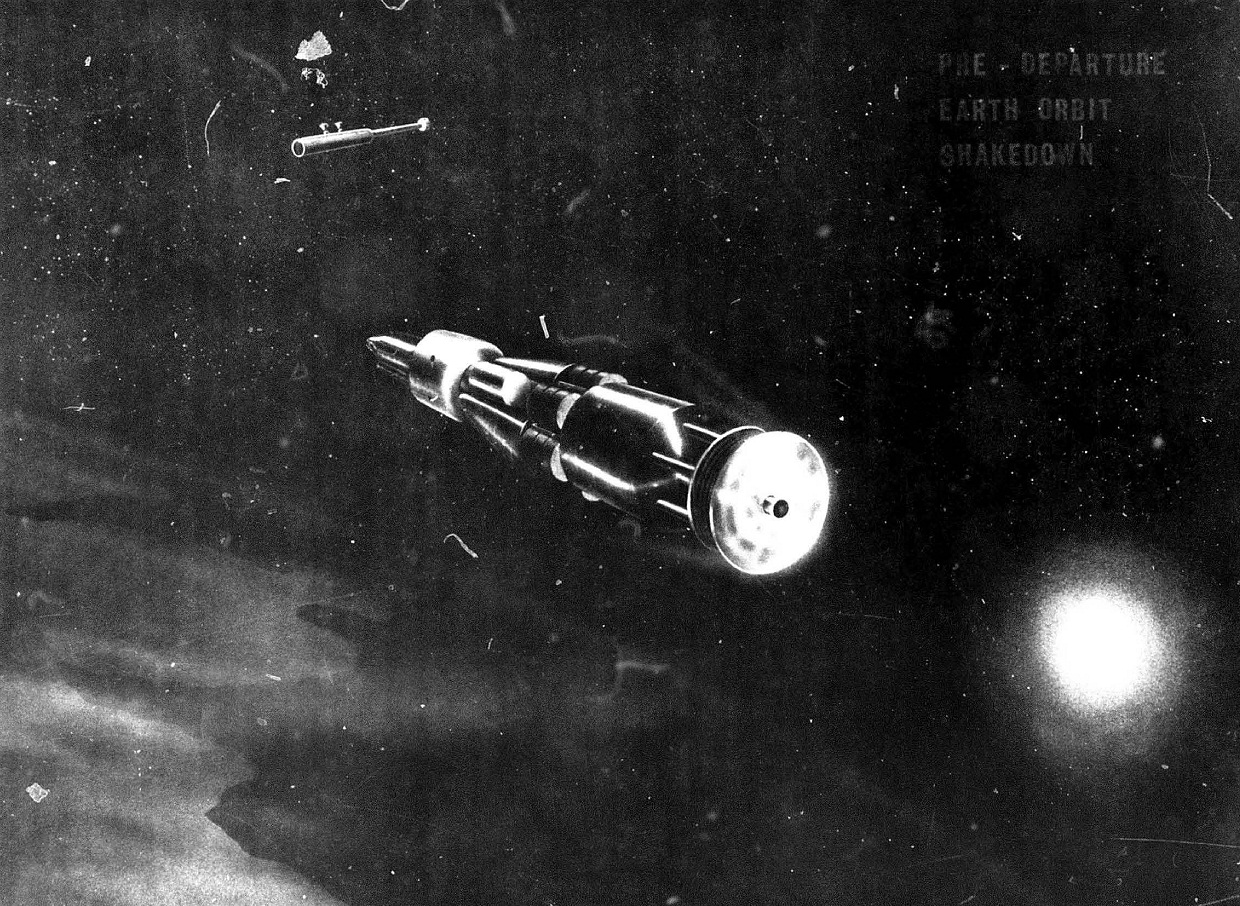
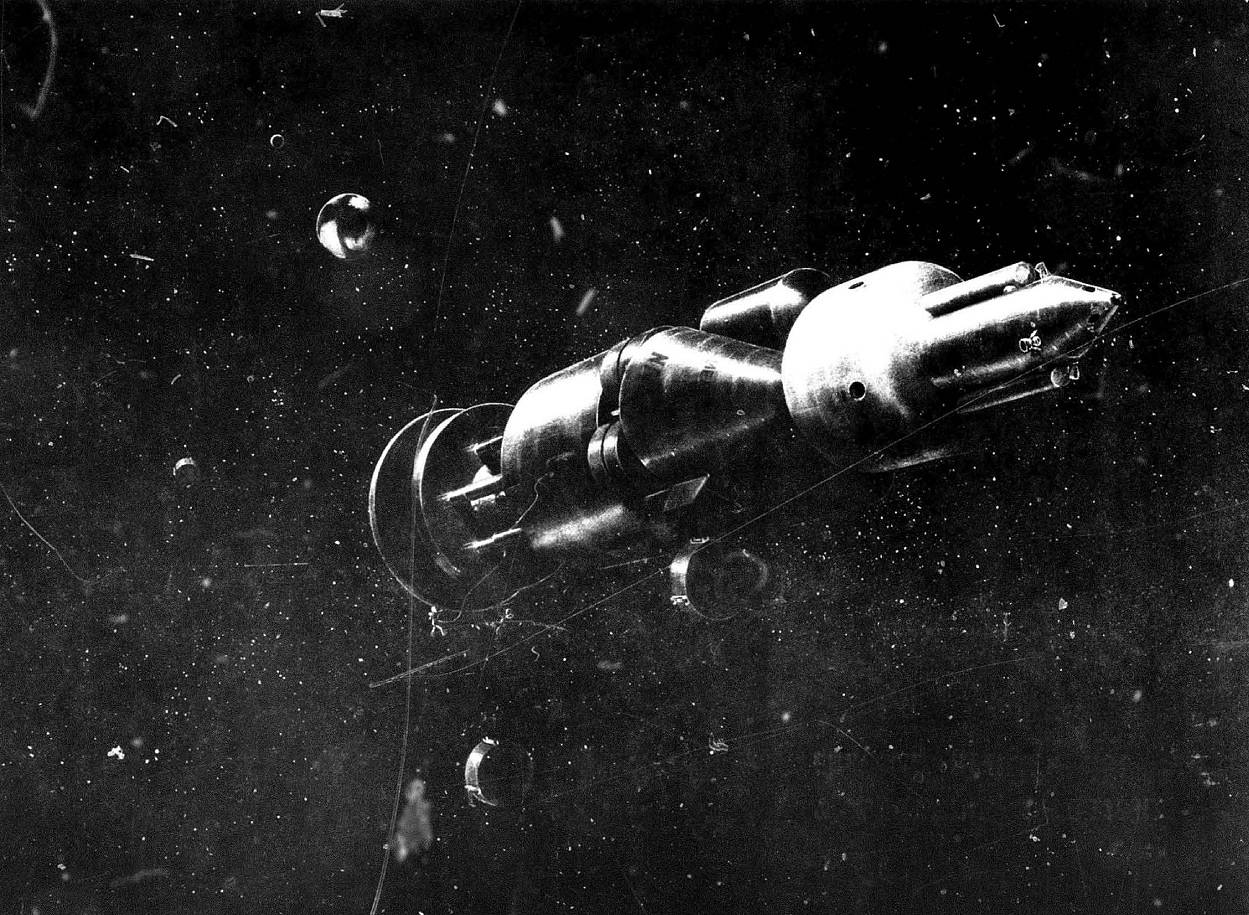
Earth departure propulsion is initiated as illustrated in Figure 3. During propulsive periods, the crew will occupy a "command post" which is adequately shielded against radiation from the propulsion system. Empty pulse unit magazines are jettisoned after each propulsion maneuver, as depicted in Figure 4. At Mars, half of the crew will descend to the surface in the Mars Excursion Module, while the other four men remain in the spacecraft. The baseline mission makes no provision for Mars surface locomotion other than walking. Limited capability is assumed for bringing a few pounds of Mars specimens back to Earth. Upon Earth return, the space vehicle is used to brake to 15 km/sec entry velocity and abandoned. The crew enters and returns to Earth by means of an Apollo-type entry module.
Although the employment of Orion propulsion for the baseline mission results in less initial mass in Earth orbit as compared to solid core rocket systems, the difference is not decisive, especially when considering that the graphite nuclear rocket is well along the development path whereas Orion is still in the concept stage. Actual mass figures are 367 tons (Orion), compared to 833 tons (nuclear rocket), assuming the nuclear rocket staged for each propulsion maneuver; the Orion vehicle is not staged.
It is not truly relevant to make such a comparison as the one just given. For one thing, the baseline mission in an "easy" year represents a mission which has been optimized for solid core nuclear rocket propulsion. Further, as already noted, Orion is not technically or programmatically a "competitor" to the nuclear rocket, although it is often thought of as such. Before further propulsion discussions, consideration of several perturbations on the baseline mission are in order.
1. All years are not "easy" years. One might well consider 1993 as representative of a "difficult" year.
2. The mission duration of 450 days is chosen, not because it is a desirable duration, but because it is about optimum for opposition class missions, with respect to initial mass required for spacecraft, using impulsive propulsion maneuvers for planetary orbit departures and arrivals (four maneuvers per round trip). There are strong biomedical and operational reasons for desiring to shorten this time substantially. These factors could lead us, for example, to wish to perform the Earth-Mars and Mars-Earth transfers in about 100 days each (an arbitrary figure commensurate with typical quoted durations for crew staytime aboard an orbiting laboratory).
3. Earth entry from 15 km/sec will impose 10-15 g's acceleration stress on the crew, which possibly may not be tolerable after an extended period in the zero gravity environment. A rotating mission module or "g" conditioning equipment on board, which would alleviate this problem, will impose weight penalties. At any rate, return to Earth orbit, rather than the "meteoric plunge" would be desirable, if operationally feasible.
4. Four men for twenty days on Mars represent a rather superficial exploration, and, therefore, although a reasonable and desirable goal for first-generation Mars stopover missions, should not be regarded as a permanent feature of a realistic Mars exploration program. If Mars exploration should continue beyond first-generation landings, we may expect the number of men, the staytime, and the mass of exploration equipment landed, all to increase in later missions. A representative extended mission might land 20 men and 100 tons of equipment for four months staytime, as the last step before a semi-permanent base. (It must be recognized here that we are projecting a somewhat indefinite distance into the future.)
If the previous baseline mission were executed in a representative "difficult" year, such as 1993, the mass in Earth orbit required for the Orion system would be 472 tons. This represents added magazines of pulse units; the space vehicle is not otherwise changed. The solid-core nuclear rocket system requires 2600 tons delivered to Earth orbit (vs. 833 tons in 1984), clearly requiring modifications in the vehicle, such as clustering additional standard modules.
The potential of advanced nuclear propulsion, characterized by an Orion system with a specific impulse of 3300 seconds, can be further demonstrated by assuming a difficult mission based on the considerations mentioned above. The difficult mission chosen might be considered as a final step prior to establishment of a semi-permanent Mars base. Whether such a mission will ever be desirable cannot be established at this time because we know too little about the planet. It conceivably could turn out to be a rather uninteresting place (e.g., earlier missions might provide very strong evidence that there is no life on Mars). However, it is worthwhile to project the characteristics of such a mission in order to acquire additional perspective in our view of possible planetary exploration programs.
The mission was assumed to take place during the opposition of January 1993. This year was chosen not as a prediction, but because it is a representative difficult year for opposition class missions. In accordance with previous discussion, the requirement was established that interplanetary transfers be limited to 100 days' duration. Table IV lists the principal characteristics of the mission. Mission dates were optimized only very roughly, by use of a chart similar to Figure 1.
TABLE IV
|
|
|
Crew Size |
20 men |
|
Mars Surface Crew Size |
20 men |
|
Mars Stopover Duration |
120 days |
|
Earth Departure Date |
J. D. 2448820 |
|
Mars Arrival Date |
J. D. 2448920 |
|
Mars Departure Date |
J. D. 2449040 |
|
Earth Arrival Date |
J. D. 2449140 |
|
Velocity Increments: Total |
72.3 km/sec |
|
Maneuver 01 |
16 km/sec |
|
Maneuver 02 |
21.5 km/sec |
|
Maneuver 03 |
18.8 km/sec |
|
Maneuver 04 (to 24-hr Earth orbit) |
16 km/sec |
|
Crew living Module Mass (Including life support) |
70 tons |
|
All-up Mass of Mars Excursion Modules (Hydrogen-Oxygen Propellants) |
2 @ 70 tons each |
|
Mass of Exploration Hardware: Total |
100 tons |
|
Inflatable Shelters |
2 @ 11.5 tons each |
|
Roving Vehicles |
4 @ 4.5 tons each |
|
Life Support Stores |
22 tons |
|
Roving Vehicle Propellant and Spares |
4.5 tons |
|
Scientific Laboratory and Equipment |
9 tons |
|
Nuclear Reactor Power Supply |
9 tons |
|
Roving Vehicle Propellant Reverter |
5.5 tons |
|
Packaging |
9 tons |
|
Mass of Mars Landers Required to Land Exploration Hardware |
90 tons |
Choice of propellants for the Mars Excursion Modules was hydrogen/oxygen on the assumption that production of exhaust gases containing fluorine or other noxious components would be precluded for fear of undesirable influences on the Martian environment. It was assumed that the mission would be launched from Earth orbit in two spacecraft, one of which would carry the crew with most of the propellant required for a return trip. The second spacecraft was assumed to carry the mission equipment and some nuclear pulse propellant which would be transferred to the first vehicle in Mars orbit prior to the return trip. In the event of loss of the cargo ship, a landing would not be possible; earlier return of the crew ship would require less delta-V and the propellant assumed to be transferred would not be required. Each ship would weigh 1870 tons in Earth orbit fully loaded, thus requiring a total mass in Earth orbit of 3750 tons. A directly analogous calculation of the crew ship initial mass assuming solid core rocket propulsion yielded a result of about 20 million tons. Of course, if this mission were to be carried out using solid core nuclear rocket propulsion, slow transfers (about 200-250 days) each way would be used, and Earth entry would be direct, rather than return to a 24-hour orbit. In this way, mass required in Earth orbit could be reduced from 20 million tons to about 8000 tons.
The use of Orion propulsion for non-military missions would incur a variety of operational problems which must be considered in any evaluation of the potential of this propulsion system. The more important of these problems are the following:
1. Dispersal of fission products in Earth's atmosphere.
2. Absorption of fast neutrons in Earth's atmosphere.
3. Production of artificial radiation belts in the vicinity of Earth.
4. Launch of hazardous nuclear material from Cape Kennedy.
5. Operation of this propulsion system near other space systems.
6. On-board crew protection.
Dispersal of fission products in the Earth's atmosphere as a result of any one Orion mission would be not more than that to be expected from a few kilotons of atmosphere testing of fission weapons. Since the fission products would enter the uppermost atmosphere from space, fallout would be widely dispersed over the Earth's surface and would extend over a period of several years. However, we must at the present time take the view that dispersal of fission products in the atmosphere is undesirable. Several approaches have been conceived for essentially eliminating this problem. These fall in the general areas of reduction of fission products, and initiation of Orion propulsion at substantial distances from the Earth.
Fast neutrons are produced by all types of nuclear explosions, and of those that enter the Earth's atmosphere from above, about half will be reflected back into space, whereas the other half will essentially all be absorbed by nitrogen-14 to form carbon-14, a long half-life radioisotope of some biological importance. The natural cosmic ray balance of carbon-14 in the atmosphere has already been greatly altered by weapons testing, and because of the long half-life of this material, will not be restored for some thousands of years. Reduction of neutron absorption in the Earth's atmosphere due to operation of an Orion vehicle can only be accomplished by separation distance between the vehicle and earth.
Details of the relations between location and intensity of a nuclear explosion in space and the resultant production of artificial radiation belts are not fully known. Presumably, there are regions where nuclear explosions will have essentially no effect. There are known to be others (as exemplified by the 1962 Starfish test) where a large nuclear explosion will produce artificial radiation belts of substantial intensity and with lifetimes on the order of a year. Operation of Orion propulsion at relatively large distances from the Earth such as 100,000 kilometers would presumably have no effect on the Van Allen belt environment.
Launches of large masses of plutonium from Cape Kennedy, if required, will pose serious range safety problems not heretofore encountered. It is presumed that the maximum credible accident during a launch would not result in a nuclear explosion. However, chemical burning of the plutonium would be very likely and would disperse this extremely hazardous material over a rather large area. Plutonium is biologically much more toxic than uranium because of its comparatively short half-life; plutonium is primarily a radiological poison whereas uranium is primarily a heavy metal chemical poison. An attractive solution to this problem would be delivery to orbit of the nuclear material by a reusable launch vehicle which would carry a moderate mass of the material in any individual flight, and whose reliability would be comparable to that of military aircraft which carry nuclear devices on a routine basis. The convenient packagability of Orion propellant units would make this an almost ideal solution.
Although the crew of an Orion vehicle can be well shielded from explosions of the pulse units, shielding of objects near the Orion vehicle would not be practical. Therefore, it will be necessary to achieve an initial separation distance of some hundreds of kilometers between an Orion vehicle and another manned installation such as an orbital launch facility prior to initiation of Orion Propulsion. This separation distance of hundreds of kilometers would also apply to distances between Orion vehicles in convoy unless very large shielding mass penalties are acceptable. Design studies have shown that reduction of acceleration and acoustic stresses imposed on the crew to completely acceptable levels will not require severe mass penalties. It is important to recognize that the propulsive periods required for Orion vehicles for the missions we have discussed are on the order of a very few hours at most. During non-propulsive periods, no part of the vehicle will present a serious radiation hazard.
One extreme operational solution to the radiation hazards imposed by an Orion system would be to launch from Earth orbit with a solid core nuclear rocket in order to be able to initiate pulse propulsion at a great distance from Earth. One case analyzed in detail assumed initiation of pulse propulsion at 100,000 km distance from Earth. Pertinent data are given in Table V.
TABLE V
|
|
|
Solid-core ISP |
8300 m/sec (845 sec) |
|
Nuclear Pulse Effective ISP |
17100 m/sec (1750 sec) |
|
Solid-core Systems Propellant Fraction |
0.85 |
|
Required Hyperbolic Excess Velocity |
0.3 EMOS (8.95 km/sec) |
|
Minimum delta-V to reach 100,000 km from L.E.O. |
2.8 km/sec |
|
delta-V at 100,000 km to attain 0.3 EMOS (assuming initial velocity = 0) |
9.33 km/sec |
|
delta-V in L.E.O. to attain 0.3 EMOS |
6.35 km/sec |
|
Optimum delta-V Split: Solid-core |
3.5 km/sec |
|
Optimum delta-V Split: Nuclear pulse at 100,000 km |
3.9 km/sec |
Nuclear pulse ISP was degraded to allow for weight of propellant magazines. The optimum delta-V split is, of course, only for the particular case analyzed. It would depend upon several factors:
a. ISP of each propulsion system
b. Required hyperbolic excess velocity
c. Pulse initiation altitude
d. Initial orbit altitude
The mass penalty (increase in initial mass in Earth orbit) for the particular case analyzed, compared to initiation of pulse propulsion directly from low orbit, was 60%. This is believed to be fairly typical.
Investigation of the previously described Orion engine system as a power plant for a lunar logistics system has identified several possible modes of operations:
1. Earth orbit to lunar orbit and return. Material to be delivered to the moon, propellants for the lunar surface shuttle, and nuclear propulsion pulse units would be delivered to Earth orbit by a conventional chemically powered launch vehicle. At the lunar end a reusable lunar-surface-to-lunar-orbit shuttle would ascend to rendezvous with the ferry vehicle in lunar orbit where propellant to descend to the lunar surface, unload cargo, and re-ascend for the next mission would be transferred to the lunar surface shuttle along with the material for delivery.
2. Earth-orbit-to-lunar-hover and return to Earth orbit. This mode was devised in order to minimize the amount of chemical propulsion required. When the nuclear pulse vehicle attains a zero relative velocity above the lunar surface, a chemically propelled one-way shuttle is dispatched to the lunar surface. The Orion vehicle then returns to Earth orbit. Implications of radiation doses from pulse units to the descending shuttle and to whatever installation might exist on the surface have not been fully assessed. It is the author's opinion that such radiation hazard would eliminate this operational mode from further consideration.
3. Earth orbit direct to lunar surface and return. In this mode of operation the nuclear pulse vehicle enters a low orbit around the moon; braking from orbit by nuclear pulse propulsion is performed while the vehicle is below the horizon relative to the lunar installation. Final transfer to the installation and braking is accomplished by chemical propulsion. After discharge of cargo, chemical propulsion carries the vehicle over the horizon from the base, where nuclear pulse propulsion may be initiated. This mode appears to be operationally the simplest, requiring no chemically propelled shuttle vehicle. However, failure of the chemical propulsion system to start during descent to the moon, or of the nuclear propulsion system to start during ascent from the moon would result in a crash on the moon.
The Orion vehicle, unless one is concerned with very large payloads delivered per flight, is severely disadvantaged for lunar ferry missions by the large engine mass. Reusable systems of any type, operating as a lunar transportation system from Earth orbit to the lunar surface, will not be economically attractive until the cost of Earth-to-orbit transportation is reduced by a factor of several below what it will be with Saturn V class expendable Earth launch vehicles.
Reasons for confining most investigations of manned planetary missions to the planet Mars were previously discussed. Some analyses of more difficult missions have been conducted. Although these analyses have not produced firm conclusions, several observations may be made.
1. Mission objectives for manned missions to the outer planets or the asteroid belt are very ill-defined at the present time. Knowledge of the origin of the solar system might be substantially improved thereby.
2. The long destination stopover time difficulty which occurs for elliptic (Hohmann) transfers between planets exists principally for missions to Venus and Mars.
3. If the difficult solar environment could be handled, a mission to the planet Mercury is conceivably the next reasonable objective for a manned exploration. Scientific value of such a mission might be significant. Propulsion requirements would demand advanced nuclear propulsion for interplanetary transfers.
4. Mission time will be the principal problem for missions to the outer planets. For example, whereas a Hohmann transfer roundtrip to Jupiter will require just slightly over seven months' staytime at Jupiter, the overall mission will require in excess of six years. Accomplishment of missions to the outer planets will require extremely high propulsion performance, implying advanced nuclear propulsion, in order to bring roundtrip times within reasonable limits.
1. "Nuclear Pulse Space Vehicle Study," (Uncl. Title), Vols. I-IV, General Atomic (division of General Dynamics) Report GA-5009 (Secret, Restricted Data)
2. Space Flight Handbooks, Vol. 3, "Planetary Flight Handbook," NASA SP-35 (1963)
3. Ruppe, H. O., "Manned Planetary Reconnaissance Mission Study: Venus/Mars Flyby" Technical Summary Report, NASA TM X-53204
4. von Braun, W., The Mars Project (English Translation) (1953)
5. Smith, J. N. (Ed.) "Proceedings of the Symposium on Manned Planetary Missions, 1963/64, "NASA TM X-53049, June 1964