Gene Roddenberry
March 23, 1987
Your possession of this Star Trek "bible" should not be considered an invitation to write or submit a story or script for the television series STAR TREK: The Next Generation.
Please don't mail in a story or script. Regretfully, this will only lead to that mail being rejected or the material destroyed.
True, Star Trek has always encouraged new writers and will seek ways to do so in the future. However, because of business, union, and insurance restrictions, neither the Star Trek office nor the production staff is permitted to accept unsolicited (unrequested) stories or scripts.
The single exception to the above rule is material submitted by recognized literary agents -- meaning those who have an established reputation as representatives of professional television writers.
Thank you for understanding this.
THESE ARE THE VOYAGES
The Mission of the Enterprise
The Next Generation
What Has Not Changed
What Is Changed From the Original Series: A New Crew (**)
THE SCRIPT
Believability
What Doesn't Work
Format
THE STARSHIP ENTERPRISE
The Bridge
A New Look
Standing Sets
Community and Family Life
MORE ON THE STARSHIP CREW
Captain Jean-Luc Picard (**)
Commander William Riker (**)
Lt. Commander Data
Lt. Commander Deanna Troi (**)
Lt. Natasha "Tasha" Yar (**)
Lt. (J.G.) Geordi La Forge
Chief Medical Officer, Dr. Beverly Crusher (**)
Wesley ("Wes") Crusher
WRITERS' AND DIRECTORS' NOTES
Star Trek Terminology
Star Trek Weaponry
The Ship's Computer
APPENDIX
Scientific Terminology
** – SIGNIFICANT CHANGES ARE MARKED WITH DOUBLE ASTERISKS
These are the voyages of the starship Enterprise
her
continuing mission: to explore strange new worlds
to seek out new
life and new civilizations
to boldly go where no one has gone
before.
STARFLEET OPERATING ORDERS:
|
STARSHIP: |
ENTERPRISE |
|
DESIGNATION: |
NCC-1701-D |
|
COMMANDING OFFICER: |
CAPTAIN JEAN-LUC PICARD |
|
STARDATE: |
41254.7 |
SHIP'S MISSION:
To expand the body of human knowledge.
To provide assistance as required to Earth/Federation colonies, commerce and travelers.
To provide for Earth/Federation security.
To seek out new life, new civilizations.
To provide further understanding of the universe and humanity's place in it. "Who are we? Where have we come from? What are we about? And where are we going?"
STAR TREK: THE NEXT GENERATION is dated near the beginning of the 24th century. 78 years have passed since the time of Kirk and Spock. They have passed into history -- but they are known as legends throughout the Federation and even beyond.
The billions of stars in our galaxy are still being charted and their solar systems explored, a task so vast that without almost unimaginable changes in the nature of humanity and its space travel methods, this could still go on for hundreds of centuries.
During the years of Captain Kirk's Enterprise 4% of the galaxy had been charted -- not explored -- since exploration would have required visits to all the approximately 11,000,000,000 stars and planetary systems in that 4% of the galaxy. By the time of our 24th century stories, only 19% of it has been charted.
If only one out of a million of the stars in the galaxy had worlds and if only one out of a million of these worlds were capable of supporting life, and if only one out of a million of those bore intelligent life, there would still be millions of inhabited worlds for us to visit.
So much for the question: "Are there any Star Trek stories left?"
THE SAME 'BAND OF BROTHERS' FEELING (And sisters too, of course!)
A large part of the success of the original Star Trek series is attributable to the fact that it was not a star and co-star series, but a family ensemble in which the continuing characters felt great affection for each other, allowing the audience to identify with and share that same feeling of affection.
THE SAME ACTION-ADVENTURE ENTERTAINMENT FORMAT
We now have more freedom and story latitude, because our series by-passes the networks and is made directly for television stations. As before, without neglecting entertainment values, we invite writers to consider premises involving the challenges facing humanity today (the 1980's and 90's), particularly those which interest the writer personally. The new Star Trek episodes will continue the tradition of vivid imagination, intelligence and a sense of fun, while still assessing where we humans presently are, where we're going, and what our existence is really about.
ALMOST THE SAME VESSEL
The Starfleet designation of our new Enterprise is "NCC-1701-D" (indicating that it is the fifth starship to carry that name.) Now twice the length of the original 23rd century Enterprise (which adds up to eight times its size) our new starship has much the same symmetry of the original, but it is now a vessel of less "battleship sterility." It serves as more of a community and home to a considerably larger and more diverse crew.
A NEW CREW:
Necessary, since this new Star Trek mission takes place 78 years after the voyages of the original starship Enterprise. We have new names and personalities, even some new shipboard titles and positions, but still aiming for the same 'band of brothers and sisters' relationships featured in the original series.
Already a 24th century Starfleet legend, Picard is an extraordinary man, much revered by his crew. He deserves the description "distinguished" despite being only in his youthful fifties. He has an unspoken but deep father-son relationship with:
Early thirties, the starship's Executive Officer and second-in-command. His twin responsibilities are (1) constantly providing the Captain with a top condition vessel and crew, and (2) acting as commander of away missions, both planetary and other kinds.
An android so perfectly fabricated (by unknown aliens) that on applying for a Starfleet commission years ago he tested out as alive. This is a point of pride to Data, whose Starfleet psychiatric profile ("Medical eyes only"), lists the android as having the "impossible dream of somehow, someday becoming human." With a phenomenal memory capacity, superior strength and similar assets, Data is an ideal Starfleet officer.
An attractive and very witty Starfleet professional, she is the starship's Counselor, a position of vital importance on space vessels of the 24th century: the success of a starship's mission depends as much on efficiently functioning human relationships as on the vessel's mechanisms and circuitry. TROI is a master in Human and Alien Psychology, also Starfleet-trained as a bridge officer. Her mother was a Betazed alien and she has inherited a form of telepathic ability which allows her to "feel" the emotions of others.
The starship Security Chief, Tasha, who performs that same function both aboard ship and on away missions. Born at a "failed" Earth colony of renegades and other violent undesirables, she escaped to Earth in her teens and discovered Starfleet, which she still "worships" today as the complete opposite of all the ugliness she once knew.
An away mission regular who is racially black and birth-defect blind -- although with prosthetic super-high tech artificial "eyes" which can detect electromagnetic waves from all the way from raw heat to high frequency ultra-violet, making other crewpersons seem hopelessly "blind" by comparison. His closest friend is Data, and the two of them are particularly efficient when working together on away missions. Because of his "eyes," Geordi can also perform some of the functions of a tricorder.
An extremely attractive woman in her early-to-mid forties, our ship's CMO worked long and hard to get her assignment to the starship Enterprise. She is one of the most talented and insightful physicians in Starfleet. She and Picard know each other from his delivering the body of her husband to her after a mission accident. While it wasn't Picard's fault, it was his orders that sent her husband there and she has found it difficult to forgive Picard -- although further stories will see the two developing a strong mutual attraction.
A smallish, bright, fifteen-year-old boy who came aboard with his mother, Beverly. Although Wes is hardly more than an awkward teenager, he is already displaying the genius of both his parents, particularly in the areas of starship engineering and related physical sciences (including warp velocity navigation.) In some future episode Captain Picard will recognize these abilities by appointing Wes an acting-ensign assigned to Starship Operations.
WHAT WE MUST HAVE:
Action/Adventure/Drama Entertainment --
Involving our starship crew and vessel --
PLUS, once the above has captured the audience's attention, we want to include our usual comments about the challenges humanity now faces.
BELIEVABILITY IS EVERYTHING. IT IS THE MOST ESSENTIAL ELEMENT OF ANY STAR TREK STORY.
If you're in doubt about a scene, you can apply this simple test: "Would I believe this if it was occurring on the bridge of the battleship Missouri?" If you wouldn't believe it in the twentieth century, then our audience probably won't believe it in the twenty-fourth.
Especially, the people must be believable -- just as believable as if they were living in our 20th century. The crew of the Enterprise are intelligent, witty, thoughtful, compassionate, caring human beings -- but they have human faults and weaknesses too -- although not as many or as severe as in our time. They have been selected for this mission because of their ability to transcend their human failings. We should see in them the kind of people we aspire to be ourselves.
A good STAR TREK story should have both a science fiction element and a personal element.
The science fiction element should be thought-provoking and visual. It need not be a huge galactic event or even a planetary one. It can be science fiction on a smaller, more personal scale.
The personal element of a STAR TREK story can be a human dilemma created either by the nature of the characters, by the plot, or by the science fiction element. Again, whatever it is, the key is to show the characters in the story acting believably. We often get our best STAR TREK by showing how real human beings cope with fantastic situations.
Please remember that a major hero of STAR TREK has always been the starship Enterprise and her mission. The ship is not just a vehicle -- she is the touchstone by which all of our characters demonstrate who they are and what they're up to in the universe.
We have found that the following does not work well for us:
1) Stories which do not materially involve our own crew. Yes, we do like to see interesting new characters -- but only when used in addition to an interesting story line involving our continuing characters.
2) We do not do stories about psi-forces or mysterious psychic powers. No matter how fantastic the events in a story, the explanation must be extrapolated from a generally accepted science theory. (We have accepted the telepathy of Lt. Commander Deanna Troi because many reputable scientists acknowledge the possibility of such abilities, but you will note that we have limited Troi to "reading" only emotions.)
3) We are not buying stories which cast our people and our vessel in the role of "galaxy policemen." (See Prime Directive) Nor is our mission that of spreading 20th century Euro-American cultural values throughout the galaxy.
4) We are not buying stories about the original STAR TREK characters: Kirk, Spock, McCoy, Uhura, Chekov, Scotty and Sulu. Or their descendants. As much as we love our original cast (they are our children, after all), we need our audience's attention centered on our new characters.
5) Writing FANTASY instead of SCIENCE FICTION. The difference between the two is profound. Despite the fact that both science fiction and fantasy can deal with unusual events, a science fiction story is based on an extrapolation of a generally accepted scientific fact or theory. Fantasy, which our format does not permit, need have no basis in reality.
6) Writing "SWORDS AND SORCERY". Knights and princesses, stalwart yeomen and dragons are not science fiction for our purposes.
7) Treating deep space as a local neighborhood. Too often, script ideas show characters bouncing from solar system to solar system, planet to planet, without the slightest comprehension of the distances involved or the technologies required to support such travel. Fine (and even fun) on SPACE RANGERS but not on STAR TREK.
8) STAR TREK is not melodrama. Melodrama is a writing style which does not require believable people. Believable people are at the heart of good STAR TREK scripts.
9) No stories about warfare with Klingons or Romulans and no stories with Vulcans. We are determined not to copy ourselves and believe there must be other interesting aliens in a galaxy filled with billions of stars and planets.
10) Stay true to the Prime Directive. We are not in the business of toppling cultures that we do not approve of. We will protect ourselves and our mission whenever necessary, but we are not "space meddlers."
11) Plots involving a whole civilization rarely work. What does work is to deal with specific characters from another culture and their interactions with our own continuing characters.
12) Mad scientists, or stories in which technology is considered the villain. It doesn't make sense for a group of 24th century interstellar travelers (whose lives depend on the successful workings of their technology) to be Luddites.
13) Stories in which our characters must do something stupid or dangerous, or in which our technology breaks down in order to create a jeopardy. Our people are the best and the brightest, and our technology is tried and proven. Likewise, our characters are very committed to their ship, their crewmates, and their mission. Please do not have them abandoning or betraying same because they have fallen in love with a beautiful pirate princess.
The format of a Star Trek script is a TEASER and FIVE parts.
The teaser can run as long as 5 pages if necessary, but should not be shorter than 3. Each part should be approximately 10-11 script pages long.
The total length of the first draft script should not be more than 55-56 pages.
Because the style of the show is a fast-paced action/drama, long rambling scenes are to be avoided. The actual running time of each episode will be 43 minutes.
STAR TREK uses the narrative device of the ship's log to provide necessary exposition for our stories.
CAPTAIN'S LOG:
The Captain's Log is a voice-over supplement to the narrative of our story. Example: "Captain's Log, Stardate 41201.3. The Enterprise is in polar orbit around the fourth moon of a Jupiter-sized planet ..."
SUPPLEMENTAL LOGS
These can include Medical Log, Science Log, and Supplemental Log, as in the past. These other log entries, when we hear them, will be made by other crew members.
Also, included now is the use of Away Logs to which is added the name and specialty of the crewperson making the log entry. Most Away Log entries will be made, of course, by Number One, William Riker.
One purpose of the log entries is to move the story along rapidly and economically with a few words sometimes doing the work of several scenes. It also allows our characters to annotate their personal responses and feelings about a situation as it is occurring.
Log entries are ALWAYS introduced with a stardate.
STARDATES
A stardate is a five-digit number followed by a decimal point and one more digit. Example: "41254.7." The first two digits of the stardate are always "41." The 4 stands for 24th century, the 1 indicates first season. The additional three leading digits will progress unevenly during the course of the season from 000 to 999. The digit following the decimal point is generally regarded as a day counter.
THE U.S.S. ENTERPRISE -- NCC 1701-D
The fifth starship to carry the name Enterprise. Twice the length of the original starship and thus approximately eight times the interior size. (See cover illustration.) She retains much the same symmetry which includes an engineering module with twin nacelles and, of course, a great saucer-shaped command module.
WHAT IS CHANGED?
Beyond the vessel's familiar symmetry, many things. The starship is designed to be home (home in a very literal sense) to 1,012 persons. Gone is the metallic sterility of the original ship, the reason being that the last century or so has seen a form of technological progress which 24th century poets call "Technology Unchained" -- which means that technical improvement has gone beyond developing things which are smaller, or faster, or more powerful, and is now very much centered on improving the quality of life.
STARSHIP INTERIORS
The living and working areas of the Enterprise reflect this emphasis on the quality of life by a lighter, brighter and more comfortable feeling everywhere. The starship's duty areas are no longer cluttered with the same profusion of gauges, instruments, and control buttons. Instead, not only the bridge but all other parts of the vessel feature black panels which on touch or voice command will become information displays. This is usually accomplished by a crewman speaking the key words, "Show me ..." followed by a statement of what is desired. (Audio answers are triggered by the command, "Tell me ..."). The "Show me" command causes the requested information to come into view on the formerly black surface. If one wants to manipulate either that information or some starship mechanism, touch buttons can be displayed at the same time.
THE BRIDGE
(See illustration.) Because of this starship's level of automation, the new bridge looks very different from the one in the original Enterprise. Gone is the need for officers to report to work to a giant cockpit lined with rows of duty stations studded with clusters of instrumentation and controls.
Instead, our new bridge combines the features of ship control, briefing room, information retrieval area and officers' wardroom. In other words, much the same kinds of things happen here as in the old bridge but with less emphasis on the mechanics of steering the starship. It is a place where the starship officers with either aboard or away responsibilities can meet, check out information, make plans, or just catch up with what is happening.
Who actually drives the Enterprise? The job of starship command and control is handled by two bridge duty officers at positions known as CON (command and vessel control including helm and navigation) and OPS (vessel operations including jobs which were once engineering functions.) These jobs can be handled by the appropriate series regulars or by others when needed. All such things are handled with the same casual effectiveness as in the past -- more like the exchanges between civilian airliner professionals than between military persons.
From the moment the starship's destination is selected and the journey begun, every detail of the voyage is guided and monitored by sophisticated 24th century sensor/computer combinations. "Routine" emergencies are sensed and analyzed with counter-measures already underway long before human help is possible, or even desirable.
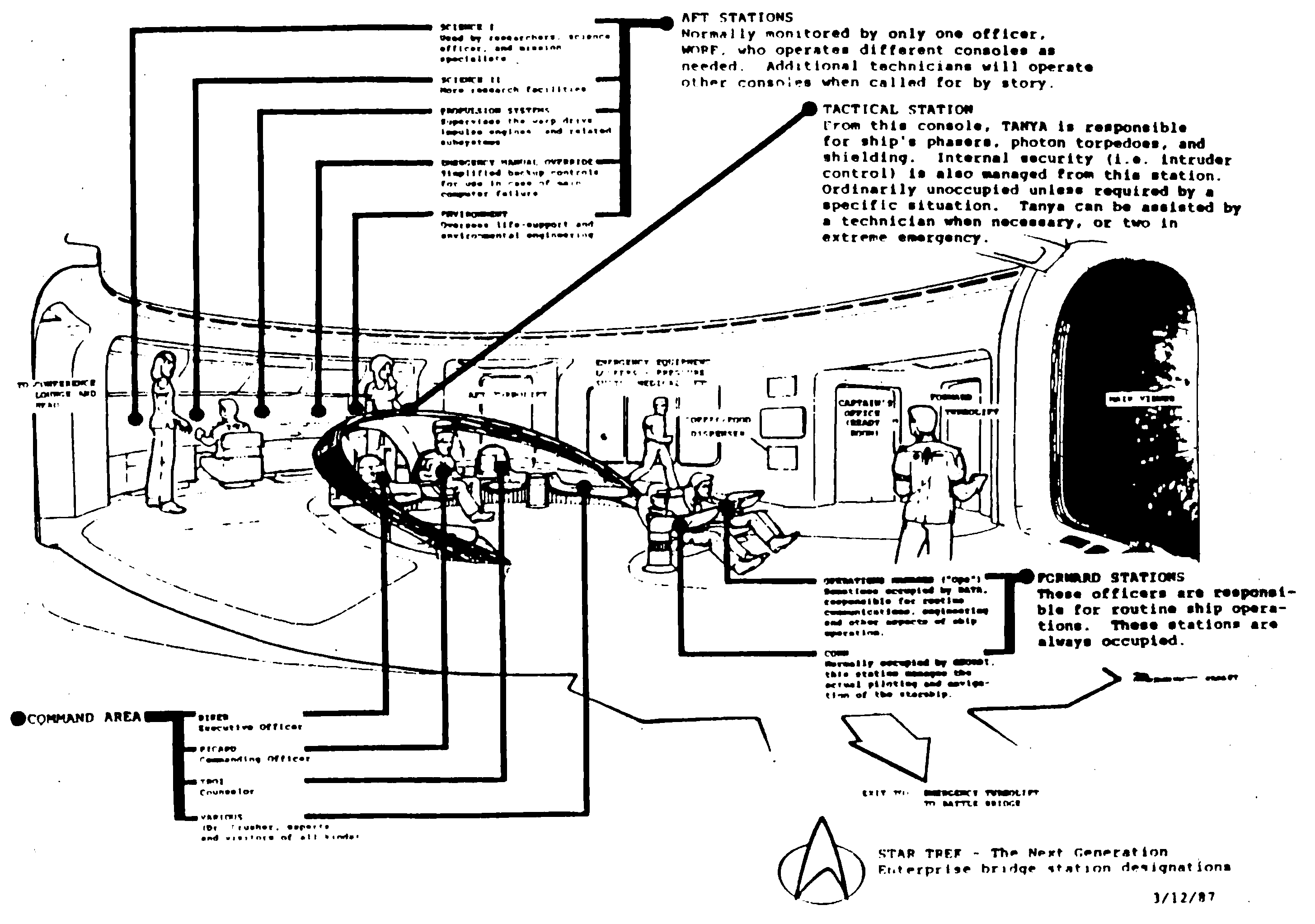 AFT STATIONS (Science I, Science II, Propulsion Systems, Emergency Manual Override, Environment) Normally monitored by only one officer, WORF, who operates different consoles as needed. Additional technicians will operate other consoles when called for by story. TACTICAL STATION From this console, TANYA is responsible for ship's phasers, photon torpedoes, and shielding. Internal security (i.e., intruder control) is also managed from this station. Ordinarily unoccupied unless required by a specific situation. Tanya can be assisted by a technician when necessary, or two in extreme emergency. FORWARD STATIONS (Ops, Conn) These officers are responsible for routine ship operations. These stations are always occupied. |
THE BRIDGE SET
The COMMAND AREA of our bridge is a semi-circle of control seats where the Captain and his next-in-command and advisors are located. Just ahead of this are two FORWARD STATIONS, "OPS" and "CON" positions. These stations are often manned by Data and Geordi La Forge. (Yes, the Enterprise is being driven by a blind man.) When either Data or La Forge leave their stations, they are promptly replaced by supernumerary officers who will be referred to by the nicknames of these stations.
The rear of the bridge has a raised semi-circular area, separated from the Command Area by a railing which is also a set of console stations. This is the TACTICAL CONSOLE. At this position, Tasha plus any necessary assistants are responsible for weaponry, defensive devices (shields, etc.) plus ship's internal security.
The rear wall of the bridge is an additional set of duty stations called AFT CONSOLES. These five stations represent functions which will also be ordinarily unsupervised unless called for by a story situation. From left to right (facing aft), these are:
1) EMERGENCY MANUAL OVERRIDE. A set of basic and simplified controls from which many ship's functions can be managed in the event of main computer failure.
2) ENVIRONMENT. Life support and related environmental engineering functions.
3) PROPULSION SYSTEMS. Bridge control of warp drive and impulse engines.
4) SCIENCES. Used by researchers, science officer, mission specialists, and the like.
5) SCIENCES. Additional console to allow researchers to interact with each other.
On the stage-left side of the bridge are two turbolifts and a door leading to the Captain's Office (sometimes called the Captain's Ready Room). On the right side of the bridge is a door leading to the bridge head and washroom.
MAIN VIEWER
The forward part of the bridge is a large wall-sized holographic "viewer." This main viewer is usually on and will dominate the bridge and the action as the original framed viewscreen could never do.
BRIDGE LOUNGE
Just behind the bridge is a large room filled with comfortable furniture and lined with huge windows facing rearward and giving a spectacular view of the aft top portion of the saucer section and the rest of the starship. This lounge has complete food facilities and is often used as an observation deck and retreat for bridge officers.
CAPTAIN'S OFFICE/READY ROOM
On the left side of the bridge (facing forward) is a door leading to the Captain's Office. Also known as the Ready Room, it has an auxiliary turbo-lift and the Captain's private head and washroom.
The Ready Room is intended as a private place for the Captain, offering both a confidential place to work and convenient rest; but it serves a second and equally important dramatic function: it can also be used for personal and private conversations.
TRANSPORTERS
As in the original series, the Transporter Beam is a device which allows us to instantaneously transmit crew or cargo from one location to another. The transporter effect will be much the same as before, but with improved detail and dazzle. Also, a transporter effect reverse angle will sometimes be used, which will be the optical effect as seen from the perspective of a person actually being beamed somewhere.
The Transporter Room itself is no longer a metallic battleship gray. As in the original series, a person being transported from the ship must stand on the transporter platform while the command "energize" is given. To transport from away, the individual uses his communicator to request "beam me up" which allows the starship Transporter chief to lock onto that person's position.
Decontamination. It will be established that the transporter is designed to filter out viruses, bacteria and other alien matter that might be picked up on an away visit. The Transporter Beam is primarily a line-of-sight device: its range is about 16,000 kilometers. (10,000 miles.)
COMMUNICATOR
The communicator is now worn as part of the familiar Starfleet insignia. In addition to providing communications as before, its monitoring functions remain in full operation constantly, allowing the starship command officers to monitor the safety and progress of a landing team at all times. Although this creates some additional difficulty in maneuvering our people into danger, story believability demands that our 24th century technology be at least as capable as 20th century technology in this area -- perhaps not such a difficulty if one realizes that 24th century "villains" are no doubt capable of technological counter-measures.
CLOTHING AND COSTUMES
Much less "military" looking than in the recent STAR TREK films, since 24th century technology centers on enhancing quality of life, clothing will be comfortable as well as attractive.
Away Teams wear costumes appropriate to their missions, which may include anything from clothing worn by inhabitants of the planet being visited or special protective gear required by the mission. Usually, away teams wear a simple all-purpose outfit, helmets included only when appropriate.
When off duty, our characters may wear clothing appropriate to their personal moods and heritage. We might see African dashikis, Pacific island sarongs, and perhaps even a New York Yankees baseball cap.
In the original series, we occasionally saw protective gear of one kind or another, and it is likely that we will again, when it is mandated by circumstance. In such a situation we will see that our 24th century spacesuits are simply skin-tight body-guards and helmets, much more attractive than the bulky diving-suits of ancient 20th century space travel.
SICK BAY
As in the original series, but vastly improved: a three room complex including Dr. Crusher's office, a set of diagnostic beds with complete medical monitoring, and a state-of-the-art medical research facility.
CORRIDORS
Again, as seen in the original series, but without the same battleship sterility. The new corridors are wider and more friendly-looking and (as elsewhere) will include vegetation.
UTILITY CORRIDORS
Redress of the corridors to suggest that this is the major access to the ship's behind-the-walls machinery. Like the Jefferies Tubes, the utility corridors may be lined with light-fiber cables and tubes to suggest the ship's internal nervous system and plumbing.
JEFFERIES TUBE
A cylindrical utility tube lined with electrical conduits and light-fiber cables, the Jefferies tube is large enough for a human being to crawl through. Jefferies Tubes provide direct access to various parts of the ship's control mechanisms and computer monitoring systems.
ENGINE ROOM
Our new Engine Room contains a huge matter/anti-matter engine. It is open at one end to convey a sense of greater space. The Engine Room is located near the base of the main module of the ship.
TRANSPORTER ROOM
There are several transporter rooms throughout the vessel. The one we will see most frequently will be an updated version of the original transporter room and, as before, a transporter chief stands at a separate console opposite the transporter dais.
PERSONAL QUARTERS
Each person on the Enterprise has personal quarters of his/her own. These quarters are much more spacious and livable than we have seen in the past. It is possible that one wall of the personal quarters may be a "holographic window" much like the holodecks: each person's quarters will reflect his or her own background and tastes. (This will be a standard set, redressed as necessary.)
INT. TURBOLIFT
The turbolifts allow our crewmembers to travel from any part of the Enterprise to any other: the turbolift travels both vertically and horizontally. The interior is a comfortable, relatively spacious cabin.
INT. SHUTTLECRAFT
The Enterprise shuttlecraft is a small, but comfortable landing vehicle for travel between the ship and a planet when the transporter is not available or practical to use. The interior of the shuttle can seat several people comfortably.
As humanity probes deeper and deeper into space with ten-year or longer missions becoming the norm, Starfleet has begun encouraging crewpersons to share the space exploration adventure with their families. Twenty-fourth century humans believe that life should be lived, not postponed.
Previous experiences in space exploration have underscored the lesson that people need people for mental and physical health. Starfleet encourages its people to participate in family and community life and bonding.
Although non-crew spouses and children are rarely seen in the command and other duty areas of the vessel, the sophistication of starships now includes a variety of single and group family modules, various levels of schools and study facilities, a large selection of entertainment, sports and other recreation forms, and contests (electronic and other) of a thousand kinds.
The Enterprise's holodecks can duplicate with startling reality almost any landscape or seaworld complete with winds, tides, precipitation, and whatever. These decks are much used in both education and recreation and are even more important in preventing crew and families from feeling that they are leading "contained and limited lives." In the holodecks, almost any kind of recreation, training or exercise can be simulated, especially since these same decks can also make potent use of the starship's gravity control system. This also permits, for example, the challenge of skiing any real or imaginable slope or engaging in an exciting variety of mid-air low gravity games and contests.
An even more experienced starship captain than we have seen in the past, having served on an incredible 22 year voyage as mission commander and ship captain on the legendary deep space charting vessel U.S.S. Stargazer.
Born in Paris, France, Picard betrays a Gallic accent only when deep emotions are triggered. Otherwise, since ethnic accents are no longer common, he carries only a touch of French phrasing in his speech. In discussions with friends, he pretends to believe that France represents "the only true civilization" to appear on Earth -- and it delights him when a witty companion wants to prove the same for England, Italy or China. He is definitely a 'romantic' and sincerely believes in concepts like honor and duty although on issues that affect the safety of his crew and starship he can be completely pragmatic and tough as hell.
Captain Picard has his share of idiosyncrasies, one being the fact he is not yet fully comfortable with having families and children aboard a vessel he commands. With the Enterprise being the first Starfleet vessel of this class, Picard supports its concept cautiously, while having his own private misgivings. He has not had much experience dealing with children and is not quite certain how to deal with young WES CRUSHER's precocious intelligence: but he has noticed the attractiveness of young Wes's mother and this too has influenced his feelings on the subject.
Women of the 24th century consider a man in his early fifties like Picard has having just entered his best years. Active duty Starfleet males (and females, for that matter) have the double attractiveness of being in prime physical condition usually through their seventies, and being more aware most humans of the rich variety of personal relationships.
Although still young by 24th century standards, he has gone the way we saw Kirk going, content with a 'starship love', a personality attribute accentuated by his long, long U.S.S. Stargazer duty. But here on the Enterprise, with over a thousand crewpersons and family members, he is also learning that life is more complex than he ever imagined.
He is called "Number One" by Captain and crew alike, although never by anyone not part of the Enterprise. (During private moments the Captain occasionally calls him William: female friends seem to enjoy saying Bill.) He is thirty years old.
"Number One" is a term whose meaning has not changed appreciably since Earth's seventeenth century when the second-in-command of sailing ships became generally known as "First Lieutenants" (hence Number One being used as the equivalent of First). The term also implies executive officer and captain-in-training.
In those same ancient days, ship's Number One was also usually in command of shore parties (the life of a ship captain is rarely considered expendable), and that remains the same today in the 24th century where our Number One takes over the risk of acting as mission commander on planet landings and other away missions. The Captain's concern is generally strategic while the First Officer's is usually tactical, with Number One exercising command over away teams and activities. Of course, the starship Captain retains overall command of all missions.
It is Number One's responsibility to present his Captain with a completely functioning vessel and a fully trained and ready crew. Although he refers to this only half-humorously as his "housekeeping function", it is a job that both yesterday's sailing ship and today's starship first lieutenants treat as a sacred trust.
Number One regards Captain Picard with a mixture of awe and affection. For Riker their relationship is that of a younger brother obedient to an elder brother whom he admires completely and hopes one day to successfully emulate. He accepts the responsibility for away missions not because he considers himself necessarily more agile or stronger than the captain, but because he knows that the success of the voyage and the mission would be considerably imperiled if the starship were to be deprived of Picard's vast knowledge and experience.
Although Riker has a lively interest in women, he considers it a point of honor never to let it interfere with his duty. He is intellectually committed to sexual equality too -- and tries hard to live up to that. The whole truth is, however, he is still young and hasn't yet lived enough to understand how completely different the two sexes can be. He's not fully aware that human females have needs of their own. For example, Riker doesn't yet fully appreciate the power of the female need to be needed. This helps the fact that the ship's lovely Betazed Counselor can enjoy his sterling youthful qualities without ever falling helplessly in love with him.
Riker also has some difficulty in accepting Lt. Commander Data as a crewman equal. A very interesting aspect of this is the fact that Data has needs not unlike that of a female crewperson -- in other words, Data needs very much to be needed. He wants to be more than just 'handy to have around' because of some set of abilities but to be personally needed for his own qualities. In short, Data needs Riker to like him too. In upcoming episodes, we'll watch an efficient working relationship grow between the two and finally become friendship.
Second in command of Number One's away team, Data (rhymes with "that-a") is an android so perfectly fabricated that only a skilled biologist would know he is not composed of normal flesh and blood. In spite of this -- or perhaps because of it -- he and GEORDI have become very close friends.
Data's appearance is that of a human in his mid-thirties. Until the role is cast, Data can be defined as representing any racial group between Pacific Oceania and the Middle East. Whatever his final physiognomy, it is a result of his being manufactured by highly advanced (and never seen) aliens who intended him to serve as a repository of all the memories of a doomed Earth-Asian space colony. Unable to save those colonists from whatever exterminated them, the aliens of that world saved the memories of those colonists, resulting in Data being in effect the "sum" of that lost colony.
In giving Data the ability to handle so many memories, the aliens equipped him with other capacities they apparently considered "normal" (at least for themselves). Thus, Data has a memory capacity of phenomenal size as compared with humans, enabling him to serve both the vessel and away teams as something of a "walking library", his reading speed, manual dexterity, strength and vision are also superior to those of humans.
When a Starfleet vessel arrived to search for the colonists, they found Data alone on the planet. This was Data's first contact with any sentient life form, and he saw his Starfleet rescuers as a beau ideal of existence and decided to live in the same way. On taking the Starfleet Academy entrance exam, despite his difference from other candidates, he excelled in the entry tests and to date has never received a mark against his performance. (Starfleet's own regulations prevent the rejection of a candidate so long as it tests out to be a sentient life form.)
Data is of the male gender, fully functional, possesses the dominant emotional traits of his "parent-colonists" and appears to be absolutely incapable of falsehood. Generally, Data speaks in a more formal brand of English than the rest of our starship crew. He usually avoids contractions like "can't" or "wouldn't."
What is most appealing about Data is not that he is a machine, but that he is a machine who is eager and enthusiastic about the adventure of life. To that end, he is an inquiry into the question, "What does it mean to be a human being?" Data's favorite story is Pinocchio -- he identifies himself with the little wooden boy who wanted to be human.
Tall and slender, and appearing about thirty years old (no doubt she's actually somewhat older), Lt. Commander Deanna Troi is half Betazoid, her Starfleet officer father having lived on Betazed with one of the humanoid alien females of that world. Although Betazeds are telepathic, human descendents have only limited telepathic ability, which in Troi's case is mainly limited to being able to "read" the emotions of others. (We consider there to be nothing 'paranormal' in this ability. For example, Spock's mental abilities in the original series were explained as an extrapolation of the often accepted science theory that all life in the universe is somehow related.)
A Starfleet academy graduate, now holding the rank of Lieutenant Commander, Troi serves as the starship's Counselor -- where her Betazoid abilities are especially useful. Her starship specialty might have been known in earlier days as psychologist or psychiatrist but now in the 24th century the science of human behavior has grown into a much more precise and important discipline. Humanity (and Starfleet) have learned that a starship is as dependent on efficiently operating human relationships as on efficient mechanisms and electronic circuits. In cases where starships encounter other life forms in deep space, the counselor's role is considered second in importance only to the captain and first officer.
It says something about the growing maturity of humanity that Starfleet graduates actually welcome the ship Counselor's insights on even their own performance. In fact, command ranks respect and make use of the Counselor in much the same way as they solicit the advice and expertise of the vessel's medical officers or other highly trained specialists. And with the commissioning of Galaxy Class starships with the added complexities (and pleasures) of families and children, the counseling role is even more welcome.
Because of her special abilities, Troi is often selected as an away team member. Even when dealing with alien life, Troi can occasionally sense something of the mood or feeling in a situation. Sometimes she senses a bit more than usual, sometimes a bit less -- or in some cases nothing. With humans she is generally able to sense more when she feels a relationship with that human.
Troi and Number One have met before; they both felt a strong mutual attraction then, they still feel it now; but their relationship remains unconsummated. Number One is now hesitating over this intimacy since Troi is under his command and he fears that this will affect his judgment. Yet, there is no doubt that the affair would be meaningful and pleasant to both and he finds it difficult to end it. At this point the relationship is a shared secret, although a few insightful colleagues (like Picard and Beverly) may suspect the truth. On the bridge, or on a mission, the demeanor of both is strictly businesslike.
Troi's alien blood line has left her with a slightly "alien" appearance, which humans consider exotically beautiful. Her telepathic receptiveness also results in a somewhat "mysterious" personality. No one questions her being an able, highly valuable Starfleet professional.
Despite the fact that she is only 28 years old, Tasha has been selected by Captain Picard as the starship's Security Chief, one of the few of the crew who performs the same function both aboard ship and off.
Accounting for her almost obsessive devotion to protecting the ship and its crew, Tasha comes from an unfortunate Earth colony where a combination of harsh environmental changes and fanatical leaders had made existence there a hellish nightmare. She managed to escape this ugliness as a teenager but carried with her a desperate hunger for peace and order in life.
Not only does Tasha satisfy this need for peace and order in her specialty but she also comes close to worshiping the Starfleet officers who embody this quality of devotion to duty and quiet decency. This is particularly true of attitude toward the commanding officers of the Enterprise whom she sees from her background and perspective as something akin to saints. Having once visited her "hell planet" home, Captain Picard understands her and has become her mentor, teaching her to apply the cushioning of history and philosophy to her almost obsessive need to protect the vessel and the crew.
Tasha's (unspecified) Ukrainian descent gives her an unusual quality of conditioned-body beauty that would have flabbergasted males of a few centuries earlier. With fire in her eyes and a muscularly well-developed and very female body, she is capable of pinning most crewmen to the mat -- or being just an exciting sensual and intellectual challenge to males who enjoy (win or lose) full equality between the genders. Neither Number One nor Captain Picard is blind to these qualities in Tasha, but she finds it difficult to treat these "saints" as mere mortals.
Tasha has a beau ideal too, which happens to be fifteen year old, WES CRUSHER. Deprived of her own childhood by the harsh life of her "hell planet" home, she treats this boy like the most wonderful person imaginable. Wes is the childhood friend that Tasha never had.
An away mission regular, who is racially black and birth-defect blind. A valuable member of any planetary exploration team, his blindness is more than compensated for in several ways, the most delightful being a wonderful sense of humor based on his ability to see in ways impossible for other humans.
Geordi wears an unusual prosthetic device which gives him a vision superior to that of ordinary human eyes. His "vision" extends through visible light upward through the ultra-violet spectrum and down through the infra-red range. Thus, he can "see" the warmth of a human body or of a recent footprint, or in total darkness. He can also see telescopically and microscopically.
Although in his young twenties, Geordi has unusual maturity. (He wants to be Captain Picard when he grows up.) His best friend is the android Data. The fact both want to be "fully human" (their private term) is something that strengthens their relationship. (Note: it is planned to visit a planet during some weekly episode where Geordi receives the equivalent of "human eyes" -- and their limitations lead to the major disappointment of his young life.)
Geordi's aboard specialty is the starship school for children. He sometimes has to deal with pupils who feel jealousy at his having vision abilities so marvelously beyond their own.
Dr. Beverly Crusher is an intelligent and strong-willed diagnostician. She has a profound sense of medicine, the kind of skill that takes years to develop: often, she will use her diagnostic skills only to confirm what she already has seen, smelled, and sensed about a patient's condition. She is first and foremost, a brilliant ship's doctor.
That she also happens to be a beautiful woman in her late thirties or early forties is an additional asset. Her wit and intelligence (and very female form) have not escaped the Captain's eye either.
Beverly's husband, Jack Crusher, was killed while serving on the U.S.S. Stargazer with Captain Picard. Beverly still has a sense that Jack's death was somehow Picard's fault. She knows that it is not logical to blame Picard, but he is so identified with the event in her mind and it was such a loss that she still has trouble dealing with Picard.
Why then did she choose to sign aboard Picard's starship? Because she has an enviable Starfleet record which has earned her this kind of 'plum' assignment. And a starship Chief Medical Officer, as we know from the original series, is in no way considered an inferior to the Captain -- in fact, a CMO's authority is the only means, other than a full court martial, by which a captain can be relieved of duty. She has told herself that her contacts with Picard need not be more than routine, and whatever personal feelings she still has about the past, can be controlled.
Beverly also has her 15-year old son Wesley to consider. The Enterprise represents a whole new life for the boy -- who looks on starships the same way that today's teenagers look upon a Maserati or a Ferrari. (See following biography.)
A four foot ten inch, fifteen-year-old boy. Several centuries previous he might have been one of the young electronic wizards who were introducing computers to a puzzled world, but here on this starship he begins as the son (sole family) of BEVERLY CRUSHER, the Enterprise's Chief Medical Officer.
Wes has inherited the genius of both of his parents. This is apparent in his superior memory and his insight into the mechanics of computer circuitry and starship warp engines. He not only sees how all the different parts of a mechanism work together (and sometimes why they don't) -- he also senses the alternative ways the same parts can be put together to produce alternative results. It is important to understand, however, that Wes's remarkable abilities are not limited merely to the ability to visualize the starship's design and functioning. A computer could do that. What Wes's human brain can do in addition is to visualize the potential of these designs and circuitries in almost unlimited combinations.
Otherwise, he is a normal fifteen-year-old boy. (He most definitely is not a 'nerd.') Sometime midway through the first year, Captain Picard will appoint Wesley an acting-ensign and it will be clear that the boy's remarkable abilities make it appropriate. It might never have happened, however, except for the fact that the intelligence and personality (and physical beauty) of Wes's mother has captured Captain Picard's attention. (Yes, our people are human.)
Wes's father was a Starfleet officer, Jack Crusher, who was killed on a previous mission with Captain Picard. Although Wes may not realize it yet, he bears many of the same strengths and qualities that made his father such a valuable Starfleet officer. Picard sees this in him and feels it a duty to Wes's father to encourage those strengths to grow to fullness.
Although Wes considers his mother as being impossibly "ancient", a 20th century woman would have to be ten years younger to have this same look. The romantic Picard can not help noticing that Beverly's natural walk resembles that of a striptease queen -- and he found it increasingly difficult to refuse the mother's request to let her son observe bridge activities. The young boy's startling intelligence carried events on from there.
Alien means not human. Different. Not of our tribe. An alien being is any life form not native to Earth.
Humanoid in our series means a life form which is similar to humans. (Two legs, arms, head, etc.) In the past, we have met humanoid aliens, such as Klingons, Vulcans and Romulans.
No longer do Starfleet Captains lead the way down to dangerous planets. His knowledge and experience is (properly) considered too valuable to be risked like that and it is now the responsibility of a specially trained mission team. This team beams first into all planet and ship-to-ship encounters and the Captain will go there only after the away team has declared it secure. Generally, the First Officer is the head of the away teams.
In the original series, our communicators were flip-open hand-held devices. In the years since then, Starfleet has developed a smaller communicator, which is now part of the ship Insignia on each individual's uniform. To activate the communicator for speaking, the person simply touches the face of the Insignia (there is a confirming beep) and says who he wishes to speak to: "Enterprise, this is Riker," Or, "Get me ... Tasha."
We no longer have consoles studded with buttons and levers and switches. Now, our work-stations look like flat black panels until they are activated, then they light up and become interactive display screens with custom keyboards as well. A crewperson simply touches the part of the display that has been programmed to be the keyboard. This allows any crew member to work at any console with a high degree of familiarity.
A very powerful set of protective force fields, also called shields, that protect the Enterprise from attack. (See SHIELDS.)
As in the past, the powerful energies of the ship's engines are channeled or metered through dilithium crystals which permit molecular level control. However, unlike the past, we now know how to recrystallize dilithium and are far less likely to experience significant problems with the ship's crystals.
We do not want to go into too much detail about the specific future of our own planet. We have, however, established that most (if not all) of the major problems facing the human species have been resolved and the Earth has since been transformed into a human paradise, with large protected wilderness areas, grand parks, beautiful cities, and a literate and compassionate population that has learned to appreciate life as a grand adventure.
The Federation is not a human-only alliance. Many worlds, human and otherwise, have joined together to form a Federation of mutual benefits and services. Starfleet vessels serve all the worlds of the Federation, not simply Earth. By the time of the 24th century, there are as many alien worlds in the Federation as human. Quite recently, for example, Klingon joined the Federation and we have begun to see Klingon officers in Starfleet.
We will probably never see a kitchen aboard the Enterprise. This does not necessarily mean that there are no kitchens -- but our 25th century crew may have a different relationship with food than we do. To them, food is not simply tasty fuel, it is an art form in its own right, and culinary achievements are highly regarded. Therefore, cooking is no longer a chore, it has become an exciting hobby.
Food and drink aboard the Enterprise is instantaneously synthesized by an in-ship transporter system that takes the necessary raw materials from storage and rearranges them into whatever the individual has ordered, delivering them via the wall-slots. These wall-slots may be seen in individual cabins and living areas, as well as in recreation and meeting rooms. There are also wall slots in the Bridge Lounge.
The force field is one of the basic tools of 24th century technology. The manipulation of energy fields is so sophisticated that it is possible to build walls of pure energy. These are called "force fields." We use manipulatable force fields as tractor beams, as deflector shields, as a protective "landing envelope" for the away teams, and as shielding for our matter/anti-matter engines.
The ship's forward viewer is much larger than we saw in the original series. It is a large wall-sized holographic viewer which dominates the whole forward half of the bridge.
Generally the forward viewer acts as the "front window" of the Enterprise, but we will also use it to view the activities of away teams and for direct communication with other ships or planet installations.
(See also WARP DRIVE) The impulse engines are contained at the rear of the saucer section of our vessel and are primarily used for maneuvering at sub-light speeds. For instance, we would use impulse power to establish an orbit, to dock, to break out of orbit, to travel from one planet to another within the same star system, or to approach another ship or a space station.
Because it is slower than light, the impulse engines are inappropriate for travel from one star to another: the distances between the stars are simply too vast.
The STAR TREK universe is metric. We do not have miles and feet and quarts. We have kilometers, meters and liters. Time is still measured in hours, minutes and seconds.
For measurements of distance between stars, we use "light years." A light year is the distance that light travels in one year. We also use "parsecs." A parsec is 3.26 light years.
Starfleet General Order Number One says that we do not have the right to interfere with the natural process of evolution on any planet. We do not have the right to interfere with the culture of the people who live on the planet. We do not have the right to interfere with the natural processes of life.
There are only two possible exceptions to the Prime Directive: 1) When the safety of the starship is jeopardized. 2) When it is absolutely vital to the interests of the Federation.
Any Captain who does find it necessary to violate the Prime Directive had better be ready to present a sound defense of his actions.
The saucer part of the Enterprise contains the living decks and the main bridge. While it has its own impulse engines, it does not have warp drive capability.
The battle module contains the engineering section, the main cargo bay, and the two nacelles containing the warp drive engines. The battle section has impulse engines as well as warp drive capability: it also has its own bridge, to which the ship's command officers evacuate in time of battle. The saucer section is then detached and the battle module is ready for action.
The Starship Enterprise is equipped with state-of-the-art scanning and detection devices. Rather than go into vast detail about how these work, we refer to them generally as "sensors." We can "scan" a planet or a ship for "life-form readings" or almost anything else we are looking for. The computer or the Science Officer may remark that "Sensors report ..." or "Sensors detect ... etc."
Although we are primarily a non-military mission, the Enterprise may occasionally find itself in military situations. To that end, we have considerable defensive power on the ship, including a very powerful set of protective force fields called "deflectors" or "shields" -- these can be imagined as a great invisible bubble of energy.
The Enterprise is able to put up several concentric shields (or bubbles) at a time. Whenever the vessel takes a direct hit, the outermost shield loses some of its power: ie. the shield is damaged or disabled. ("Captain, two of our shields are down.") When the last shield is gone, the ship is totally vulnerable.
Shields are raised with any of several commands: "Shields up," or even simply "Shields." Conversely: "Shields off," or "Shields down."
Under normal conditions, we will always have "navigational shields" operative. These are deflector shields which sweep out far ahead of the vessel's path through space, deflecting from the ship's course everything from stray hydrogen atoms (which could cause considerable damage at warp speeds) to full size meteorites and asteroids and other space debris. These shields are all automatically controlled by the ship's computer.
Whenever the power of the shields is increased, there is a commensurate loss in ship's power. Maximum shielding can be maintained only for a limited time.
A shuttlecraft is a small limited-purpose spacecraft, generally used when the transporter beam is inappropriate or unavailable. It can carry up to ten people from the Enterprise down to the surface of a planet and back again.
The shuttlecraft are docked in one of two shuttlecraft hangars in the main saucer section of the ship. The entrances to these hangars can be seen at the top rear of the saucer.
Because the total area of Earth-explored space is so vast, Starfleet has established a network of starbases throughout the explored part of the galaxy to monitor and direct the operations of its starships. Starbases exist as needed -- some are on planets, others are deep-space stations. Starships like the Enterprise will often rendezvous with the nearest Starbase to pick up or discharge personnel.
The Enterprise is a Starfleet vessel. It operates under the aegis of the United Federation of Planets.
Starfleet is not a military organization. It is a scientific research and diplomatic body.
Although the duties of the Enterprise may include some military responsibilities, the primary purpose of the Enterprise -- as with all Starfleet vessels -- is to expand the body of human knowledge. (See the Mission Orders at the beginning of this document.)
In practice this means that our armaments and militarism have been de-emphasized over the previous series and very much de-emphasized over the movies. We will not see saluting. We may hear the word "sir", but it is extended as the same kind of courtesy used by junior and senior officers on civilian airliners. It is traditional, however, to use ship's ranks on the bridge, an acknowledgment of the naval heritage of Starfleet.
Ordinary radio waves travel at the speed of light. This is too slow for our purposes. At light-speed, messages between a ship and a Starbase would take years.
Fortunately, we have subspace radio which operates through another dimension of space. Subspace radio waves allow us near-instantaneous contact with a Starbase when we are within a few dozen light years. Beyond that, subspace messages take several hours or days.
For the most part, subspace contact with the nearest starbase is advisory. A starship Captain has the authority to implement Starfleet policy for himself, his crew and his ship, as he deems appropriate. Only in matters of the highest importance will Starfleet overrule a Captain's judgment.
The tractor beam is a manipulatable force field: it allows us to grab and pull another object in space -- even another ship, if necessary. It is the equivalent of a grappling hook and towing line. The tractor beam can be used to pull an object into transporter range, whereupon it can be beamed aboard into the Transporter Room.
The transporter beam is a device which allows us to "beam" crew or cargo back and forth between ship and planet.
The beam converts matter into energy, beams that energy to a fixed point, then re-converts it back into its original matter structure. The transporter beam is primarily a line-of-sight device: its range is 10,000 kilometers (16,000 miles).
Our new transporter beam is much more reliable than the older devices of the original series, and is much more resistant to ion storms and other mechanical breakdowns. However, because the transporter is a line-of-sight device, it is occasionally possible that a landing party may be unable to beam back to the Enterprise immediately. This situation will occur whenever the ship is in an orbit that takes it over the horizon.
To be transported from the ship to the surface of a planet; we need the landing coordinates. The "passenger" stands on one of the lights of the transporter platform and when he/she is ready, says "Energize." The transporter effect then piles up in the air and the individual fades out.
To transport from the surface of a planet to the ship, an individual needs a communicator. He contacts the ship, announces, "One to beam up," and stands away from other people and objects. The communicators function as locaters for the transporter beam. Without the communicator, or an alternate method of precisely locating an individual, we cannot beam him/her up to the ship.
The transporter beam control also detects bacteria and parasitical life-forms and will also detect illicit weapons, drugs and other forms of contraband material being beamed aboard.
A tricorder is a small walkman-sized device which is capable of scanning and recording information about alien landscapes, cities and objects. A tricorder is part of the standard equipment for all Away Team missions.
The turbolift looks like, and is used like an elevator, but with one important difference: it can travel horizontally as well as vertically. A turboshaft network extends throughout the entire starship, and it is possible to travel from any point in the ship to any other via turbolift.
To use the turbolift, a crewperson simply enters the compartment and speaks his/her destination aloud. Example: "Sick bay" or "Bridge." The ship's computer will instantly compute the most direct route and send the turbolift to the exit nearest the desired destination. Because the ship's computer is constantly monitoring the daily routines of our people, there will be many times when it will know exactly where to deliver the turbolift's passengers without their even having to say (but if it does need instructions it will ask for them.)
(See also 'Impulse Power') The two huge nacelles at the back of the ship contain our warp drive engines. Those engines allow the Enterprise to travel at many times the speed of light. The distances between star systems are so vast -- vast beyond the ability of a human mind to imagine -- that without the warp drive, it would take 50,000 years (!!) to travel from one star to the next. (Our audience is patient, but not that patient.) Warp drive speed is measured in Warp Factors.
Warp Factor 1 is the speed of light. (669,600,000 miles per hour!) Warp 10 is the physical limit of the universe -- beyond that normal time-space relationships do not exist and a ship at that velocity may simply cease to exist.
Generally, the highest speed the Enterprise will cruise at is Warp 6 -- which measures one light-year per hour. The higher speeds (up to Warp 9.9) are available to us, but with a commensurate drain on our power supplies, and a correspondingly limited ability to maintain that higher speed.
Our away team members and our ship's security squads are equipped with two models of phaser. The hand-phaser is a small, but very powerful weapon. It is the same size of a pocket flashlight, but it packs as much firepower as a 20th century destroyer-killing missile. The pistol-phaser is a pistol-sized weapon with correspondingly greater power. (The phaser rifle is rarely seen, rarely used. It is powerful enough to kick Los Angeles into the ocean.)
The phaser beam is a high-intensity beam of phased coherent light. In actual usage, it scrambles the flow of electrical currents and light fiber currents.
At low levels, the phasers only stun a living being or disrupt a piece of machinery momentarily. It is a standing order that our phasers are always set to stun, unless OTHERWISE directed by a superior officer.
The ship's phasers have all the power of the Enterprise's matter/anti-matter engines behind them. They are quite capable of disintegrating another Constitution class vessel -- or even a small moon, if necessary. Because the phasers are beams of phased light, they cannot be used at warp speeds. This is why we have:
The photon torpedo is perhaps the single most powerful weapon available to the Enterprise. It is a tiny piece of anti-matter held in a magnetic bottle. (i.e. the black casket we saw in the Star Trek movies.) A photon torpedo is built around a miniature warp engine and can be used to track and destroy an enemy vessel while either it and/or the Enterprise are travelling at warp speeds.
Enterprise NCC-1701-D is controlled by the most sophisticated computer system ever installed in a starship: it has access to the entire library of recorded human knowledge and can present any desired information almost instantly upon request.
The computer can be accessed through any console -- indeed, any ship's work-station can be reprogrammed to be exactly the kind of console needed for a specific task. Information can be displayed on any screen in the ship. Access to the computer is not controlled by the consoles, it is controlled by individual personal clearances.
The computer speaks with a pleasant, non-emotional female voice. Intelligent and articulate conversations are possible with this computer -- and it is not uncommon to see a crewmember engaged in an interactive conversation with the computer, which can behave as if it is a fully sentient being.
The computer monitors the location of every individual aboard the Enterprise through his/her communicator, and it arranges all communications as necessary. Likewise, the computer automatically monitors all logs, including those generated on away missions.
In actual practice, we will see the ship's computer (and communication system) used this way:
"Show Me ... Ensign La Forge's service record."
The requested information will appear on the console or on the screen the person is facing. On the holodeck, the "Show Me" command will be used to reprogram the entire simulation: "Show Me ... the surface of Ceti Alpha V?." "Yes sir, which hemisphere?"
"Tell Me ... how long will it take to get to Earth."
This is the audio equivalent of "Show Me." The computer will respond verbally: "Seven point nine days, sir."
"Get Me ... Ensign La Forge."
"Get Me" tells the computer to locate the desired person (or persons) and open up a communications channel. We will hear a confirming beep and then the requested person's voice, "La Forge here."
"Play Me ... Beethoven's Ninth Symphony."
Our computer can also provide a wide variety of entertainment. "Play Me" is usually used to request music. In this particular case, the computer might respond, "Yes, sir. Which orchestra? Who's conducting? In what hall?"
In general usage, our computer is smart enough to understand what is desired, even if the request is not strictly to form. "Get Me ... Ensign La Forge's service record," or "Show Me ... the last chapter of The Godfather" will also produce the desired result.
Our computer can also be directly addressed, "Computer. Talk to me about ... the history of the Ferengi Alliance." This will initiate a conversation with the computer. The Computer is likely to ask, "What exactly do you wish to determine?" and this will initiate an inquiry into the matter.
RESTRICTED ACCESS:
Our computer is capable of instantaneous voice-identification. Should a person request information that he or she is not cleared for, the computer will respond politely, "I'm sorry, you're not cleared for that information." Should a person who is cleared for that information request it while an unauthorized person is in the room, the computer will point that out as well. The unauthorized person will either have to leave the room or be given authorization before the computer will display the restricted information.
A world, like the Earth: some are pleasant, some are not. We usually identify a planet by the name of the star it orbits, followed by a Roman numeral. For instance, Earth would be known as Sol III, indicating that it is the 3rd planet out from a star named Sol. (Sol is the name of our sun.) Planets like Earth are called M-type. Part of the primary mission of the Enterprise is to explore M-type planets. Many (but not all) M-type planets are inhabited by intelligent beings.
A large object orbiting a planet is called a "moon." Moons can be of various sizes. The two moons of Mars are only five and ten miles in diameter. Several of the moons of Jupiter and Saturn are nearly as big as the Earth.
A small object orbiting a planet is called a "satellite." In common usage, the word generally means a manufactured device or inhabitable station: but the word can also include naturally occurring moonlets.
A VERY LARGE ball of hydrogen in the process of continuous explosion which can go on for hundreds of millions of years before the star is burned out. Planets revolve around stars. At planetary distances, a star is called a sun and provides heat and light to the planet's inhabitants.
A star as seen from one of its orbiting planets.
A star and its family of planets and moons. Also called a "star system."
Between planets. Travel from one planet to another within the same solar system is called 'interplanetary' travel. A trip from the Earth to Mars, or even the Earth to the moon, is interplanetary. The Enterprise is definitely capable of interplanetary travel.
Any large body in space (i.e. the sun, the moon, the Earth) generates a significant gravitational field. This gravitational field makes it possible for another object to circle it eternally, just as the Earth circles the sun and the moon circles the Earth. When the Enterprise visits a planet, it takes up a "parking orbit", also known as a "standard orbit."
Whenever an orbiting object, a satellite or a starship is in too low an orbit around a planet, it will actually be passing through the thinnest part of the planet's atmosphere. The resulting slight friction of the air molecules is actually enough to slow down the orbiting object a little bit each orbit. This is called a "decaying orbit." Eventually, the object will enter the planet's atmosphere which will cause it to burn up as it plunges to the ground. Generally, the Enterprise will not take up an orbit close enough to a planet for this to be a danger. Occasionally, however, for various reasons, we may see the ship take up a CLOSE ORBIT, which requires constant low-level acceleration to maintain. Should power fail during a close orbit, the starship's orbit will decay.
Light travels at 186,000 miles per second. (669,600,000 miles per hour!) It cannot go faster. This is one of the physical laws of the universe. It takes light 8 1/2 minutes to get from the sun to the Earth. It takes light 4 1/3 years to get from here to the nearest star.
Traveling faster than the speed of light is considered impossible in the 20th century -- which is why the 22nd century invention of the warp drive caused considerable consternation within the community of astronomers and physicists.
The distance light travels in one year. The nearest star to Earth, Proxima Centauri, is 4 1/3 light years away.
Between stars. Although the stars within a galaxy can be many hundreds of light years apart, warp speed makes it possible to travel these distances in a matter of days or weeks. The Enterprise is specifically designed for rapid, efficient interstellar travel. (See the section on Warp Drive in STAR TREK TERMINOLOGY.)
Billions and billions of stars whirling around in a VAST spiral-shaped whorl. The Earth and its sun are way out near the edge of the Milky Way galaxy. By the 24th century, we have charted only 19% of the galaxy. It takes a galaxy about a hundred million years to rotate even once.
Between galaxies. The Enterprise is not powerful enough or fast enough to reach even the nearest galaxy to ours. The Andromeda Galaxy is so far away that even at Warp 10, it would take over 300,000 years to get there.
This is a large, practically infinite, mostly empty space. It is the place in which we find everything else. The universe is filled with billions and billions of galaxies.
And, it is still expanding . . .