|
|
Star Wars Source
Compendium
|
|
|
Star Wars Source
Compendium
|
Over the decades, it has become rather hard to keep track of specific passages or citations within the Star Wars canon; especially for the purposes of establishing "ground facts" for analysis of the Star Wars universe.
This page is intended to collect as many of these passages as possible into one place; and provide citations (where it came from; and if possible, the exact page number); so that debators aren't reduced to the following possible phrases:
"These figures are based on the WEG "One Million Member Worlds and 50 million Colonies, Protectorates and Governorships" statement."
"That is supported by a direct official statement by in Vision of the Future saying the Empire has hidden away the military forces of 250 sectors in the Unknown Regions."
Where possible, full statements have been preserved. If the statement is too verbose or overlong, bracketed statements [...] indicating cuts for brevity have been used. In some cases, I have summarized the information. My summaries and commentaries are indicated by the use of Bold Text.
This page is primarily concerned with the old OT novelizations, supplementary material that was released around the time of the films themselves, and the early (1987-1995) West End Games (WEG) Sourcebooks.
Why?
Because decades later, when you look in current (2025) Star Wars errata in both the current novels and current roleplaying game sourcebooks; you find statements or numbers that are almost direct copy-lifts from the old WEG books thirty years earlier.
Thus, in order to get accurate statements on the Star Wars galaxy, we have to go back to the earliest possible times those statements were created; rather than their present interpretations, similar to how modern day Gospel scholars consult the earliest possible Greek or Aramaic texts when making modern-day translations of the Gospel.
Star Wars: A New Hope
|
Empire Strikes Back
|
Return of the Jedi
|
These novelizations were released in December 1976, 1980 and 1983 and for a long time, provided the only “backstory” glimpses into what Star Wars was behind the scenes; besides the other novels (Han Solo Trilogy by Brian Daley c. 1979-80 and the Lando Trilogy by L. Neil Smith c. 1983)
Star Wars: From the Adventures of Luke Skywalker Novelization (December 1976) by Alan Dean Foster (ghostwriting for George Lucas)
|
Star Wars: Empire Strikes Back Novelization by Donald Glut
|
Star Wars: Return of the Jedi Novelization by James Kahn
|
This material was printed during the time the original trilogy (ANH/ESB/ROTJ) was "active" (1977-1984)ish.
Guide to the Star Wars Universe (First Edition) by Raymond L. Velasco, 1984DEATH STAR: “The Death Star’s destructive power was equivalent to that of the entire Imperial fleet. Roughly the size of a class IV moon...” (p.46) DEATH STAR II: “Because of the first Death Star’s great success a second Death Star was later constructed over the Moon of the planet Endor. This battle station was larger than the first (approximately 100 miles in diameter) and more than twice as powerful.” (p.46) EMPEROR: “malevolent dictator of the Empire, leader of its military forces, and superior of Lord Darth Vader. Formerly a member of the Imperial Senate, the Emperor, then called Senator Palpatine, began on his road to power during a time in the Old Republic when social injustice and corruption were rampant throughout the galaxy. Through fraud, clever promises, and astute political maneuvering, Palpatine managed to get himself elected President of the Republic. Soon afterward, he repayed his political debts and declared himself Emperor. One of his first acts as Emperor was the extinction of the Old Republic’s guardians of peace—the Jedi Knights. Anakin Skywalker, the young Jedi apprentice who aided him and who was later to be known as Darth Vader, was turned to the dark side by the Emperor when the latter recognized Vader’s abilities.” (p.59) EXECUTOR “Lord Darth Vader’s personal
flagship; classified as a Super Star Destroyer—approximately
five times larger and more destructive than any Star Destroyer in
the Imperial fleet. Executor represents the best and newest
vessel available in the Imperial inventory. Like most ships in
its class, Executor is used as a command ship, a spacegoing
headquarters from which to guide planetary invasions, space
battles, and the like.” (p.63) SPACE SLUG a colossal wormlike creature residing within
the furrows and craters of asteroids and planets. The slug’s
metabolic systems allow it to survive on airless worlds and
subsist on just about anything. Scientists have speculated that
space slugs may grow to lengths as great as 750—900 meters.
(E) (p.175) |
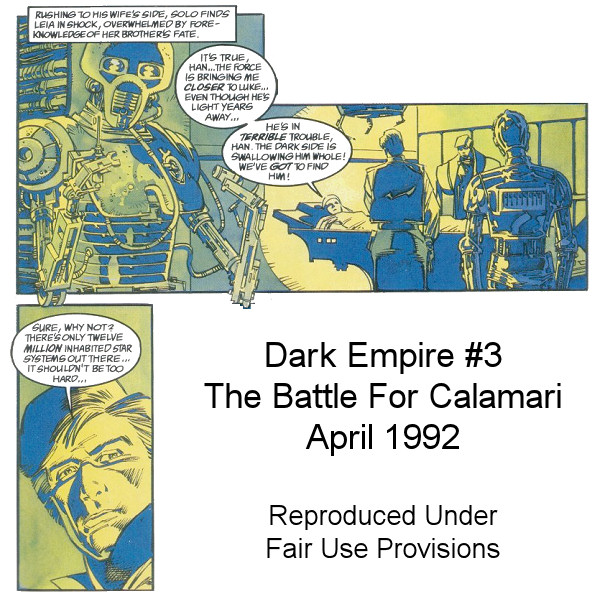
Dark Empire Trade Paperback, 1993
|
The very first WEG Sourcebook, printed in 1987 finally provided detailed knowledge on the Star Wars universe (for example, the species names Twi'lek, Rodian, and Quarren originated in the first WEG sourcebook.)
A year later in 1988, the Imperial Sourcebook was printed, followed by the Rebel Alliance Sourcebook in 1990 (Both were revised and reprinted for the 2nd Edition later on).
Those two "core" books went into a level of autistic detail never quite seen before or since in licensed Star Wars material (especially for Imperial Military TO&Es) and have been continually recycled by almost every later Star Wars RPG system after WEG's bankruptcy caused them to lose the Star Wars license.
If you're interested in Bounty Hunters / Role Playing one, there are three extra WEG sourcebooks which are quite useful:
There's Bounty Hunting material in GG9 that isn't in GG10; hence my recommendation for the trilogy.
Another really good set of "must have" books for those role playing those on the wrong side of the law are:
WEG Star Wars Style Guide, Version 2.0 (August 1994)NOTE: I've chosen to reproduce certain chapters from their Style Guide completely; as this was a product that was never distributed commercially, and it provides some really great information on how to "get" the "feel" for Star Wars. It's rather sad that so many later authors who played in the Star Wars universe (Kevin J Anderson and his Sun Crusher) didn't read the WEG Style Guide, which explictly called out such "power scaling" attempts in "No Superlatives or Absolutes". |
Snippets
|
|
Chapter
Three Writing in the Star Wars Universe Star Wars writers must write with the same tone, spirit and atmosphere as the Star Wars movies. They must be consistent with what has been done in the universe in the past, including game products, novels and comics. Here are some hints and rules to make sure you’re writing best fits the Star Wars feel. All these areas are general guidelines. Talk to us. We do offer some flexibility for exceptional ideas. But these are cliches and poorly executed concepts we see repeatedly. No Juvenile WritingA lot of authors write for an audience composed exclusively of 12-year-olds. We expect writing that is serious, exciting, original, and interesting. Don't be redundant, condescending or simplistic. Your audience is a group of highly intelligent high school, college and older age individuals. If you’re looking for suggestions on appropriate tone and style, look at the writing styles used in Star Wars: The Roleplaying Game, Second Edition and The Star Wars Sourcebook. PG & PG-13The Star Wars universe is a PG and PG-13 universe. Profanity should be limited to hell and damn (or Star Wars slang equivalents such as Stang). And we should see very little blood (and only in very dramatic situations) and no extreme violence. We should see no nudity. Sexuality is a topic best left undiscussed — romance in a traditional, non-graphic nature is acceptable. Potentially disturbing situations, such as torture, should be “faded out"—just as when Darth Vader interrogates Princess Leia in Star Wars. We know what’s going to happen and the camera doesn’t have to show us to get across the dramatic impact. Like the movies, do not glamorize negative traits, such as people who look down on aliens or members of the opposite sex: these characters can have these traits, but they should be presented as negative traits. These traits should also be limited exclusively to the characters — these traits shouldn’t be part of the narrator’s point of view. Likewise, players and their characters shouldn’t be encouraged to use abusive slang or dehumanize characters. Remember, what comes around goes around. Likewise, do not glamorize the abuse of alcohol. Drugs are off limits —we often use the term “spice” as a substitute. You may also name something, “ryll” for example, but don’t describe its drug-like qualities. If you have any questions, ask yourself, “Does this fit in the Star Wars movies?” If you even hesitate to say yes, then your material is questionable and you should send this material in advance to West End for commentary. Don't Be RedundantToo many authors pad-out their word counts by saying the same thing three times, or using “As we said before ..." We trim mercilessly, and more importantly, this means that you’ll have to come up with completely new sections to fulfill your word count obligations outlined in your contracts. Don't Make Fun of Star WarsMaterial may not make fun of the Star Wars universe. You may certainly present humor from the point of view of a character, or humor inherent in a certain situation, but you may not make fun of or be degrading to the Star Wars universe. Have fun with Star Wars instead. Use the Star Wars SettingThe Star Wars universe is a lot more than the Rebels versus the Empire. There are independent companies, hostile bounty hunters, intelligent aliens, and so forth. When creating plots, villains and settings, use this setting to the utmost. Remember, it’s a big galaxy out there, and you can help fill it — if what you create fits existing material and has that Star Wars feel to it. Be exciting! Star Wars should be chaotic, fast-moving action adventure. The worlds and characters should be interesting.. If you want guidelines on pacing for adventures and how to make believable worlds, see the adventure The Abduction of Crying Dawn Singer. However, the largeness of scale must have context. You may not create something that’s too big, powerful, destructive, or valuable, or else the Empire would have taken control of it. Before the death of the Emperor, if it was really important to the Empire, it would crack down and assert control. On the other hand, if it would be cheaper and easier to intimidate others into doing their bidding, the Empire would use that tactic. For example, most large businesses stayed Independent by swearing allegiance to the Empire and keeping any illegal activities very quiet. Writing in the New RepublicThe era of the New Republic is an era of decay. The Empire has steadily lost ground and it has fragmented into many, many factions. However, the Republic isn’t all that much better off. Constant infighting prevents the Republic from making any real gains, and the economy has stagnated. Credits, weapons and ships are scarce. By the events of Heir to the Empire, the New Republic is barely maintaining power. A year later, in Dark Empire, the Empire has reunified just long enough to take power again, but after the Alliance was defeated and forced to flee Coruscant, the Empire factionalized again, triggering a major civil war. Lots of new, experimental weapons are being developed, but beyond that, the economy is still in a shambles. Minimize Real World ReferencesSince we are trying to maintain the Star Wars universe as an independent fictional universe, don’t use real world references unless absolutely necessary. Limit references to objects that could conceivably exist in the universe — as in the Tim Zahn novels: cigarra, hot chocolate and tea. When you want to refer to a specific type of technology, you can refer to it with a synonym — for instance, walkie talkies are comlinks, video phones are vidcomms, cars are ground transports. Never use references to real world locations, events, or people — don’t draw comparisons to fictional characters, celebrities and so forth. Never use the names of other people’s trademarks —for example, no characters named Bilbo or Gandalf or Judge Dredd. Create Real and Logical CharactersStar Wars is a real universe. Star Wars is more than good guys versus bad guys. People in the Star Wars universe are real people, with real motivations, goals, faults and weaknesses. Create three dimensional, interesting, complex characters with depth. People have real motivations, just like people in our world: to get a good job, to get rich, to find a date. They don’t do things without reason. People are good and evil, and many have high and lofty ideals, but many also have realistic motives. Granted the Empire is evil, but let’s see some realistic evil: the Empire is trying to control people and maintain power. They’re not going to execute people unless they think it will get them something — obedience from those who are around, for instance. The citizens of the Empire are, more often than not, Just folks who don’t realize how evil the Empire can be because it never affects them personally. The Empire has a great deal of control of information, so most of the time people don’t hear about atrocities on backwater worlds. In the Empire proper no one is going to think about revolting against what they perceive as a “not perfect but could be worse” government. Besides, if someone does hear about an atrocity, they figure the victims were criminals and rabble-rousers who deserved what they got. It’s not that people don’t care, but they, like lots of Americans, choose not to get involved. Be Logical, Be Consistent, and Do Your ResearchBe internally consistent. Authors often contradict themselves in their own writing. If a character is a “really good bounty hunter,” then he should act like one, and not make juvenile mistakes (this comes back to researching your subject). Think the universe through: if you are putting a military base on a world, ask yourself, why was it put here in the first place? What was the objective? Likewise, it’s not very believable to have a “hidden” pirate base in the heart of a highly populated system. Now, on the other hand, you could have a crime lord’s enclave in the depths of Nar Shaddaa, but that’s because it is a lawless world where the police don’t really care. Think things through logically! Do your homework! If you are inventing a new world that's really unusual, call up an astrophysics professor at a local university to see if it’s plausible. If you’re inventing a gang, do research on Earth gangs to see how they operate, and then modify that information to fit the Star Wars universe. Remember, any costs incurred while doing research are tax deductible if you keep your receipts. People make the most mistakes when covering military tactics and procedures. Research the deployment of warships, or troop movement, or army organization, or whatever else is relevant. The bottom line is people who really know how these things are done in the real world will be reading your material, so make sure you know what you're talking about. Think new planets through: we’ve had too many worlds that are too much like Earth or “there is one settlement and the rest is wilderness.” This is fine once in a while, but it seems that every planet in the galaxy is like that. Develop worlds with unique cultures, industries, attitudes, and so forth. If a planet has been settled for thousands of years, it could have some amazing architecture, huge monuments and other things that make anything on Earth look downright piddly. When building a planet, figure out its economy. What do residents do for a living? What is the economy based on — manufacturing goods or exporting natural resources? Is it just getting by? What are the various climates like? Don’t do one planet/one climate worlds — Tatooine and Hoth were extreme examples. Make this a believable universe. Why do people come here? Why do they leave? What happens here? Think BigDon’t underestimate the size and scope of the galaxy. There’s a galaxy of billions of stars, with a hyperspace-linked culture that has been around for over 20,000 years. There is room for an astounding amount of diversity. Likewise, not everything or everyone should be from Tatooine or Bespin (just like not everything interesting happens in Boise, Idaho). It is a universe of neat gadgets, cool aliens, mystery and a hint of magic. Espionage, military scenarios, Indiana Jones in space, westerns, old Star Trek, simple combat, lost cultures, lightweight cyberpunk, smuggling, “pirates in the Caribbean” and even horror themes all fit into the Star Wars universe if done properly. Trouble SpotsFeel free to introduce new elements to the universe, like aliens, ships and planets, but be careful to maintain the balance of the universe. Don’t advance the technology, change the power structure of the galaxy, or anything like that. We aren’t interested in teleportation gadgets, super-duper hyperdrives, or “aliens invade the galaxy’ plots. Likewise, we are not Interested in time travel, alternate dimension or alternate universe stories. We are not interested in tired cliches ... no planets obviously stolen from other science fiction stories, no cat, lizard or bug aliens. When creating something new, make it original. For example, Wookiees have canine and simian aspects, but are a wholly unique invention. Do Not Talk About the PastYou may not discuss anything of galactic significance which occurs prior to Star Wars: A New Hope. This includes subjects such as the Clone Wars, specifics about the Old Republic, how the Emperor rose to power, how the Rebellion stole the X-wing prototype, the fall of the Republic, the extermination of the Jedi Knights, the history of Emperor Palpatine or Darth Vader, the Mandalorians or anything about the history of the Jedi Knights. No Superlatives or AbsolutesDon’t make stuff the “biggest” or “best” or “worst" or “most" anything. You can make something big and impressive and nasty by sheer description. You may not use these absolute descriptives because somehow, somewhere, somebody will come up with something bigger and badder (and they probably were inspired by your idea in the first place). Similarly, don't make sweeping statements about the nature of the Star Wars galaxy. Instead of saying, “All customs inspectors in the galaxy will do this," limit your perspective to something more local—“Customs inspectors on this planet ..." People will do things differently in different parts of the galaxy, so you will have worlds that are wildly different. Stormtroopers Are Loyal!Real stormtroopers are fanatically loyal to the Emperor. After the death of the Emperor, some Imperials might dress up normal soldiers in stormtrooper uniforms, but “real” stormtroopers still loyal to the remnants of the Empire are unswayable. Use the Major Players SparinglyDon’t submit plots in which the major movie characters
play a significant part. Maybe they guest star or have a short
cameo for a scene or two. Think of Sean Connery’s role in
Robin Hood: Prince of Thieves. Don’t use Darth
Vader, the Emperor, or other heavy adversaries.
Be Fluent in Star WarsKnow your Star Wars history and the universe. You are expected to know the history in the Star Wars universe chapter in Star Wars: The Roleplaying Game, Second Edition. There is also a lot of information out there in our various products that you probably don’t know, as well as Information from the novels and comics you should be familiar with. As a bare minimum, you are expected to have and be familiar with Star Wars: The Roleplaying Game, Second Edition, The Star Wars Sourcebook, The Imperial Sourcebook, and The Rebel Alliance Sourcebook. A handy reference for anyone writing Star Wars is Bill Slavicsek’s A Guide to the Star Wars Universe published by Del Rey. It’s a fairly comprehensive encyclopedia of much of the material which has appeared in the films, the radio plays, the comics, the novels, and even the roleplaying game. If your product is set after the Battle of Endor, you must also be familiar with the sourcebooks for Timothy Zahn’s trilogy of novels. If you are using locations or places from the movies, you must have The Star Wars Movie Trilogy Sourcebook. You are likely to find other supplements, like The Death Star Technical Companion, Galaxy Guide 6: Tramp Freighters, and Galaxy Guide 7: Mos Eisley handy as well. Do not hesitate to call the Star Wars editors at West End Games with history or continuity questions. Other points about the Star Wars galaxy you might find useful include: • Hyperspace has been around for thousands of years. • The Republic lasted for 1,000 generations, or 25,000 years. It is so old that a lot of the past isn’t too well known. • There are millions of worlds in the Known Galaxy (the Empire, New Republic, settled space); there are lots of worlds beyond the Known Galaxy that are unexplored or rumored to exist. These outer worlds may have ancient technology, such as really old hyperdrives. • There are billions of suns in a galaxy. • The Empire had at least 25,000 Star Destroyers.
Star Wars Timeline
|
|
Chapter
Five Writing Source Material The trend these days among gamers is they want source material. Adventures are good for one run, but good source material can be the foundation of an excellent and rich campaign, and it can help spice up an existing campaign. What Is Source Material?Many of our sourcebooks and supplements fit the description of source material — anything that helps fill in the gaps and details the Star Wars galaxy. Unlike adventures, source material doesn’t require a plot, although exciting characters and settings are much more important. Source material can be picked up by gamemasters and players and used in their own campaigns. Some examples of Star Wars sourcebooks Include The Heir to the Empire Sourcebook, Rebel Alliance Sourcebook, the numerous Galaxy Guides, and the General Cracken books. Articles featuring source material on new planets, ships, or campaign ideas can also be used in the Star Wars Adventure Journal. Be OrganizedSince source material isn’t usually held together with a plot like a story or adventure, organization is very important. Begin with a brief overview of what you’re writing about — avoid phrases that state “this supplement/article will talk about the Ison Corridor and the many interesting worlds found there.” Be direct. Tell readers something useful right away — “The Ison Corridor is a little-known trading route in the Outer Rim Territories, home to numerous smugglers and the infamous gangster Greasy Boab." Be LogicalSource material must all fit together in a logical way. Remember, although the Star Wars universe is a fictional universe, it does operate along many laws of reality. Characters must have reasonable motivations, planets must have believable climates and terrain, governments, cities and starports must all fit together logically. And in many cases when writers are describing new systems or characters, everything is inter-related. Be OriginalOriginal themes are cool. Stay away from Star Wars cliches (ice and desert planets, Hutt crimelords, smugglers with Wookiee copilots...), and don’t do something that's an obvious swipe from someone else’s stories (ringworlds, federations, space stations near wormholes ...). Your readers want new, exciting and original source material to work into their games. Give them plenty of ways to use your source material — adventure ideas, new gamemaster characters with stats, new planets to explore, new ships to play with, small sidebars detailing other aspects of your subject. Look at what's been done in West End’s Star Wars products and you’ll see the wide range of subjects and presentations that source material covers. |
|
Chapter
Six Writing Game-Related Fiction The Star Wars Adventure Journal accepts game-related fiction — short stories about people in the Star Wars universe (no main characters from the movies!) with adventure ideas, informational sidebars, and character, alien, ship, and planet stats for those that appears in the story. Although this game-related fiction is similar to other fictional sidebars and introductions in both source material and adventures, it is much more difficult to write. Short game-related fiction for the Journal must be excellent. Not okay, not passable, not mediocre. The Journal only accepts the best of the fiction available. It is a privilege for the Journal to publish game-related fiction, so writing game-related fiction for Star Wars is a privilege. Warning!Short story writing is not like writing source material or adventures. There is much more emphasis on a tight and logical plot, deep and developing characters, and a strong sense of setting, tone, and atmosphere. In adventures and source material, the actual ideas are most important, and the writing is secondary. They can usually be fixed by an editor. But a short story is carried by the ideas, the writing and the style. If you have never written fiction or short stories before, do not attempt to write game-related fiction for Star Wars. If you wish to pursue writing fiction, go to your local bookstore and pick up a book on writing. We recommend a book by science fiction author Damon Knight called Creating Short Fiction (published by Writer’s Digest Books). It has some good tips on writing and developing your writing style, and contains some fun exercises on creating setting, tone and characters. Some people get degrees in creative writing. Others learn to write creatively on their own. The key is to always keep writing and to be willing to use your mistakes and other people’s criticisms to improve your work. Relating Stories to the GameAll fiction in the Star Wars Adventure Journal must be “game-related.” This means you must provide complete game stats for all characters, ships, creatures, planets, aliens, new equipment, or anything else included in your story. You must also provide adventure ideas so gamemasters can try to integrate the action, characters, settings and situations in the story into their own game campaigns. The same rules that apply to writing adventures and source material also apply to stories. Be logical and original. If your story doesn’t make us sit back and say “Wow!” when we finish reading it, we probably won’t buy it. Look at some of the work that appears in the Star Wars Adventure Journal to get a better sense of what we expect and what’s been done. |
Star Wars: The Roleplaying Game, 2nd Edition
|
Star Wars: The Roleplaying Game, 2nd Edition; Revised & Expanded[Page 116] Sublight Benchmarks. While starships move at relatively slow speeds in orbit, they can achieve incredible velocities in open space. Here are some very rough guidelines for sublight travel times. • Five minutes to fly from orbit to a safe hyperspace jump point. COMMENTARY: [This puts the emergency jump from Jedha in ROGUE ONE into context -- it was incredibly dangerous, but it offered a 1% chance of survival; versus 99% death if they continued to fly in sublight below the ejecta from the Death Star's superlaser impact point.] • Half an hour to fly from a planet to one of its moons. • Two to six hours to fly from one planet to the nearest planet in the system. (Two hours for relatively close terrestrial worlds; the upper limit is for flying between distant gas giants.) • Anywhere from 10 to 48 hours to fly from a star to the outer limits of the system, depending upon distance and the presence of any hazards such as asteroid belts or gas clouds. (It takes about 15 hours to reach the outer limits of a "representative" system composed of a single yellow star and less than a dozen significant planetary bodies.) |
Star Wars Sourcebook, 2nd Edition, Revised & Expanded
A rather short bibliography is given at the end of the sourcebook:
|
Imperial Sourcebook, 2nd Edition
IMPERIAL ARMY INFORMATION
IMPERIAL NAVY INFORMATION
|
Rebel Alliance Sourcebook, 2nd Edition
|
Death Star Technical Companion (1991)
|
Han Solo and the Corporate Sector Sourcebook
|
Galaxy Guide 1: A New Hope
|
Galaxy Guide 2: Yavin and Bespin
|
Galaxy Guide 3: The Empire Strikes Back (page 48)“The Imperial Star Destroyer squadron assigned to Darth Vader after the Battle of Yavin was code-named the Imperial Death Squadron. First under the command of Admiral Griff, and later Admiral Ozzel, and later still Admiral Piett, the Squadron consists of Vader’s Super-class Star Destroyer and a mix of five Imperial I and II Star Destroyers. The Executor is the first of four Super-class Star Destroyers. At over eight kilometers in length, the Executor is capable of winning engagements without firing a single shot. Not that it doesn't have adequate firepower to back up its impressive size. Over 1,000 weapons batteries are capable of reducing any planetary surface to slag. The only other remaining Star Destroyers whose provenance is unclassified are the Avenger and the Devastator. The first, Captain Needa’s vessel, has a proud history of over 436 planetary suppressions since commissioned, its last being Dankayo. Strangely, it has served under eight different captains in the last few years. COMMENTARY: [“Reducing any planetary surface to slag”, and “proud history of over 436 planetary suppressions” are interesting datapoints to file away.] |
Galaxy Guide 6: Tramp Freighters, 2E
|
|
Chapter 6: Tramp Freighters and the Rebellion (page 24~ ish) – Complete due to importance. The Rebel Alliance has, for many years, used tramp freighters for much of their cargo transportation (often to the shock and dismay of unwary freighter captains). The Empire: Unlimited Cargo Capacity; Control of Bulk Transport Either directly through Imperial ownership, or indirectly through intimidation of large shipping corporations, the Empire controls virtually all of the bulk cargo vessels plying the spaceways. Roughly one-third of the large ship cargo carried in the galaxy is war materiel for the Empire’s forces: weaponry, equipment, supplies, fuel, and whatever else needs transporting. The remaining space is taken up by private goods, and these are so heavily scrutinized that it is nearly impossible for the Alliance to transport anything that way. The major transport system of the galaxy supports the Empire. The Alliance: Too Few Ships; Too Many Purposes This places a crushing burden on the Rebel Alliance. The Empire has an almost limitless cargo carrying capacity with which to supply its bases and fleets: the Rebellion would be pleased to have the Alliance’s yearly cargo capacity equal the Empire’s monthly capacity, but they are not yet even close. Part of the problem is, of course, that the Alliance simply does not possess enough manufacturing capacity for all of its pressing needs. Its few heavy factories are stretched to the breaking point trying to produce enough warships and repulsorcraft to keep the battle going; cargo transports are of secondary importance. An additional problem is that, even given their lack of cargo ships, the Alliance must use the ships they have for purposes other than simple transport of goods. Rebel transports shuttle cargo from one point to another; they also carry troops into battle or evacuate personnel from discovered bases, serve as hospital vessels, and, in desperate circumstances, may be converted into warships. One Further Complication: Imperial Interdiction Finally, the Alliance suffers because its transport ships can rarely take the most economical, direct route available. There are usually several different hyperspace routes available between planets, one of which is the fastest and thus the most fuel-and time-efficient. Naturally, this means that everyone will want to take that route — transports, bulk freighters, and Imperial warships. Also, such routes are often frequented by Imperial Customs agents. A freighter captain who encounters one of the enemy customs vessels is subject to search at any time — and while it is difficult enough to explain away replacement starfighter parts — “er, you see, I was selling them for scrap on Ord Mantel!" — it’s nearly impossible to explain away a load of injured Rebel troopers. On popular routes, the risk of meeting an Imperial Customs ship is about one in 20; rather than risk it. Rebel ships commonly take longer but less-traveled routes. One Solution: Grand Theft, Imperial Spacecraft The Alliance supplements its meager construction capacity through the simple expedient of stealing the Empire’s ships. In the early days, Alliance craft had good success in luring Imperial combat vessels away from the transports they were escorting and then closing in and capturing the defenseless cargo ships, thus winning both the ships and their cargo. This practice, however, is quickly becoming more dangerous than it is worth. Though it is often unable to anticipate new Alliance tactics, the Imperial Navy has shown itself adept at restructuring its operations to counter Alliance tactics it is familiar with. These days, most Imperial sentry ships refuse to take the bait and leave their charges when attacked; if they do so, it is quite likely that it is as part of a trap, designed to sucker in the Rebel forces for destruction. Pretending to be lured off, the Imperial warships obligingly race off into space after the decoy Rebel force. Once they are gone, the second Rebel force appears and confidently close in on the “helpless" transports — only to discover, sometimes too late, that the transports are bristling with camouflaged weapons and tractor beams to hold the attackers until the warships return. Ever innovative, the Rebel Alliance has recently discovered another source of transports. The Rebellion now seeks to capture large passenger vessels and convert them into cargo ships. Non-essential areas (everything except the engines, navigation equipment, etc.), are stripped from the vessel to make room for cargo holds and loading gear. However, these are relatively uneconomical craft, unable to carry very much weight compared to the amount of fuel they consume. They are also rather fragile, and easily disabled by enemy fire. Though still quite useful behind the lines, a converted passenger liner is dead meat in battle — they explode so easily and so spectacularly that enemy forces take them out in the early seconds of conflict. The Alliance has found that it can supplement its meager supply capacity through the use of tramp freighters. In many cases, the captains of the tramps are not even aware that they are carrying Alliance goods (though some certainly suspect, but, being desperate for the work or in general sympathetic to the Alliance’s cause, turn a blind eye). Unfortunately, these captains are often incarcerated (or executed) for being Rebel sympathizers, even when they are unaware of the true nature of their cargo. A large portion of the Alliance’s material is produced in small factories hidden on thousands of worlds scattered across the galaxy, far from where the fighting is and far from where it is needed. In many cases, it is impractical for the Alliance’s ships to collect this material themselves, being preoccupied with maintaining the Alliance’s Fleet or other, more important, duties. Instead, tramp freighters haul the cargo. A freighter may get a job carrying, for instance, a load of foodstuffs from a farming world to an industrial world. At the same time, dozens of other freighters have similar jobs, collecting a variety of goods from other planets. Each load is innocent enough — protein, plant fibers, electronic parts, and whatnot, to pass Imperial inspection. What the freighter captains do not know, however, is that the goods come from Alliance-sympathetic farms or hidden factories, and they are being shipped to Alliance-owned warehouses on the industrial world. When enough cargo has collected at the warehouses, a large Alliance ship stops at the world and collects the cargo in bulk. This method of transport is expensive, but it serves to stretch the Alliance’s transport capacities as far as is possible. It is rather hard on the tramp freighter captain who discovers the hard way (say, through being arrested and having his ship confiscated) that he is carrying goods for the Alliance. The ethics of this system bothers Alliance High Command, though they have few options at this point. However, to the best of their abilities, they are recruiting freighter captains to take over these runs and thus ensure that the carrier has some idea of what he is risking. BULK FREIGHTERS After many years of association, the planets of the galaxy have become interdependent. A galaxy-wide economy based on the import and export of goods has allowed some worlds to specialize in areas of production, knowing that their other needs would be taken care of by other worlds. A complex system such as this is impossible to maintain without a huge fleet of freighters able to transport goods from one world to another. In years past, the transport was primarily carried out by small, independently-owned stock light freighters. However, this old method of trade is slowly disappearing and being replaced by the more economical bulk freighters. The container ships, space barges and other huge ships which now ply the spaceways are largely corporate-owned, but the Empire maintains its own fleets of such vessels, and some wealthy individuals have purchased one or more of the craft to get in on the money. The Alliance has very few of these ships at its disposal, as they are expensive to maintain, hard to come by through “unofficial” channels, and are fairly impossible to hide. It is interesting to note that the advent of the bulk freighter did not mean the demise of t he light-freighter industry; on the contrary, it has thrived. This may appear illogical on the surface, though the reasons for the continued success of the tramp freighter lies in their ability to go anywhere, fast. Captains of bulk freighters are often ordered to bypass planets, systems — even sectors — that are deemed unprofitable; smaller worlds that do not command enough resources to attract the services of bulk ships become hungry markets for the smaller transport ships. Simply by overlooking a system, the bulk freighters are creating a huge market for the smaller, independent freighter captain; while the tramp freighters do not often see the level of profit a bulk freighter routinely earns, it is possible to make a comfortable living. |
Galaxy Guide 7: Mos Eisley
|
Galaxy Guide 8: Scouts
|
Galaxy Guide 9: Fragments from the Rim (1993)
|
Galaxy Guide 10: Bounty Hunters
|
Galaxy Guide 12: Aliens - Enemies and Allies
|
Pirates and Privateers Sourcebook
|
The Far Orbit Project
|
A WORLD TO CONQUER by Dustin Browder (Star Wars Adventure Journal)
|
Planets of the Galaxy Volume 3, West End Games, 1993COMMENTATOR'S NOTE: The book is summarized due to sparsity of information: Elrood Sector (Outer Rim), has just five major worlds of note (including the Sector Capital); they are: Elrood (Capital): 6 billion To patrol Elrood Sector, the Empire maintains a force of two ISDs: Thunderflare and Stalker, one Bayonet-class Light Cruiser Rintonne’s Flame, several Skipray Blastboats, and twelve minor hyperdrive equipped patrol craft which can carry a pair of TIE Fighters. |
Flashpoint! Brak Sector, West End Games, 1995
|
Lords of the Expanse: Sector Guide, West End Games, 1997
|
Rules of Engagement: Rebel SpecForces Sourcebook (p.6)Historical Special Forces There have been a number of special forces units throughout history—most notably, the Old Republic Rocket Jumpers, Freedom Warriors and Atrisian Assault Corps. The Rocket Jumpers—officially designated "the Rocket-jumper Elite Advance Unit"—were short-range assault troops propelled by primitive rocket packs. They jumped into heavy fighting to break stalemates and sieges, seized and held ground until regular units could reinforce the area, and rapidly reinforced threatened positions. Only the most highly qualified and dedicated troopers were allowed to serve the Republic in this way. The Freedom Warriors were highly trained troops supporting the Jedi Order in resource-heavy operations. Although the unit's ranks were only open to those who could not feel the Force as Jedi do, the Freedom Warriors were able to effectively battle Sith-tainted soldiers and Sith-spawned monstrosities. The Atrisian Assault Corps was the hammer of the Emperors of the Kitel Phard dynasty—fast, hard-hitting. and able to roll over every enemy it encountered. The Corps included His Majesty’s Roto-gunners, the Imperial Atrisian Grenadiers, and the Queen’s Own Armored Cavalry Troop. COMMENTARY: [That last bit about the "Atrisian Assault Corps" explains why some units in the Imperial OOB are designated as "Atrisian" -- they've become in-universe synonymous with heavy assault mechanized units; similar to how "Panzer" is known by the average normie on Earth post-WW2.] |
Tales of the Bounty Hunters, Edited by Kevin J. Anderson, December 1996
|
Heir to the Empire by Tim Zahn
|
Shadows of the Empire Sourcebook (p. 26)In the Emperor's Service Moff Jerjerrod knelt before the Emperor in his vast throne room. He bowed his head and hoped he would leave the Imperial Palace alive. “Rise, my friend. I have a special challenge for you,” the Emperor said. “I want you to ease your campaign against the Rebels and leave your work in Logistics and Supply.” Jerjerrod shifted uneasily. He didn’t dare voice his concern that he was needed in that ministry to make sure Imperial resources weren’t overextended. “Do not concern yourself with the logistical status of the Empire,” Palpatine stated, as if he had read the Moff’s mind. “I have a much more important task for you, far better suited to your talents.” The Emperor told Jerjerrod what he was to do. • • • After Jerjerrod had left the Emperor’s throne room, passing through the antechamber with the Royal Guards, he had to get through the Supplicants Waiting Hall. There they were, all lined up — every one of them waiting to see the Emperor. Advisor Golthan stood at the head of the line, with Alec Pradeux and Kren Blista-Vanee behind him. Various Grand Moffs, admirals and other dignitaries waited behind them. “What did the Emperor want with you?” Pradeux asked. “Certainly not much,” Golthan sneered. “You’re just a Moff, Jerjerrod — you couldn’t possibly have been given any duty of significance.” Jerjerrod grimaced. “I’ve been named Director of Imperial Energy Systems, a new subdepartment of the Ministry of Energy. Not terribly exciting, I’ll admit, but I’m still proud to be carrying out the Emperor’s will.” Pradeux looked nonplussed. “Why haven’t I been told of this new subdepartment?” “It looks as if you are about to be briefed,” Blista-Vanee said, nodding toward the Royal Guards who were summoning Pradeux into the antechamber. “I’m sure there is a reasonable explanation for this appointment.” He looked down on Moff Jerjerrod. “You are a competent overseer, but certainly not the sort to whom the Emperor entrusts vital tasks.” The Moff nodded humbly. “The Emperor has entrusted me with developing a line of large-scale portable power plants for use in disaster relief efforts.” “How quaint,” Golthan sneered again. “It almost seems like a demotion for you, Jerjerrod. Were you not formerly an administrator in charge of Logistics and Supply?” Yes, Jerjerrod thought. And now I'm in charge of the project which will finally bring about the destruction of the Rebel Alliance. COMMENTARY: [Could this be where the “Death Star disguised as Imperial Energy Project” meme that was used in ANDOR came from originally?] |
Truce at Bakura NovelNOTE + COMMENTARY: In the Truce at Bakura novel, Mon Mothma herself has to specifically ask a droid where Bakura is; which is a nice inversion of the “leader knows everything” trope; and a precursor of the “Who?” meme from the first Guardians of the Galaxy movie. The droid's reply after bringing up the galaxy map is: “According to this file, its economy is based on the export of repulsorlift components and an exotic fruit candy and liqueur. Settled by a speculative mining corporation during the final years of the Clone Wars, and taken over by the Empire approximately three years ago, to absorb and control its repulsorlift production capacity.” Truce at Bakura SourcebookNOTE: The author of the novel also helped co-author the sourcebook, so the information here is very high reliability.
|
Vision of the Future by Timothy ZahnChapter 1:“It most certainly is not, sir,” Ardiff said stiffly. “We still hold eight sectors—over a thousand inhabited systems. We have the Fleet, nearly two hundred Star Destroyers strong. We’re still very much a force to be reckoned with. … Pellaeon was sure Ardiff knew it as well as he did. A thousand systems left, out of an Empire that had once spanned a million. Two hundred Star Destroyers remaining from a Fleet that had once included over twenty-five thousand of them. COMMENTARY: [This gives us a rough count of 100-150~ inhabited systems of note per sector at this stage in the development of the Star Wars Galaxy.] Chapter 5“Sending away four of the [Braxtant] sector fleet’s thirteen Star Destroyers is not something to be done lightly.” COMMENTARY: [At this point, some Imperial Sector Fleets are about 50% under-strength regarding heavy capital units, despite on paper, there being enough ISD's (200~) to outfit every Sector with a near full complement of ISDs] Chapter 26:CONTEXT FOR FOLLOWING EXCERPT: [Luke and Mara have found a holographic map showing the Unknown Regions with an enormous amount of detail filled in. Previously, they found a similar holographic map in the Emperor's old quarters, but that holomap didn't show any detail for the Unknown Regions:] Luke’s mouth felt dry. “Are you saying that Thrawn and Palpatine had the whole thing planned out from the beginning?” “Of course they did.” Mara gestured at the holo. “Just look at all the territory he opened up. He couldn’t possibly have done that by himself, with just a single Star Destroyer. Palpatine must have been feeding him men and ships all along the way.” “But that can’t all be Imperial territory,” Luke said. “I mean … it can’t.” “Why not?” Mara countered. “Oh, I agree there probably aren’t more than a few actual colonies out there. But you can bet there are Imperial garrisons scattered all over the place, plus intel centers and listening posts and probably a few full-blown shipyards. And if I know Thrawn, probably a whole network of alliances with the natives, too.” “But if that’s Imperial territory, why hasn’t the Empire made any use of it?” Luke argued. “I’ve seen the data, Mara—they’re down to practically nothing over there.” “It’s obvious, isn’t it?” she said quietly. “They’re not using it because they don’t know it’s there.” For a long minute neither of them spoke. Luke gazed at the holo, listening to the distant hum of the spiral slideway, the terrible implications of those gently glowing lights tumbling over each other in his mind. There had to be the equivalent of two hundred fifty sectors there—nearly thirty times the Empire’s current size. With thirty times the Empire’s number of warships, garrisons, and shipyards? Very possibly. |
Attack of the Clones: Incredible Cross Sections, Curtis Saxton, 2002
|
Star Wars: The Essential Atlas, Daniel Wallace & Jason Fry, 2009
|