|
|
Galactic Empire
Sourcebook
|
|
|
Galactic Empire
Sourcebook
|
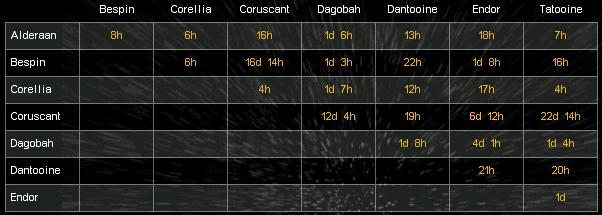
To estimate rough travel times in your games, you can use the following tables. It's important to note that these travel times are for the “average” person – if you are well connected, you can move at the speed of plot via knowing secret or lesser known hyperspace routes.
WEG Generalized Hyperspace Travel
Times
|
Behind the Magic CD-ROM
Presentation c. 1990s
|
|||||||
|
|
Bespin |
Corellia |
Coruscant |
Dagobah |
Dantooine |
Endor |
Tatooine |
|
Alderaan |
8 hrs |
6 hrs |
16 hrs |
1 day, 6 hrs |
13 hrs |
18 hrs |
7 hrs |
|
Bespin |
|
6 hrs |
16 days, 14 hrs |
1 day, 3 hrs |
22 hrs |
1 day, 8 hrs |
16 hrs |
|
Corellia |
|
|
4 hrs |
1 day, 7 hrs |
12 hrs |
17 hrs |
4 hrs |
|
Coruscant |
|
|
|
12 days, 4 hrs |
19 hrs |
6 days, 12 hrs |
22 days, 14 hrs |
|
Dagobah |
|
|
|
|
1 day, 8 hrs |
4 days, 1 hr |
1 day, 4 hrs |
|
Dantooine |
|
|
|
|
|
21 hrs |
20 hrs |
|
Endor |
|
|
|
|
|
|
1 day |
Wizards of the Coast D20 Regional Travel Times (x1 Hyperdrive) in HoursDeep Core: Byss NOTE: The travel times below take into account travel time within the region – i.e. the Outer Rim requires 48 hours to travel from end to end, because it's on the outside of the Galaxy, while the core worlds only have a 6 hour travel time as they are all very compact and close to each other. NOTE II: Adjust by multiplying by the speed of your hyperdrive; x2, multiply by 2, etc. |
||||||||
|
Travelling from |
Deep Core |
Core Worlds |
Colonies |
Inner Rim |
Expansion |
Mid Rim |
Outer Rim |
Wild Space |
|
Deep Core |
12 |
18 |
24 |
48 |
72 |
96 |
120 |
144 |
|
Core Worlds |
24 |
6 |
24 |
36 |
60 |
84 |
96 |
120 |
|
Colonies |
48 |
24 |
12 |
24 |
48 |
72 |
96 |
120 |
|
Inner Rim |
72 |
36 |
24 |
18 |
24 |
48 |
72 |
96 |
|
Expansion Region |
96 |
60 |
48 |
24 |
24 |
24 |
48 |
72 |
|
Mid Rim |
120 |
84 |
72 |
48 |
24 |
36 |
24 |
48 |
|
Outer Rim |
144 |
96 |
96 |
72 |
48 |
24 |
48 |
24 |
|
Wild Space |
168 |
120 |
120 |
96 |
72 |
48 |
24 |
12 |
If these estimates aren't good enough, you can analyze what we see in the movies to try and estimate “straight line” speeds:
The distance from Sullust to Endor is about 30,000~ LY based off scaling from the official Star Wars map (HERE); using a map scaler (LINK).
We know that all the Rebel Starfighters made the jump themselves; which gives us a possible mission profile based off US P-51 pilots flying seven hour missions from Iwo Jima to Japan in 1945; adjusted for the fact that Star Wars pilots can let the astromechs fly the craft during FTL and relax:
4.5 Hours flight to Endor; 30 minutes combat; 4.5 hours back to Sullust; 9.5 hours total mission time.
The requirement for a "fly back" portion is due to the fact that during planning the attack on the second Death Star, the Rebels have to operate under the assumption that the attack may fail or be called off shortly after arrival at Endor. Since it would take too long to land the starfighters onto the Rebel Capital Ships; the fighters need to have sufficient return endurance to fly home or to a pre-arranged rendezvous.
The next constraint is the fact that the Rebel fleet jumped together and arrived at Endor together – all units had to move at the speed of the slowest unit. According to WEG stats, GR-75 Medium Transports only have x4 hyperdrives; but they were keeping up with the rest of the fleet (Nebulon Bs and Corvettes have x2 drives). Therefore, I have to conclude that the Rebellion refitted its GR-75s with x2 hyperdrives in order for them to act as Fleet Auxiliaries.
Calculations using those constants result in the following table of hyperdrive “ratings”:
|
Hyperdrive Rating |
Speed (LY/hr) |
Hyperdrive Rating |
Speed (LY/hr) |
|
0.125x |
104,000 |
2048x (150 LY/D) |
6.25 |
|
0.25x |
52,000 |
4096x (75 LY/D) |
3.125 |
|
0.5x |
26,000 |
8192x (37.4 LY/D) |
1.562 |
|
1x |
13,000 |
16384x (18.7 LY/D) |
0.7812 |
|
2x |
6,500 |
32768x (9.3 LY/D) |
0.3906 |
|
4x |
3,250 |
65536x (4.68 LY/D) |
0.1953 |
|
8x |
1,625 |
131072x (2.3 LY/D) |
0.0976 |
|
16x |
800~ |
262144x (1.1 LY/D) |
0.0488 |
|
32x |
400~ |
524288x (0.58 LY/D) |
0.0244 |
|
64x |
200~ |
1048576x (0.29 LY/D) |
0.0122 |
|
128x |
100~ |
2097152x (0.14 LY/D) |
0.0061 |
|
256x |
50~ |
4194304x (2.22 LY/Mo) |
0.00305 |
|
512x |
25~ |
8388608x (1.1 LY/Mo) |
0.001525 |
|
1024x |
12.5~ |
16777216x (0.5 LY/Mo) |
0.0007625 |
What's interesting is that the higher “hypothetical” ratings of x0.125 and x0.25 tend to support Palpatine's Revenge of the Sith journey from Coruscant to Mustafar (some 60,000~ LY) in an hour or less (constrained by the need for Anakin to survive unassisted in Mustafar’s harsh atmosphere).
The other ends of the hypothetical drive ratings let us fix various proto-historical dates in the development of the Galaxy, such as when a true “Galactic Republic” became possible.
In the 1830s, it took about six months (4,380 hours) for a person to travel via sailing ship from London to Calcutta on Earth – the equivalent distance would be from Coruscant to the Outer Rim, some 50 kLY; giving us a travel speed of 11 LY/hr, or the equivalent of a Class x1024.
Further down the scale, a x4096 drive at 3 LY/hr turns the journey from Coruscant to Alderaan (8200 LY) into a 3.5 month voyage, while travelling to the fringes of the Outer Rim becomes a two-year journey comparable to the Magellan Expedition's circumnavigation of Earth from 1519-1522.
At the lowest end of the scale; a x16777216 drive takes about 275~ days to travel 5 LY; which while slow compared to what we see in the movies, is a significant improvement over the 50 years it would take at 7.1% the speed of light to travel that distance via conventional fusion propulsion.
Another thing that leaps out to me is is that presumably the Bureau of Ships and Services (BoSS) redefines hyperdrive speeds every few thousand years; as this is the only way we can explain Class One drives; when presumably in the era of the x1024 drives, they were also known as Class Ones.
My current “feel” for each era of Star Wars regarding hyperdrive speeds is:
|
Era |
Drive Speeds |
Core to Outer Rim (65,000 LY) |
|
Galactic Empire (0 BBY) |
x0.5 to x4 |
20 Hours |
|
High Republic (1000 BBY) |
x8 to x32 |
1.5 to 7 days |
|
Middle Republic (2000 BBY) |
x128 to x256 |
30 to 60 days |
|
Early Republic (3000 BBY) |
x512 to x2048 |
3.5 months to 14 months |
|
Regional Powers (4000 BBY) |
x4096 to x16384 |
2.3 to 9.5 years |
|
Galactic Settlement (5000 BBY) |
x32768 to x131072 |
19 to 75 years |
|
Core Settlement (6000 BBY) |
x262144 to x1048576 |
150 to 600 years |
|
Core Founding (7000 BBY) |
x2097152 to x8388608 |
1200 to 4800 years |
This provides a nice gradient of long periods of technological stability that are vital to preserving the “feel” of Star Wars, while also providing the necessary technological progression required over long time scales.
In A New Hope, the Rebel Starfighters traversed a distance of 400,000 km in less than 5 minutes (300~ seconds) as shown by their performance in A New Hope as they transit from Yavin IV to the Death Star around the Gas Giant Yavin giving them an average cruise velocity of around 1,300 km/sec and acceleration on the order of 1700G per early 2000s analysis by Michael Wong (LINK).
Rebel Starfighter acceleration may have been limited due to the short distance of 400,000 km to the Death Star; but it provides us with a rule of thumb to estimate sublight transit times based off our own solar system: From Earth to Mars would take 16.5 hours. Past that, the Asteroid Belt would take 2.3 days, Jupiter 5.6 days and Neptune 38.6 days.
What's interesting is if you “sanity check” things with the Delta-V equation, using same weight ratio as a F-15 (13,154 kg empty, 6,103 kg fuel mass), with a restriction of 33% of total Delta-V (reserving a third each for flyout, combat, and flyback); you end up with 1,357 km/sec from a 1.1~ million ISP propulsion system; so there's room for improvement within Star Wars, given that the theoretical limit of deuterium-tritium fusion is about 2.7~ million ISP.
Presumably over 10,000+ years, the races of Star Wars may have shifted from deuterium-tritium fusion reactions to Rhydonium fusion reactions for “mobile” applications since Rhydo is a room temperature fuel (as shown in Andor S2) and easier to handle than “traditional” cryogenic fusion fuels.